Ceremony & Vows
Catholic Wedding Requirements: Your Complete Pre-Cana & Paperwork Timeline
From baptismal certificates and Pre-Cana to canonical freedom and the Nuptial Mass, here is every requirement for marrying in the Catholic Church — with the timeline your parish actually needs.
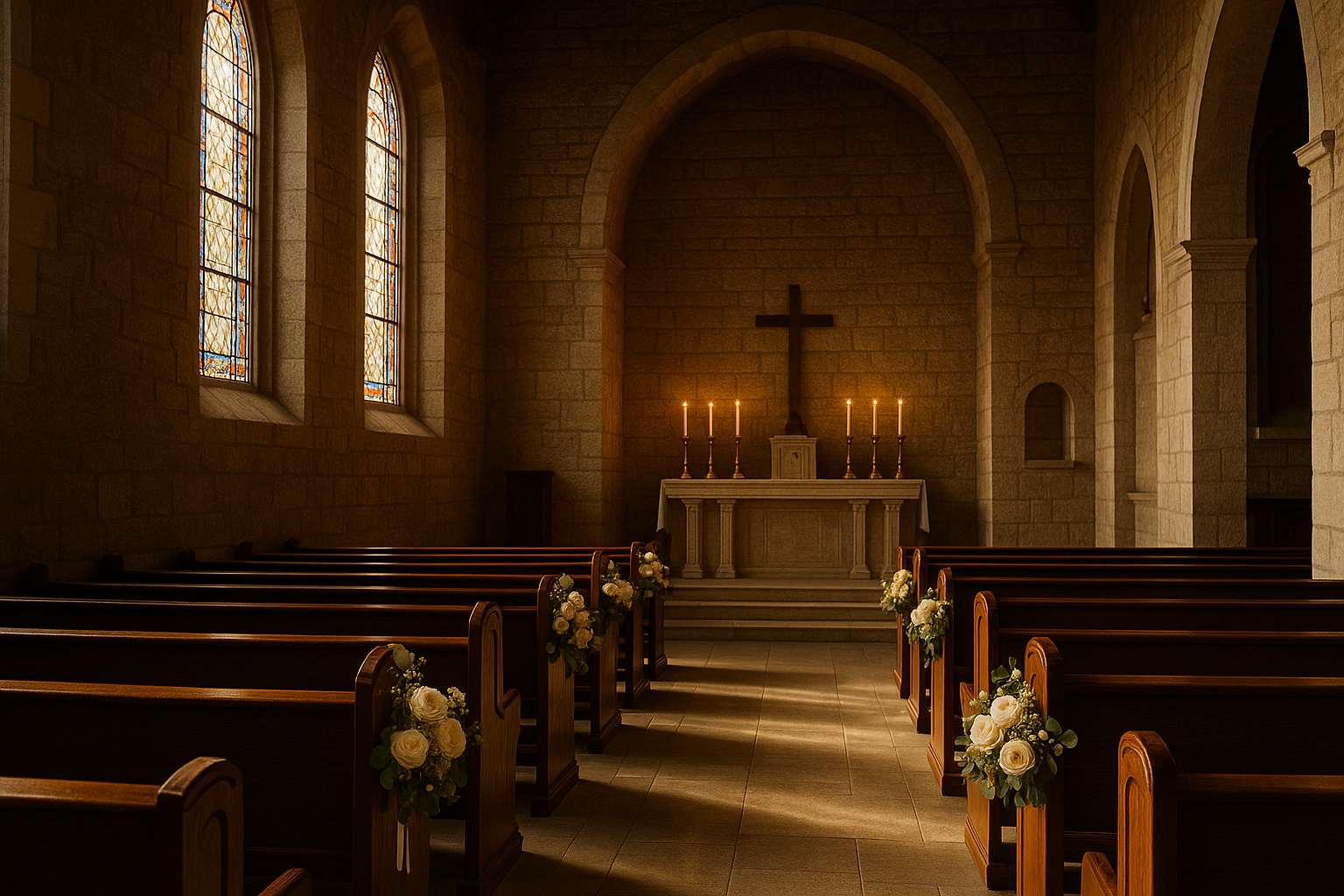
To marry in the Catholic Church, at least one party must be Catholic, both must complete Pre-Cana marriage preparation, gather current baptismal certificates and other required documents, and contact the parish six to twelve months before the desired date. The earlier you begin, the smoother the process.
A Catholic wedding is one of the most meaningful, richly ceremonial celebrations a couple can choose. It is also one of the most process-intensive — and that distinction catches many engaged couples off guard. Unlike booking a civil venue, planning a Catholic ceremony begins with a conversation at the parish, not at the reception hall. Get that sequence right, and the rest of the preparation flows with grace. Get it backward, and you may find yourself facing impossible timelines.
This guide covers every requirement — canonical, documentary, and practical — that couples planning a Catholic wedding in 2026 need to understand. It is organized by sequence so you can see what must happen before what.
What are the basic eligibility requirements for a Catholic wedding?
The Catholic Church sets several foundational requirements for a marriage to be sacramentally valid. Understanding these at the outset — before any date is set or venue considered — is the most important planning move you can make.
At least one party must be Catholic. A marriage between two Catholics is the standard case. A marriage between a Catholic and a baptized non-Catholic Christian is permitted without special dispensation, though it requires additional pastoral preparation. A marriage between a Catholic and a non-baptized person requires a bishop's dispensation called a "dispensation from disparity of cult" — routinely granted but requiring formal request.
Both parties must be free to marry. This is the canonical requirement of freedom to marry, and it is non-negotiable. Freedom to marry means no prior valid marriage is in effect. If either party has been previously married, the prior marriage must be resolved before a Catholic wedding date can be confirmed. For Catholics whose prior marriage was in the Church, this means obtaining a Declaration of Nullity (an annulment) — a canonical process that examines whether the prior marriage met all requirements for validity. This process can take several months to more than a year, depending on the diocese and circumstances. Begin immediately if this applies to your situation.
Both parties must give free, full, and informed consent. Marriage in the Church requires genuine consent — freely given, not coerced, and with understanding of what is being consented to. The parties must understand that Catholic marriage is permanent (for life), exclusive (monogamous), and open to children. A marriage contracted under duress or fundamental misunderstanding of these properties is canonically invalid.
The ceremony must take place in canonical form. This means a Catholic church, before a Catholic priest or deacon, with two witnesses. Dispensation for another location can be granted by the local bishop; this is occasionally done for significant pastoral reasons (a bride's family home chapel, a hospital ceremony for a gravely ill party) but is not routinely granted for aesthetic preference alone.
What documents do you need for a Catholic wedding?
| Document | Who Needs It | Where to Obtain | Timing Note |
|---|---|---|---|
| Baptismal certificate | Catholic party (both, if both Catholic) | Parish where baptism took place — not a photocopy | Must be issued within 6 months of wedding date |
| Proof of Confirmation | Catholic parties | Parish of Confirmation or listed on baptismal certificate | Required before wedding; unconfirmed Catholics may complete Confirmation beforehand |
| Proof of First Communion | Catholic parties | Often annotated on baptismal certificate | Confirm with your parish whether separate documentation is needed |
| Civil marriage license | Both parties | County clerk's office | Issued shortly before the wedding; check your county's specific timing window |
| Declaration of Nullity (annulment) | Previously married parties | Diocesan tribunal of the diocese where prior marriage occurred | Begin immediately — process takes months to over a year |
| Witness affidavits | Both parties | Signed by one or two people who know each party | Testifying to freedom to marry; completed as part of marriage prep process |
| Dispensation (if applicable) | When one party is non-Catholic or non-Christian | Requested through your parish priest to the local bishop | Allow additional weeks for processing |
A critical detail that surprises many couples: baptismal certificates must be recently issued — within six months of your wedding date — because parishes add canonical notations (confirmation, prior marriage, annulment) to the baptismal record over time. A certificate you received years ago may not reflect your current canonical status. Order new certificates when your wedding date is confirmed, not at the outset of engagement.
What is Pre-Cana and what does it actually involve?
Pre-Cana is the Catholic Church's required marriage preparation program, named for the Wedding at Cana in Galilee where, according to the Gospel of John, Jesus performed his first miracle. According to PreCana Online, the program is designed to help couples examine their readiness for a permanent, sacramental commitment — not to create barriers, but to build strong foundations.
Pre-Cana typically covers: communication styles and conflict resolution; finances and shared financial values; sexuality, intimacy, and natural family planning; parenting expectations and religious upbringing of children; the theology of marriage as sacrament and covenant; and the practical dimensions of building a life together. Most couples who complete it report that the conversations it initiates — sometimes uncomfortable, sometimes revelatory — are among the most valuable pre-wedding investments they made.
Formats vary significantly by diocese and parish. Common options include:
- Weekend retreat — an immersive Friday evening through Sunday afternoon experience, often at a retreat center, with couples presenting and sponsor couples sharing their own marriage experience
- Evening series — four to eight weekly sessions covering specific topics, led by parish staff or sponsor couples
- Online programs — certified programs (some dioceses accept these; others require in-person attendance) for couples with geographic or schedule constraints
- Sponsor couple model — an experienced married couple from the parish meets privately with the engaged couple several times; more personal, less structured
Most programs also include a premarital inventory — a questionnaire-based tool that surfaces areas of alignment and potential tension before the wedding. The two most widely used in U.S. parishes are FOCCUS (Facilitating Open Couple Communication, Understanding, and Study) and Prepare/Enrich. Results are discussed privately with a facilitator, not scored as pass/fail. Pre-Cana costs $50 to $200, covering materials, retreat facility fees, and administrative costs.
What is the full timeline for a Catholic wedding preparation?
The most important insight about Catholic wedding preparation is that the Church's timeline — not the venue's availability or the caterer's booking calendar — must govern your planning sequence. Contact the parish first.
| Timing Before Wedding | Action | Notes |
|---|---|---|
| 12+ months | Contact your parish; meet with priest or deacon; confirm date availability | Do this before booking a reception venue; parish calendar fills up |
| 9–12 months | Begin Pre-Cana enrollment; start annulment process if applicable | Pre-Cana programs have their own enrollment cycles and deadlines |
| 6–9 months | Complete premarital inventory (FOCCUS or Prepare/Enrich); gather witness affidavits; request dispensations if needed | Allow extra weeks for any dispensation processing through the bishop |
| 3–6 months | Order baptismal certificates (too early — they must be dated within 6 months of wedding); confirm church music selections with music director; finalize ceremony program | Begin discussing readings, music, and homily content with your officiant |
| 2–4 months | Order baptismal certificates; gather all final documents; meet with priest for final pre-wedding pastoral meeting | Most dioceses want all paperwork submitted 2 months before the wedding date |
| 4–8 weeks | Obtain civil marriage license (check your county's window — some licenses are only valid for 60 or 90 days) | Confirm your county's specific timing requirements |
| 1–2 weeks | Wedding rehearsal; confirm all music cues, reader assignments, and processional order with priest and musicians | Schedule the rehearsal when your entire wedding party can attend |
What is the difference between a Nuptial Mass and a ceremony without Mass?
A Catholic wedding can take one of two primary forms: the Rite of Marriage within Mass (the Nuptial Mass) or the Rite of Marriage without Mass. The choice depends on both parties' faith backgrounds and is best made in conversation with your priest.
The Nuptial Mass is the full sacramental expression. It includes the Liturgy of the Word, the Rite of Marriage itself, and the Liturgy of the Eucharist, with Communion offered to practicing Catholics. It runs approximately 60 to 90 minutes. This is the typical choice when both parties are practicing Catholics and their families are predominantly Catholic — when most guests can participate in Communion.
The ceremony without Mass uses the Rite of Marriage within a Liturgy of the Word, without the Eucharistic portion. It runs approximately 30 to 45 minutes. When one party is non-Catholic, this form is generally recommended to avoid the pastoral awkwardness of non-Catholics being unable to receive Communion while the Catholic guests do. It is a fully valid, fully sacramental ceremony; the absence of the Eucharistic portion does not diminish the sacramental nature of the marriage.
Both forms include all the essential elements: exchange of vows, blessing and exchange of rings, the Nuptial Blessing, and the declaration of marriage. Your priest will guide you toward the form most suited to your specific situation, families, and communities.
The Catholic wedding ceremony, at its heart, is not primarily a logistical challenge to be navigated — it is a theological act. The bride and groom are the ministers of the sacrament; they confer it upon each other through their freely given consent. The priest serves as the Church's official witness. Understanding that distinction tends to transform how engaged couples approach the preparation. Every document gathered, every Pre-Cana session attended, every canonical question answered is preparation not for a paperwork submission but for a lifelong covenant. Couples who bring that understanding to their preparation consistently describe it as one of the most meaningful seasons of their relationship.
Frequently asked
How far in advance do I need to contact my parish before a Catholic wedding?
The clear guidance from dioceses across the United States — including the Archdiocese of New York and the Diocese of Trenton — is to contact your parish a minimum of six months to one year before your desired wedding date, and ideally before you book your reception venue. This is not merely bureaucratic caution: it reflects genuine logistical reality. Pre-Cana programs fill up and have their own enrollment deadlines. Baptismal certificates must be current, meaning issued within six months of the wedding date, so ordering too early requires you to re-order them. If either party has been previously married, the annulment process alone can take many months and must be fully resolved before a wedding date can be confirmed. The earlier you contact your parish priest or deacon, the more buffer you have for everything that follows.
What documents are required for a Catholic wedding ceremony?
The core required documents are: a baptismal certificate for each Catholic party, issued recently — within six months of your wedding date — from the baptismal parish itself, with all canonical notations current. Photocopies are generally not accepted. Proof of First Communion and Confirmation is typically required for Catholic parties. If either party has been previously married and civilly divorced, an annulment decree (a Declaration of Nullity) or a death certificate for the former spouse must be in hand before a wedding date can be confirmed. A civil marriage license from your county clerk's office is also required. Some dioceses further require witness affidavits: one or two people who know each party and can testify that they are free to marry. Check with your specific diocese, as requirements vary; the Diocese of Raleigh and the Archdiocese of New York each publish their own detailed preparation guides online.
What is Pre-Cana and how long does it take?
Pre-Cana is the Catholic Church's required marriage preparation program, named for the Wedding at Cana where Jesus performed his first miracle. It is mandatory for couples wishing to marry in the Catholic Church. The program is designed to help couples explore their readiness for the sacramental commitment of marriage, covering communication, finances, sexuality, parenting expectations, conflict resolution, and the theology of marriage as a permanent and life-giving covenant. Formats vary widely by diocese and parish: some offer a weekend retreat, others run a series of evening sessions over several weeks, and some parishes offer certified online programs for couples with scheduling constraints. Many parishes also pair couples with a sponsor couple — experienced married parishioners — for ongoing mentorship. Most couples also complete a premarital inventory such as FOCCUS (Facilitating Open Couple Communication, Understanding, and Study) or Prepare/Enrich. Pre-Cana typically costs $50 to $200, covering materials, retreat fees, and administrative expenses.
Can a non-Catholic marry in the Catholic Church?
Yes. The Catholic Church permits marriages between a Catholic and a baptized non-Catholic Christian without extraordinary dispensation, though the couple must meet with the priest or deacon to discuss the difference in faith traditions. The Catholic party is required to promise to do everything in their power to raise any children Catholic; the non-Catholic party is informed of this promise but does not have to agree to it. A marriage between a Catholic and a non-Christian (unbaptized) requires a specific dispensation called a 'dispensation from disparity of cult,' which must be granted by the local bishop. This is a more formal process but is routinely granted in most dioceses when the couple proceeds in good faith. Both forms of mixed-faith marriage require the same Pre-Cana participation and document gathering as any Catholic marriage. Many couples in these situations find the preparation process illuminating rather than restrictive — it opens substantive conversations about faith, family, and shared values that serve the marriage well.
What is the difference between a Catholic wedding with and without Mass?
A Catholic wedding can be celebrated either within a full Nuptial Mass or as a standalone Rite of Marriage (a wedding ceremony without Mass). The Nuptial Mass — also called a Nuptial Liturgy within Mass — is the fuller expression of the sacrament and is the typical choice when both parties are Catholic. It includes the Liturgy of the Word, homily, the Rite of Marriage, and the Liturgy of the Eucharist, with Communion offered to practicing Catholics. A full Nuptial Mass runs approximately 60 to 90 minutes. A ceremony without Mass uses the Rite of Marriage within the Liturgy of the Word, without the Eucharistic portion, and runs approximately 30 to 45 minutes. When one party is non-Catholic, the ceremony without Mass is generally recommended to avoid the awkward situation of some guests not receiving Communion. Your priest will guide you toward the right option based on your specific circumstances and the faith background of your families.
What are the canonical requirements for a valid Catholic marriage?
Canon law identifies several essential requirements for a marriage to be considered valid in the Catholic Church. Both parties must be free to marry — meaning no prior valid marriage exists (an annulment resolves a prior invalid marriage sacramentally). Both must give free and full consent — a marriage entered under coercion or fear is canonically invalid. Both must understand the nature of Catholic marriage: permanent, exclusive, and open to children. The ceremony must take place in canonical form — before a Catholic priest or deacon, in a Catholic church, with two witnesses — unless a dispensation for another location has been granted by the bishop. At least one party must be Catholic. The ceremony must take place according to the canonical rite unless a dispensation is obtained. These requirements are not bureaucratic hurdles; they reflect the Church's theology that marriage is a sacrament conferred by the couple upon each other through their free and informed consent before God and the Church.
How much does a Catholic wedding ceremony cost?
Catholic wedding fees vary widely by parish, diocese, and location, but the general landscape in 2026 is as follows. Many parishes charge a church use fee ranging from $500 to $2,000 or more for non-parishioners; registered, active parishioners often receive a significantly reduced or waived fee. Music fees — organist, cantor, choir — typically run $200 to $600 depending on musicians and program length. Pre-Cana program costs are typically $50 to $200. The marriage preparation meeting with the priest or deacon is generally part of parish ministry and not separately charged. Donation to the officiant (priest or deacon) is customary and typically ranges from $100 to $300, though it is never required. Total ceremony costs for a Catholic wedding commonly run $800 to $3,000, not including floral decoration of the church (which may be subject to the church's own floral guidelines) or photography fees, which may also be subject to specific restrictions inside the nave.