Ceremony & Vows
Christian Wedding Ceremony: The Complete Guide (2026)
Whether you are planning a Catholic Nuptial Mass or a non-denominational Protestant service, this guide covers every requirement, tradition, and decision — from Pre-Cana to the recessional.
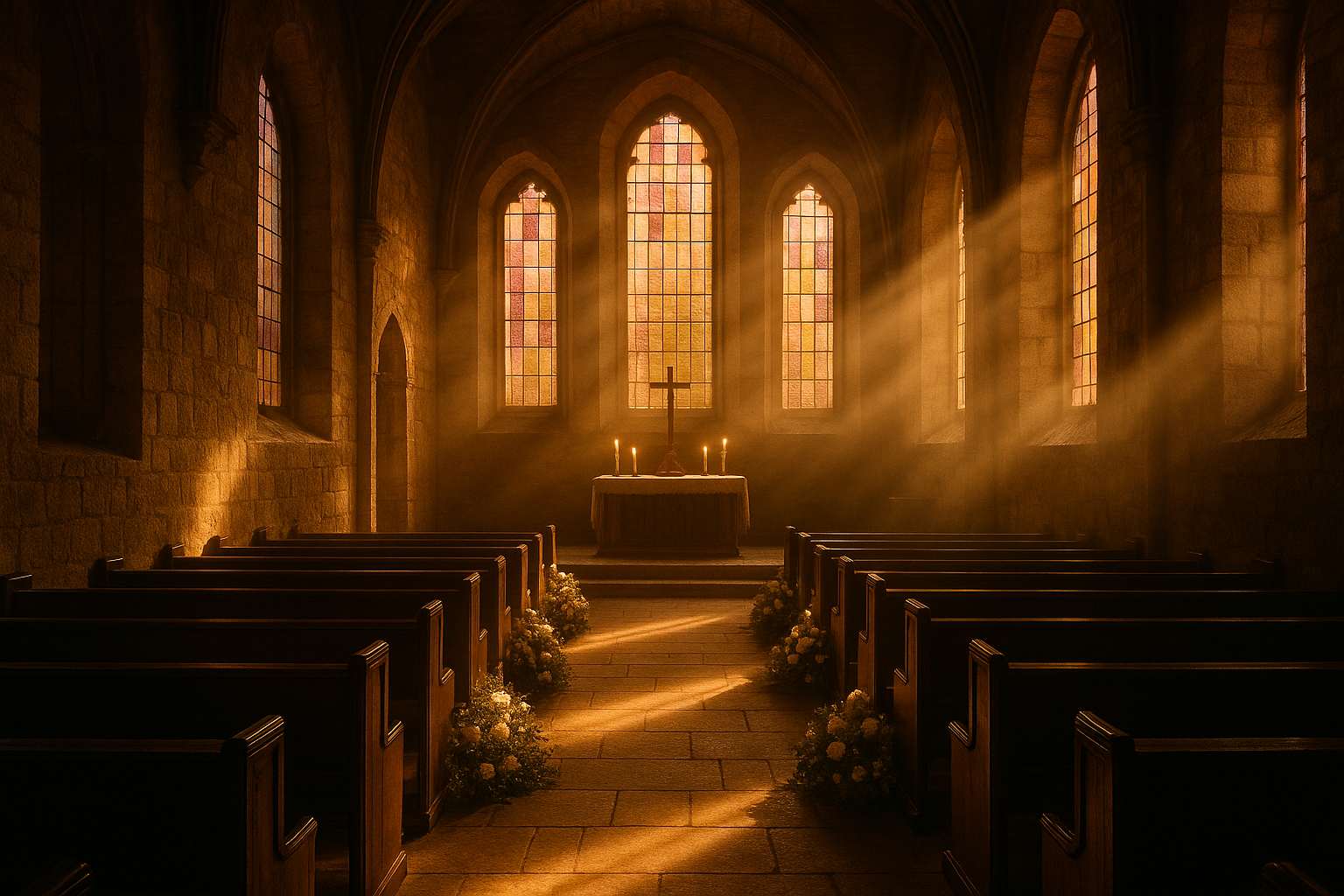
A Christian wedding ceremony is a public act of worship and covenant before God and your community — not merely a formality before the reception. Whether Catholic or Protestant, it requires planning your readings, music, Pre-Cana or counseling, and officiant at least six to twelve months before your date. The ceremony is the heart of the day; every other element flows from the vows you exchange here.
What makes a Christian wedding ceremony different from a civil one?
In a civil ceremony, a judge or justice of the peace legally joins two people as a married couple. That ceremony can be deeply meaningful — but it makes no theological claim. A Christian wedding goes further: it is a public declaration before God and your gathered community that your marriage is a sacred covenant, not merely a legal contract.
For Catholic couples, that distinction carries particular weight. In Catholic theology, marriage between two baptized persons is one of the seven sacraments. The couple themselves are the ministers of the sacrament — the priest or deacon officiates but does not confer it. The indispensable act is the couple's free, informed consent exchanged in the approved canonical form before witnesses. This is why the Church takes preparation so seriously: you cannot retroactively minister a sacrament you were not fully prepared to receive.
Protestant traditions — Baptist, Methodist, Presbyterian, Lutheran, Episcopal, non-denominational — view marriage as a holy covenant ordained by God, not a sacrament in the Catholic sense, but a deeply sacred act. The structure and requirements vary enormously by denomination and individual pastor. What unites all Christian ceremonies: Scripture, vows, prayer, and the gathered community belong at the center of the event.
What does the Catholic path look like — requirements, timeline, and structure?
The first step for any Catholic couple is contacting the parish. In major cities, popular parishes book Saturday wedding slots 18–24 months in advance. Contact your parish priest before you book any other vendor.
Pre-Cana is mandatory. Every U.S. diocese requires it and it cannot be waived. It typically covers communication skills, finances, natural family planning, theology of the body, and parenting. Formats include weekend retreats ($150–$275 per couple), evening series over six to eight weeks ($50–$150), and virtual programs accepted by most dioceses since 2020 ($175–$225 at some archdioceses). Most couples who approach it with openness find it genuinely valuable. According to the United States Conference of Catholic Bishops, Pre-Cana is the Church's primary tool for helping couples build marriages that endure.
Beyond Pre-Cana, at least one partner must be a baptized Catholic, the Catholic partner should be confirmed, and both must be free to marry (no valid prior marriages without an annulment). The wedding must ordinarily take place in a Catholic church unless the bishop grants a dispensation.
The Catholic Order of Service (without Nuptial Mass)
Recommended when one partner is not Catholic or guests are largely non-Catholic. Duration: approximately 30–45 minutes.
- Entrance Rite — Processional, greeting, and opening prayer
- Liturgy of the Word — Two readings from the approved USCCB lectionary, with a responsorial psalm
- Homily — Reflection on the readings and the meaning of Christian marriage (8–12 minutes is ideal)
- Questions Before Consent — The priest asks the couple to affirm they marry freely, intend lifelong fidelity, and are open to children
- Exchange of Consent (Vows) — The sacramental moment; two approved forms available
- Blessing and Giving of Rings
- Universal Prayer — Intentions often written by the couple
- Lord's Prayer
- Nuptial Blessing — Three solemn forms to choose from
- Signing of the Marriage Register
- Recessional
With a Nuptial Mass (for two Catholics in good standing), add the full Liturgy of the Eucharist after the Nuptial Blessing — extending the ceremony to 60–90 minutes. Plan for 15–20 minutes of communion distribution for a 150-person wedding, and confirm the number of Extraordinary Ministers of Holy Communion needed with your priest early.
How do Protestant traditions differ — and what does each denomination require?
Protestant ceremonies span a vast spectrum. The Episcopal service is governed by the Book of Common Prayer and closely resembles the Catholic rite in formality. Southern Baptist and non-denominational Evangelical ceremonies can be as informal as the couple and pastor choose to design. Here is a practical overview:
| Denomination | Pre-marital requirement | Ceremony formality | Communion typical? | Duration |
|---|---|---|---|---|
| Episcopal | Required counseling; 30-day notice | High liturgical | Optional | 45–60 min |
| Lutheran (ELCA/LCMS) | Recommended; varies by pastor | Moderate to high | Optional | 30–60 min |
| Methodist (UMC) | Encouraged; varies by pastor | Moderate | Optional | 30–45 min |
| Presbyterian (PCUSA) | Recommended | Moderate | Rare | 30–45 min |
| Baptist (SBC) | Varies widely | Low to moderate | Rare | 30–45 min |
| Non-denominational Evangelical | Varies by pastor | Low to moderate | Rare | 30–60 min |
The typical Protestant order of service moves through: prelude music → seating of mothers → processional → welcome and invocation → scripture readings → sermon/homily → vows → ring exchange → optional unity ceremony → prayers → pronouncement → kiss → recessional. Personal vows are welcomed or encouraged in virtually all Protestant traditions.
Music for your ceremony
Music is the emotional architecture of the service. In 2025–2026, contemporary worship music has largely replaced traditional hymns at the recessional among Evangelical and non-denominational couples. Phil Wickham's House of the Lord and This Is Amazing Grace, Maverick City Music's Joy of the Lord, and Bethel Music's Raise a Hallelujah are among the most-requested recessional songs. For processionals, classics like Pachelbel's Canon in D and Trumpet Voluntary remain beloved; acoustic arrangements of A Thousand Years (Christina Perri) and Hillsong United's Oceans are strong contemporary choices.
Important for Catholic ceremonies: The USCCB guidelines require that sacred music at a Catholic wedding be appropriate to the liturgy. Purely secular love songs are typically not permitted during a Nuptial Mass. Work with your parish music director early — most parishes have a staff organist or cantor available for $150–$400; outside musicians require advance parish approval. String quartets run $800–$2,500 for a ceremony.
What does a Christian wedding ceremony realistically cost in 2026?
| Item | Estimated cost |
|---|---|
| Church facility fee | $200–$2,500+ |
| Priest or deacon stipend | $100–$300 |
| Pre-Cana preparation | $50–$275 |
| Musicians (organist, cantor) | $150–$400 |
| Civil marriage license | $30–$100 |
| Total estimate | $530–$3,475+ |
Protestant ceremonies typically run $480–$4,600 or more, with the widest variance in musician costs (strings or a live worship band versus a single acoustic guitarist). Landmark cathedrals and historic city-center churches charge significantly above these ranges — always ask for a full fee schedule when you first contact the church.
The civil marriage license ($30–$100) is required by every state regardless of religious ceremony — apply in the county where the ceremony will be held, observe any state waiting period, and file the signed license promptly after the ceremony. Source: USCCB Marriage Preparation.
2026 ceremony trends to know
- Unplugged ceremonies are now near-universal. Couples and pastors request that guests put away phones so they experience the ceremony fully present. Professional photographers unanimously endorse this.
- Contemporary worship music at the recessional has largely replaced classical hymns in Evangelical circles — Phil Wickham and Maverick City Music dominate requests.
- Cord of Three Strands has overtaken the unity candle as the most-requested unity element among non-denominational couples.
- Hispanic and Filipino Catholic traditions — the arras (13 gold coins), lazo (large rosary looped around the couple), and veil ceremony — are included as optional elements in the 2016 revised Rite of Marriage and are increasingly chosen by couples of all backgrounds.
- Shorter, more theologically substantive homilies: couples are requesting 8–12 minute homilies grounded in chosen readings, rather than generic marriage advice.
Frequently asked
Do we have to get married in a church for a Christian ceremony?
For Catholics, canon law requires a church setting unless a dispensation is granted by the local diocese — this is rare and reserved for serious reasons. For most Protestant denominations, the location is flexible; the ceremony can be held outdoors, in a hotel ballroom, or at any venue the pastor is willing to officiate. Non-denominational ceremonies are held almost anywhere. Always confirm with your specific officiant before booking a non-church venue. A Catholic couple wishing to marry outdoors should speak with their parish priest early — the process for obtaining a dispensation can take several weeks.
Can we write our own vows for a Catholic wedding?
The Catholic Rite of Marriage requires specific approved language for the exchange of consent. Couples choose between two forms: repeating the vows phrase by phrase after the priest, or responding 'I do' to three questions posed by the priest. Personal vows cannot replace the approved canonical form. However, some priests permit a brief personal statement immediately after the formal consent has been exchanged — discuss this directly with your priest well in advance of the wedding. Protestant and non-denominational ceremonies typically allow fully personalized vows, subject to the pastor's guidance on length and content.
What is Pre-Cana and can we skip it?
Pre-Cana is the Catholic Church's required marriage preparation program — it is mandatory for every couple seeking to marry sacramentally in the Catholic Church and cannot be waived. Every U.S. diocese mandates it. Formats include weekend retreats ($150–$275 per couple), evening series over six to eight weeks ($50–$150), and virtual programs accepted by most dioceses. It is not a screening test; you cannot fail. It covers communication skills, finances, natural family planning, theology of the body, and conflict resolution. Most couples who approach it openly report genuine value. Begin enrollment at least six to twelve months before the wedding, as popular parish dates fill 18–24 months in advance.
What scripture readings work best when our guest list includes non-Christians?
1 Corinthians 13 ('Love is patient, love is kind') is universally understood and emotionally resonant for guests of any background — but it requires a confident reader who can carry it without rushing. John 15:9–12 ('Love one another as I have loved you') is brief, clear, and deeply moving. For Catholic ceremonies, John 2:1–11 (the Wedding at Cana) works beautifully when the priest will preach on Christ's transformative presence in marriage. Avoid passages that require deep theological context to land — prioritize readings that speak the language of love and commitment to any listener.
How much should we budget for a Christian wedding ceremony?
Catholic ceremonies typically cost between $530 and $3,475 or more, covering the church facility fee ($200–$2,500 depending on parish and parishioner status), a priest or deacon stipend ($100–$300), Pre-Cana ($50–$275), musicians ($150–$400 for parish staff; significantly more for outside musicians), and the civil marriage license ($30–$100 by county). Protestant ceremonies range from $480 to $4,600 or more, depending on church rental or donation, pastor's honorarium ($150–$500), pre-marital counseling, and musicians. Cathedral and landmark church weddings in major cities can exceed these ranges substantially.
What is the most popular unity ceremony for Christian weddings in 2026?
The Cord of Three Strands (drawn from Ecclesiastes 4:12) has surpassed the unity candle as the most-requested unity element among Evangelical and non-denominational couples in 2025–2026. Three cords braided together represent the husband, wife, and God — a distinctively Christian symbol. Unity sand remains popular for outdoor weddings and blended families where children participate. The unity candle is still widely used in Catholic and mainline Protestant ceremonies but requires careful planning for outdoor venues with fire restrictions. Foot washing (John 13) has grown among couples seeking a ceremony centered on humble service.
My partner is not Catholic — can we still have a full Nuptial Mass?
Yes, with the local bishop's permission, typically granted through your parish pastor via a dispensation for 'mixed religion' — this is a routine process and should not discourage interfaith couples. However, most pastors will recommend a ceremony without Mass when one partner is not Catholic, because the non-Catholic partner cannot receive communion, and a congregation where roughly half the guests are unable to receive creates pastoral and logistical complexity. A ceremony without Mass is equally sacramentally complete (30–45 minutes) and often more hospitable for a diverse guest list. Discuss the decision early with your priest.