Ceremony & Vows
10 Most Meaningful Cultural Wedding Rituals of 2026
According to The Knot's Real Weddings Study, 38% of couples now incorporate cultural or religious elements in their ceremony. These are the ten rituals — drawn from traditions spanning five continents — that carry the deepest meaning and translate most beautifully into a modern ceremony.
cultural wedding rituals 2026multicultural wedding ceremonywedding unity traditionsHindu Saptapadi weddingCeltic handfasting ceremonyworld wedding traditions
The quick verdict
38% of couples now blend cultural or religious elements into their ceremony. These ten traditions — spanning five continents — carry the deepest meaning and translate most beautifully into a modern wedding.
- Best overall
- Saptapadi (Hindu Seven Steps) — The most structurally complete ritual in global wedding culture — seven specific vows, a sacred fire as witness, and a ceremony arc that builds from nourishment to eternal friendship over the course of the seven steps.
- Best value
- Jumping the Broom (African American) — Among the most accessible rituals to prepare and execute — a decorated broom, two willing people, and one of the most joyful, participatory moments in any ceremony.
- Best for Couples incorporating a partner's heritage for the first time
- Chinese Tea Ceremony — Intimate, family-centered, easily explained to guests, and produces one of the most genuinely moving moments in any multicultural reception — the couple's parents receiving tea and responding with red envelopes and blessings.
How we evaluated
We selected these ten rituals based on authenticity and historical depth (each has roots in a living cultural tradition), visual and emotional resonance in a contemporary ceremony, accessibility for couples from outside the originating tradition who choose to honor a partner's heritage, and breadth of representation across global cultures. We drew on academic and cultural documentation, published ceremony guides from faith leaders, and the sourced descriptions of couples who have incorporated each ritual. These are not ranked competitively — they are presented as a reference for couples making intentional choices about what belongs in their ceremony.
- Authenticity and historical depth. Each ritual has verifiable roots in a living cultural or faith tradition, not a recent commercial invention.
- Ceremonial resonance. Each translates effectively as a standalone moment in a contemporary wedding ceremony, regardless of guest background.
- Accessibility. Each can be meaningfully incorporated by couples who hold the tradition and by couples honoring a partner's heritage.
- Explanation-readiness. Each ritual carries clear, communicable meaning that can be explained in the ceremony program and by an officiant in one or two sentences.
Rating scale: Ratings reflect cultural depth, ceremonial resonance, and accessibility for modern couples on a 1–5 scale.
Last verified .
At a glance
| # | Name | Rating | Best for | Pricing |
|---|---|---|---|---|
| 1 | Saptapadi — The Hindu Seven Steps | 5.0 | Hindu couples and multicultural couples where one partner is Hindu or of South Asian heritage, seeking the full ceremonial weight of the tradition | Included in pandit fee ($500–$2,000+); full mandap setup varies by vendor |
| 2 | Breaking the Glass — Jewish Tradition | 5.0 | Jewish couples, interfaith couples where one partner is Jewish, and secular couples with Jewish heritage seeking a singular ceremony moment of universal emotional resonance | $5–$20 for a ceremonial glass; shadow box preservation $40–$120 |
| 3 | Chinese Tea Ceremony | 5.0 | Chinese and Chinese-American couples, and multicultural couples where one partner is of East Asian heritage, seeking an intimate family-honoring ritual | $40–$200 for traditional tea set; attire varies |
| 4 | Celtic Handfasting | 4.5 | Couples with Irish, Scottish, or Celtic heritage, and secular couples who want a tactile, visually compelling unity ritual without religious framing | $15–$60 for ceremony cords; artisan sets $40–$150 |
| 5 | Arras — Latin American Unity Coins | 4.0 | Latin American Catholic couples, interfaith couples where one partner is Latinx, and any couple who wants to formally acknowledge financial partnership as a sacred dimension of marriage | $20–$100 for coin set; engraved or sterling sets $80–$250 |
| 6 | Paebaek — Korean Post-Wedding Family Ceremony | 4.5 | Korean and Korean-American couples, and multicultural couples where one partner is of Korean heritage, seeking a family-honoring post-ceremony ritual | $150–$400 for hanbok rental; venue setup minimal |
| 7 | Libation Ceremony — West African and African Diasporic Tradition | 4.5 | African American couples, West African and diaspora couples, and multicultural couples who want to honor both ancestral heritage and those who have passed from their families | Minimal — a meaningful vessel and liquid; $20–$80 |
| 8 | San-san-kudo — Japanese Sake Ceremony | 4.0 | Japanese and Japanese-American couples, and multicultural couples where one partner is of Japanese heritage, seeking a visually refined family-inclusive unity ritual | $40–$200 for traditional sake set; artisan lacquerware $150–$400 |
| 9 | Money Spraying — Nigerian and West African Tradition | 4.0 | Nigerian and West African couples, African diasporic couples, and any couple who wants the most participatory and jubilant ritual moment in their reception | Guest-provided; coordination budget $50–$150 |
| 10 | Jumping the Broom — African American Tradition | 4.5 | African American couples honoring their heritage, and any couple who wants the most joyful, crowd-involving, and photographically spontaneous moment in their ceremony | $15–$50 for a decorated broom; DIY with family participation |
Saptapadi — The Hindu Seven Steps
The most structurally complete ritual in global wedding culture — seven sacred vows made together around a sacred fire, each one defining a dimension of shared life
Editor's pick
The Saptapadi, or Seven Steps, is the ceremonial heart of a traditional Hindu wedding and one of the oldest continuously practiced marriage rituals in the world. The couple walks together seven times around the sacred fire — called Agni, who serves as divine witness — each step accompanied by a specific vow. The seven vows progress from nourishment and strength through prosperity, happiness, progeny, longevity, and culminate in the seventh: eternal friendship and partnership. It is that final step — the declaration of lifelong friendship — that distinguishes the Hindu ceremony's architecture from most Western formats, which tend to treat love as the culmination rather than friendship. The Saptapadi requires a pandit (Hindu priest), a properly constructed mandap (ceremonial canopy), and the sacred fire as its witness. For couples who are not Hindu by background but wish to honor a partner's heritage, including the Saptapadi with genuine family participation and clear guest explanation is one of the most profoundly moving gestures in multicultural ceremony design. Budget for the full mandap setup, typically included in a pandit's ceremony fee, which ranges from $500 to $2,000 for a standalone ceremony. South Asian weddings where the mandap is the centerpiece of a full multi-day celebration have higher total costs.
Strengths
- Structurally the most complete premarital covenant ritual — seven specific vows rather than a single abstract promise
- The sacred fire as living witness creates a visual and sensory centerpiece unlike any other tradition
- The progression from nourishment to eternal friendship gives the ceremony a building emotional arc
Weaknesses
- Requires a pandit, mandap, and sacred fire — cannot be abbreviated into a brief ceremony add-on; the full ritual takes 45 to 90 minutes
- Best for
- Hindu couples and multicultural couples where one partner is Hindu or of South Asian heritage, seeking the full ceremonial weight of the tradition
- Pricing
- Included in pandit fee ($500–$2,000+); full mandap setup varies by vendor
Source: The Celebrant Directory — Unity Rituals from Around the World · Visit Saptapadi — The Hindu Seven Steps
Breaking the Glass — Jewish Tradition
The moment that draws every guest's breath — a single shattering gesture that holds fragility, memory, and unrestrained joy in the same instant
Few moments in any ceremony carry the emotional density of the Jewish breaking of the glass. At its conclusion, the groom (and in many contemporary ceremonies, both partners) stamps a foot down on a wrapped glass. The crash is immediate, complete, and crowds the room with simultaneous shouts of "Mazel tov!" The ritual is among the most recognized in global wedding culture — even guests entirely unfamiliar with Jewish tradition respond viscerally to the sound. Its meanings are layered. The most commonly cited is the destruction of the Temple in Jerusalem — a reminder that joy and sorrow coexist, that even in the most joyful moment, we hold memory of loss. Other interpretations: the irreversibility of marriage (the glass cannot be unbroken); the fragility of life itself, which the couple now navigates together; and in some traditions, the shattering of the old self to make way for the new partnership. For interfaith couples, the breaking of the glass is among the most transferable Jewish wedding rituals — its visual power, its sound, and its emotional immediacy translate to any guest regardless of background. Wrap the glass in a cloth napkin or velvet bag for safety; many couples later have the shards preserved in a shadow box or incorporated into a piece of commemorative art.
Strengths
- The most viscerally immediate ritual in Jewish wedding tradition — the sound produces an involuntary collective response from every guest
- Transferable across interfaith ceremonies with clear officiant explanation
- The layered meanings — Temple remembrance, irreversibility, fragility — provide rich material for a brief officiant reflection
Weaknesses
- In Orthodox ceremonies, the specific glass used and the timing are governed by halacha (Jewish law); secular adaptations should not claim Orthodox validity they do not have
- Best for
- Jewish couples, interfaith couples where one partner is Jewish, and secular couples with Jewish heritage seeking a singular ceremony moment of universal emotional resonance
- Pricing
- $5–$20 for a ceremonial glass; shadow box preservation $40–$120
Source: The Knot — 50 Wedding Traditions From Around the World · Visit Breaking the Glass — Jewish Tradition
Chinese Tea Ceremony
The most family-centered ritual in East Asian wedding culture — an intimate exchange of honor, gratitude, and blessing between the couple and their parents
The Chinese tea ceremony is the relational heart of a traditional Chinese wedding and one of the most genuinely moving moments in any multicultural reception. The couple serves tea — typically a sweetened red date and lotus seed tea — to their parents and family elders in a carefully observed order of hierarchy. Each elder who receives tea responds with a red envelope (hongbao) containing a monetary gift and verbal blessings for the couple's future. The exchange is intimate: it happens between four people at a time (the couple and the elders being served), which means the ceremony feels personal even in a room of two hundred guests. The primary meaning is relational: the couple formally enters their new family roles while honoring the generation that raised them. Red and gold are the traditional colors — red for luck and prosperity, gold for divine blessing. In Chinese-American and modern Chinese ceremonies, tea ceremony attire often includes a change into a traditional qipao (cheongsam) for the bride. The tea ceremony typically takes place at the reception, making it accessible as a meaningful addition even when the ceremony itself follows a Western format. Couples whose heritage is not Chinese but who wish to honor a partner's family can incorporate the tea ceremony with the full blessing of Chinese families who almost universally regard it as a gesture of deep respect.
Strengths
- Intimate, family-centered structure creates genuine emotional connection between generations — not a performance, but a real exchange
- Flexible timing: can occur at the reception, making it compatible with any ceremony format
- Deeply accessible to guests of any background with brief explanation
Weaknesses
- The hierarchical order of service (who receives tea first, and from which side of the family) is specific to Chinese family customs and should be confirmed with elders from both families before planning
- Best for
- Chinese and Chinese-American couples, and multicultural couples where one partner is of East Asian heritage, seeking an intimate family-honoring ritual
- Pricing
- $40–$200 for traditional tea set; attire varies
Source: Blue Nile — Meaningful Wedding Traditions from Around the World · Visit Chinese Tea Ceremony
Celtic Handfasting
The literal origin of 'tying the knot' — an ancient Celtic binding ritual that has become one of the most requested unity ceremonies in modern weddings
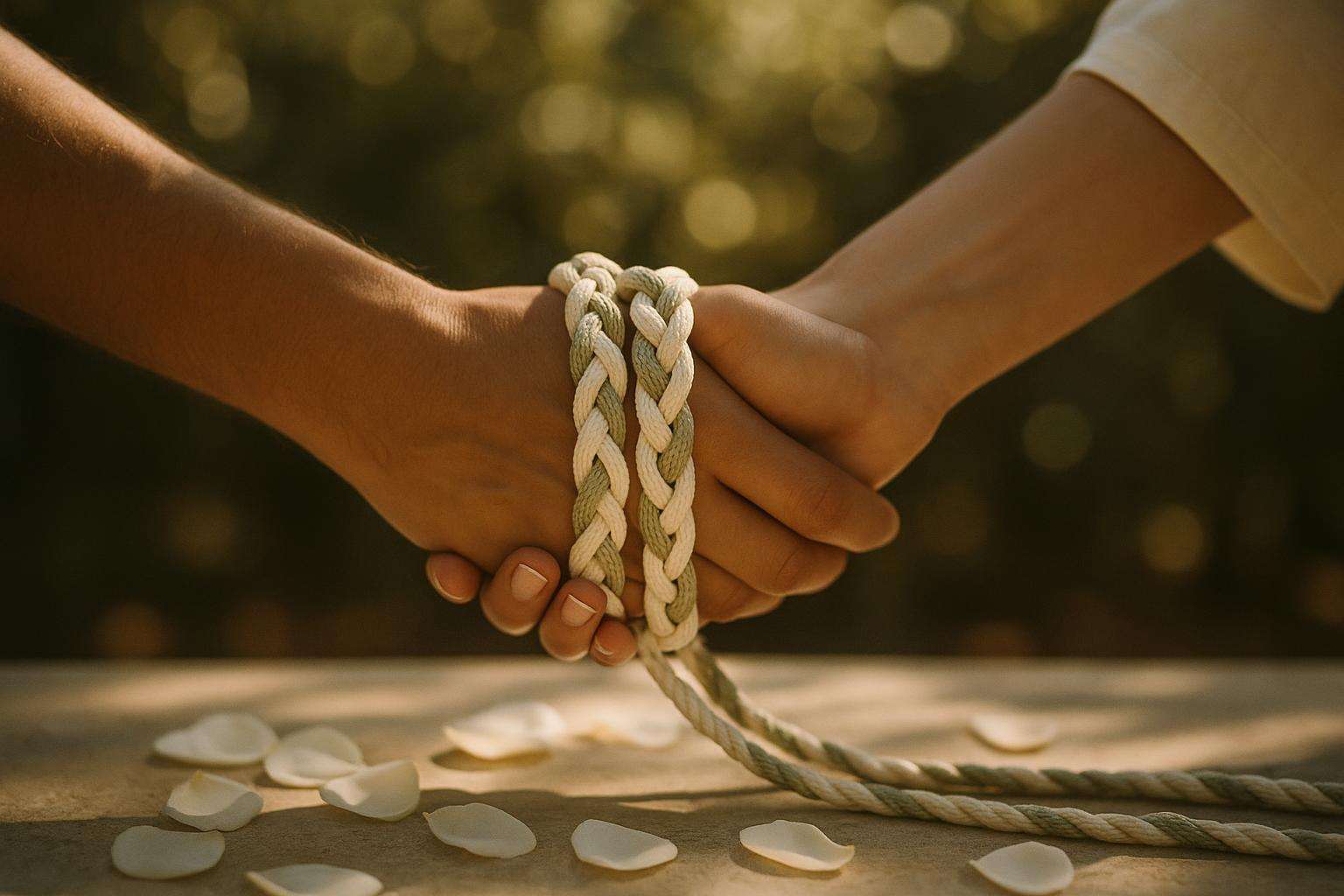
Handfasting is the practice that gave the English language the phrase "tying the knot," and its origins reach back to pre-Norman Ireland and Scotland where the binding of hands symbolized the formal joining of two people and two families. In its traditional form, the couple's hands are clasped together and bound with one or more cords by the officiant, a parent, or a trusted elder — each cord representing a specific quality the couple wishes to bring to their marriage. The colors chosen for the cords carry meaning: white for purity and new beginnings, gold for prosperity and wisdom, green for growth and the earth, red for passion and courage, blue for healing and loyalty. The binding is typically undone at the ceremony's end, and the cords are kept by the couple as a keepsake. Celtic handfasting is among the most versatile unity rituals in global ceremony design: it carries no religious requirement, can be performed by any officiant, takes only two to three minutes, and is visually arresting in photographs. Its broad adoption in contemporary ceremonies has been largely driven by couples of Irish, Scottish, and Celtic descent reclaiming their heritage — but it has also been embraced widely by secular couples who respond to its tactile symbolism. One consideration: "handfasting" has also been used historically to describe a temporary betrothal period (one year and one day), which is distinct from the modern ceremony ritual. Your officiant should clarify the modern meaning in the ceremony program to avoid confusion.
Strengths
- No religious requirement — fully accessible to secular and interfaith ceremonies with any officiant
- Visually arresting and highly photographable; the bound hands create a distinctive ceremonial image
- Cord colors carry personalized meaning — couples can choose to represent specific values
Weaknesses
- The historical "trial marriage" meaning of handfasting is distinct from the modern unity ritual; brief explanation in the program prevents misinterpretation
- Best for
- Couples with Irish, Scottish, or Celtic heritage, and secular couples who want a tactile, visually compelling unity ritual without religious framing
- Pricing
- $15–$60 for ceremony cords; artisan sets $40–$150
Source: The Celebrant Directory — Unity Rituals from Around the World · Visit Celtic Handfasting
Arras — Latin American Unity Coins
Thirteen blessed coins exchanged as a pledge of shared provision and mutual trust — a Latin Catholic tradition that transforms financial partnership into sacred covenant
The Arras, or unity coins, is a traditional ritual of Latin American Catholic ceremonies in which the groom presents the bride with thirteen coins — blessed by a priest, often carried in an ornamental box or cocha (shell-shaped vessel) — as a pledge of shared stewardship over their household. The bride accepts the coins and holds them in her cupped hands as the groom pours them from his own hands, symbolizing mutual trust and the couple's intention to share all resources. In many ceremonies, the coins are then returned together to the vessel, representing the irreversibility of the exchange. The number thirteen is symbolically significant: twelve coins represent the twelve apostles and the twelve months of the year; the thirteenth represents Christ as the center of the household. For Latinx couples, the Arras ritual is often one of the most emotionally resonant elements of the ceremony — particularly for those whose grandparents or parents also included it. For multicultural couples incorporating the ritual to honor a partner's heritage, the coins can be personalized with meaningful engravings. The padrino system — where a godparent sponsors specific elements including the Arras — is an opportunity to involve a meaningful family elder in a formal ceremonial role.
Strengths
- Transforms the practical reality of financial partnership into a sacred ceremonial moment — unusual and powerful in Western ceremony design
- The padrino sponsorship creates a meaningful role for a family elder without adding ceremony complexity
- Engraved or personalized coin sets make lasting keepsakes
Weaknesses
- Catholic theological context (apostles, Christ as household center) is integral to the traditional ritual; non-Catholic couples adapting it should understand this framing before choosing a secular interpretation
- Best for
- Latin American Catholic couples, interfaith couples where one partner is Latinx, and any couple who wants to formally acknowledge financial partnership as a sacred dimension of marriage
- Pricing
- $20–$100 for coin set; engraved or sterling sets $80–$250
Source: Courtly — Wedding Traditions Around the World · Visit Arras — Latin American Unity Coins
Paebaek — Korean Post-Wedding Family Ceremony
A post-ceremony ritual of deep family blessings, where the couple bows to each set of parents and receives wisdom, dates, and chestnuts as symbols of children and prosperity
The Paebaek is a traditional Korean post-wedding ceremony that takes place immediately after the main ceremony, typically in a more private setting with close family members. The couple, dressed in traditional hanbok (colorful formal garments), performs a series of deep bows (keunjeol) to the groom's family, then the bride's family. Parents receive the couple's formal respect and respond with words of blessing and wisdom. Dates and chestnuts are then thrown toward the couple — the bride catching them in her skirt. In Korean symbolism, dates represent sons and chestnuts represent daughters; how many the bride catches is playfully interpreted as a prediction of children. The ceremony carries deep Confucian values of familial respect, generational continuity, and the formal integration of two families. For Korean-American couples, the Paebaek is often the most anticipated element of the entire wedding by older family members. It is intimate by design — not a public performance, but a private family ritual that follows the public ceremony. The hanbok attire for the couple is typically rented or borrowed; full Paebaek attire rental runs $150 to $400 for the ceremony. For multicultural couples, the Paebaek adapts beautifully: the specific bows can be explained to guests through a program note and brief narration, and the chestnuts-and-dates toss reliably becomes one of the most joyful and photographed moments of any reception.
Strengths
- Deeply family-centered — the parents are the active participants, not just the audience, which creates an unusually meaningful role for the older generation
- The chestnuts-and-dates toss is one of the most joyful and spontaneous-feeling moments in multicultural ceremony design
- Intimate by structure: a private ritual that separates family intimacy from the public ceremony
Weaknesses
- Hanbok attire requires sourcing — Korean bridal rental shops or Korean-American community resources in major metros; limited availability in smaller cities
- Best for
- Korean and Korean-American couples, and multicultural couples where one partner is of Korean heritage, seeking a family-honoring post-ceremony ritual
- Pricing
- $150–$400 for hanbok rental; venue setup minimal
Source: Blue Nile — Meaningful Wedding Traditions from Around the World · Visit Paebaek — Korean Post-Wedding Family Ceremony
Libation Ceremony — West African and African Diasporic Tradition
A pouring of water or spirits to honor the ancestors — one of the most ancient and spiritually resonant ways to bring those who came before into the circle of the wedding
The libation ceremony is one of the oldest ritual forms in human culture, practiced across West Africa, the African diaspora, and various Indigenous traditions worldwide. In a wedding context, the officiant (or a designated elder) pours water, wine, or spirits — often in each cardinal direction — while naming the ancestors of both families who are being honored and invited to witness the union. The pouring is accompanied by spoken invocations: names of those who have passed, expressions of gratitude for their sacrifices, and prayers that their blessing might rest on the new household being formed. For African American couples, the libation ceremony is one of the most powerful ways to connect the present marriage to a long and meaningful lineage — particularly given the historical disruption of African family structures during slavery. The ritual acknowledges that the people who built the foundation of the family deserve to be present at the celebration of its continuation. For couples of West African heritage, the specific forms of the libation are deeply tied to ethnic tradition — Yoruba, Igbo, and Ghanaian ceremonies each have their own language and forms. For secular or multicultural couples incorporating the ritual, the officiant's spoken words carry the most weight: this is not a prop, but a spoken act of remembrance that should be crafted with care.
Strengths
- One of the most direct ways to bring deceased family members into the wedding ceremony — many couples describe it as the most emotionally significant moment of their day
- Flexible: can be incorporated into any ceremony format; requires minimal physical preparation
- Universally resonant — guests of any background understand and are moved by the act of honoring those who came before
Weaknesses
- Requires a skilled, culturally informed officiant who can speak the invocations with genuine knowledge — a poorly performed libation feels hollow rather than sacred
- Best for
- African American couples, West African and diaspora couples, and multicultural couples who want to honor both ancestral heritage and those who have passed from their families
- Pricing
- Minimal — a meaningful vessel and liquid; $20–$80
Source: The Celebrant Directory — Unity Rituals from Around the World · Visit Libation Ceremony — West African and African Diasporic Tradition
San-san-kudo — Japanese Sake Ceremony
Three cups, three sips, three layers of meaning — a refined and visually beautiful Japanese ritual that seals the union through shared sake
San-san-kudo — meaning "three-three-nine-times" in Japanese — is the traditional Shinto wedding ritual in which the couple each takes three sips from three increasingly large cups of sake. The number three is auspicious in Japanese culture; the three cups represent heaven, earth, and humanity; and the three sips from each cup represent past, present, and future. In traditional Shinto ceremonies, the couple's parents also sip from the cups, formally sealing the union of two families rather than merely two individuals. The ritual is one of the most visually refined in global ceremony design — the cups, often lacquerware or celadon ceramics, the white paper (hakozen) on which they rest, and the formalized pouring movements create an aesthetic that is simultaneously ancient and contemporary. San-san-kudo adapts beautifully to Western ceremony formats: as a standalone unity ritual, it takes approximately three to four minutes, requires no religious infrastructure beyond the sake set itself, and can be explained in one or two sentences by the officiant. For couples of Japanese heritage, the ritual carries deep meaning that the ceremony program should explain with specificity. For couples incorporating it to honor a Japanese partner's heritage, using a set gifted or approved by the partner's family adds a layer of meaning that transcends the ritual's aesthetics.
Strengths
- Visually refined and highly photographable — the sake set creates a distinctive ceremonial aesthetic unlike any Western unity tradition
- Family inclusion is built into the structure, making it naturally multigenerational
- Adapts seamlessly into Western or secular ceremony formats with no religious infrastructure required
Weaknesses
- Sake is an alcoholic beverage — couples whose guests include non-drinkers or those with sobriety should discuss substitutions with their officiant in advance
- Best for
- Japanese and Japanese-American couples, and multicultural couples where one partner is of Japanese heritage, seeking a visually refined family-inclusive unity ritual
- Pricing
- $40–$200 for traditional sake set; artisan lacquerware $150–$400
Source: The Celebrant Directory — Unity Rituals from Around the World · Visit San-san-kudo — Japanese Sake Ceremony
Money Spraying — Nigerian and West African Tradition
The most joyful public blessing in global wedding culture — guests shower the couple with currency as a celebration of prosperity and communal support
Money spraying is one of the most exuberant traditions in West African and Nigerian wedding culture, and watching it for the first time is an experience that guests of any background rarely forget. As the couple dances — often to Afrobeats, highlife, or jùjú music — family members and guests approach and shower them with bills, physically pressing currency to their foreheads or releasing it in the air around them. The gesture is not merely financial: it is a public declaration of prosperity, happiness, and communal support for the new household. Money spraying is traditional at Nigerian weddings across Yoruba, Igbo, and other ethnic communities, and its modern diaspora adaptations have evolved the practice into a fashion moment as well — the couple's outfits (often a change into asọ-ọkẹ fabric or an agbada) are chosen with the photography of the money spray in mind. Logistics: assign a trusted family member to collect the bills after the spray for the couple, and coordinate with your venue about floor coverage. In some Nigerian-American ceremonies, denominations are prepared in advance and distributed to specific guests to ensure the visual density of the moment. One consideration: venue rules about currency and whether your photographer has experience capturing the dynamic motion of the spray affect the outcome significantly.
Strengths
- One of the most kinetic, joyful, and photographically spectacular moments in global wedding tradition — no guest forgets a money spray
- Communal by design: it gives every guest a tangible way to participate in blessing the couple
- Bridges ceremony and celebration — naturally occurs during dancing, at the intersection of music and movement
Weaknesses
- Requires coordination (bill collection, venue prep, photographer briefing) that adds logistical complexity; a poorly organized spray looks chaotic rather than joyful
- Best for
- Nigerian and West African couples, African diasporic couples, and any couple who wants the most participatory and jubilant ritual moment in their reception
- Pricing
- Guest-provided; coordination budget $50–$150
Source: Courtly — Wedding Traditions Around the World · Visit Money Spraying — Nigerian and West African Tradition
Jumping the Broom — African American Tradition
One of the most joyful and participatory moments in any ceremony — a decorated broom, two willing people, and a tradition that sweeps away the old to make room for the new
Best value
Jumping the broom is among the most beloved traditions in African American wedding culture — and one of the most immediately accessible to guests of any background. At the close of the ceremony, a decorated broom is placed on the floor before the couple. Together they jump over it, and the crowd erupts. The ritual carries complex and powerful history. During American slavery, when African Americans were legally prohibited from marrying, jumping the broom was a community-recognized act of commitment — a ceremony performed within the community when the legal system denied that right. Today, it is celebrated as a symbol of agency, of the couple sweeping away the past and entering the new life together on their own terms. The broom itself is traditionally decorated by family members — with ribbons, flowers, or fabric that matches the wedding palette — and is kept afterward as a family heirloom. Some couples display it in their home; others pass it on to future generations. The broom jump takes approximately thirty seconds in the ceremony but produces the most spontaneous emotional response of any ritual on this list. The joyful chaos of the crowd's reaction, the couple's leap, and the decorated broom in frame make for some of the most memorable photographs of any wedding day.
Strengths
- The most spontaneously joyful moment in any ceremony — the crowd's involuntary response is unlike any other tradition's effect
- Deeply meaningful history of agency and self-determination makes it one of the most powerful rituals in African American ceremony culture
- The decorated broom is a lasting keepsake and family heirloom
Weaknesses
- The history of jumping the broom is complex and debated among Black scholars and community members; couples should research and engage with that history thoughtfully before including it
- Best for
- African American couples honoring their heritage, and any couple who wants the most joyful, crowd-involving, and photographically spontaneous moment in their ceremony
- Pricing
- $15–$50 for a decorated broom; DIY with family participation
Source: The Knot — 50 Wedding Traditions From Around the World · Visit Jumping the Broom — African American Tradition
Frequently asked
Is it appropriate for a couple to incorporate traditions from a heritage they did not grow up in?
Yes, with depth rather than decoration. Including your partner's cultural rituals meaningfully honors their heritage and enriches your ceremony. The distinction that matters is intent and involvement. If you include a tea ceremony because your partner's grandmother performs it and has taught you its significance, that honors her tradition. If you include it as a stylish backdrop without family connection or understanding, it does not. Before incorporating any ritual, research its origin and meaning, involve family members who carry that tradition, and credit it explicitly in your ceremony program. Your officiant should explain each ritual in real time so every guest understands what they are witnessing. Cultural rituals included with genuine respect, family participation, and explanation are one of the most powerful ways to build meaning into a ceremony.
How do we choose which cultural rituals to include in our ceremony?
A useful prioritization framework has four tiers. First, any rituals required by your faith or religious authority — a nikah witness requirement, the ketubah signing, the Saat Phere — are non-negotiable in a faith-based ceremony and belong at the top of your list. Second, rituals that are deeply meaningful to you personally, regardless of family pressure. Third, rituals that are particularly meaningful to your parents or grandparents, since a gesture in their direction carries enormous emotional weight. Fourth, rituals that educate guests about your heritage or tell your story. Tiers one through three are your anchors; tier four is where you exercise curation. No ceremony can honor every tradition from both families equally, so choose intentionally, explain everything, and let the depth of two or three well-chosen rituals outweigh a checklist of eight performed without meaning.
Do we need a special officiant to include cultural rituals?
Not necessarily, but finding the right officiant matters more than most couples expect. For faith-specific rituals — the full Hindu mandap ceremony, the Orthodox Jewish ceremony, the Islamic nikah — you need an officiant who is authorized and trained within that tradition. For cultural rituals that are not faith-specific, such as Celtic handfasting, jumping the broom, money spraying, or the Korean Paebaek, a skilled secular officiant who takes time to understand the ritual's meaning can incorporate it beautifully. The question to ask every candidate is whether they can describe a previous ceremony where they included your specific traditions. An officiant who says they are open to anything without experience is a risk; one who has facilitated your specific combination before and can speak to it with genuine knowledge is invaluable. Ask to see or hear a sample ceremony script before booking.
How do we explain cultural rituals to guests who are unfamiliar with them?
Three tools, used together, are highly effective. First, your ceremony program: print a brief, warm explanation of each ritual's origin and meaning alongside the order of service, treating it as an act of hospitality, because a guest who understands what they are witnessing is a guest who is moved by it. Second, brief officiant narration in real time, introducing each ritual with one or two sentences of context before it begins, without interrupting the ceremony's emotional flow. Third, a wedding website heritage page published before the event, which lets guests arrive already familiar with what to expect and deepens their engagement during the ceremony itself. QR codes in the program linking to the website page are a practical, low-cost bridge between paper and digital explanation.
Are there cultural rituals that can be adapted for a non-religious ceremony?
Many of the world's most beautiful wedding rituals have no inherent religious requirement and adapt naturally to secular ceremonies. Celtic handfasting needs only a cord, willing hands, and a meaningful officiant. Japanese San-san-kudo requires sake cups and a moment of shared intentionality. The African American broom jump requires only a decorated broom and the couple's consent. The Latin arras coins ceremony carries a universal message of shared stewardship that transcends any specific theology. The Norse loving-cup tradition of sharing a drink is deeply meaningful and entirely secular. What transforms any of these from decorative flourish into a genuine ritual is the same thing that animates every wedding ceremony: intention, explanation, and emotional presence. The words your officiant speaks, and the meaning your guests understand, are what make the ritual real.