Ceremony & Vows
DIY Chuppah Ideas 2026: 7 Beautiful Designs for Every Budget
A chuppah you build yourself carries meaning no rental can replicate. Here are seven stunning DIY chuppah designs — from heirloom tallit canopies to copper-framed florals — with real cost ranges and construction guidance.
diy chuppah 2026jewish wedding ceremonychuppah designsheirloom tallitoutdoor chuppah
The quick verdict
An heirloom tallit canopy is the most meaningful DIY chuppah — zero material cost, infinite sentimental weight. For visual drama on a budget, birch branch structures and copper pipe frames achieve stunning results for under $400. Below are seven designs ranked from simplest to most ambitious.
- Best overall
- Heirloom Tallit Canopy — Maximum meaning at minimum cost — a grandparent's prayer shawl stretched across four simple poles is the most theologically resonant, the easiest to build, and the most emotionally powerful chuppah you can create.
- Best value
- Birch Branch Structure with Greenery — Birch poles (available at most craft stores for $30 to $60 total), twine, and eucalyptus garlands create a beautifully organic outdoor chuppah for under $200 in materials.
- Best for Modern, photography-forward indoor ceremonies
- Copper Pipe Frame with Draped Fabric — Copper pipe from any hardware store assembles into a sleek minimalist frame that photographs beautifully, supports any canopy material, and can be resold or repurposed after the wedding.
How we evaluated
We evaluated each DIY chuppah design on five criteria: construction difficulty for non-professionals, total material cost at 2026 prices, structural stability (particularly for outdoor settings), photographic impact, and symbolic meaning within Jewish wedding tradition. Ratings reflect the design's overall merit for self-building wedding couples, not professional event designers. Cost estimates are based on current pricing at major retail sources including craft stores, hardware stores, and Etsy.
- Construction difficulty. How feasible the design is for a couple or family members building it without professional carpentry or floral design training.
- Material cost. Total cost of materials at 2026 retail prices, excluding tools most households already own.
- Structural stability. How reliably the finished structure remains stable indoors and in typical outdoor conditions.
- Photographic impact. How beautifully the design photographs in ceremony images — a significant consideration given that chuppah photos are among the most-viewed images from any Jewish wedding.
- Symbolic meaning. How naturally the design connects to traditional chuppah symbolism: shelter, home, openness, and the presence of family.
Rating scale: Ratings are on a 1-5 scale.
Last verified .
At a glance
| # | Name | Rating | Best for | Pricing |
|---|---|---|---|---|
| 1 | Heirloom Tallit Canopy | 5.0 | Any Jewish couple with access to a meaningful tallit or family textile, regardless of venue, style, or budget | $0–$150 for poles and bases (tallit separate) |
| 2 | Birch Branch Structure with Greenery | 4.7 | Outdoor ceremonies in garden, vineyard, woodland, or farm settings where a natural organic aesthetic is intentional | $80–$200 in materials |
| 3 | Copper Pipe Frame with Draped Fabric | 4.5 | Modern, minimalist, or industrial-chic venues; couples who want a clean-lined structural frame they can dress up or down with different fabric and floral treatments | $100–$250 in materials |
| 4 | Lush Floral Arch Chuppah | 4.6 | Photography-forward couples and anyone whose ceremony aesthetic centers on lush, garden-inspired florals | $200–$600 in materials (florals + frame) |
| 5 | Macrame or Chiffon Fabric Drape Chuppah | 4.2 | Indoor ceremonies, sheltered outdoor settings, beach ceremonies in light-wind conditions, and couples drawn to bohemian, coastal, or romantic aesthetics | $60–$250 in materials (macrame or fabric + poles) |
| 6 | Faux Greenery-Wrapped Frame | 4.0 | Couples with limited prep time, minimal floral experience, or a strong preference for low-stress setup; also excellent for late autumn and winter weddings when fresh greens are expensive | $140–$280 in materials |
| 7 | Acrylic Panel Chuppah | 4.3 | Modern, design-forward ceremonies in architectural indoor venues; couples for whom ceremony photography is a top priority | $300–$700 rental; $600–$1,200 to build |
Heirloom Tallit Canopy
The most meaningful chuppah — and the least expensive
Editor's pick
Stretching a family prayer shawl — a grandparent's tallit, a late father's, or one commissioned specially for the wedding — across four simple wooden or bamboo poles is among the most profoundly moving things a Jewish couple can do in their ceremony. The tallit as chuppah connects the couple directly to the person whose prayer shawl now shelters their vows; the heirloom object becomes the architecture of the most sacred moment. This design requires almost no construction skill. Purchase or source four wooden dowels or bamboo poles (6 to 8 feet tall, available at craft stores like Michael's or Hobby Lobby for $8 to $15 each), attach small S-hooks or tie ribbon loops at the four corners of the tallit, and hang the tallit from the poles using the loops. Weight the bases with concrete-filled buckets or decorative planters, and the structure is complete. The total material cost — for poles and weighted bases — runs $0 to $150 depending on what you already have and how you finish the bases. The tallit itself may be an heirloom you already possess (zero additional cost), a family member's tallit borrowed for the ceremony, or a new one commissioned from an artisan ($100 to $600 for a handwoven piece). According to Smashing the Glass, the UK's leading Jewish wedding blog, the heirloom tallit chuppah is among the fastest-growing trends in 2025 and 2026 Jewish wedding design — couples are actively seeking ceremony elements that connect them to ancestry and continuity, and nothing does this more simply or powerfully.
Strengths
- The most symbolically resonant chuppah possible — the prayer shawl of a beloved family member physically shelters the ceremony
- Lowest material cost of any design: $0 if the tallit is a family heirloom; $0–$150 for poles and weighted bases
- Simplest construction of any chuppah design — four poles, four ribbon loops, a stable base
Weaknesses
- Visual simplicity may feel understated for couples who want a more elaborate, florally decorated ceremony focal point
- Best for
- Any Jewish couple with access to a meaningful tallit or family textile, regardless of venue, style, or budget
- Pricing
- $0–$150 for poles and bases (tallit separate)
Source: Chuppah Ideas and Styling for a Modern Jewish Wedding — Smashing the Glass · Visit Heirloom Tallit Canopy
Birch Branch Structure with Greenery
Beautifully organic, naturally symbolic, and achievable for under $200
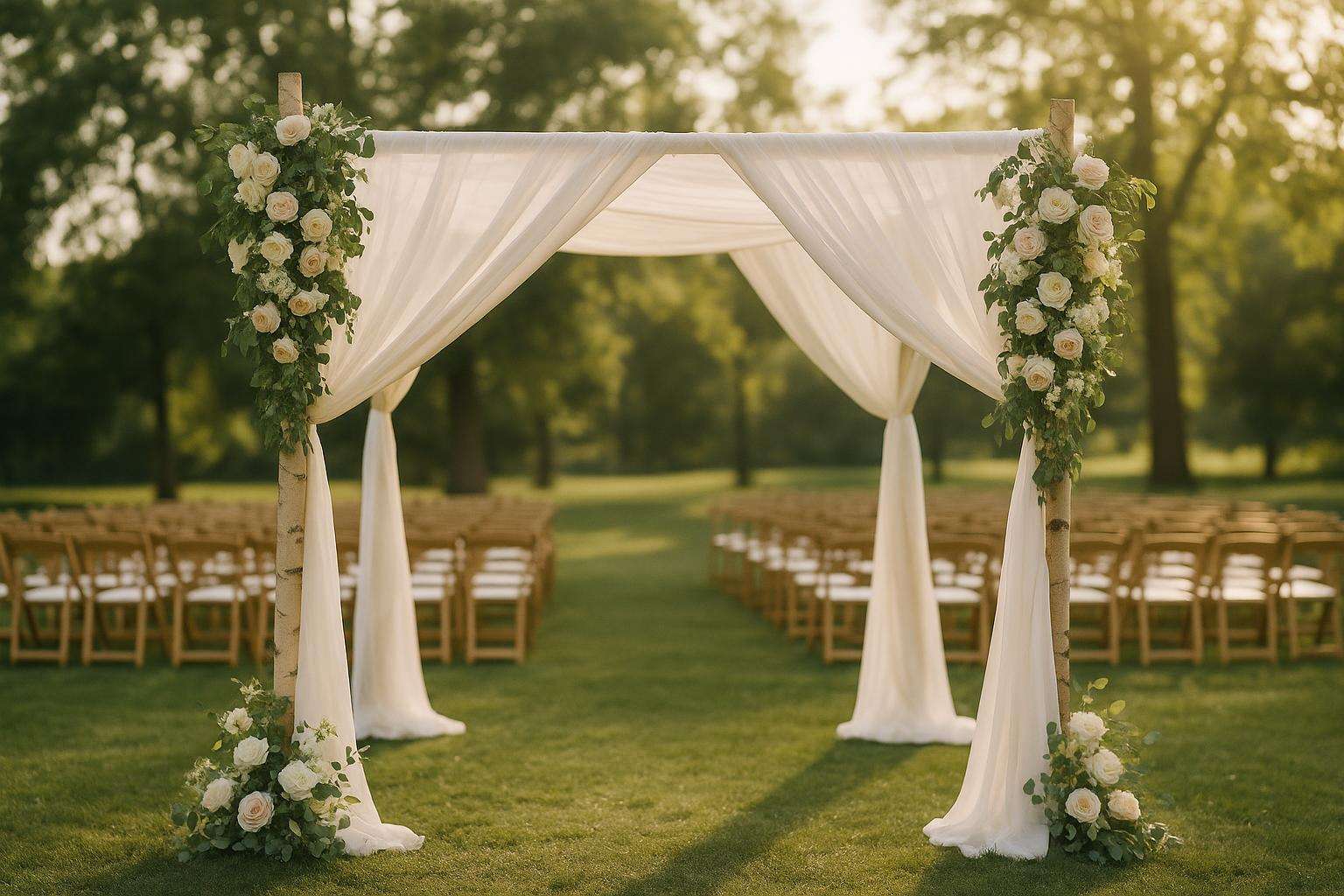
Birch branches as chuppah poles carry their own symbolism: new growth, white bark that reflects light, and a connection to the natural world that resonates powerfully at outdoor ceremonies. A birch branch chuppah uses four tall, relatively straight birch trunks or branches (4 to 6 inches in diameter, 8 to 10 feet tall, sourced from a tree trimming service, a lumber yard, or a craft store's seasonal floral section for $30 to $60 total) as poles. The canopy can be white or natural linen draped simply across the top, or omitted entirely in Sephardic style. Decoration is done with eucalyptus garlands, greenery swags, or small bundles of seasonal blooms zip-tied, wired, or tied with twine along the poles and across the top crossbar. Many couples carve their initials and wedding date into one of the poles — a small, deeply personal touch that creates a lasting keepsake. The finished structure is grounded in weighted concrete bases painted or wrapped to match the aesthetic. Total material cost runs $80 to $200 for poles, greenery garlands (available at craft stores or through wholesale floral suppliers), linen or fabric, and base materials. For a slightly more polished look, add small clusters of dried or fresh flowers at the corners and along the top — purchased from a local florist or grocery store floral department for $40 to $80 — and the chuppah photographs beautifully against both natural and architectural backgrounds. This is among the most popular DIY chuppah designs at outdoor ceremonies in 2025 and 2026, prized for its natural elegance and the ease with which it can be adapted to different floral color palettes.
Strengths
- Naturally elegant and organic aesthetic that photographs beautifully at outdoor venues with almost any floral color palette
- Low material cost — $80 to $200 including poles, greenery garlands, and base materials
- Highly adaptable: the same structure can be dressed up with fresh florals or kept simply draped with white linen depending on budget
Weaknesses
- Birch poles can be heavy and require two people for transport and assembly; sourcing branches the right size and shape takes advance planning
- Best for
- Outdoor ceremonies in garden, vineyard, woodland, or farm settings where a natural organic aesthetic is intentional
- Pricing
- $80–$200 in materials
Source: Top 10 Stunning Chuppah Decor Ideas — Our Family Chuppah · Visit Birch Branch Structure with Greenery
Copper Pipe Frame with Draped Fabric
Sleek, modern, and endlessly customizable with any canopy or floral treatment
Copper pipe has moved from interior design accent to wedding staple, and for good reason: buffed to a warm shine, it reads as deliberately luxurious while remaining one of the most affordable structural materials available. A copper pipe chuppah frame is built from standard 1-inch copper pipe (available at any Home Depot or hardware store for approximately $3 to $5 per linear foot) cut to length and assembled with elbow and tee fittings. No soldering is required — press-fit or slip-joint couplings hold the frame together reliably without permanent bonding, which means the structure can be disassembled and resold or repurposed after the wedding. The standard frame requires four vertical poles (8 feet each) and four horizontal crossbars (4 to 6 feet each, depending on canopy size), plus eight elbow fittings and four tee fittings. Total pipe and fitting cost at 2026 hardware store pricing: $80 to $150. The canopy fabric is draped over the crossbars or attached with small clips — white or ivory muslin ($15 to $30 for enough fabric) creates an airy, minimalist look; lace ($30 to $80) creates something more romantic and traditional. The frame looks its best with a loose, flowing fabric rather than a taut draped sheet, and the warm copper tone pairs beautifully with blush, ivory, and white florals. Add greenery or small floral clusters wired to the top corners for a finished, editorial look. Total build cost including fabric and basic florals runs $100 to $250.
Strengths
- Modern, editorial aesthetic that photographs beautifully and pairs with virtually any floral color palette or fabric treatment
- Fully disassemblable — press-fit copper joints require no soldering; the frame can be resold or kept as a home garden structure
- Affordable hardware store materials: pipe and fittings total $80 to $150 at 2026 pricing
Weaknesses
- Copper pipe is heavier than wood or bamboo poles, making single-person transport and assembly awkward — plan for two people
- Best for
- Modern, minimalist, or industrial-chic venues; couples who want a clean-lined structural frame they can dress up or down with different fabric and floral treatments
- Pricing
- $100–$250 in materials
Source: 37 Chuppah Ideas for a Jewish Wedding Ceremony — The Knot · Visit Copper Pipe Frame with Draped Fabric
Lush Floral Arch Chuppah
The most photographed chuppah design — spectacular visual impact for couples willing to do the floral work
The lush floral chuppah — a structure generously adorned with fresh, dried, or faux flowers and cascading greenery — is the most photographed Jewish wedding ceremony element in 2025 and 2026. It requires more preparation time and the highest material investment of any DIY design, but the visual payoff is genuine: this chuppah commands the room and produces ceremony photographs that are immediately recognizable as beautiful. The base structure can be anything — a wooden frame, copper pipes, birch branches, or a rented metal arch ($50 to $120 rental from most florists or party rental companies). The florals are attached with floral wire, zip ties, or water tubes for fresh stems, working from a grid pattern outward. Eucalyptus, Italian ruscus, or seeded eucalyptus provides the greenery base ($40 to $100 from a wholesale flower market or Trader Joe's floral section the day before the wedding). Focal blooms — white or blush garden roses, peonies, ranunculus, or daisies — are added in clusters for visual depth ($60 to $150 depending on quantity and variety). Total fresh floral material for a generously adorned chuppah: $150 to $400 in addition to the frame cost. For a lower-cost alternative, high-quality faux florals from retailers like Afloral or Amazon can achieve a very similar visual result at $80 to $200 and last indefinitely — an increasingly popular approach for 2025 to 2026 couples who want lush chuppah florals without the day-before assembly panic. Begin assembly the morning of the wedding at minimum; ideally the evening before for fresh flowers.
Strengths
- Produces the most spectacular ceremony photographs of any DIY chuppah design — immediately recognizable and deeply beautiful
- Highly adaptable to any color palette, floral style, or degree of lushness depending on budget
- Can be executed with fresh flowers, faux florals, or a mix — faux florals reduce cost and assembly pressure significantly
Weaknesses
- Highest labor investment of any DIY chuppah — fresh floral assembly requires 3 to 5 hours the morning of or evening before the wedding
- Best for
- Photography-forward couples and anyone whose ceremony aesthetic centers on lush, garden-inspired florals
- Pricing
- $200–$600 in materials (florals + frame)
Source: Chuppah Ideas — Smashing the Glass · Visit Lush Floral Arch Chuppah
Macrame or Chiffon Fabric Drape Chuppah
Soft, romantic, and deeply personal — ideal for bohemian, coastal, and indoor ceremonies
A macrame or layered fabric drape chuppah achieves its beauty through textile rather than florals — layers of chiffon, organza, or hand-knotted macrame hung from a simple frame create an ethereal, light-catching canopy that looks particularly striking in venues with strong natural light or at outdoor ceremonies in the late afternoon. Macrame chuppahs can be sourced from Etsy artisans ($80 to $250 for a custom chuppah panel) or created by a skilled member of the family — macrame is a craft many people learned during the pandemic-era craft revival and the skill transfers beautifully to chuppah work. Chiffon or organza fabric drapes are sourced from fabric retailers: two to three yards of chiffon at $4 to $8 per yard provides an airy canopy, and multiple panels in layered colors can create depth and movement. The frame is typically bamboo or wooden dowels ($30 to $60), and the fabric is tied, clipped, or softly gathered at the corners. Ribbon, string lights, and small dried flower bundles are popular additions for bohemian aesthetics. Because fabric is lightweight, this design is particularly easy to transport and set up. The completed chuppah has a romantic, impermanent quality — the fabric moves gently in a breeze, which is part of its charm and also its slight outdoor limitation: in strong wind, it becomes unwieldy. This is one of the most popular DIY chuppah designs for indoor ceremonies in converted lofts, gallery spaces, and beaches in 2025 to 2026.
Strengths
- Extraordinarily beautiful in natural and soft artificial light — fabric movement creates an ethereal, alive quality that no rigid structure replicates
- Lightweight and easy to transport; chiffon and bamboo poles pack flat and assemble in under 30 minutes
- Fully customizable: macrame from an artisan adds handcrafted meaning; layers of colored chiffon shift the aesthetic from boho to romantic to modern
Weaknesses
- Lightweight fabric panels are vulnerable to strong outdoor wind — best suited to sheltered outdoor settings or indoor ceremonies
- Best for
- Indoor ceremonies, sheltered outdoor settings, beach ceremonies in light-wind conditions, and couples drawn to bohemian, coastal, or romantic aesthetics
- Pricing
- $60–$250 in materials (macrame or fabric + poles)
Source: 37 Chuppah Ideas for a Jewish Wedding Ceremony — The Knot · Visit Macrame or Chiffon Fabric Drape Chuppah
Faux Greenery-Wrapped Frame
The most cost-effective lush look — reusable, stress-free, and surprisingly beautiful
Faux floral and greenery technology has advanced dramatically in the past five years, and the best artificial eucalyptus, ivy, and boxwood garlands now require genuine scrutiny to distinguish from fresh. A faux greenery-wrapped chuppah uses a standard metal arch or pipe frame as the base, then wraps it with thick faux garland strands from the top crossbars down the poles. The result is a lush, green structure that looks intentionally garden-inspired rather than obviously artificial — particularly effective when photographed in natural light or with a floral fill. The greenery garlands are available at IKEA (SMYCKA faux eucalyptus garlands, approximately $10 to $15 each), Amazon, and craft stores; a generously wrapped chuppah requires six to eight garland strands ($60 to $120 total). The base frame is purchased or rented from a party supply store or floral rental company for $50 to $100. Adding a few clusters of real flowers — tucked into the garland at the top corners and along the crossbar — creates a fresh, convincing mixed arrangement for an additional $30 to $60. Total: $140 to $280 in materials, and the garlands are fully reusable. This is a particularly strong option for couples planning a shorter engagement with less prep time, or anyone assembling the chuppah the morning of without floral experience. Faux garlands cannot wilt, require no conditioning, and look the same at 6 pm under reception lighting as they did at 11 am during setup.
Strengths
- Cannot wilt, requires no conditioning, and looks identical at the end of the day as at the beginning of setup
- Fully reusable — garlands can be repurposed as home decor, passed to the next couple in the family, or resold
- More affordable than fresh florals for equivalent visual volume, with minimal assembly skill required
Weaknesses
- Lacks the fragrance and subtle natural variation of fresh florals; requires strong light or real-flower accents to avoid looking artificial in close-up photography
- Best for
- Couples with limited prep time, minimal floral experience, or a strong preference for low-stress setup; also excellent for late autumn and winter weddings when fresh greens are expensive
- Pricing
- $140–$280 in materials
Source: Top 10 Stunning Chuppah Decor Ideas — Our Family Chuppah · Visit Faux Greenery-Wrapped Frame
Acrylic Panel Chuppah
The most contemporary chuppah design — translucent, architectural, and photography-forward
The clear acrylic or Lucite frame chuppah is the defining ceremony design trend of 2025 and 2026 Jewish weddings. A transparent frame draped or decorated with cascading florals appears to float in the ceremony space — it creates a dramatic architectural focal point without visual weight, and it photographs extraordinarily well because the background remains visible through the structure. True DIY acrylic chuppahs are at the ambitious end of the build spectrum: acrylic sheets are cut to size, joined with acrylic-safe bonding cement, and secured to weighted bases — a process that requires access to a table saw or the assistance of a plastics supplier who can cut the material to spec. For most couples, this design lands in semi-DIY territory: rent a clear acrylic frame from a specialty wedding rental company ($300 to $700 for the frame rental in most metropolitan markets) and decorate it yourself with garlands, loose hanging blooms in water tubes, or a fabric canopy draped across the top. The floral decoration follows the same approach as a lush floral chuppah but is often more selective — a cluster of cascading blooms at each corner of the clear frame creates maximum visual impact with less material. Because the frame is transparent, even a relatively minimal floral treatment reads as abundant and intentional. This design works particularly well in indoor reception spaces with strong architectural features or mood lighting that will show through the clear panels.
Strengths
- The most visually contemporary chuppah design available — translucent frame makes florals appear to float in space, producing unforgettable ceremony photographs
- Background scenery and lighting remain visible through the frame, integrating the chuppah with the venue's architecture
- Semi-DIY rental approach keeps the design accessible without requiring specialized fabrication skills
Weaknesses
- Highest cost of any design on this list when renting or building; true DIY requires plastics fabrication tools or a vendor relationship
- Best for
- Modern, design-forward ceremonies in architectural indoor venues; couples for whom ceremony photography is a top priority
- Pricing
- $300–$700 rental; $600–$1,200 to build
Source: Chuppah Ideas and Styling for a Modern Jewish Wedding — Smashing the Glass · Visit Acrylic Panel Chuppah
Which should you choose?
Couple with a meaningful family tallit · Jewish couple with a grandparent's or parent's prayer shawl available
Goal:Create a deeply personal chuppah that honors family heritage at minimal cost
Heirloom Tallit Canopy — Maximum emotional resonance at almost zero material cost — the prayer shawl itself is the canopy.
Outdoor garden wedding couple · Couple marrying at a vineyard, botanical garden, or private estate
Goal:Build a beautiful outdoor chuppah for under $200 that photographs naturally against a garden backdrop
Birch Branch Structure with Greenery — Natural materials, organic aesthetic, and low material cost combine with strong photographic impact in garden settings.
Modern minimalist couple · Couple marrying in an urban loft, gallery, or contemporary venue
Goal:Build a chuppah that feels architecturally intentional — clean lines, no visual clutter
Copper Pipe Frame with Draped Fabric — Copper pipe produces a modern, warm-toned structural frame that pairs beautifully with simple fabric and minimal florals.
Frequently asked
Does a DIY chuppah have to be used at an outdoor ceremony?
Not at all — DIY chuppahs are built for both indoor and outdoor ceremonies, and several designs on this list are actually better suited to indoor settings. The heirloom tallit canopy, copper pipe frame, macrame drape, and acrylic panel chuppah all work beautifully indoors. The main structural consideration is different: outdoor chuppahs require weighted bases (concrete-filled buckets or drive stakes) to resist wind and remain stable in varying ground conditions. Indoor chuppahs need only bases heavy enough to prevent tipping on level floors, which is a significantly easier engineering challenge. If you are building a chuppah for an indoor ceremony, any of the designs on this list are achievable; confirm the ceiling height at your venue before committing to an 8-foot pole design in a space with lower beams.
Who traditionally holds the chuppah poles at a Jewish wedding?
In traditional Ashkenazic Jewish ceremonies, four honored guests — typically close male friends, family members, or community elders — hold the four chuppah poles throughout the ceremony. This is considered a deeply meaningful honor, one of the most intimate assignments a couple can make. For a DIY chuppah built on poles meant to be held, ensure the poles are comfortable to grip for 30 to 45 minutes (smooth birch, bamboo, or copper pipe all work well), and that the structure is light enough not to be burdensome. For DIY chuppahs built on weighted bases that stand independently, no pole holders are needed. Many modern couples choose this freestanding format, which gives honored guests the freedom to participate fully in the ceremony as witnesses rather than physical supports.
What is the symbolic meaning of the four open sides of the chuppah?
The chuppah's four open sides are one of the most beautiful symbols in Jewish wedding tradition, drawing directly from the biblical narrative of Abraham and Sarah. In the book of Genesis, Abraham is described as keeping his tent open in all four directions so that guests could be welcomed from any direction they approached — an embodiment of hachnasat orchim (the practice of welcoming guests), considered among the highest expressions of righteousness. The chuppah's open sides signal that the home this couple is building will be similarly open: welcoming to family, community, and the stranger. Some rabbis also connect the open sides to the divine presence, which cannot be enclosed. When you stand under your chuppah — handmade or rented — you stand in a space that is simultaneously your most intimate moment and a publicly made promise of openness to the world.
How far in advance should I start building or preparing my DIY chuppah?
Begin material sourcing and any cutting or construction at least two to three weeks before the wedding. For designs involving concrete-weighted bases, allow a minimum of 48 hours for the concrete to cure after pouring — this step cannot be rushed. For copper pipe frames, assembly is straightforward but benefits from a practice run before the wedding day to confirm your fittings are correct and the structure is stable. For floral or greenery decoration, if using fresh florals, condition your flowers 48 hours before the ceremony (keep in cool water after cutting the stems at an angle) and complete assembly the morning of or the evening before at the latest. Faux greenery can be assembled at any time and stored flat until setup day. Set up the chuppah at your venue at least three to four hours before guests arrive to allow time for adjustments and photography.
Can a non-Jewish couple use a chuppah at their wedding ceremony?
The chuppah is a Jewish ceremonial structure with deep religious and cultural significance, and its use is most meaningful in the context of a Jewish or interfaith Jewish ceremony. That said, many interfaith couples — where one partner is Jewish and one is not — choose to incorporate a chuppah as an act of cultural honoring and as a visual symbol of the home they are building together. In these contexts, the chuppah's symbolism translates beautifully across traditions: the concept of sheltering love, of building a home open on all sides, resonates with people of many faiths and none. Non-Jewish couples who wish to incorporate a canopy structure as a ceremony focal point for its visual beauty might consider a floral arch, a bamboo arch with linen draping, or a natural wood arbor rather than a chuppah specifically — structures that carry similar visual energy without the specific religious framing of the Jewish ceremony canopy.