Ceremony & Vows
How to Write Personal Wedding Vows: A Step-by-Step Guide for 2026
61% of couples write their own vows — and the ones that move people to tears are never the most poetic. They are the most specific. Here is exactly how to find the words, structure them, and deliver them with presence.
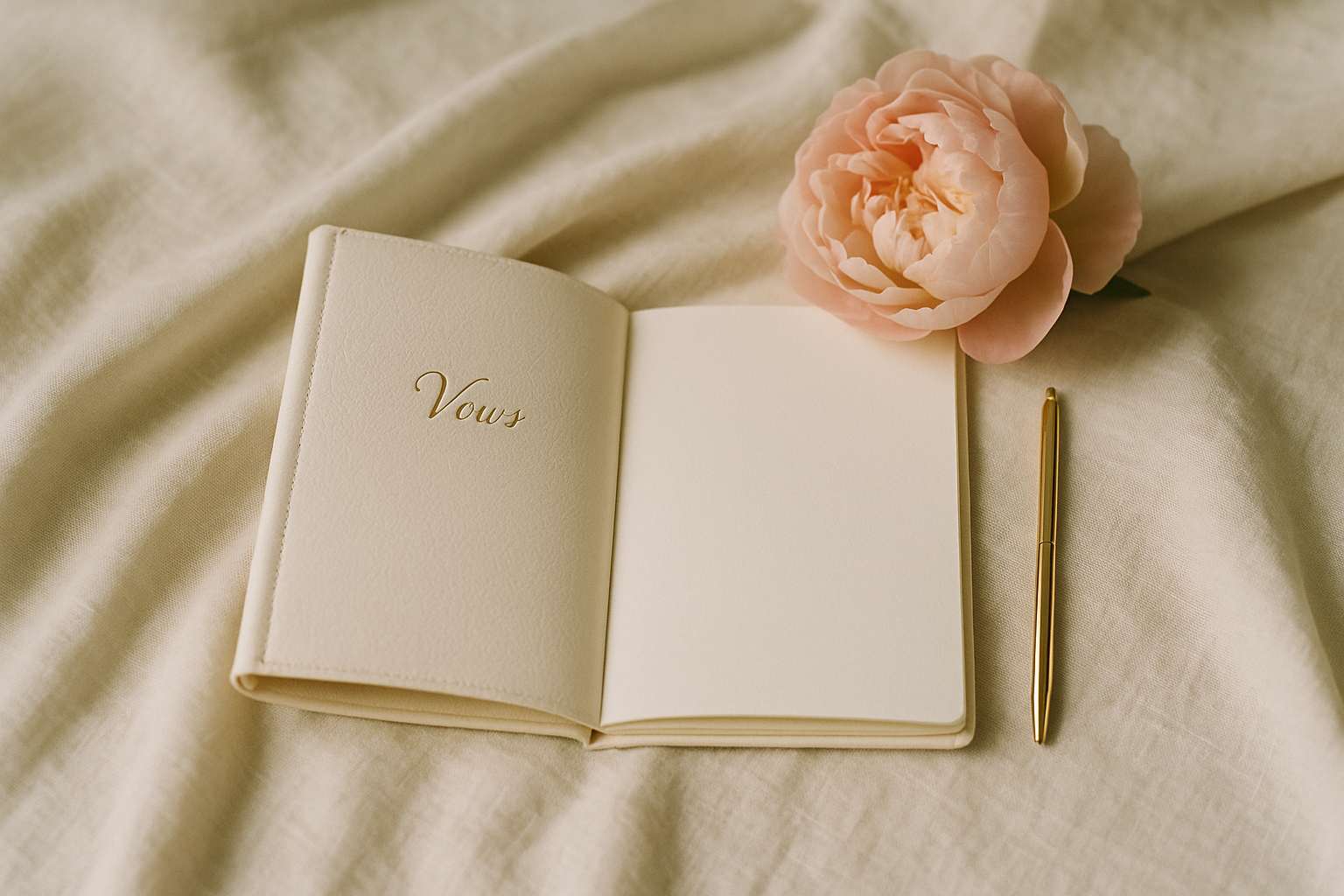
According to The Knot's 2026 Real Weddings Study — based on 10,474 U.S. couples married in 2025 — 61% of couples wrote their own personal vows, the highest rate ever recorded. The vows that move people to tears are never the most elaborate. They are the most specific: the particular memory, the real promise, the voice that is unmistakably yours.
Every other element of your wedding day frames the moment. Your vows are the moment. They are the only words spoken at your wedding that are addressed entirely to one person and heard by everyone who loves you both. They deserve more than a hurried first draft the week before the ceremony.
This guide gives you exactly what you need: a six-part writing structure, a week-by-week timeline from twelve weeks out to the altar, a 15-prompt brainstorming checklist you can use tonight, delivery coaching that accounts for genuine emotion, and real guidance on vow books from affordable to heirloom. Start here. Trust the process.
Should you write your own vows or use traditional language?
This is a decision to make together, early — and neither answer is superior. They serve different purposes and carry different kinds of power.
Traditional vows derive their force from communal weight. When you speak the words "to have and to hold, from this day forward, in sickness and in health, till death do us part," you are speaking language that generations of married couples before you have spoken. Your grandparents may have exchanged these exact words. That continuity is meaningful and real. Traditional vows are also the required form in several faith traditions where personalization is either prohibited or tightly constrained — Catholic couples must use one of two Vatican-approved vow formulations, and Hindu Saptapadi vows are enacted through seven ritual steps with Sanskrit mantras led by the pandit.
| Tradition | Core Vow Form | Personal Additions Permitted? | First Step |
|---|---|---|---|
| Catholic | One of two Vatican-approved formulations; priest-led consent exchange | Limited — brief addition after required language only, requires priest approval | Schedule Pre-Cana; confirm with your priest before writing anything |
| Protestant / Episcopal | "Have and to hold" language; call-and-response or repeat-after structure | Wide latitude — most denominations permit full personal vows or additions | Ask your minister or pastor what the denomination permits |
| Jewish (non-Orthodox) | Traditional ceremony does not include spoken vows; Ketubah + ring exchange + Sheva B'rachot | Modern and Conservative ceremonies increasingly include personal spoken vows | Discuss with your rabbi; modern Ketubot often include egalitarian spoken text |
| Hindu (Saptapadi) | Seven steps around the sacred fire; Sanskrit mantras with pandit | Western-style personal vows often added as a separate moment in dual ceremonies | Confirm dual-ceremony structure with pandit and civil officiant |
| Civil / Secular | "I do" affirmation led by officiant; Declaration of Intent required legally | Fully open to personalization; officiant approves final text | Ask your officiant for word count guidance and any required phrases |
Personal vows give you something that tradition cannot: specificity and narrative intimacy. They allow you to name the exact reasons you are choosing this person — not "someone who makes me laugh," but "the person who made me laugh so hard I cried during that thunderstorm in our first apartment in October, when we had no furniture and ate takeout on the floor." That specificity is what guests remember. It is what your partner will carry for the rest of their life.
The hybrid approach — a brief personal statement followed by the required traditional language — is growing steadily and solves the most common tension. It satisfies liturgical requirements, ensures both partners make the same foundational promises, naturally limits total length, and prevents the common imbalance where one partner writes four minutes of vows and the other writes thirty seconds. If your partner is writing from scratch alongside you, sharing his own vow-writing framework early ensures you both land on the same length and tone.
How do you write wedding vows that sound like you, not everyone else?
The answer is almost entirely about specificity. The vows that make an entire room exhale quietly — that make your partner's eyes fill before you have even reached the promises — are vows rooted in concrete, recognizable truth. Not "you changed my life" but the specific Tuesday morning, the specific conversation, the small gesture that revealed everything. Specificity is the engine of emotional resonance in a vow as surely as it is in any good writing.
Use this six-part framework as your scaffold:
- The opening address. Begin with your partner's actual name — not "my love," not "today as I stand here," but their first name. It grounds the entire vow in the present moment immediately. It says: I am talking to you, specifically, right now.
- The grounding memory. Name one specific shared moment: the first meeting, a turning point, an ordinary afternoon that revealed something essential. Give it the city, the season, the particular detail that makes it yours and no one else's. This is what separates your vows from any other couple's vows on any other day.
- Two or three specific qualities. Not "your kindness" in the abstract. Not "your sense of humor." Instead: "the way you quietly text your grandmother on the anniversary of your grandfather's death because you know she will be thinking of him." Particularity is everything.
- Three to six actionable promises. Balance the serious with the tender; the aspirational with the practical. Promises should be specific enough to be checkable and personal enough that they could only be made to this person. "I promise to always save you the last bite" is more moving than "I promise to love you forever" because it is credible, small, and real.
- A forward-looking vision. One or two sentences gesturing toward the future you are building — the shared dreams, the shared values, the particular way you intend to show up for each other in ordinary life.
- A clean closing line. Do not overthink this. After everything that has come before it, three words often carry the most weight. Trust the preparation; trust the love; let the close be simple.
What to avoid: vague generalities that could describe any relationship, clichés that have appeared in thousands of other vows, inside jokes that exclude your assembled guests, and details that would embarrass your oldest or most conservative family member. As the Emily Post Institute notes in its wedding etiquette guidance, what belongs in a private letter is not always what belongs in a public ceremony spoken before everyone you love.
What is the step-by-step timeline for writing wedding vows from scratch?
Starting earlier produces better vows, without exception. More time means more drafting iterations, more opportunity for the emotional material to settle between sessions, and more room to cut what sounds like a greeting card and keep what sounds like you.
The writing timeline
12 weeks before: Consult your officiant first. Ask: Is there a word count limit? Are there required phrases or legally mandated language? Does the ceremony venue set a time cap? Do they need a copy of your vows in advance? Confirm whether you will use a traditional, personal, or hybrid structure. Set ground rules with your partner — length range, general tone, whether you will include humor — without sharing any content.
8–10 weeks before: Run your brainstorming session. Set aside 30 to 60 uninterrupted minutes with a notebook or blank document. Do not write vows. Write answers to prompts. Get it all out without editing, structuring, or judging any of it. The raw material here is what your final vows will be made from.
Brainstorming prompts — answer in full sentences:
- What is the first thing I noticed about them that had nothing to do with appearance?
- What is one small, ordinary moment that showed me exactly who they are as a person?
- What do they do that I hope never changes?
- When did I know, with certainty, that I wanted to marry this specific person?
- What is the hardest thing we have navigated together, and what did it show me about us?
- What does a random Tuesday look like with this person — and why does it feel like enough?
- What do they do better than anyone I have ever known?
- What inside-knowing do we share that I could reference briefly and warmly for our guests?
- How has loving them changed the way I see myself?
- What am I most looking forward to building with them?
- What promise, if I kept only one, would matter most to them?
- How will I show up on the hard days — not the extraordinary ones, but the ordinary difficult ones?
- What quirk of theirs have I grown to love that I never expected to love?
- What is one thing they do for others, quietly, that most people do not notice?
- What does "home" feel like with them?
6–8 weeks before: Write a messy, unfiltered first draft. Get everything on paper without editing as you go. Then put it away for at least three to five days before returning to it with fresh eyes.
4–6 weeks before: Return and revise. Cut everything that sounds generic. Keep everything that sounds unmistakably like you. Read it aloud and time it — this is non-negotiable. Silent reading runs approximately three times faster than spoken delivery under ceremony-day emotion. Share word count (not content) with your partner and adjust if needed.
2–4 weeks before: Share your draft with your officiant — ideally also with one trusted reader who will give honest feedback on length, tone, and flow. Practice reading aloud daily. You are not memorizing; you are building comfort and familiarity so the words feel natural under pressure.
1 week before: Finalize the text. Print on high-quality paper or have the vows written into your vow book. Give a backup copy to your officiant, your wedding planner, or your maid of honor. Do one final timed reading and record it once to hear yourself.
Day of: Trust your preparation. You have done the work. Bring the physical copy. Do not read from your phone.
How do you deliver your vows with presence — even if you might cry?
Preparation is the only reliable antidote to ceremony-day nerves. If you have read your vows aloud fifteen to twenty times, the physical act of speaking them will feel deeply familiar even when your hands are trembling and your voice threatens to give way.
Always use a physical copy — never a phone. A phone screen photographs poorly, can time out or receive a notification at the worst possible moment, and provides no emotional anchor when you need one. A well-chosen vow book or a printed card on quality paper gives your hands something purposeful to hold and keeps the moment in the photographic frame where it belongs.
Slow down deliberately. Adrenaline accelerates speech. If you practiced at what felt like a comfortable pace, consciously slow down further on the ceremony day itself. The silence between your promises is where the emotion lives for your guests — inside the pause, not the words. Let each sentence land before you continue.
Eye contact at key moments. You do not need to maintain unbroken eye contact — that creates its own performance pressure. Instead, lift your eyes from the page at three or four specific moments: when you say your partner's name, when you deliver the most important promise, and for the final line. Three genuine moments of true eye contact carry more emotional weight than a continuous stare.
Account for emotion in advance. It is completely normal — and genuinely beautiful — to cry, laugh, or briefly lose your voice. Every guest in that room will love you for it. The preparation that helps most is targeted: identify the line that you know will undo you, and practice that specific line repeatedly until it is so familiar your body can move through the feeling while still delivering the words. You may still cry. You will not be caught off guard.
For gatherings of more than 20 guests, amplification is essential. Confirm with your venue whether clip-on or handheld microphones will be available, and who manages the handoff during the vow exchange. A drop in vocal volume from emotion must still be audible to every guest in the room — a voice that breaks beautifully is only moving if it can be heard.
Which vow books are worth buying?
A vow book serves two purposes simultaneously: a functional ceremony prop and a physical heirloom you will return to on anniversaries for years to come. The market spans every price point.
At the accessible end, basic linen or paper vow book sets from Amazon and Etsy run $8 to $20 for a matching pair — functional, presentable in photographs, and entirely appropriate. Mid-range velvet or fabric options with foil stamping and lined pages cost $20 to $40 per set. Premium full-grain leather books with personalized initials, the wedding date, and archival-quality acid-free paper run $35 to $80 per set; Etsy's vow book marketplace hosts thousands of options at every price point, with Ox & Pine's full-grain leather books ($25 per book, 13,000+ favorites) consistently among the most recommended. Forest Nine handcrafts cowhide leather vow books made to order in a small workshop, developing unique markings with use — their quality reviews are exceptional. Heirloom-quality hand-bound sets from specialty Etsy makers and independent bookbinders reach $100 to $300.
For the ceremony itself, 4 inches by 5.5 inches is the most common size — fits comfortably in one hand without appearing bulky in photographs. Matching sets for both partners photograph beautifully and tell the complete story in a flat lay shot. Order at least six weeks before the wedding to allow for personalization, production, and delivery. A trend worth noting for 2025–2026: some couples commission custom calligraphy inside their vow books as a wedding-morning activity, sitting together while the vows are written in by a calligrapher before the ceremony — an intimate ritual that has become its own beloved moment.
Sources: The Knot Worldwide 2026 Real Weddings Study (10,474 U.S. couples, 2025 data); A Practical Wedding; Wandering Weddings; The Knot vow writing guide.
Frequently asked
How long should personal wedding vows be?
The ideal length is 1 to 2 minutes per person spoken aloud — roughly 150 to 250 words at a ceremony pace of 100 to 120 words per minute. One and a half minutes, about 180 words, is the sweet spot. Long enough to say something specific and true; short enough that the emotional arc stays taut. Vows beyond three minutes tend to flatten: the emotional build plateaus and guests begin anticipating the ending rather than resting inside the moment. The most important editing step is to read your draft aloud and time it. Silent reading runs three times faster than spoken delivery under ceremony adrenaline. A draft that reads in 45 seconds will take two full minutes at the altar. Coordinate word count — not content — with your partner at least four weeks before the ceremony. A 30-second imbalance is noticeable and emotionally awkward for guests.
When should I start writing my wedding vows?
Start writing eight to twelve weeks before your wedding day. Earlier is almost always better: more iterations, more time for the emotional material to settle, and more room to cut what sounds like a greeting card and keep what sounds like you. The most common mistake is waiting until the week before, then writing under deadline pressure and pre-wedding chaos. Begin with a brainstorming session — 30 to 60 minutes of answering prompts freely, no editing. Write the first rough draft no later than six to eight weeks out, then put it away for several days before returning with fresh eyes. Budget two to four weeks for revision and daily aloud practice. Give your finalized vows to your officiant and one trusted backup person — maid of honor or best man — at least one week before the ceremony, along with your own printed copy for ceremony day.
What should I include in my personal wedding vows?
Strong personal vows follow a recognizable narrative arc. Open with your partner’s actual name — not "my love," but their real name, which grounds the moment immediately. Anchor the vow in one specific shared memory: the city, the season, the detail that revealed everything. Name two or three specific qualities stated concretely — not "your kindness" but "the way you quietly text your grandmother on the anniversary of her hardest day." Make three to six actionable promises that balance the serious with the tender, specific enough to be believable and personal enough they could only apply to this person. Add a sentence gesturing toward the future you are building. Close simply — after everything that preceded it, three words often carry the most weight. Avoid vague generalities, clichés from other vows, inside jokes that exclude guests, and details that would embarrass your oldest family member.
How do I keep my vows a secret from my partner while still coordinating?
Agree on three things only — and protect the content. First, settle on a word count range together, for example both targeting 180 to 220 words. Second, agree on overall tone: purely emotional, playful with one or two gentle jokes, or lyrical and nature-forward. Third, decide whether to include humor, specific shared memories, or forward-looking promises. Those three agreements give enough creative alignment to write independently with confidence. Share your word count — not your content — with your partner two to four weeks before the ceremony. If one of you is at 150 words and the other at 450, adjustments can be made without ruining the surprise. If you are worried about imbalance, ask your officiant or a trusted mutual friend to read both drafts independently and flag major mismatches. This protects the surprise while ensuring the ceremony moment feels complete and balanced.
Is it okay to use an AI tool to help write my vows?
Yes — as a starting point, brainstorming scaffold, or structural template. AI tools including ChatGPT and dedicated vow-writing applications like Provenance can be useful for first-draft language, structural options, or overcoming blank-page paralysis. What AI cannot access is your specific memories, your precise relationship, or your authentic voice. Heavily AI-generated vows often read as generic because they are: the emotional resonance of personal vows comes entirely from the specificity of your real experience, not from beautifully constructed language about love in the abstract. Use AI to get started, then make it entirely yours. Replace every phrase that could apply to any couple with a detail that could only apply to you two. The final vows should sound unmistakably like your own voice on one of the most important days of your life.
What are the best vow books to use for the ceremony?
Vow books serve two purposes: a functional ceremony prop and a physical heirloom you return to on anniversaries. Linen or paper sets from Amazon or Etsy run $8 to $20 for a pair — presentable in photographs and completely functional. Mid-range velvet or fabric options with foil stamping cost $20 to $40 per set. Premium full-grain leather books with personalized initials and archival paper run $35 to $80 per set. Ox & Pine’s full-grain leather books (around $25 per book on Etsy, 13,000+ favorites) are consistently highly rated. Forest Nine handcrafts cowhide leather books made to order in a small workshop with exceptional reviews. Heirloom hand-bound sets reach $100 to $300. For the ceremony, 4 by 5.5 inches fits comfortably in one hand without appearing bulky in photographs. Order at least six weeks out to allow for personalization and delivery.
What if I start crying and cannot finish my vows?
This is one of the most human things that can happen at a wedding, and guests universally receive it as a profound expression of love. Pause, breathe, and take a moment — your officiant and partner will wait. The preparation that helps most is targeted practice: identify the line you know will undo you and practice it repeatedly until it is deeply familiar. Familiarity does not eliminate emotion, but it allows you to move through the feeling rather than being stopped by it. Beth Stokes, a Humanist wedding officiant in Massachusetts, advises walking around your home practicing the full vow aloud while your partner is out — words that feel natural on paper can feel stiff when spoken in an emotionally charged setting. Accept in advance that you may cry. Building that expectation into your preparation means it will not catch you off guard on the day.