Ceremony & Vows
Interfaith Wedding Ceremony: The Complete Planning Guide
Twenty-six percent of married Americans have a spouse of a different religious background. Planning a ceremony that honors both traditions well — not as a compromise, but as something richer than either alone — is one of the most meaningful things a couple can do.
An interfaith wedding ceremony works when the couple chooses the right officiant, identifies which rituals carry the most meaning in each tradition, builds a structure that gives both equal presence, and has honest family conversations early — producing a ceremony that is more layered and personal than either tradition alone could create.
Marriage across religious and cultural lines is no longer the exception in America — it is rapidly becoming the norm. Pew Research Center data shows that 26% of currently married Americans have a spouse of a different religious identity. Among couples who married in the last decade, only 52% wed someone of the same faith, compared to 81% before 1972. For roughly one in four brides today, the ceremony she plans must hold space for more than one tradition.
Done with care, an interfaith ceremony is not a compromise between two families. It is an opportunity to create something genuinely richer and more layered than a ceremony drawn from a single tradition. The couples who do this well tend to produce weddings that guests describe, years later, as the most meaningful they have ever attended. The couples who do it poorly — by treating the ceremony as a logistics problem rather than a spiritual opportunity — tend to produce a source of family tension that outlasts the wedding itself.
The difference almost always comes down to three things: the officiant, the structure, and the family conversation. Get those three right, and everything else follows.
How do you choose the right officiant for an interfaith wedding?
The officiant is your single most consequential vendor decision for an interfaith ceremony — more important than the venue, the flowers, or the music. A skilled interfaith officiant produces a ceremony that honors two traditions with depth and dignity. An ill-prepared one produces a ceremony that feels like two different services stitched together, leaving both families feeling that their tradition received the B-team treatment.
| Option | Structure | Cost Range | Best For | Key Tradeoff |
|---|---|---|---|---|
| Two co-officiants from different traditions | Separate clergy from each faith share the ceremony | $400–$1,600 total | Couples whose families want authentic representation of each tradition's clergy | Requires coordination; not all clergy will co-officiate across faiths |
| Single trained interfaith officiant | One professional with expertise in both traditions | $300–$1,000 | Couples prioritizing a seamless, unified ceremony flow | Quality varies widely; must verify genuine knowledge of both traditions |
| One clergy + one lay officiant | Faith clergy plus an ordained friend or family member | $100–$800 | Budget-conscious couples where one tradition has an available clergy member | Lay person requires real coaching and rehearsal preparation |
The critical question to ask every potential officiant before any other conversation: "Have you specifically officiated ceremonies blending [Tradition A] and [Tradition B]?" Not ceremonies involving one of those traditions — specifically both. A rabbi who is also trained in interfaith ministry and has deep working knowledge of Christian ceremony structure is a very different resource than a rabbi who has occasionally welcomed non-Jewish family members at otherwise standard ceremonies.
Ceremony Officiants notes the essential distinction plainly: "There is a big difference between a ceremony that has a few religious or cultural elements thrown together haphazardly and a ceremony that is custom-designed with the history and depth of those traditions in mind." Request a sample script from every officiant you consult. If the script shows genuine literacy in both traditions, you have a starting point worth developing. If it shows surface-level cultural awareness — the right words without the underlying understanding — keep looking.
How do you build a ceremony structure that honors two traditions equally?
There are two proven architectural approaches, and choosing between them is one of the most important early ceremony decisions you will make.
Approach A: Alternating traditions. Rituals from each tradition are placed side by side throughout the ceremony, alternating so that both are given roughly equal weight and airtime. A Jewish-Christian ceremony using this approach might open with a Christian prayer, move to the Ketubah signing, include a New Testament reading followed by a passage from Psalms, exchange rings with the Sheva Brachot (Seven Blessings), incorporate a unity candle, and close with the breaking of the glass. The couple and their families always know where they are in the ceremony and can anticipate when their tradition will be represented.
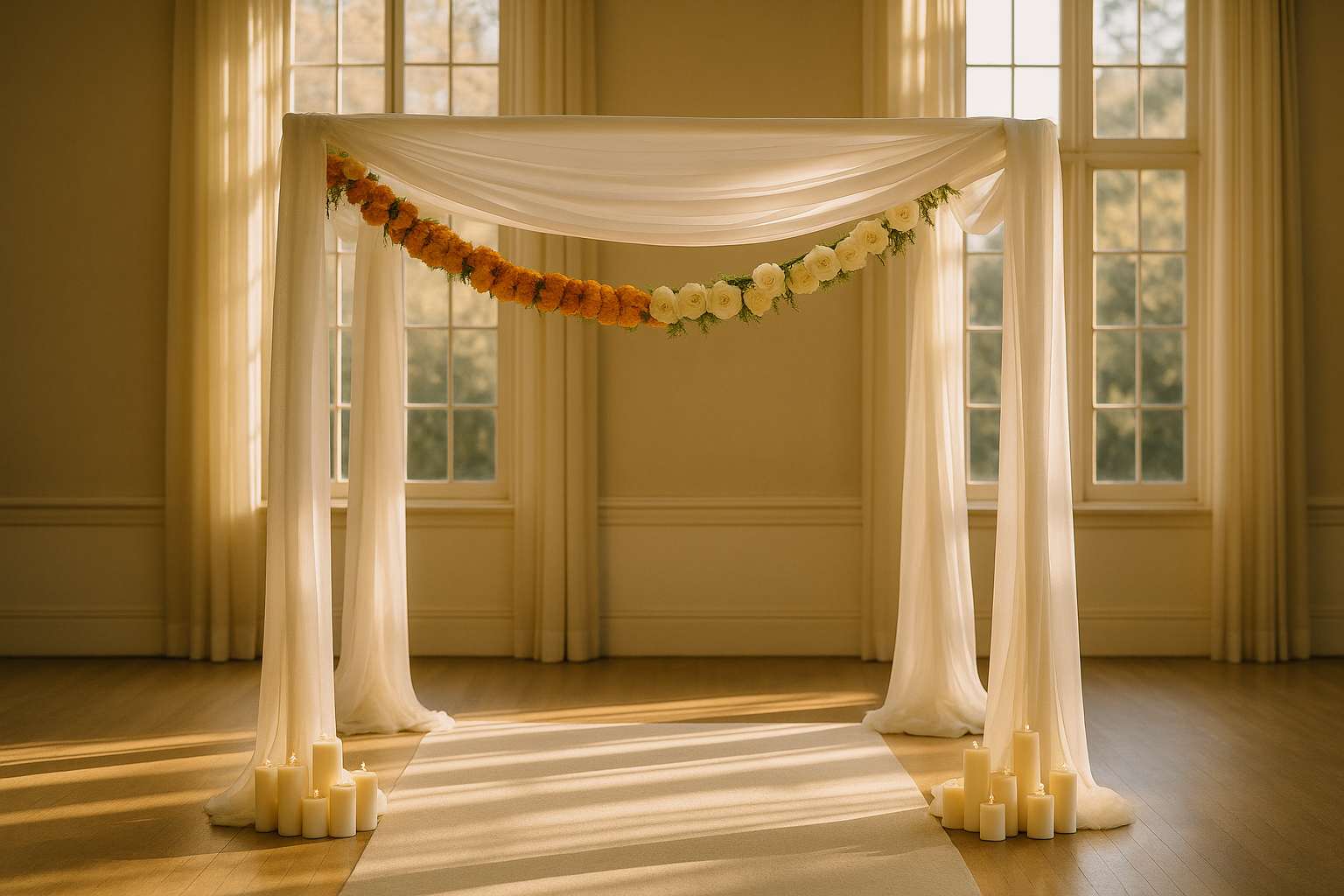
Approach B: Woven integration. Rather than alternating, this approach identifies the thematic parallels between the two traditions and builds rituals that embody both simultaneously. The most well-known example is the mandap-chuppah — a single structural element that draws on the Hindu mandap and the Jewish chuppah, two canopies representing home and shelter. A sand ceremony drawing from both traditions, or a unity ritual with elements of meaning in both faiths, achieves a similar integration. This approach is more visually cohesive and tends to produce the most emotionally powerful moments — but it requires an officiant with genuinely deep knowledge of both traditions to execute without cultural misstep.
A useful planning tool: list the five most meaningful ritual elements from each tradition. Then identify which ones have a natural parallel in the other tradition. The parallels are your integration map. Every major faith tradition has a threshold moment, a covenant statement, a witness participation, a sacred text or wisdom, a symbolic act, and a declaration. Find where those parallel, and build around the intersection.
How do you navigate family expectations around an interfaith ceremony?
The family conversation is where interfaith ceremonies are won or lost before the planning has properly begun. The practical protocol that consistently works is to have this conversation within the first four to six weeks of the engagement — before any vendors are booked, before the ceremony structure is designed, and before positions have hardened.
Timing matters enormously. A family that is consulted early, before decisions are finalized, feels included and respected. A family that is informed late, once the ceremony is essentially designed, tends to feel that their tradition and their voice have been dismissed. The presenting complaint is often about a specific ritual element — "I really hoped there would be a full Catholic mass" or "we expected the Nikah to be at our mosque" — but the underlying concern is almost always the same: fear that their tradition, their culture, and their place in their child's life is being diminished.
The most effective approach with families is to identify meaningful ceremonial roles for parents and grandparents from both sides early in the planning process. Assigning a reading, a blessing, or the honor of escorting the couple to a sacred structure transforms potential critics into ceremony advocates. A grandparent given the honor of reciting the Sheva Brachot at a Jewish-Christian ceremony, or an aunt asked to lead the garland exchange at a Hindu-Western ceremony, becomes a stakeholder in the ceremony's success rather than a skeptic on the sidelines.
For couples navigating significant religious distance — where one or both families have strong convictions about the supremacy of their tradition — premarital counseling through a professional therapist or a trusted clergy member can surface the values beneath the ceremonial debates and make the practical planning conversations considerably more productive. Organizations like 18Doors specifically support Jewish interfaith couples through this process with trained counselors, facilitators, and a national network of rabbis willing to officiate interfaith ceremonies.
What does an interfaith ceremony cost in 2026?
| Element | Low | Mid | High |
|---|---|---|---|
| Single interfaith officiant | $300 | $600 | $1,000+ |
| Co-officiation (two officiants) | $400 | $800 | $1,600+ |
| Custom ceremony script writing (add-on) | $0 (included) | $150–$300 | Bundled in premium fee |
| Bilingual ceremony program design + printing | $150 | $300–$500 | $800+ (bespoke) |
| Custom chuppah or mandap rental | $400 | $800–$1,500 | $3,000+ (custom floral) |
| Ketubah (printed or illustrated) | $100 | $300–$600 | $1,200+ (original art) |
The most powerful interfaith ceremonies are not necessarily the most expensive. What drives cost is primarily the officiant's caliber and the structural elements — a custom mandap-chuppah, a beautifully illustrated Ketubah, or a bespoke bilingual program. All of these are investments in meaning and memory that tend to generate a return far exceeding their cost. The ceremony program in particular is worth investing in: a beautifully designed bilingual program that explains each ritual to guests who are unfamiliar with one or both traditions transforms that unfamiliarity from anxiety into curiosity and inclusion. The Knot's interfaith planning guidance specifically notes the ceremony program as one of the highest-value tools available to interfaith couples precisely because it does the educational work the officiant cannot do while conducting the ceremony itself.
Frequently asked
How common are interfaith weddings in the United States today?
More common than most couples realize — and the number is rising steadily. According to Pew Research Center data, 26% of currently married Americans have a spouse of a different religious identity, and among cohabiting couples the figure rises to 38%. Among couples who married in the last decade, only 52% wed someone of the same faith, compared to 81% of couples who married before 1972. This generational shift means that for roughly one in four women walking down an aisle today, the ceremony they plan will need to hold space for more than one tradition. The planning infrastructure has evolved to match this reality: professionally trained interfaith officiants, interfaith ceremony specialists, and organizations like 18Doors (which specifically supports Jewish interfaith couples) now serve this need with expertise and depth that simply did not exist a generation ago.
What are the three main options for an interfaith wedding officiant?
The three most common approaches each carry distinct advantages and tradeoffs. The first — two co-officiants from different faith traditions, such as a rabbi and a minister — is the most spiritually representative option, giving each tradition its own authentic voice. Cost ranges from roughly $400 to $1,600 total, but coordination between officiants requires real preparation: a mandatory joint rehearsal and clear communication about who leads which elements. The second option is a single trained interfaith or nondenominational officiant who conducts the entire ceremony, weaving elements from both traditions under one guiding voice. This produces the most seamlessly unified ceremony flow, typically costing $300 to $800, though quality varies enormously — always request a sample script and ask specifically about the officiant's depth of knowledge in your two traditions. The third option pairs one faith's clergy with a lay person (a trusted friend ordained online) who handles the secular or second-tradition portions. It is the most accessible budget option but requires genuine preparation of the lay officiant.
How long does an interfaith wedding ceremony typically run?
A thoughtfully planned interfaith ceremony runs 45 to 60 minutes — slightly longer than a single-tradition ceremony, which commonly runs 30 to 45 minutes. The extra time is the price of honoring two traditions properly, and guests who understand the ceremony's dual structure generally receive this length warmly. The error to avoid is allowing the ceremony to expand beyond 75 minutes without pruning. The accumulation of elements from two traditions — if nothing is curated — produces a ceremony that feels less like a beautiful blending and more like two services awkwardly stitched together. The guidance from experienced interfaith planners is consistent: identify the three or four rituals that carry the most meaning from each tradition, and give those deep attention. Everything else is optional. A ceremony that lasts 50 minutes and features two deeply felt rituals per tradition will always outperform an 80-minute ceremony that rushes through seven.
How do you handle family expectations and potential conflict around an interfaith ceremony?
Family dynamics in interfaith ceremony planning are often the most emotionally complex element, and the stakes are highest when families have not had time to prepare. The practical protocol that consistently works is: have the family conversation within the first four to six weeks of your engagement, before any vendors are booked. This timing signals that the couple values family input and prevents families from feeling that the ceremony is a fait accompli they are being informed of rather than included in. The most effective framing is one that acknowledges both decisions already made and areas where input is genuinely welcome. When conflict surfaces, look for the underlying concern — a parent resisting the inclusion of a Jewish ritual is usually worried that their tradition will feel invisible, not that they object to the ritual itself. Address the deeper concern. Assigning meaningful ceremonial roles to parents and grandparents from both sides — a reading, a blessing, the escorting of the couple — turns potential critics into ceremony advocates.
What is the mandap-chuppah, and is it appropriate if only one partner is Hindu?
The mandap-chuppah is an increasingly beloved symbol of Hindu-Jewish interfaith weddings — a single ceremony structure that draws on both traditions. The Hindu mandap is a four-posted canopy under which the ceremony's sacred rituals take place; the Jewish chuppah is a four-posted canopy under which the couple stands, representing the new home they are building together. Both are canopies of shelter, family, and sacred space. When thoughtfully designed, the mandap-chuppah incorporates the visual vocabulary of both — four posts, a floral canopy, a draped fabric ceiling — standing as a symbol visible to both families that neither tradition has been subordinated to the other. Whether it is appropriate when only one partner is Hindu depends on the couple's own values and their families' feelings. The key question is whether the structure reads as genuine honoring of both traditions or as a cultural prop. A couple who works with a designer or florist experienced in both traditions tends to produce results that feel authentic; a last-minute imitation can miss the mark.
Do we need two marriage licenses for an interfaith ceremony with two officiants?
No — you need exactly one civil marriage license regardless of how many officiants participate. In most U.S. states, only one officiant needs to be legally authorized to solemnize a marriage, and only one signature is required on the license. The second officiant participates in the ceremony as a co-celebrant without needing to be licensed. What matters legally is that at least one of your officiants is properly registered in your state to solemnize marriages — this is not automatic for all clergy, and it varies by state. Confirm with your county clerk's office before the ceremony which requirements apply in your jurisdiction. Some religious ceremonies — the Jewish Ketubah, the Islamic Nikah, certain Buddhist blessings — are spiritual and cultural agreements that exist independently of the civil license. These carry their own profound meaning and do not require separate legal documentation in the United States, though couples should confirm state-specific rules with a local attorney if they have questions.