Ceremony & Vows
Sheva Brachot Meaning: The Seven Blessings Every Jewish Bride Should Know
The Sheva Brachot are the liturgical heart of the Jewish wedding ceremony — seven ancient blessings that connect your marriage to creation, community, and the hope of Jerusalem. Here is what each one means and how to make them deeply personal.
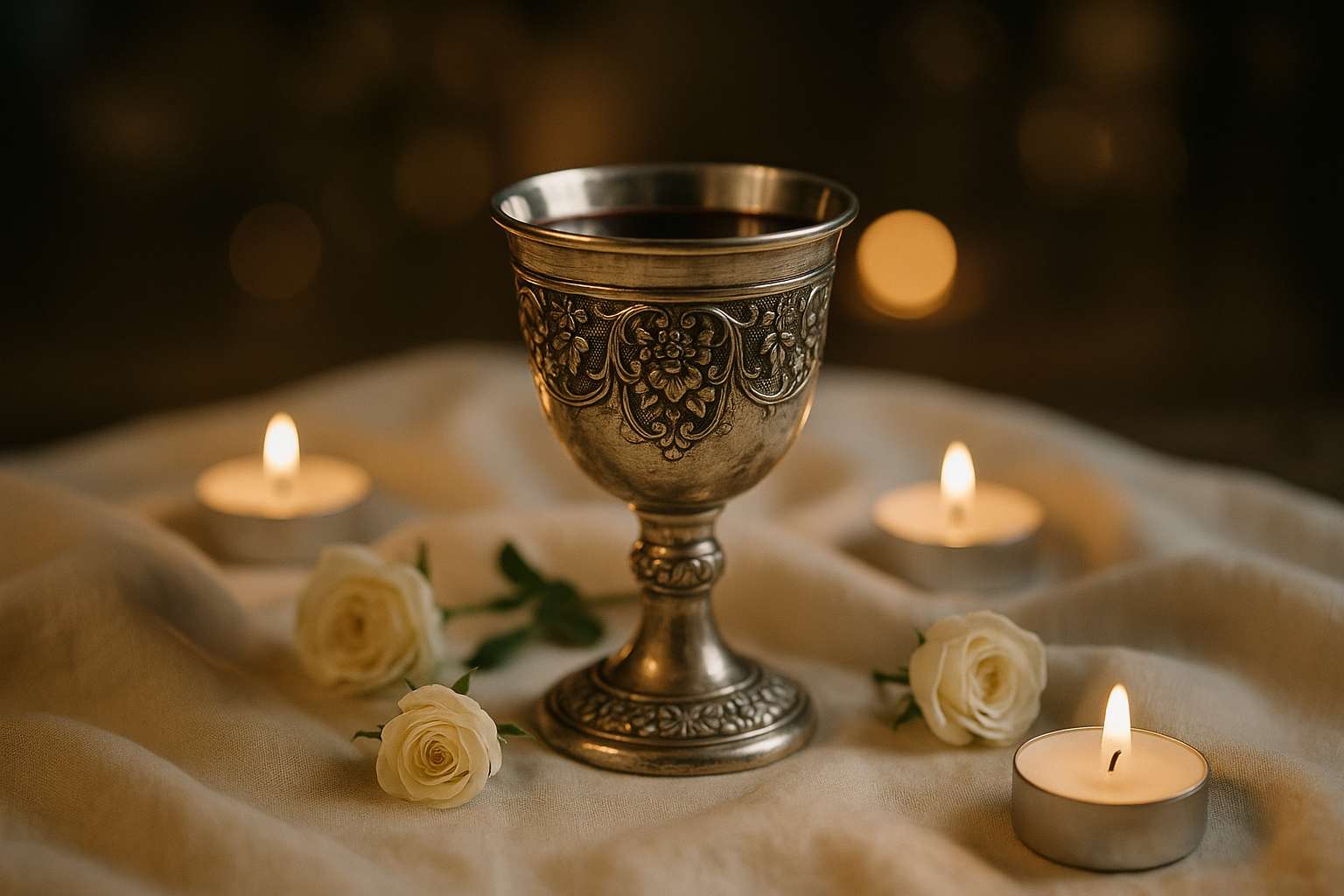
The Sheva Brachot are seven ancient blessings chanted under the chuppah over wine, linking the couple's personal joy to creation, community, and the Jewish people's hope for Jerusalem. Recited by honored guests and repeated at celebratory dinners for seven days after the wedding, they are the theological heart of Jewish marriage.
Of all the rituals in a Jewish wedding ceremony, the Sheva Brachot carry the most weight. They transform what might otherwise be a legal contract into a layered covenant — personal, communal, and cosmic at once. Under the chuppah, while the couple stands at the threshold of a new life together, seven ancient blessings remind them that their joy is not only their own. It belongs to the Jewish people, to all humanity, and — in the theology of these blessings — to the Creator of the universe.
According to My Jewish Learning, the Sheva Brachot derive from the Talmud (tractate Ketubot) and have been recited in essentially their current form for close to two thousand years. That continuity is not accidental. These blessings were designed to be overheard by history — to echo the same words spoken at Jewish weddings in ancient Babylon, medieval Spain, and nineteenth-century Poland. Every time they are chanted under a chuppah in 2026, they link that couple to an unbroken chain of Jewish marriage stretching back to the rabbinical period.
What are the seven blessings — and what does each one mean?
The Sheva Brachot are not seven random blessings assembled for convenience. They build on one another with deliberate theological logic — beginning with the most universal (the sanctification of wine, the creation of the world) and moving inward toward the most intimate (the specific joy of this bride and this groom, surrounded by love).
| Number | Primary Theme | What It Expresses |
|---|---|---|
| First | Wine (Kiddush) | Sanctification of God's name over the fruit of the vine; the same blessing that opens Shabbat and every Jewish celebration |
| Second | Creation — all things | Praise for God who created all things for His glory; the wedding is placed within the totality of creation |
| Third | Creation — humanity | Acknowledgment that God created human beings; the couple is recognized as part of the human family God formed |
| Fourth | The divine image | Praise for creating humans in the image of God (tzelem Elohim), with the capacity for love, creativity, and continuity |
| Fifth | Zion and Jerusalem | Prayer for the restoration of Jerusalem and the joy of the Jewish people; even at the apex of personal happiness, collective hope is held |
| Sixth | The couple | May this couple be as glad as Adam and Eve in the Garden of Eden — a prayer for perfect joy at the beginning of a new life together |
| Seventh | Joy — ten kinds | A cascading enumeration of joy: gladness, celebration, bride and groom, delight and song, mirth, love, brotherhood, peace, and companionship |
The progression is intentional and beautiful. The blessings begin with wine — the most basic Jewish sanctification — expand outward to creation and humanity, narrow inward through the divine image and the hope of Jerusalem, and arrive at last at this specific couple, showered in ten kinds of joy. By the time the seventh blessing is chanted, the room has been reminded that this marriage is not merely a personal milestone. It is an act of participation in the ongoing story of creation itself.
Why does one blessing reference Jerusalem — at a wedding?
This is the question most non-Jewish guests ask, and it deserves a full answer. The fifth blessing invokes the restoration of Jerusalem and the joy of the Jewish people alongside the joy of the couple. At what might seem like an incongruous moment — the height of personal celebration — the blessings insert a prayer for collective redemption.
This is not meant to cast a shadow on the occasion. According to Chabad's guide to the Sheva Brachot, the inclusion of Jerusalem reflects a core Jewish theology: that personal joy and national hope are inseparable. Just as the breaking of the glass at the ceremony's end commemorates the destruction of the Temple even at the moment of greatest celebration, the fifth blessing ensures that no Jewish wedding forgets the wider covenant of which it is a part.
For many contemporary couples, this blessing is the most theologically profound moment of the ceremony — the place where the personal and the communal become one. Rabbis often describe it as the moment that transforms a wedding from a private party into a public act of Jewish continuity. Assigning this blessing to a grandparent or family elder, who has personally witnessed Jewish history across generations, adds another layer of meaning.
How to distribute and personalize the seven blessings
In modern ceremonies — across Conservative, Reform, Reconstructionist, and many liberal Orthodox communities — it has become standard and beloved practice to distribute the seven blessings among seven honored guests rather than having the rabbi chant them all. This transforms the Sheva Brachot from a liturgical performance into a communal embrace.
Here is how to do it beautifully:
Choose with intention. Match each blessing's theme to the person you are asking. The second blessing (creation of all things) might go to a science teacher or naturalist who shaped one partner's worldview. The fifth (Jerusalem and the Jewish people) might go to a grandparent who carries personal memory of Jewish history. The seventh (ten kinds of joy) might go to the friend who has been your most joyful presence throughout the engagement.
Give ample lead time. Assign readers at least three weeks before the wedding. Send them the text — in Hebrew, transliteration, and English translation — along with a brief personal note explaining why you chose them for this particular blessing. That note is itself a gift.
Offer the option of Hebrew or English. Some guests will want to honor the tradition by attempting the Hebrew; others will be most meaningful in English. Both are valid and welcome in liberal denominations. Confirm with your rabbi which approach is appropriate for your ceremony.
Build a bilingual program. Even guests unfamiliar with Jewish tradition can be moved by the Sheva Brachot when they understand what each blessing expresses in real time. A well-crafted ceremony program with transliterations, translations, and one-line descriptions of each blessing's theme is one of the highest-return investments in your ceremony experience.
According to 18Doors, a leading resource for interfaith Jewish families, couples are increasingly supplementing the traditional blessings with personal additions — a brief poem, a family story, or an English reflection on each blessing's theme. This hybrid approach honors the ancient text while personalizing the ceremony in ways that feel genuinely contemporary.
The Sheva Brachot week: celebrating for seven days
The Sheva Brachot do not end under the chuppah. In Jewish tradition, the couple's joy is extended for seven days following the wedding through a series of festive meals — each hosted by different friends or family members, each concluding with a repeat recitation of the seven blessings.
Two conditions govern whether the blessings may be recited at these post-wedding meals: a minyan of ten adult Jews must be present, and at least one panim chadashot — a "new face," someone who was not present at the wedding or any prior Sheva Brachot meal — must be in attendance. The requirement for a new presence is a beautiful mechanism: it keeps the celebration expanding outward throughout the week, drawing more people into the couple's joy.
In traditional and observant communities, the full seven-day Sheva Brachot is a major logistical undertaking — seven dinners in seven days, coordinated across extended family and community. Designating a family member or planner to manage the calendar, confirm minyan counts, and arrange for panim chadashot at each meal is practical wisdom. In liberal and modern communities, one or two post-wedding celebratory dinners held in the spirit of the tradition are common and warmly meaningful.
The Sheva Brachot week also has a practical gift: it combats post-wedding blues. The abrupt transition from months of engaged preparation to the morning-after quiet can be emotionally disorienting. A week of dinners, surrounded by people who love you, reciting blessings over wine, extends the celebration with communal warmth rather than letting the joy simply evaporate.
Planning your Sheva Brachot: a practical timeline
The most common mistake couples make with the Sheva Brachot is treating them as a logistics item to be resolved the week of the wedding. The logistics require early attention — particularly the distribution of readings, the preparation of the ceremony program, and the coordination of the post-wedding week.
4–6 months before: Decide whether you will have the rabbi recite all blessings or distribute them among guests. Confirm your rabbi's preference and denominational requirements for readers.
3–4 months before: Choose your seven readers and extend the honor. Send them a brief explanation of the tradition and their specific blessing.
6–8 weeks before: Send each reader the full text — Hebrew, transliteration, and English — with your personal note about why you chose them. Confirm their comfort level with Hebrew or English delivery.
2–4 weeks before: Finalize the ceremony program, including transliterations and thematic notes for all seven blessings. Confirm the order of readers with your rabbi and day-of coordinator.
Post-wedding week: Designate a trusted friend or family member to coordinate the Sheva Brachot dinners — host assignments, minyan confirmation, and panim chadashot arrangements. Do not leave this to spontaneity; it requires active coordination to fulfill beautifully.
Frequently asked
What does "Sheva Brachot" mean in English?
Sheva Brachot (שֶׁבַע בְּרָכוֹת) translates directly from Hebrew as "seven blessings." They are also known in halachic literature as Birkot Nissuin — the "blessings of marriage" — to distinguish them from blessings recited at the betrothal stage of the ceremony. The word sheva carries additional resonance in Hebrew because it means both "seven" and "oath" — the same root that animates the biblical language of covenant throughout the Torah. Recited under the chuppah over a second cup of wine, the Sheva Brachot are considered the liturgical centerpiece of the Jewish wedding ceremony, the moment when the couple's personal joy is woven into a larger tapestry of creation, community, and national hope. In contemporary ceremonies, they are often distributed among seven honored guests, each reciting one blessing aloud.
Who recites the Sheva Brachot at a Jewish wedding?
In traditional ceremonies, the officiating rabbi chants all seven blessings. In modern Conservative, Reform, and Reconstructionist ceremonies — and increasingly in some Orthodox communities — the blessings are distributed among seven honored guests: grandparents, siblings, mentors, close friends, or anyone the couple wishes to honor with a moment under the chuppah. Each guest is assigned one blessing and may recite it in Hebrew, in English, or bilingually. When distributing the blessings among guests, it is a beautiful custom to share a brief note explaining why you chose each person for their particular blessing — this transforms a liturgical requirement into a living portrait of the people who have shaped your lives. Guests should receive the text with transliterations at least two to three weeks in advance.
What happens during the post-wedding Sheva Brachot week?
For the seven days following the wedding, tradition calls for the couple to be honored at festive meals hosted by different friends and family members — one gathering per day. At the conclusion of each meal's Grace After Meals (Birkat Hamazon), the Sheva Brachot are recited again over a cup of wine. Two conditions must be met for the blessings to be said: a minyan (a quorum of ten adult Jews) must be present, and at least one panim chadashot — a "new face," meaning a guest who was not present at the wedding or at any prior Sheva Brachot meal that week — must be in attendance. This requirement for a new presence encourages the couple to keep expanding their circle of celebration throughout the week. In observant communities, the full seven-day Sheva Brachot is a deeply meaningful tradition; in liberal communities, one or two post-wedding celebratory dinners honoring the spirit of the custom are common.
Are the Sheva Brachot the same in Orthodox, Conservative, and Reform ceremonies?
The traditional text of the seven blessings is essentially the same across denominations — it derives from the Talmud (tractate Ketubot) and has been recited in essentially its current form for nearly two thousand years. The primary variation is not in the text itself but in who recites it and how. In Orthodox ceremonies, the rabbi typically chants all seven blessings in Hebrew; witnesses and guests must meet specific halachic requirements. In Conservative ceremonies, the blessings are often distributed among honored guests (Jewish adults, with denominational variation on exact requirements). In Reform and Reconstructionist ceremonies, any seven honored guests may be chosen regardless of background, the blessings may be read bilingually, and couples sometimes supplement the traditional blessings with personal reflections or original poetry on the themes of each blessing. The fifth blessing, which invokes the restoration of Jerusalem, is present across all denominations — a reminder that every Jewish wedding carries national and communal significance.
What is the meaning of the fifth Sheva Brachot blessing about Jerusalem?
The fifth blessing — 'Grant great joy to the beloved companions, as You gave joy to Your creation in the Garden of Eden long ago. Blessed are You, Eternal, who gives joy to bride and groom' (paired with prayers for Jerusalem's restoration) — is theologically the most distinctive element of Jewish marriage liturgy. Every Jewish wedding carries within it a conscious remembrance of the destruction of the Temple in Jerusalem and a prayer for national redemption. At the very apex of personal joy, the Jewish people insert a moment of collective longing. This is not meant to diminish the happiness of the occasion but to sanctify it: the couple's joy is understood as a foretaste of the ultimate joy of an entire people restored. Many rabbis describe this blessing as the moment that transforms a wedding from a private celebration into a public act of faith and hope. In an egalitarian ceremony, this fifth blessing is often given to a grandparent or family elder to honor the continuity it embodies.
Can non-Jewish guests participate meaningfully in the Sheva Brachot?
Absolutely — and with some intentional preparation, non-Jewish guests can find the Sheva Brachot among the most moving moments of the ceremony. The key is a bilingual ceremony program with transliterations and brief explanatory notes for each blessing's theme. When guests understand that the second and third blessings celebrate the act of creation, that the fifth links the couple's joy to a nation's hope, and that the seventh enumerates ten forms of joy as the couple is showered with them, they are no longer observing a ritual — they are witnesses to something ancient and alive. Non-Jewish family members assigned to recite a blessing in English translation are given a meaningful role in an interfaith ceremony. The warmth and hospitality of welcoming all guests into understanding is itself a reflection of the first blessing's theme: creation and the generosity of God's world.