Ceremony & Vows
Traditional vs Personal Wedding Vows: How to Choose
Sixty-one percent of couples wrote their own vows in 2025. But traditional vows have survived centuries for good reasons. This is an honest comparison — costs, legal standing, time investment, and practical delivery — so you can choose what is actually right for your ceremony.
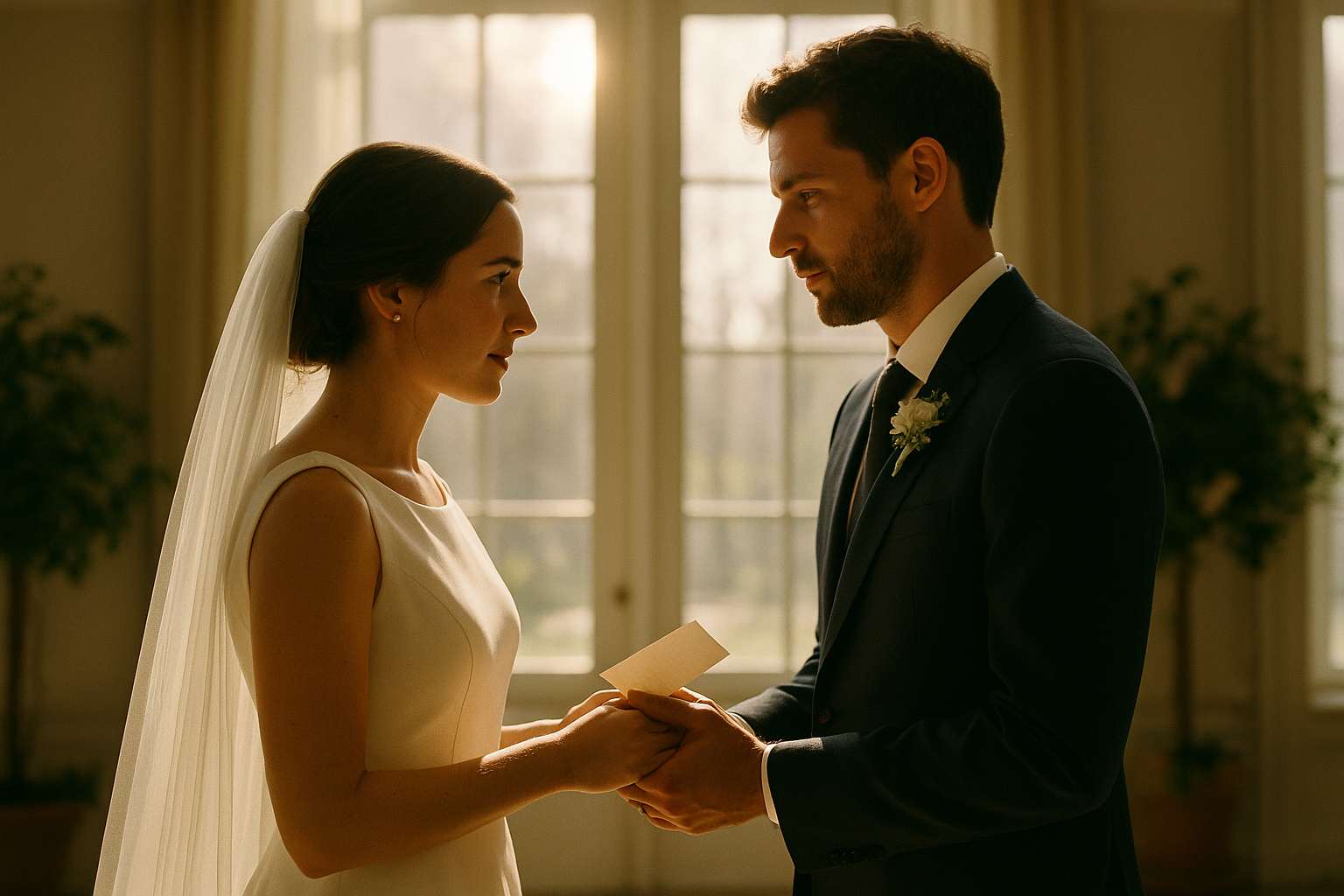
Traditional vows take minutes to decide and 30 to 60 seconds to deliver. Personal vows require hours of writing and 1 to 2 minutes of emotionally exposed public speaking. According to The Knot's 2026 Real Weddings data, 61 percent of couples wrote their own vows in 2025 — but the remaining 39 percent who chose traditional language were not doing anything less meaningful. The right choice is the one that reflects who you both actually are, not what you think you are supposed to want.
The vow decision feels heavier than almost any other wedding planning choice — heavier, in fact, than it needs to. The words you say at your ceremony will be remembered by you, your partner, and a handful of people in the front rows. They will not be fact-checked, recorded in an accessible archive, or compared to another couple's vows on your anniversary. What matters is that they are honest and that they are yours.
Here is an exact comparison of what each option actually requires, so you can make this decision based on information rather than anxiety.
What are the real differences between traditional and personal wedding vows?
| Factor | Traditional Vows | Personal Vows |
|---|---|---|
| Time to prepare | Minimal — review and memorize or confirm with officiant | 4–8 hours of drafting, editing, and practice |
| Delivery length | 30–60 seconds per person | 1–2 minutes per person (150–300 words ideal) |
| Emotional risk | Low — familiar language reduces spontaneous emotion | Higher — specific personal content can overwhelm delivery |
| Guest experience | Familiar, anchored, universally legible | Intimate, specific, can feel more immersive |
| Religious requirements | Often prescribed; some denominations require specific language | May require approval from religious officiant |
| Legal standing | Identical — neither form creates the marriage | Identical — legal contract is the signed license |
| Coordination required | None beyond confirming preferred version with officiant | Length-matching, emotional-register alignment with partner |
| 2025 prevalence (The Knot) | 39% of couples | 61% of couples |
What do traditional wedding vows actually say, and where do they come from?
The traditional English wedding vow — "I, [name], take you, [name], to be my lawfully wedded [husband/wife], to have and to hold, from this day forward, for better, for worse, for richer, for poorer, in sickness and in health, to love and to cherish, until death do us part" — traces its modern form to the 1549 Book of Common Prayer, written during the reign of Edward VI of England. It is one of the longest-surviving ritual texts still in active daily use in the English-speaking world, and its durability reflects both its compression and its honesty: it names the actual conditions of a lifelong commitment rather than describing the pleasant ones only.
The Catholic form — "I, [name], take you, [name], to be my wife/husband. I promise to be faithful to you, in good times and in bad, in sickness and in health, to love you and to honor you all the days of my life" — uses slightly different language but shares the same covenant structure. Jewish vows under a huppah traditionally use the Aramaic declaration of acquisition ("Harei at mekudeshet li") alongside ring exchange, with English personal statements often added for the guests' understanding.
Choosing traditional vows is not a default or a failure of imagination. It is a decision to situate your marriage within a specific historical and sometimes spiritual tradition — to say the same words that millions of couples before you have said, and to mean them in full.
How do you actually write personal wedding vows that are worth reading?
The past-present-future structure is the most consistently effective framework for personal vows, and it works because each section does a distinct emotional job. One Story Weddings' vow-writing guide describes the framework this way: begin with a specific memory that establishes who your partner is to you (past), name what you most value in them and your relationship as it currently exists (present), then close with concrete promises that reflect how you intend to show up for them (future).
The most common mistake in personal vow writing is substituting general declarations for specific evidence. "You are my best friend" is true for many couples but memorable for none. "You drove four hours in a snowstorm to bring me dinner when my grandmother died" is specific, true, and immediately tells every guest in the room who your partner is without requiring an introduction. The goal is to make strangers understand your love by hearing one or two real facts about it — not to catalog every feeling you have ever had.
Aim for 150 to 300 words, spoken at a pace of roughly 130 words per minute with pauses for emotion. This is 1 to 1.5 minutes. If your draft is significantly longer, look for abstract statements that can be removed or consolidated: three references to their kindness probably need to become one. Read the draft aloud ten to fifteen times in the week before the wedding; the emotional intensity that feels overwhelming in the first reading diminishes to manageable by the fifth, and you will be genuinely grateful for that preparation when you are standing at the altar.
Frequently asked
Do traditional or personal wedding vows have more legal standing?
Neither traditional nor personal vows carry intrinsic legal weight in most U.S. jurisdictions — the legal contract of marriage is created by the marriage license you sign, not by the words spoken at the ceremony. Most states and counties require only that the officiant be legally registered, that both parties consent, and that the license be signed by witnesses and submitted after the ceremony. This means the vows themselves — whether traditional, personal, or improvised — are a ritual declaration rather than a legal instrument. That said, some religious ceremonies have specific canonical requirements for vow language in order for the marriage to be recognized by that institution, such as Catholic sacramental marriage or certain Orthodox ceremonies. If you are marrying in a religious context with institutional requirements, consult your officiant or religious authority before departing from prescribed language.
How long should wedding vows be — traditional or personal?
Traditional vows typically run 30 to 60 seconds each. Personal vows perform best at 150 to 300 words per person, which translates to 1 to 2 minutes at a measured, emotional speaking pace — a finding consistently echoed by officiants at American Marriage Ministries and backed by ceremony timing data from The Knot. This is enough to be meaningful and specific without creating a ceremony that feels like a speech. A common mistake is writing personal vows at 400 to 600 words: what reads beautifully on paper becomes an extended monologue that audiences begin to mentally disengage from around the 90-second mark. If you find yourself writing more, look for places where general statements can be cut in favor of one or two specific, concrete moments. A vow that mentions one real memory will always land harder than a vow that names five abstract feelings.
What is the hybrid vow approach and how does it work?
A hybrid vow structure combines the proven architecture of traditional vows with personal additions that reflect the specific couple. The format typically works as follows: the officiant leads the couple through the traditional vow structure — the 'I take you' or 'I promise to love you in sickness and in health' framework — and then invites each partner to add a personal statement of one to three sentences. Alternatively, the couple writes fully personal vows but opens each one with the traditional 'I, [name], take you, [name], to be my lawfully wedded [husband/wife]' which grounds the ceremony in familiar language and tends to quiet any restlessness in the congregation before the personal material begins. This hybrid structure is particularly useful when families are divided — one side expecting traditional religious language, another expecting personalization — because it honors both expectations within a single ceremony.
What is a good structure for writing personal vows?
The structure used most widely by professional vow coaches and officiants follows a past-present-future framework: begin with a specific memory of the person you are marrying (past), name what you most value or admire about them and your relationship as it stands today (present), and close with your promises — concrete commitments, not generic ones (future). The past section serves as the emotional anchor: 'I remember the night you stayed on the phone with me for three hours when I didn't know what to do' lands in a way that 'you have always been my best friend' does not. The promises in the future section perform better as specific and slightly unexpected — 'I promise to always be the one who kills the spiders' — alongside the foundational ones. Specificity, honesty, and brevity are the three qualities every professional officiant cites when reviewing vow drafts.
How do you deliver personal wedding vows without crying or losing your place?
This is one of the most practically important questions couples face, and the answer is almost entirely about preparation. Read your vows aloud — not silently — at least ten to fifteen times in the week before the wedding. The physical act of speaking them reduces the emotional shock of saying them in public significantly; the emotional response you experience in private practice tends to moderate with repetition. Write your vows on a small, firm card rather than paper, which shakes visibly when hands tremble. Make the font larger than you think you need. Practice looking up from the card at the end of each sentence rather than reading in an unbroken downward gaze. If you begin to feel overwhelmed during delivery, take a breath and look directly at your partner's eyes rather than at the guests — this usually grounds the emotion rather than escalating it. Tell your officiant in advance if you are worried about losing composure; they can quietly place a hand on your shoulder as a reset cue.
Should both partners write personal vows or just one?
Both partners should write personal vows if either one chooses to depart from traditional vows. Mismatched vows — one partner reading a heartfelt personal statement while the other repeats the traditional 'I do' — creates an inadvertent power imbalance that guests notice even if they do not articulate it, and that the partner receiving the personal vows sometimes finds quietly painful in retrospect. The decision to write personal vows should be made together, early in the planning process, and should include an agreement on length so neither partner is surprised to discover their vow is three times longer or shorter than their partner's. It is entirely reasonable to show each other your vow drafts before the wedding; many couples find this practical rather than unromantic, particularly if they want to ensure the emotional register and length are aligned.