Ceremony & Vows
Unity Ceremony Ideas for 2026: 10 Rituals That Add Real Meaning
A unity ceremony transforms the vow exchange from two people making individual promises into something the entire room participates in witnessing. These are the ten most meaningful options — for religious ceremonies, secular celebrations, blended families, and everything in between.
unity ceremony ideas 2026wedding unity ritualhandfasting ceremonysand ceremonyblended family wedding
The quick verdict
One ritual done well creates a ceremony moment guests carry home with them. These are the ten best options — with what they mean, what they cost, and how to choose the one that fits your ceremony.
- Best overall
- Community Vow (Collective Witness) — Two minutes, no materials, no cost — and it transforms every guest from a spectator into an active participant. The most underused and most effective addition in 2026.
- Best value
- Handfasting — Genuinely ancient, visually dramatic, and the braided cords become a lasting keepsake. The fastest-growing secular unity ritual in 2025–2026.
- Best for Blended families with children
- Sand Ceremony — No other ritual allows children's participation as naturally or as meaningfully. Each child's color woven into the vessel is a declaration that this marriage includes them.
How we evaluated
Each unity ritual was evaluated on symbolic depth, ceremony versatility across religious and secular celebrations, how simple it is to execute, how much it engages guests, and the keepsake or lasting value it leaves behind. We also note the timing each ritual adds so couples can plan ceremony length accurately. Recommendations reflect 2026 guidance from The Knot, Robyn Ashley Weddings, Wedgewood Weddings, and practicing wedding officiants.
- Symbolic depth. How clearly and powerfully the ritual communicates the joining of two lives to guests.
- Ceremony versatility. Whether the ritual works across religious, secular, interfaith, and blended-family ceremonies.
- Execution simplicity. How easy the ritual is to set up, rehearse, and perform without disrupting ceremony flow.
- Guest engagement. The degree to which the ritual draws guests into the moment as participants or moved witnesses.
- Keepsake value. Whether the ritual leaves a lasting object or memory the couple keeps after the day.
Rating scale: Ratings are on a 1-5 scale reflecting meaning, versatility, ease of execution, and lasting value.
Last verified .
At a glance
| # | Name | Rating | Best for | Pricing |
|---|---|---|---|---|
| 1 | Unity Candle Ceremony | 4.5 | The most widely recognized unity ritual in Western ceremonies | $25–$150 for a candle set; personalized engraved sets $60–$200 |
| 2 | Sand Ceremony | 4.6 | Best for outdoor weddings and blended families with children | $20–$80 for a kit; custom engraved vessels $60–$180 |
| 3 | Handfasting | 4.7 | Best for couples seeking an ancient ritual with modern resonance | $15–$75 for ribbons or cords; custom braided cords $40–$150 |
| 4 | Wine Box Ceremony (Time Capsule) | 4.5 | Best for couples who love the idea of a gift to their future selves | $30–$120 for a wooden keepsake box; wine $15–$60 |
| 5 | Ring Warming Ceremony | 4.6 | Best for intimate ceremonies where guest participation is meaningful | $5–$30 (velvet pouch or flower nest to pass the rings) |
| 6 | Cord of Three Strands | 4.7 | Best for Christian and Evangelical ceremonies seeking a faith-rooted ritual | $20–$60 for a cord of three strands kit |
| 7 | Tree Planting Ceremony | 4.4 | Best for nature-loving couples and outdoor or garden ceremonies | $30–$100 (pot, sapling, soils, trowel) |
| 8 | Rose Ceremony | 4.3 | Best for ceremonies honoring the families of origin | $15–$40 for four to six long-stem roses |
| 9 | Community Vow (Collective Witness) | 4.8 | Best for secular ceremonies that want communal weight without religious framing | $0 |
| 10 | Beverage Blending Ceremony | 4.4 | Best for couples who want a joyful, personalized, and unexpected unity moment | $15–$50 (beverages + two serving vessels + one shared vessel) |
Unity Candle Ceremony
The most widely recognized unity ritual in Western ceremonies
The unity candle ceremony is the most practiced unity ritual in American weddings — Catholic, Protestant, and secular alike — and its persistence across decades is earned. The ritual uses three candles: two tapers (one for each partner) and a single pillar candle at the center. The two tapers are typically lit by the mothers of the couple before the ceremony begins, symbolizing the families of origin. At the unity moment, the couple uses their individual tapers to light the central pillar candle together — representing two lives becoming one. The symbolism is visually immediate, emotionally clear, and universally understood by guests of every background. After the lighting, couples typically leave their individual tapers burning alongside the unity candle to symbolize that they maintain their individual identities within the marriage — or extinguish them to represent the merging of two into one. Both interpretations are meaningful; choose consciously and tell your officiant which you prefer so they can explain it to guests. The one practical constraint: wind. The unity candle ceremony is difficult to execute outdoors without hurricane glass holders to protect the flame. For outdoor ceremonies, either use enclosed vessels or choose a different ritual. Candle sets range from simple to elaborately personalized and are available everywhere from party supply stores to custom makers on Etsy.
Strengths
- Universally recognized and emotionally legible for guests of all backgrounds
- Beautifully integrates both families through the mothers lighting the tapers
- Photographs magnificently — candlelight is universally flattering
- Appropriate for Catholic, Protestant, and secular ceremonies
Weaknesses
- Wind is a genuine obstacle for outdoor ceremonies — hurricane glass or candle holders are essential
- Best for
- The most widely recognized unity ritual in Western ceremonies
- Pricing
- $25–$150 for a candle set; personalized engraved sets $60–$200
Source: The Knot
Sand Ceremony
Best for outdoor weddings and blended families with children
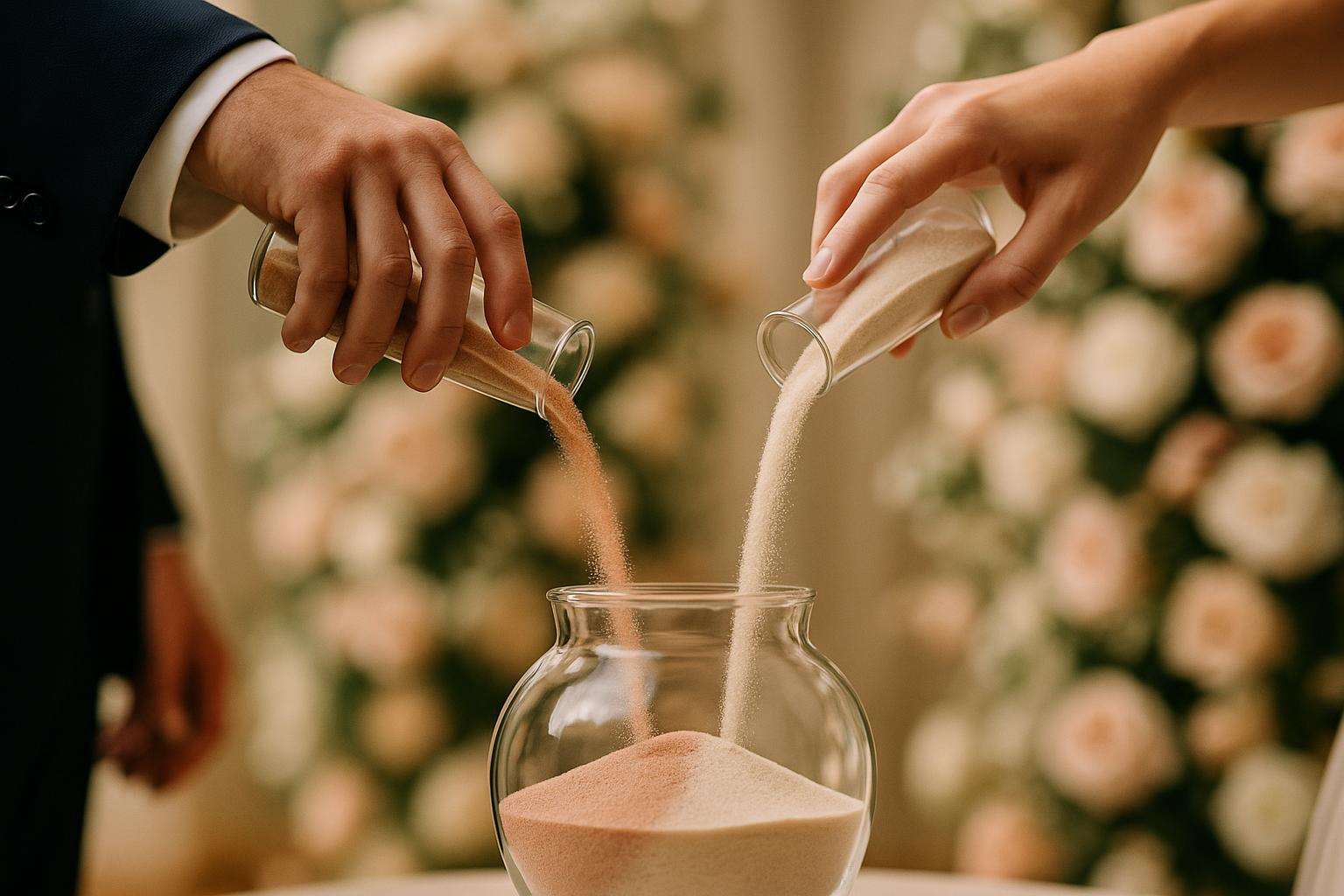
The sand ceremony is both visually beautiful and deeply practical. Each partner (and optionally, children or parents) pours differently colored sand from individual vials into a shared vessel, creating a layered pattern that cannot be separated once combined. The metaphor is powerful and explicit: two distinct lives, each with their own color and identity, permanently interwoven. The combined vessel — typically a glass jar, hourglass, or custom keepsake container — goes home with the couple and can be displayed in their home as a permanent reminder of the ceremony. The sand ceremony is at its most meaningful when children from a previous relationship pour their own color alongside the couple's — a visual declaration that this marriage includes them, that their color is woven into the new family's foundation. This is the most common reason couples choose sand over candle when they are blending families, and for this specific use case it is unmatched. One creative variation circulating in 2025–2026: using sand or glass crystals from places of personal significance — from the beach where you met, from both hometowns, from a place you traveled together. Another: sending the combined glass crystals to a glass-blowing studio to be fused into a one-of-a-kind art piece. Any colored sand works; craft stores and Etsy offer wedding ceremony sand kits starting around $15.
Strengths
- Ideal for outdoor ceremonies — no flame risk
- Most meaningful unity ritual for blended families with children
- Creates a permanent keepsake displayed in the home
- Children's participation can be deeply meaningful and moving for guests
Weaknesses
- The visual effect depends on the vessel quality — a cheap plastic container undermines what could be a beautiful keepsake; invest in a glass or crystal vessel
- Best for
- Best for outdoor weddings and blended families with children
- Pricing
- $20–$80 for a kit; custom engraved vessels $60–$180
Source: Robyn Ashley Weddings
Handfasting
Best for couples seeking an ancient ritual with modern resonance
Handfasting is among the oldest recorded marriage rituals in the Western world, with origins in pre-Christian Celtic culture. The phrase 'tying the knot' comes directly from this practice. In a handfasting ceremony, the couple's clasped hands are bound together with cords or ribbons by the officiant — often with a spoken blessing for each cord or wrap. The resulting bound hands are held aloft for the gathered community to witness. After the ceremony, the cords are kept as a keepsake representing the binding of the union. Handfasting has seen a significant rise in popularity in 2024–2026 as couples seek ceremony elements that feel both ancient and distinctly personal — rooted in something real, not invented. It is appropriate in secular, pagan, Wiccan, Celtic-heritage, and many interfaith ceremonies, and can be adapted to virtually any ceremony structure. The cords themselves are a meaningful design decision: custom braided cords incorporating the couple's wedding colors, a cord made from fabric with personal significance (a piece of a grandmother's wedding dress, a worn flannel shirt), or simple ribbon in the ceremony palette all carry different emotional weight. The ritual typically adds four to eight minutes to ceremony length depending on how many cords and blessings are incorporated. Custom handfasting cords on Etsy range from simple ribbon sets to elaborately braided cord sets with personalized pendants or charms.
Strengths
- Genuinely ancient — rooted in pre-Christian Celtic history with real cultural depth
- Creates a physically memorable and visually dramatic ceremony moment
- Highly adaptable: works in secular, pagan, Celtic, interfaith, and many religious ceremonies
- Custom cords become a lasting keepsake
Weaknesses
- Adds 4–8 minutes to ceremony length; plan the timing carefully with your officiant to maintain emotional momentum
- Best for
- Best for couples seeking an ancient ritual with modern resonance
- Pricing
- $15–$75 for ribbons or cords; custom braided cords $40–$150
Source: Wedgewood Weddings
Wine Box Ceremony (Time Capsule)
Best for couples who love the idea of a gift to their future selves
The wine box ceremony transforms the unity moment into a gift addressed to the couple's future — specifically, to the version of themselves they will be at a milestone anniversary. Before the ceremony, each partner writes a private love letter to the other and selects a bottle of wine together. During the ceremony, both partners seal the letters and the wine inside a wooden box, which is then locked or nailed shut by the couple together as a ritual act. The box is opened at a chosen anniversary milestone — commonly the fifth, tenth, or twentieth year — when the couple sits together, opens the wine, and reads the letters they wrote on their wedding day. The emotional depth of this ritual comes from its deferral: the words written on your wedding day become a conversation between the person you were and the person you have become. An important practical note: the box should be sealed with food-safe materials and stored in a cool, dark location. Some couples also invite close family members to include notes or small mementos, expanding the time capsule into a family artifact. The wine box ceremony adds approximately three to five minutes to ceremony length and requires the box to be built and assembled before the wedding day.
Strengths
- Creates a ceremony gift to your future selves that deepens in meaning with time
- Involves a deliberate, joint act (sealing the box) that is visually ceremonial
- Can include family contributions, expanding the keepsake's emotional richness
- Works in all ceremony types — religious and secular
Weaknesses
- Requires pre-ceremony preparation (building and sealing the box); the bottle of wine must be selected and letters written before wedding week — not suitable for last-minute addition
- Best for
- Best for couples who love the idea of a gift to their future selves
- Pricing
- $30–$120 for a wooden keepsake box; wine $15–$60
Source: The Knot
Ring Warming Ceremony
Best for intimate ceremonies where guest participation is meaningful
The ring warming ceremony is one of the most communally resonant unity rituals available — and one of the most powerful for intimate ceremonies where each guest in the room is someone the couple genuinely loves. Before the ring exchange, the rings are placed in a small pouch, a velvet bag, or a nest of flowers and passed gently through the assembled guests. Each person holds the rings briefly, infusing them with a private wish, a prayer, or a silent blessing for the marriage. After traveling through the entire room, the rings are returned to the best man or ring bearer and exchanged at the altar — now carrying the wishes of every person who loves the couple, physically embedded in the metal before it touches their hands for the first time. The ring warming is most effective for ceremonies under 80 guests — it loses both practical manageability and emotional intimacy in large crowds, where the rings must pass too quickly to allow genuine reflection. For the right ceremony, it is deeply moving. Provide guests with a small printed card or program note explaining the ritual before it begins, and have your officiant guide the room through a moment of shared silence while the rings travel.
Strengths
- Transforms every guest from a passive witness to an active participant in the ceremony
- The rings carry the wishes of the entire community into the exchange — a beautiful ongoing symbol
- Requires minimal materials — just the rings, a pouch, and an officiant explanation
Weaknesses
- Only works well for ceremonies under 80 guests; larger crowds make the logistics impractical and dilute the intimacy
- Best for
- Best for intimate ceremonies where guest participation is meaningful
- Pricing
- $5–$30 (velvet pouch or flower nest to pass the rings)
Source: Robyn Ashley Weddings
Cord of Three Strands
Best for Christian and Evangelical ceremonies seeking a faith-rooted ritual
The cord of three strands is drawn from Ecclesiastes 4:12 — 'A cord of three strands is not quickly broken' — and is one of the fastest-growing unity ceremonies in Evangelical and non-denominational Christian weddings, having overtaken the unity candle as the most requested ritual in many Southern and Midwestern communities. The ritual involves three cords (representing the husband, the wife, and God or faith) braided together by the couple during the ceremony. The braiding itself — requiring cooperation, coordination, and an intentional joining of hands and purpose — becomes a visual metaphor for the marriage they are building. The finished braid is kept as a keepsake and often displayed in the couple's home or framed alongside a print of the Ecclesiastes verse. Custom cord of three strands sets are widely available through Christian wedding vendors, Etsy, and faith-based gift shops. Kits typically include three pre-cut cords in the couple's wedding colors, a stand or frame for display, and printed instructions for the officiant. The ceremony adds three to six minutes to the service and can be incorporated naturally into any Protestant or non-denominational ceremony structure.
Strengths
- Rooted in specific scripture — spiritually meaningful for Christian couples in a way generic rituals are not
- Fastest-growing unity ritual in Evangelical communities; culturally resonant
- The physical act of braiding is collaborative and visually legible
- Creates a lasting keepsake that references the theological meaning of the marriage
Weaknesses
- Specifically Christian in symbolism — not appropriate for interfaith, secular, or non-Christian ceremonies
- Best for
- Best for Christian and Evangelical ceremonies seeking a faith-rooted ritual
- Pricing
- $20–$60 for a cord of three strands kit
Source: The Knot
Tree Planting Ceremony
Best for nature-loving couples and outdoor or garden ceremonies
In the tree planting ceremony, the couple (and often their families or children) plants a sapling together, combining soils from each partner's hometown, family property, or a meaningful place. The act of planting something living — something that requires care, grows slowly, and deepens its roots over years — is among the most resonant metaphors available to any ceremony. The planted tree goes home with the couple and is tended together as part of their shared life; some couples move it into the ground at their permanent home when they establish one. This ceremony works beautifully for outdoor and garden weddings where a planted sapling is contextually natural, and for environmentally minded couples for whom sustainability and living things carry personal significance. It also works powerfully when children from a blended family participate — each child pouring a different soil into the pot creates the same inclusive symbolism as the sand ceremony in a more tactile, living format. The practical preparation: bring a pot, a small sapling (a tree with personal significance — an apple tree from her family's property, a cherry tree from a region connected to his heritage), and soil from the two significant locations. A small trowel as a prop handles nicely in ceremony photographs.
Strengths
- The planted tree becomes a living symbol that grows alongside the marriage
- Works beautifully for blended families when children participate in soil pouring
- Ideal for outdoor, garden, and vineyard settings
- Environmentally resonant — aligns with sustainability-minded couples' values
Weaknesses
- Requires logistical preparation before the wedding; the couple must have a plan for where the tree will be planted after the ceremony
- Best for
- Best for nature-loving couples and outdoor or garden ceremonies
- Pricing
- $30–$100 (pot, sapling, soils, trowel)
Source: Wedgewood Weddings
Rose Ceremony
Best for ceremonies honoring the families of origin
In the rose ceremony, the couple presents roses to each set of parents — typically a single long-stem rose to each mother — as their first act as a married couple, before turning to exchange roses with each other as their first gifts to one another in the marriage. The gesture is simultaneously backward-facing (honoring the families that shaped them) and forward-facing (inaugurating the practice of giving to each other). It is tender, brief, and universally legible across every guest demographic. The rose ceremony works particularly well when the couple has a close relationship with their parents and wants to make that acknowledgment visible and ceremonial. It can be adapted for grandmothers, stepparents, or other significant adults who shaped the couple's lives — four roses instead of two, or a small arrangement presented to each set of parents together. At its simplest, the rose ceremony requires four to six long-stem roses wrapped in a small bow and placed near the altar in advance — the entire ritual takes three to five minutes and costs almost nothing. It requires no special materials beyond the flowers themselves.
Strengths
- Explicitly honors both families in a ceremonial, memorable way
- Simple, brief, and requires no special equipment beyond the roses
- Universally understood and emotionally clear for all guests
- Can be adapted to honor stepparents, grandparents, or other significant adults
Weaknesses
- Relatively brief and simple — for couples wanting a ritual with longer duration or greater visual drama, another option will feel more substantial
- Best for
- Best for ceremonies honoring the families of origin
- Pricing
- $15–$40 for four to six long-stem roses
Source: Robyn Ashley Weddings
Community Vow (Collective Witness)
Best for secular ceremonies that want communal weight without religious framing
The community vow is not a traditional unity ritual in the physical-object sense — but it is increasingly one of the most emotionally powerful additions available to a secular ceremony. After the couple exchanges their personal vows, the officiant turns to the assembled guests and asks them to make a communal commitment: 'Will you, the family and friends gathered here, offer your love, your support, and your presence to [Name] and [Name] in the years ahead? If so, please say: we will.' The response — a room full of people who love the couple saying 'we will' in unison — transforms passive observers into active participants and gives the ceremony the communal weight that religious ceremonies achieve through congregational prayer. It is particularly effective for interfaith and secular ceremonies where guests represent diverse faith backgrounds, because the language requires no religious affiliation while still invoking genuine collective commitment. The community vow adds approximately two minutes to ceremony length, requires no materials, and costs nothing. The only requirement is an officiant willing to facilitate it and language written into the ceremony script in advance.
Strengths
- Transforms every guest from a spectator into a participant in the marriage
- Requires no materials, no advance preparation beyond the script, and no cost
- Gives secular and interfaith ceremonies the communal dimension that religious ceremonies achieve through prayer
- Two minutes of ceremony time with outsized emotional impact
Weaknesses
- Effectiveness depends entirely on the officiant's delivery and the language chosen; a flat or rushed community vow lands poorly — brief rehearsal with your officiant is essential
- Best for
- Best for secular ceremonies that want communal weight without religious framing
- Pricing
- $0
Source: Wedgewood Weddings
Beverage Blending Ceremony
Best for couples who want a joyful, personalized, and unexpected unity moment
The beverage blending ceremony is a playful and personal adaptation of the sand ceremony that replaces colored sand with meaningful drinks. The couple pours two separate beverages — wine from their favorite vineyard, cocktails that represent each of their personalities, cold brew coffee from their shared morning routine — into one vessel, then raises it together and takes a shared sip of the combination they have created. The symbolism mirrors the sand ceremony (two distinct flavors becoming something neither could be alone) but adds a dimension of immediate sensory experience and, often, genuine humor that makes the room laugh and relaxes the emotional register of the ceremony in a way few rituals can. The beverage blending ceremony is at its best when the two drinks chosen have a personal story — a wine from the vineyard where they got engaged, a gin that references a shared travel memory, a tea that connects to a family tradition. The variation most commonly executed: white wine and red wine poured together to create a rosé, then shared as a toast. For non-alcohol ceremonies, sparkling juices, flavored sodas, coffee and cream, or tea blends work equally well and can carry the same personal specificity.
Strengths
- Creates a joyful, sensory, and often humorous ceremony moment that releases tension beautifully
- Highly personalizable to a specific shared drink, memory, or tradition
- Works for alcohol-free ceremonies with adapted beverages
- Minimal cost and preparation required
Weaknesses
- The shared sip element requires willingness to drink in front of guests; not ideal for couples who are camera-shy about eating or drinking during the ceremony
- Best for
- Best for couples who want a joyful, personalized, and unexpected unity moment
- Pricing
- $15–$50 (beverages + two serving vessels + one shared vessel)
Source: The Knot
Frequently asked
How long does a unity ceremony take?
Most unity rituals add three to six minutes to your ceremony length. The ring warming at a large ceremony can take longer if rings must travel through many rows. Handfasting with multiple cords and blessings can extend to eight to ten minutes. The community vow takes approximately two minutes. When planning your ceremony timeline, add the full estimated duration of your chosen ritual to the ceremony length before presenting it to your officiant — experienced officiants can then pace the surrounding elements to maintain emotional momentum and keep the overall ceremony within your desired length. The most common pacing mistake is placing the unity ritual too early in the ceremony, before the emotional build of the vows has been completed. The ideal placement is after the vow exchange and ring exchange, before the pronouncement — when the emotional energy of the ceremony is at its peak.
Can we include more than one unity ritual?
Generally no — and the research from professional officiants and wedding planners is consistent on this point. One well-chosen unity ritual, thoroughly explained and given its full emotional due, creates a powerful and memorable ceremony moment. Two rituals back-to-back create a pacing problem: guests begin anticipating when the ceremony will move forward rather than resting inside the experience. The only exception is a brief community vow combined with one physical ritual — the community vow adds only two minutes of spoken language and does not compete with a sand ceremony or handfasting for attention or emotional space. For couples who are genuinely drawn to multiple rituals, choose the one that is most meaningful to both of you and do it completely — a ring warming done with a story, with adequate time for every guest to hold the rings, with explained meaning and a quiet moment of collective intention, is worth more than three abbreviated rituals.
Do unity ceremonies work in religious ceremonies?
Yes, with the important caveat that religious ceremony frameworks vary in how much flexibility they permit. The Catholic Rite of Marriage permits optional unity rituals as long as they do not interrupt or replace required liturgical elements; the unity candle is the most common addition and is explicitly permitted. Most Protestant denominations allow couples to choose their unity ritual freely with pastoral approval; the cord of three strands has specific theological grounding that resonates in Evangelical and non-denominational contexts. Eastern Orthodox and Orthodox Jewish ceremonies have more fixed structures that leave limited room for additional rituals. Always confirm any unity ritual addition with your officiant or priest well before the ceremony — some additions require approval several weeks in advance, and some venues have physical constraints (no open flame, limited space at the altar) that affect which rituals are possible.
What should the officiant say during the unity ritual?
Your officiant should explain the ritual's meaning before it begins — not after, and not assumed. Guests who do not understand what they are witnessing cannot be moved by it. A brief, warm two to three sentence introduction from the officiant before the ritual begins is the most important preparation step, and it should be written into the ceremony script rather than improvised on the day. For example, before a handfasting: 'The phrase tying the knot comes from this ancient Celtic tradition. These cords represent the binding of two lives into one — a knot that grows stronger with every tug rather than loosening with time.' For a community vow: 'A marriage is not made only by the two people at this altar. It is held in place by everyone in this room. I am going to ask you all to make a promise of your own.' Ask to review your officiant's planned language for the unity moment at least one month before the ceremony.
Should we involve our families or children in the unity ceremony?
For couples with children from previous relationships, family inclusion in the unity ritual is one of the most meaningful wedding decisions available. The sand ceremony is the most natural format for children's participation — each child pours their own color alongside the couple's, visually weaving them into the new family structure in a way that is clear, dignified, and moving for every guest in the room. The tree planting ceremony offers a similar inclusive format. For parents, the unity candle's tradition of having mothers light the individual tapers is the most established form of family inclusion. If neither parent is present or if the family dynamics are complex, a private ring warming shared only with immediate family before the ceremony — or during a first-look moment — provides inclusion without ceremony logistics. Whatever you choose, involve the family members in rehearsal so the logistics are clear and the moment is not undermined by uncertainty about where to stand or what to do.