Ceremony & Vows
Wedding Processional Order: Who Walks When, and Why It Matters
The processional is the emotional opening of your ceremony — every guest will witness it together in real time. Here is the complete guide to processional order across Christian, Jewish, Catholic, and modern ceremony traditions, with timing, etiquette, and variations for every family situation.
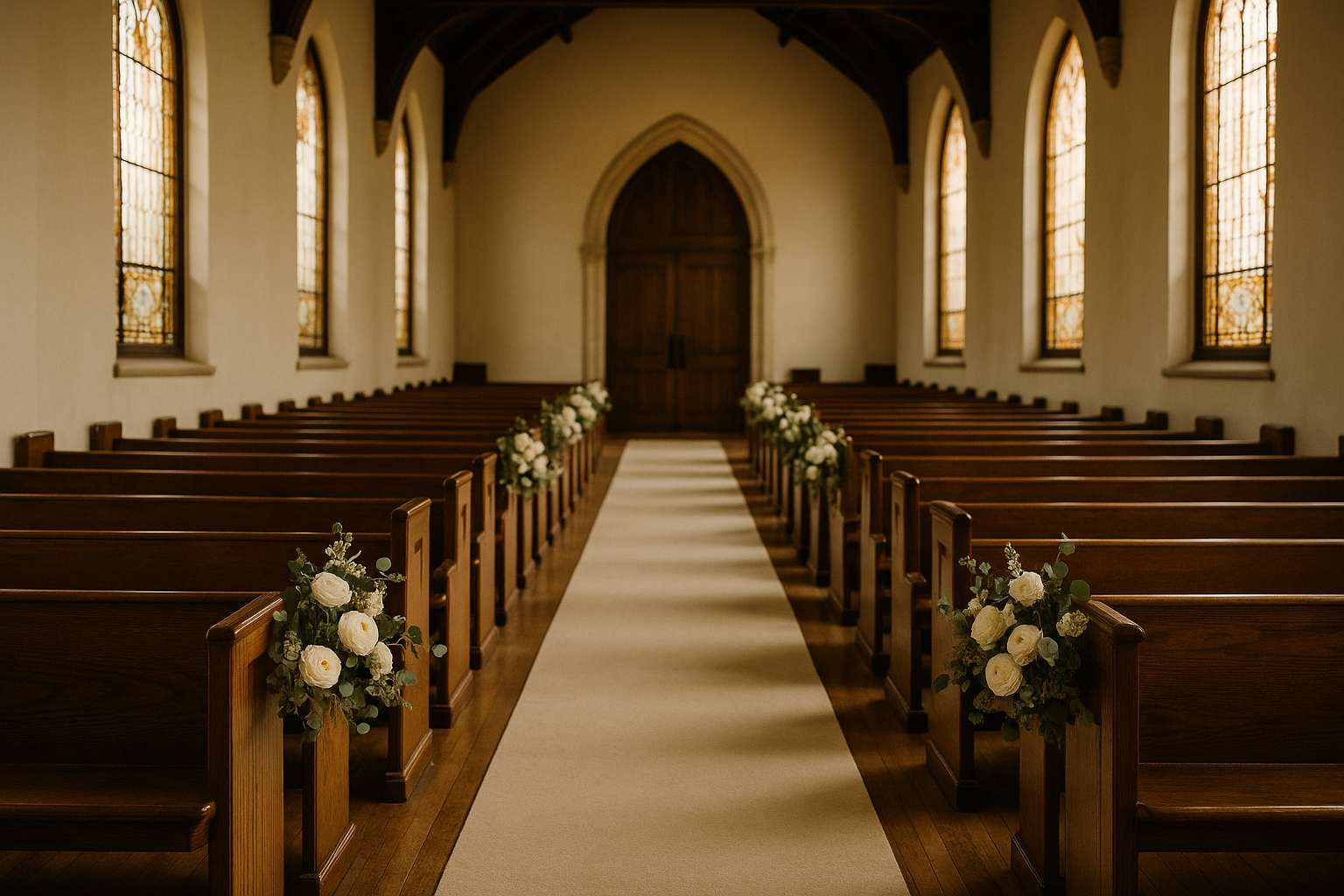
In a traditional Christian processional, grandparents and parents enter first, then attendants, then the maid of honor, then flower girl and ring bearer, and finally the bride. Jewish processionals have both sets of parents escort their child to the altar. Modern ceremonies increasingly see couples entering together. The processional typically takes three to seven minutes.
The wedding processional is the only moment of your entire celebration that every single guest experiences together, in real time, with no possibility of distraction. The cocktail hour is mingling. The reception is movement. But the processional — from the first usher's arm offered to the first grandmother to the final step of the bride's walk — holds the room in a shared, sequenced attention that will not come again.
Getting the order right matters more than most couples realize. A misstep — a grandparent walked to the wrong row, a family member seated on the wrong side, the groom's mother seated after the bride's when protocol says otherwise — sends a signal. It communicates, however unintentionally, that someone was not thought of. The correct processional order is not bureaucratic formality; it honors the relationships in the room by acknowledging who holds what place in the couple's life.
This guide covers the processional from first guest to altar — across multiple ceremony traditions — with every detail you need to brief your ushers, musicians, and wedding party for a flawless opening act.
What is the traditional Christian wedding processional order?
The traditional Christian (including nondenominational, Protestant, and most civil-religious) processional builds emotional anticipation row by row, always reserving the most powerful entrance for last. The sequence, as Minted's complete processional guide and The Knot's tradition breakdown both confirm:
- Officiant — takes their position at the altar before the processional begins, often entering from the side or sacristy
- Groom — enters from the side with his best man, or walks to his position accompanied by both parents; takes his place at the altar and faces guests
- Grandparents — escorted by an usher or family member to reserved front-row seats; groom's grandparents seated first, then bride's grandparents
- Groom's parents — escorted to their reserved seats
- Bride's mother — escorted last among seated family; her seating signals that the processional is imminent
- Groomsmen and bridesmaids — walk in pairs or individually, typically in reverse seniority order (less senior attendants enter first)
- Maid or matron of honor — last bridesmaid to walk; highest attendant honor
- Ring bearer — follows the maid of honor
- Flower girl — immediately precedes the bride; her presence signals the bride is about to enter
- Bride — accompanied by her escort, to a change in music; guests rise when the music shifts
The music shift for the bride's entrance is not optional — it is the cue guests use to stand, turn, and be ready. Coordinate the exact transition point with your musicians or DJ in advance.
How does the processional differ by tradition?
| Tradition | Who Escorts the Bride | Groom's Entrance | Parents' Role | Notable Distinction |
|---|---|---|---|---|
| Protestant / Nondenominational | Father, or both parents, or chosen escort | Enters from side with best man before processional | Seated before bridesmaids walk | Seating of bride's mother signals ceremony start |
| Catholic | Traditionally father; variations accepted | Enters from side; takes altar position first | Formally escorted and seated; groom's mother seated before bride's | Seating of mothers is a named, recognized ceremonial moment; priest enters separately from sacristy |
| Jewish | Both parents escort the bride | Groom walks escorted by both his parents | Both sets of parents walk their child down the aisle and stand under the chuppah | Both families visually present throughout; reflects that marriage unites two family units |
| Hindu | Escorted by maternal uncles (mama) in most North Indian traditions | Baraat procession of groom and his family to the venue; may take 20–45 minutes | Both families participate in Milni (formal greeting) at the venue entrance before the bride appears | Timing governed by muhurt (auspicious time) determined by the pandit; hard scheduling constraint |
| Modern / Secular (2026) | Bride walks alone, or couple enters together | Groom and bride enter simultaneously in many contemporary ceremonies | Optional; may be seated in advance or walk with children as family unit | Couples entering together is now mainstream in nonreligious ceremonies; reflects partnership equality |
What are the most common processional mistakes and how do you avoid them?
The processional is the primary reason for having a wedding rehearsal. These mistakes are avoidable with advance preparation:
No written processional order distributed to ushers, musicians, and the officiant. Verbal briefings are forgotten under pressure, especially when the ceremony day arrives and emotions run high. Create a one-page document naming every person in the processional, their position in the sequence, and the music cue for each entrance. Print three copies: one for the officiant, one for the musicians or DJ, one for the day-of coordinator or head usher.
Flower girls and ring bearers positioned too early. Young children — particularly those under five — do not wait well. The longer they stand in a formal processional position before it is their turn, the higher the risk of a meltdown, a sudden sprint, or a sit-down protest. Position young children just before the bride's entrance — the shortest possible wait. Have a parent or familiar family member stationed at the end of the aisle to encourage them forward and retrieve them immediately after their walk. Professional officiant Lisa Pote recommends keeping young children with a wrangling parent at the back of the aisle until their cue rather than staging them in the wings.
Music that ends before the bride reaches the altar. Brief your musicians to loop or extend the processional piece. The music should sustain until the bride is fully in position — never cut while she is still walking. This coordination requires rehearsal, not assumption.
No plan for row dismissal during the recessional. After the ceremony concludes and the couple processes out, someone must manage the orderly dismissal of guest rows. Without this, 150 people surge the aisle simultaneously and block exit photos. Designate one usher explicitly to manage row dismissal from the front, one row at a time.
Insufficient buffer time between guest arrival and processional start. Build a minimum of five to ten minutes of cushion between the stated ceremony start time and the actual processional begin. Guests arrive late, parking is unpredictable, and starting the processional with guests still filing in is entirely avoidable. Let ushers know to seat the last stragglers before signaling the musicians.
How do you handle special family situations in the processional?
The most emotionally complex processional decisions involve families that do not follow the tidy two-parent nuclear model — which, in 2026, describes the majority of families. A few principles:
Divorced parents. If the relationship is genuinely amicable, both parents can escort the bride together (one on each side) or each can walk separately. If the relationship is strained, the parent who primarily raised the bride typically has precedence as escort; a stepparent can be honored in another visible role — a reading, a designated seat of honor marked in the program, an acknowledgment from the officiant. Make your decision early and communicate it privately to each parent in advance.
Blended families with multiple parent figures. Some brides have a biological father, a stepfather who raised them, and a mother who remarried — each of whom holds a real parental role. Options: walk with two parents (one on each side), have the ceremony program acknowledge all parental figures by name, or ask the officiant to make a brief verbal acknowledgment during the welcome. The processional does not have to carry the entire weight of honoring all parental relationships; other ceremony moments can bear some of it.
Absent or deceased parents. An empty reserved seat with flowers, a symbolic candle, or a brief program note is a graceful acknowledgment. Walking alone as a tribute to an absent parent — rather than asking someone to stand in — is increasingly common and widely understood as deeply meaningful. No explanation to guests is required.
The processional is, at its heart, a choreography of love — an ordered arrival of everyone who has contributed to the moment that is about to unfold at the altar. When it is well-prepared, guests experience it as effortless. When it is unrehearsed, the mechanics show. Prepare it with the same care you bring to every other element of your ceremony, and it will be precisely what it should be: the beginning of everything.
Frequently asked
Who walks down the aisle first in a traditional wedding processional?
In a traditional Christian or nondenominational processional, the sequence moves from least to most ceremonially significant, building emotional anticipation toward the bride's entrance. The officiant typically takes their position first, either entering from the side or already present at the altar. The groom often follows — entering from the side or walking to his position accompanied by the best man or both parents. Then grandparents are escorted to their reserved seats, followed by the groom's parents and then the bride's mother (whose seating signals the ceremony is imminent). Next come bridesmaids and groomsmen walking in pairs or individually, then the maid or matron of honor, then the flower girl and ring bearer, and finally the bride herself — the last and most emotionally weighted entrance. The bride's entrance is accompanied by a change in music, which cues guests to rise. Every element of this sequence is designed to build emotional anticipation, culminating in the bride's walk.
How is the Jewish wedding processional order different?
The Jewish wedding processional differs from the Christian tradition in a meaningful way: both sets of parents escort their own child down the aisle, reflecting the Jewish theological understanding that marriage unites two complete family units, not just two individuals. The typical Jewish processional order is: rabbi and cantor enter first; then grandparents of the groom are escorted to their seats, followed by grandparents of the bride; groomsmen walk, then the best man; then the groom walks escorted by both his parents; bridesmaids walk, then the maid of honor; then the ring bearer and flower girl; and finally the bride, escorted by both her parents. Both sets of parents then stand under the chuppah alongside the couple. This contrasts with the Christian tradition in which parents are typically seated before the processional begins, and only the bride is formally escorted. The shared parental escort is one of the most moving visual differences between Jewish and Christian ceremony aesthetics.
Can the bride walk herself down the aisle?
Yes, absolutely — and this choice is increasingly common, widely respected, and entirely appropriate in 2026. Walking yourself down the aisle is a meaningful statement of self-determination: you arrive as a whole person, choosing this marriage from your own agency, rather than being presented or given away by another. Many brides find it deeply moving to pause at the top of the aisle, take a breath, and walk the full length of the ceremony space alone with every eye on them. If you wish, you can still create a moment of ceremony at the beginning of the aisle — pausing, collecting yourself, letting the emotion of the room land — before beginning your walk. No escort is needed to make a powerful entrance. Alternatively, some brides walk in together with their partner, which is now mainstream in secular and nondenominational ceremonies, reflecting a partnership model rather than a presentation model. Both of these are not alternatives to tradition; they are new traditions being written right now.
What is the correct processional order for a Catholic wedding?
A Catholic processional follows the general structure of the traditional Christian processional, with several specific elements. The priest or deacon typically enters the sanctuary from the sacristy before the wedding party processional begins — often in procession with altar servers. The groom and his attendants then take their positions at the altar. The seating of the mothers is a recognized, formal moment in Catholic ceremony protocol: the groom's mother is escorted and seated first, then the bride's mother is seated last, serving as the signal that the processional is about to begin. Bridesmaids and groomsmen walk in pairs; the maid of honor is last of the attendants. The flower girl and ring bearer precede the bride. The bride is traditionally escorted by her father; contemporary variations (both parents, walking alone) are accepted and practiced across Catholic communities with pastoral sensitivity. The priest does not typically walk in this processional; the couple and wedding party process toward the already-positioned priest. Confirm specific liturgical preferences and processional protocol with your priest at your pre-wedding meetings.
How do we handle divorced or estranged parents in the processional?
Divorced parents in a processional require advance thought and, ideally, a private, gracious conversation with each parent before the wedding day. If the relationship between divorced parents is amicable, many couples have both parents escort the bride together — one on each side — or walk individually. If the relationship is strained, the parent who raised the bride (or the biological parent) typically takes the escort role; a stepparent can be honored in another visible way — a reading, a seat of honor designated in the program, a specific acknowledgment in the vows or officiant's address. The most important principle is to make your decision in advance and communicate it privately to each parent before the wedding — not to make an announcement at the rehearsal that surprises anyone. Most parents, when asked directly and with genuine love, are gracious. The awkwardness usually comes from avoidance rather than the conversation itself.
How long does the wedding processional typically take?
A typical wedding processional lasts three to seven minutes, depending on the size of the wedding party, the length of the aisle, and the pacing of the music. A small wedding with two attendants on each side and no grandparent escort may take as little as two to three minutes from the first person walking to the bride reaching the altar. A larger wedding with six pairs of bridesmaids and groomsmen, a formal grandparent escort, and a long aisle can easily take six to eight minutes. The bride's walk itself should be paced deliberately — slower than your natural walking speed, especially on grass, gravel, or any uneven outdoor surface. A good rule of thumb: practice your processional pace at the actual venue during the rehearsal, in your actual shoes or their height equivalent. This is one of the most commonly underestimated rehearsal elements and one of the most photographically significant moments of the entire ceremony.
What are the current 2026 trends in wedding processionals?
Several meaningful shifts are shaping wedding processionals in 2026. Couples entering together — both partners walking in simultaneously, often to the same song — has moved from countercultural to mainstream in secular and nondenominational ceremonies; it reflects a contemporary partnership model rather than a presentation model and is now one of the most commonly requested processional variations among nonreligious couples. Micro-processionals are growing among intimate weddings (under 50 guests): rather than a formal ushered sequence, guests are freely seated before the couple enters together or individually, creating a warm, dinner-party register rather than a theatrical one. Reverse seating — no bride's side or groom's side; ushers fill seats for balance and instruct guests to sit anywhere — is gaining traction for blended families and tight-knit social groups where the distinction feels arbitrary. Unplugged ceremony announcements during the seating phase, delivered by ushers or stated in the program, are now standard practice rather than an unusual request; couples are protecting the processional moment from phone interference as a matter of course.