Ceremony & Vows
Best Wedding Processional Songs of 2026: Classical, Modern & Unexpected
The processional is the most emotionally weighted musical moment of your ceremony — the song playing when you walk toward the person you are going to marry. Here are the picks worth knowing, from Bach to Einaudi to Ed Sheeran.
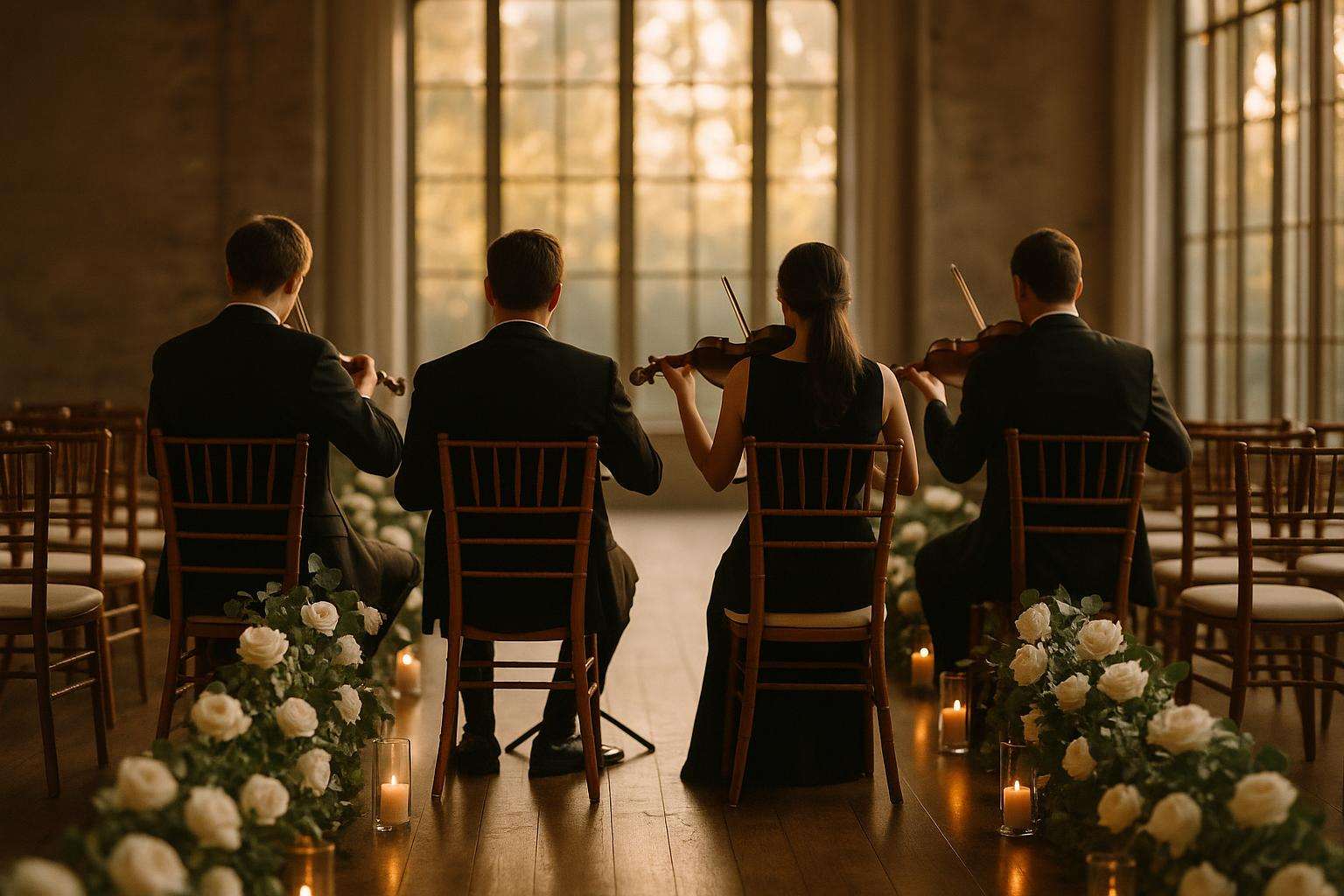
wedding processional songs 2026bride entrance musicceremony song ideasstring quartet weddingacoustic wedding songsclassical wedding music
The quick verdict
The music playing when you walk down the aisle will be remembered by every guest in the room. Here are the 2026 selections worth knowing — from timeless classical to contemporary acoustic.
- Best overall
- Canon in D — Pachelbel — Works in every venue, at every formality level and across every faith tradition; the reputation for overuse is greatly exaggerated in practice.
- Best value
- Can't Help Falling in Love (Kina Grannis acoustic) — Crosses generational lines, moves at a natural processional pace and creates genuine emotional response across diverse guest lists.
- Best for A modern, distinctive entrance
- Experience — Ludovico Einaudi — Cinematic and emotionally overwhelming; a signal of intentional music selection that few guests will have heard at a previous wedding.
How we evaluated
Songs selected based on booking frequency data from ceremony musicians and venues (2025–2026), cultural longevity, versatility across ensemble types, and emotional resonance reported by couples and planners. Faith-tradition appropriateness is noted where relevant.
- Booking frequency. How often U.S. ceremony musicians and venues report the piece being requested across the 2025–2026 wedding seasons.
- Ensemble versatility. Whether the piece holds up across solo piano, string quartet, organ, live vocalist and recorded-track formats.
- Tradition and formality fit. Appropriateness across faith traditions and formality levels, from cathedral Nuptial Mass to casual outdoor ceremony.
- Emotional register and pacing. Whether the tempo suits a natural walking pace and the piece builds appropriately for a bridal entrance.
Rating scale: Ratings are on a 1-5 scale, in half-point increments, reflecting overall suitability as a wedding processional.
Last verified .
At a glance
| # | Name | Rating | Best for | Pricing |
|---|---|---|---|---|
| 1 | Canon in D — Johann Pachelbel | 5.0 | ||
| 2 | Can't Help Falling in Love — Elvis Presley (or Kina Grannis cover) | 4.9 | ||
| 3 | A Thousand Years — Christina Perri | 4.8 | ||
| 4 | Jesu, Joy of Man's Desiring — Johann Sebastian Bach | 4.8 | ||
| 5 | Experience — Ludovico Einaudi | 4.9 | ||
| 6 | Perfect — Ed Sheeran | 4.7 | ||
| 7 | Trumpet Voluntary — Jeremiah Clarke | 4.6 | ||
| 8 | A Million Dreams — from The Greatest Showman | 4.6 | ||
| 9 | Spring (The Four Seasons) — Antonio Vivaldi | 4.5 | ||
| 10 | Clair de Lune — Claude Debussy | 4.5 |
Canon in D — Johann Pachelbel
The most-requested ceremony piece of the past two centuries. And for very good reason.
The Pachelbel Canon in D has been the default bridal processional for so long that it has occasionally been called overused — a critique that misses what makes it so enduringly effective. The piece builds with a deliberate, measured pace that matches the natural tempo of a processional; its harmonic structure creates a sense of anticipation that resolves beautifully without a jarring peak; and its familiar quality settles guests into the ceremony emotionally before the first vow is spoken. On a string quartet, it is luminous. On a solo violin with piano, it is intimate and warm. On an acoustic guitar arrangement, it becomes unexpectedly personal and modern. The Canon works in a grand cathedral, a garden, a beach ceremony, and a ballroom equally well. It is, after two hundred-plus years of bridal processionals, still the safest choice and often the most genuinely moving one. Couples who have heard it at a thousand weddings and dismissed it as cliché routinely hear it played live by a string quartet as the wedding party enters and find it perfect all over again. As The Knot notes, it remains among the top processional requests year after year.
Strengths
- Universal emotional resonance — guests of all ages and backgrounds recognize and respond to it
- Flexible tempo allows musicians to match the exact pace of the procession in real time
- Available in every ensemble format; no arrangement sounds wrong
Weaknesses
- Genuinely familiar to the point that some couples seeking a more personal or unexpected selection will prefer something less traditional
- Best for
- Pricing
Source: Wedding Processional Songs — The Knot · Visit Canon in D — Johann Pachelbel
Can't Help Falling in Love — Elvis Presley (or Kina Grannis cover)
Sweet and timeless. In Kina Grannis's acoustic version, it is something even more.
Elvis's 1961 original carries an almost mythological romantic weight — the unhurried melody, the declaration of surrender to love as something beyond reason or will. At weddings, it lands with a warmth that crosses generational lines: grandparents who have always loved Elvis, parents who know the version from the 2012 movie "Safe Haven," and younger guests who recognize Kina Grannis's acoustic cover from viral wedding aisle videos. Kina Grannis's stripped-down version — ukulele, soft vocals, no percussion — creates an intimacy in a live ceremony setting that the original does not. It moves at exactly the right pace for a processional: unhurried but not dragging, tender but not maudlin. According to Bella Bridesmaids' 2026 processional guide, it has given audiences the "Ahhhh" moment consistently since its viral wedding resurgence. If you choose this song, hire a live vocalist with acoustic guitar — the recorded version played through a speaker system does not produce the same emotional effect.
Strengths
- Crosses generational lines more effectively than any other processional song on this list
- The Kina Grannis cover is immediately recognizable from widely shared wedding videos, creating an additional layer of emotional association
- Simple enough for a solo vocalist to carry without an ensemble — ideal for intimate ceremonies with limited musician budgets
Weaknesses
- Extremely popular — couples seeking a more distinctive or personal selection may prefer something less frequently heard at weddings in recent years
- Best for
- Pricing
Source: 101 Best Wedding Processional Songs — Bella Bridesmaids · Visit Can't Help Falling in Love — Elvis Presley (or Kina Grannis cover)
A Thousand Years — Christina Perri
Written for Twilight, adopted by weddings everywhere, and now a ceremony standard.
Christina Perri wrote "A Thousand Years" for the final Twilight film in 2011, but its wedding life has now far outlasted its cinematic origin. The song's processional appeal is structural: the verse builds from piano and vocal to a lush, layered arrangement in the chorus, creating natural emotional escalation that maps beautifully onto the progression from wedding party to the bride's entrance. String quartet arrangements are extraordinarily popular — the melody carries powerfully on strings, and a skilled quartet can modulate the tempo and dynamics to match each moment of the procession in real time. The lyrical content ("I have died every day waiting for you / Darling, don't be afraid, I have loved you for a thousand years") resonates with couples who connect to its quality of patient, certain love. According to the 2025–2026 ceremony song rankings from The Barn at Green Garden Farm, it remains among the top five most-requested bridal entrance songs. Note for Catholic ceremonies: confirm with your music director whether the lyrical content is appropriate for liturgical use.
Strengths
- Natural dynamic arc maps perfectly onto wedding party entrance followed by bridal entrance
- Universally known but emotionally associated specifically with weddings and love rather than other occasions
- Available in instrumental arrangements that retain full emotional impact without lyrics
Weaknesses
- May not be permitted as-is in a Catholic Nuptial Mass — confirm with parish music director before planning
- Best for
- Pricing
Source: Top 50 Wedding Ceremony Songs for 2025 & 2026 · Visit A Thousand Years — Christina Perri
Jesu, Joy of Man's Desiring — Johann Sebastian Bach
Steady, luminous, and appropriate for every faith tradition. The second-most-requested classical piece.
Bach's "Jesu, Joy of Man's Desiring" occupies a unique position in the ceremony music repertoire: it is sacred without being exclusively denominational, joyful without being triumphant, and steady enough in its rhythm to support a procession at a reliable, unhurried pace. Its steady triplet flow — that rolling, continuous motion — creates a sense of both movement and calm simultaneously, which is a rare quality in processional music. It is the first choice of many ceremony musicians for brides who want the quality and weight of classical music without the ubiquity of the Pachelbel Canon. On organ, it fills a stone church with appropriate grandeur. On solo piano, it is intimate and warm. On a string quartet, it is breathtaking. It is universally approved for Catholic ceremonies and appropriate for Protestant, Episcopal, and non-denominational services alike. Couples with no particular faith connection also choose it frequently for its musical quality alone.
Strengths
- Universally appropriate across faith traditions; specifically approved for Catholic liturgical use
- Less frequently heard than the Canon, making it feel slightly more distinctive without being unfamiliar
- Works beautifully at multiple tempos — can be played more slowly for a longer bridal walk or more crisply for a shorter aisle
Weaknesses
- Less emotionally immediate for guests unfamiliar with classical music than more widely known pieces like Canon in D
- Best for
- Pricing
Source: Wedding Processional Songs — The Knot · Visit Jesu, Joy of Man's Desiring — Johann Sebastian Bach
Experience — Ludovico Einaudi
The modern classical standard. Cinematic, minimal, and emotionally overwhelming.
Ludovico Einaudi's compositions have quietly become the dominant contemporary classical option for wedding ceremonies — and "Experience" is the piece that appears most frequently. The Italian composer's style is minimalist in the best sense: simple melodic patterns that build through repetition and layering into something completely overwhelming. In a ceremony setting, "Experience" creates an atmosphere that is simultaneously intimate and cinematic — the kind of music that makes a moment feel both small and enormous at once. It works exceptionally well when the soloist has a long aisle to cover: the piece's steady build accommodates a two- to three-minute walk without the feeling of rushing or stalling. According to professional pianist Paul Fagan's 2026 ranking of top wedding entrance songs, Einaudi's compositions are "here to stay for weddings in 2025 and beyond." Note: as a contemporary composition, "Experience" requires a performance license (through ASCAP or BMI) for live public performance — confirm with your musician that they have appropriate licensing.
Strengths
- Produces an immediate, profound emotional response in audiences regardless of classical music familiarity
- Minimal and modern enough to feel personal without being esoteric
- Builds naturally from quiet to full — ideal for the transition from wedding party entrance to bridal entrance
Weaknesses
- Requires performance licensing as a contemporary composition; confirm with your musician before selecting
- Less appropriate for highly traditional or liturgical Catholic ceremonies — check with music director
- Best for
- Pricing
Source: Top 10 Wedding Entrance Songs 2026 — Paul Fagan · Visit Experience — Ludovico Einaudi
Perfect — Ed Sheeran
The modern anthem of certain, unadorned love. An acoustic version makes it fully ceremony-worthy.
"Perfect" has become the most-requested Ed Sheeran song at wedding ceremonies, and its appeal is easy to understand: the lyrical content is about looking at your partner and seeing exactly what you hoped to find. The verse — understated, conversational — builds to a chorus that opens emotionally in a way that matches the physical moment of the bridal entrance. An acoustic version (guitar and vocal) works beautifully in a ceremony; the full produced version with percussion and strings works better as a cocktail hour or reception piece. If you are considering this song, request a live acoustic performance rather than a recorded track — the live, in-the-room quality of a solo vocalist and guitarist transforms the emotional register entirely. It is appropriate for secular ceremonies and many non-denominational Christian services; check with your Catholic music director before including it in a Nuptial Mass. Ed Sheeran released "Perfect" in 2017 on the album Divide, and the song reached number one in both the United States and the United Kingdom, which is part of why nearly every guest recognizes it within the first few bars.
Strengths
- Immediately legible to every guest — lyrical content creates shared understanding of what the moment means
- Acoustic version is genuinely moving in a live ceremony setting
- Appropriate for a wide range of venue types from casual outdoor to elegant ballroom
Weaknesses
- Extremely well-known; couples seeking a more unexpected selection will find this one less distinctive
- Not appropriate for Catholic Nuptial Mass without music director approval
- Best for
- Pricing
Source: Top 50 Wedding Ceremony Songs for 2025 & 2026 · Visit Perfect — Ed Sheeran
Trumpet Voluntary — Jeremiah Clarke
Regal, ceremonial, and entirely appropriate for grand venues and formal ceremonies.
The Trumpet Voluntary — frequently misattributed to Henry Purcell but now correctly credited to Jeremiah Clarke — is the quintessential processional for a grand, formal ceremony in a historic or architecturally significant venue. It carries a sense of pageantry and official ceremony that no other piece matches; it was played at the wedding of Princess Diana and Prince Charles in 1981, among many royal occasions, and retains that quality of occasion. In a cathedral, ballroom, or historic estate, it is extraordinary — especially performed on a live trumpet with organ. In a casual outdoor or intimate setting, it is stylistically incongruent. Use this piece deliberately: if your venue has grandeur, the Trumpet Voluntary matches it beautifully. If your ceremony is intimate or informal, one of the other pieces on this list will serve you better. Jeremiah Clarke composed the piece, properly titled the Prince of Denmark's March, around 1700, and it remains a staple of the organ-and-trumpet repertoire performed at formal British state and royal occasions to this day.
Strengths
- Conveys a sense of occasion and historic ceremony that no other piece replicates
- Played live on trumpet, it fills a large space with energy and announces the moment unmistakably
- Entirely appropriate for Catholic, Episcopal, and high-church Protestant services
Weaknesses
- Stylistically appropriate only for grand, formal venues — can feel incongruous in casual or intimate settings
- Best for
- Pricing
Source: Wedding Processional Songs — The Knot · Visit Trumpet Voluntary — Jeremiah Clarke
A Million Dreams — from The Greatest Showman
Hopeful, soaring, and surprisingly moving when performed live.
"A Million Dreams" from the 2017 film "The Greatest Showman" has built a quiet but consistent presence in ceremony music since the film's release, and in 2025–2026 it has become a fixture on ceremony request lists. Its appeal lies in what it is about: the dreaming of a future together, the belief in something not yet built but deeply imagined. For couples whose relationship has involved real sacrifice or long-distance longing — or simply a shared sense of dreaming something into being — this song lands with personal specificity. Live piano or piano-and-vocal renditions are consistently cited as especially moving in ceremony settings. Instrumental versions on string quartet work beautifully. The piece builds from intimate opening to a full, soaring chorus, making it a natural choice for a bridal entrance with a longer aisle. The song was written by Benj Pasek and Justin Paul, the same songwriting team behind La La Land, and its steady, hymn-like build makes it especially forgiving for a processional that needs to stretch to cover a long entrance.
Strengths
- Lyrical theme of shared dreaming resonates with many couples' personal story
- Natural dynamic arc — quiet verse to soaring chorus — maps well onto a bridal processional
- Somewhat less ubiquitous than other contemporary selections, making it feel more personally chosen
Weaknesses
- Film association means some guests will mentally place themselves in a movie theater rather than fully in the ceremony moment
- Performance license required for live public performance
- Best for
- Pricing
Source: Top 50 Wedding Ceremony Songs for 2025 & 2026 · Visit A Million Dreams — from The Greatest Showman
Spring (The Four Seasons) — Antonio Vivaldi
Bright, celebratory, and perfectly matched to outdoor spring ceremonies.
Vivaldi's "Spring" from The Four Seasons is the most seasonally specific of all the classical processional selections — and when the season aligns, it is extraordinary. The bright, joyful energy of the opening violin passages communicates celebration and renewal in a way that arrives instantly rather than building gradually. It moves at a natural walking pace; it requires no warm-up to land emotionally; it produces genuine delight. For outdoor ceremonies in spring (March through early June) or summer, in gardens, vineyards, or estates with natural light, it is an ideal choice. For winter indoor ceremonies in stone churches, it creates a slight tonal mismatch — the music's brightness competes with the season's natural gravity. A string quartet performs it most authentically and most beautifully; a solo violinist can carry it well for more intimate ceremonies. Vivaldi published The Four Seasons in 1725 as part of a larger set of violin concertos, and "Spring" remains one of the most recognized pieces of Baroque music, instantly signaling celebration to even casual listeners.
Strengths
- Immediately joyful — guests smile when it begins, before the processional is even underway
- Exceptionally appropriate for outdoor garden, vineyard, or natural setting ceremonies
- No licensing required; public domain material
Weaknesses
- Strong seasonal association means it reads as tonally incongruent at winter or autumn formal indoor ceremonies
- Best for
- Pricing
Source: Wedding Processional Songs — The Knot · Visit Spring (The Four Seasons) — Antonio Vivaldi
Clair de Lune — Claude Debussy
The most quietly emotional piece in the classical repertoire. For intimate ceremonies only.
Debussy's "Clair de Lune" is not frequently discussed as a processional, which is part of what makes it such a distinctive choice. It is less a march and more a meditation — flowing, introspective, almost lunar in its quality of light. For a very intimate ceremony of under sixty guests, in a smaller chapel, garden, or private estate, played on solo piano, it creates an atmosphere of extraordinary tenderness. The bride walking toward the altar during this piece feels less like an entrance and more like a arrival — a quiet, certain homecoming. It does not work in large spaces where the piano cannot fill the room without amplification, and it does not work if you want a building, triumphant quality to your entrance. But for the couple who wants their ceremony to feel like a private, sacred moment that happens to have witnesses, it is genuinely unlike anything else on this list.
Strengths
- Highly distinctive — an unexpected choice that immediately signals intentionality and personal selection
- Creates an atmosphere of intimacy and tenderness that few other processionals achieve
- Extraordinary on solo piano; requires no ensemble or additional instrumentation
Weaknesses
- Not suited to large spaces or amplified ceremonies — requires intimate acoustics to land as intended
- Lack of rhythmic drive means it works better for shorter aisles; can lose momentum on very long processionals
- Best for
- Pricing
Source: 101 Best Wedding Processional Songs — Bella Bridesmaids · Visit Clair de Lune — Claude Debussy
Frequently asked
What is the difference between the wedding party processional and the bridal processional?
Most ceremonies use two distinct musical moments within the processional sequence. The wedding party processional covers the entrance of the groomsmen, bridesmaids, and any junior attendants — typically lasting two to four minutes. The bridal processional is the separate, emotionally weighted moment of the bride's own entrance, lasting one to three minutes. Using two different pieces for these two moments is standard practice and allows for meaningful distinction: a moderately paced, beautiful piece for the wedding party entrance, followed by the most carefully chosen, emotionally resonant piece for the bride's arrival. Many couples use one classical piece for the wedding party and a more personal contemporary selection for the bridal entrance, or escalate from a quieter, more intimate piece to a fuller, more triumphant one. Coordinate with your musicians at the rehearsal to confirm the transition point and the cue for the bridal piece.
Should we use live musicians or recorded music for the ceremony processional?
Live music for the ceremony processional is the single highest-impact music investment available to most couples, and worth prioritizing in the budget if at all possible. A string duo — violin and cello — costs $600–$1,200 in most U.S. markets and creates an atmosphere that recorded music, regardless of sound system quality, cannot replicate. The critical advantage of live musicians in a processional context is real-time adaptability: they watch the procession and adjust their tempo to match your pace and the flow of the aisle, hold notes during unexpected pauses, and respond to the emotional energy in the room. Recorded music requires precise cueing and cannot adapt. If budget is constrained, prioritize live music for the processional and recessional and use a playlist for the prelude. A solo acoustic guitarist or pianist at $400–$900 for the ceremony is a meaningful compromise that still delivers the warmth and responsiveness of live performance.
Can we play any song we want at a Catholic wedding processional?
No — and this is the most consequential music constraint most Catholic brides encounter. The USCCB guidelines require that music at a Catholic wedding, including within a Nuptial Mass, be sacred and appropriate to the liturgy. Purely secular love songs — even very beautiful ones — are not permitted during the Mass itself. Your parish music director is the authoritative voice on what is and is not permitted at your specific church. In practice, most classical instrumental pieces (Pachelbel, Bach, Vivaldi, Handel) are approved without issue. Contemporary Christian compositions appropriate to the liturgical context are typically approved. Contemporary secular love songs (Ed Sheeran, Christina Perri, Elvis) should be discussed with your music director before planning around them. Many directors will find creative accommodations — playing a piece instrumentally, or reserving a secular selection for the recessional — if you bring the conversation to them early and with openness.
How long should the bridal processional song be?
The bridal processional song should last as long as it takes the bride to walk the aisle at a comfortable, unhurried pace — typically ninety seconds to three minutes, depending on the length of the aisle. Before your ceremony, walk the aisle at the pace you intend to maintain (not faster than you would normally walk in a formal gown), and time it. This number tells your musicians how long the piece needs to last. For shorter aisles, choose a piece that works well even if only the opening section is played. For very long aisles (cathedral length), choose a piece with a genuine build — something like 'A Thousand Years' or Einaudi's 'Experience' — that rewards the full duration rather than feeling like it is repeating to fill time. Coordinate with your musicians at the rehearsal and walk the full aisle with music so everyone knows the pace and cues.
What is the difference between a processional and a recessional song?
The processional is the music played as the wedding party and bride walk toward the altar before the ceremony — typically tender, building, and emotionally weighted toward the moment of arrival. The recessional is the music played immediately after the pronouncement of marriage, as the newly married couple walks back up the aisle together — typically joyful, triumphant, and celebratory in energy. The emotional arc from processional to recessional is one of the ceremony's most satisfying design elements: music that moves from anticipation and tenderness to pure, exuberant joy. Classic recessionals include Beethoven's 'Ode to Joy,' Mendelssohn's 'Wedding March,' and — at Catholic and high-church Protestant ceremonies — jubilant hymns such as 'Joyful, Joyful, We Adore Thee.' Contemporary recessionals include Phil Wickham's 'House of the Lord,' Ben E. King's 'Stand By Me,' and — particularly beloved — any song the couple can genuinely imagine running down the aisle to.