Ceremony & Vows
What Is a Ketubah? The Jewish Marriage Contract Explained
The ketubah is two thousand years old, legally significant, spiritually foundational, and — in 2025–2026 — one of the most beautiful objects produced for any wedding. Here is everything you need to understand it, choose it, and honor it.
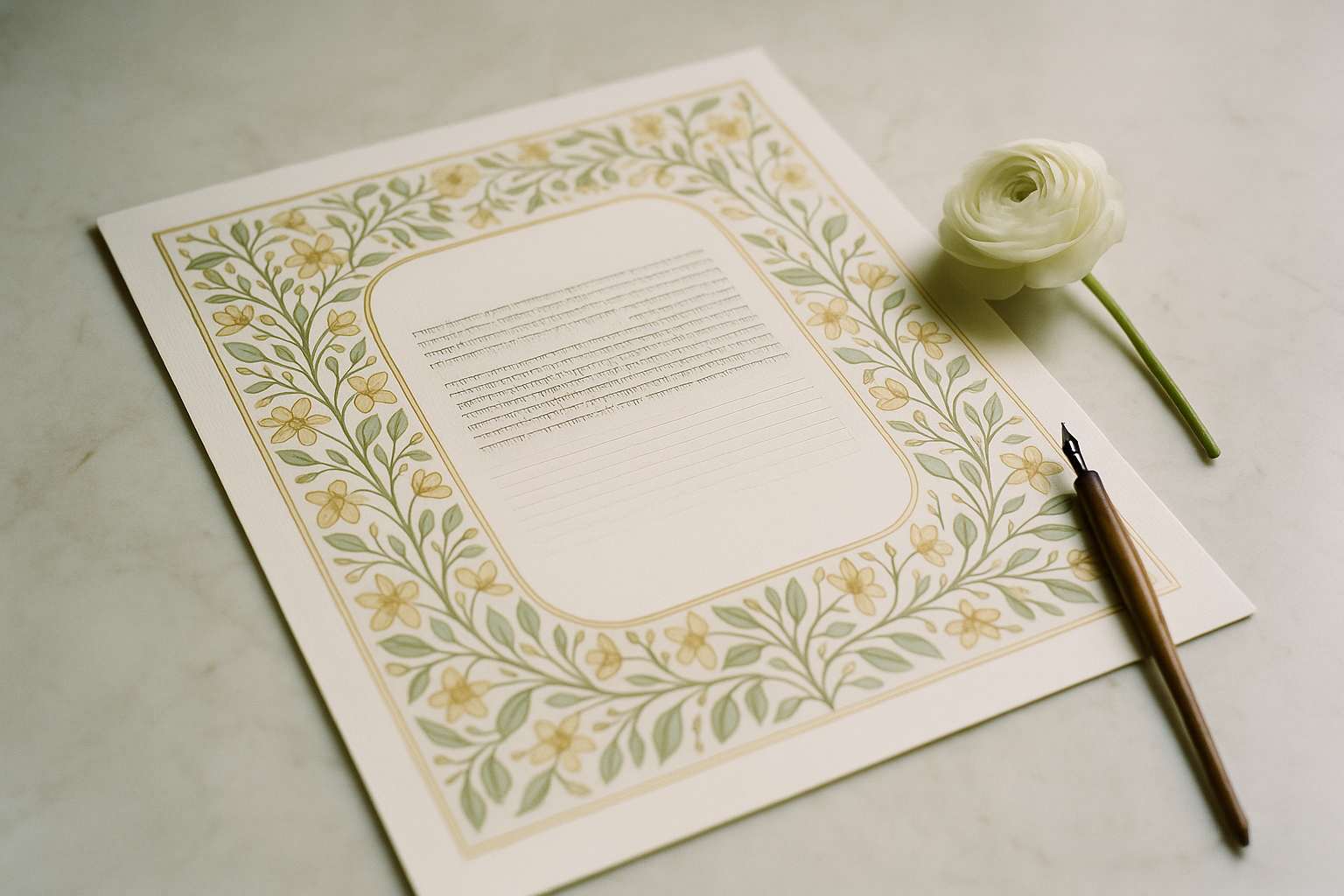
A ketubah is a Jewish marriage contract with origins dating to approximately 440 BCE and codified in the first century CE — it specifies the groom's commitments to his wife, is signed by two witnesses before the ceremony, and is read aloud under the chuppah. In 2025–2026, the ketubah is also one of the most beautiful and personally expressive objects a couple can commission for their wedding day.
A Jewish wedding involves many moving elements — the chuppah, the Sheva Brachot, the breaking of the glass, the hora. But of all of them, the ketubah holds a particular place: it is the only element that the couple will carry out of the ceremony and live with for a lifetime. It hangs on the wall of the home as a daily witness to the covenant made under the canopy.
Understanding the ketubah fully — its legal origins, its spiritual weight, its denominational variations, its modern design possibilities — is one of the most rewarding preparations a bride can make. Here is everything you need to know.
What Is the Ketubah, and Where Does It Come From?
The ketubah (כְּתוּבָּה) means, literally, "it is written." It is a marriage document specifying the obligations the groom undertakes toward his wife and, in the event of divorce or his death, what provision she would receive. According to the Babylonian Talmud, the ketubah was enacted by Simeon ben Shetach in the first century BCE so that it might not be a light thing for a man to divorce his wife — it was, in origin, a protective document for women at a time when they had few legal rights.
The earliest surviving ketubah, found in Egypt and written in Aramaic on papyrus, dates from approximately 440 BCE. An entire tractate of the Talmud — Ketubot — is devoted to describing its purpose, requirements, and legal implications. As Chabad's authoritative overview explains, the ketubah remains an official record of the Jewish marriage ceremony, listing the date, location, and names of both parties and their parents.
The earliest illustrated ketubahs originated in Venice in the late sixteenth and early seventeenth centuries, where Jewish communities began decorating the documents with arches, columns, and ornate botanical motifs — the beginning of the artistic tradition that has flowered into the extraordinary variety available today.
What Is Inside a Ketubah — and How Does It Vary by Denomination?
The content of the ketubah is not identical across all Jewish communities and denominations. The structure is consistent; the specific text and its level of customization vary significantly.
| Denomination | Text Language | Content Approach | Witness Requirements |
|---|---|---|---|
| Orthodox | Traditional Aramaic | Husband's obligations to wife; halachically fixed text | Halachically observant Jewish males; no blood relatives |
| Conservative | Aramaic + English; egalitarian addendum | Traditional text plus Lieberman clause or modern egalitarian version | Jewish adults; policy varies; confirm with rabbi |
| Reform | English, Hebrew, or bilingual | Contemporary mutual commitments language; highly customizable | Any adult witnesses; not required to be Jewish |
| Reconstructionist | English or multilingual | Fully egalitarian; may include personal vows | Any adult witnesses |
| Interfaith | Custom; often multilingual | May omit traditional legal language entirely; focuses on shared values | Per officiant's guidance |
According to My Jewish Learning's comprehensive overview, while many traditionally observant Jews continue to use the ketubah's original text, many liberal Jews have adapted the text to make it more gender-inclusive and mutually expressed. A wide variety of ketubah texts now exists, with many focusing less on legalities than on the couple's love and vision for their shared future.
What Happens at the Ketubah Signing — and How Do You Plan for It?
The ketubah signing is one of the most intimate and emotionally significant moments of the entire Jewish wedding — and one of the most frequently under-planned. It takes place twenty to thirty minutes before the ceremony, in a private room, with the two witnesses, the rabbi, and (in liberal ceremonies) both partners and close family.
What happens in sequence:
- Both witnesses read and verify the document
- In Orthodox ceremonies, the groom undertakes the obligations specified; in egalitarian ceremonies, both partners commit mutually
- The two witnesses sign (this is the halachically essential act)
- The rabbi signs
- In mutual-signing ceremonies, both partners sign
- The document is transferred to the chuppah for the ceremony
Planning requirements: confirm with your venue that a private room is reserved exclusively for this purpose during the signing window. Many venues default to using this room for other preparations. The room needs a table, adequate light, and a door — and it should be in your venue contract by name.
2025–2026 Ketubah Design Trends
The ketubah has experienced a genuine artistic renaissance, and 2025–2026 represents its highest-quality moment. The dominant design movements:
- Botanical illustration: Intertwining florals, olive branches, pomegranates, and Trees of Life in both traditional and contemporary palettes — the most enduringly popular direction
- Papercut art: Layered three-dimensional relief work in the tradition of Jewish paper-cutting, creating extraordinary depth and intricacy
- Modern minimalism: Clean geometric compositions in gold and cream, reading as gallery objects rather than ceremonial documents
- Bold classical symbolism: Hamsa, Star of David, and menorah incorporated into contemporary graphic frameworks
- Heirloom calligraphy: Scribal sofer-written ketubahs in the traditional manner, representing the most deeply traditional choice and a genuine lifetime keepsake
Ketubah Costs and Ordering Timeline
- Printed digital template: $50–$150
- Illustrated art-print ketubah: $250–$500 (most popular range)
- Handcrafted or commission-painted: $500–$1,500
- Traditional scribal calligraphy (sofer-written): $1,500–$3,500
- Framing (separate): $75–$400
Order no later than eight weeks before the wedding for illustrated and printed pieces. Scribe-written ketubahs require twelve weeks minimum. Rush fees are significant and quality sometimes suffers under compressed timelines. Commission the frame simultaneously — many couples intend to frame their ketubah after the wedding and never do. Pre-ordering the frame and assigning a family member to bring it to the reception for immediate display is the practical approach.
As the Library of Congress's cultural archive notes, ketubot are often hung prominently in the home by the married couple as a daily reminder of their vows — making the visual quality of the piece a genuine long-term investment, not simply a wedding-day detail.
Frequently asked
What does ketubah mean, and what does it contain?
The word ketubah (כְּתוּבָּה) comes from the Aramaic root meaning 'it is written' — a document, a written record. The traditional ketubah specifies the date and location of the wedding, the full names of the bride and groom and their parents, and the groom's obligations to his wife: historically, food, clothing, shelter, and conjugal rights. In contemporary liberal communities, these obligations are typically rewritten as a mutual covenant of partnership, love, and shared values. The document is signed by two witnesses (not blood relatives of either party) before the ceremony begins and is read aloud under the chuppah. In Orthodox tradition, the bride does not sign the ketubah; in Conservative, Reform, and Reconstructionist ceremonies, mutual signing is common. The ketubah is not a civil document in the United States — it holds civil legal standing only in Israel — but its spiritual and communal significance is profound and enduring.
Does the ketubah text have to be in Hebrew or Aramaic?
For halachic validity in Orthodox communities, the traditional Aramaic text must be used — this is non-negotiable and not open to personal customization beyond the insertion of proper names and dates. Conservative rabbis generally require either the traditional text or an approved egalitarian version (often the Lieberman clause, which adds a mutual commitment to the traditional framework). Reform and Reconstructionist rabbis accept essentially any ketubah text the couple chooses, including entirely English, bilingual, or wholly original texts. Interfaith couples frequently work with custom texts that omit specifically legal language in favor of poetic commitments in English or multiple languages. Confirm the requirements with your specific officiant early in your planning — this is the one element of the ketubah that is not a personal aesthetic choice for traditionally observant couples.
Who can be a ketubah witness?
In Orthodox and traditional Conservative ceremonies, witnesses must be adult Jewish men who are not blood relatives of the bride or groom and who are halachically observant. The two-witness requirement is not symbolic — it is legally necessary for the document's validity under Jewish law. In liberal Conservative and Reform ceremonies, adult Jewish men and women who are not blood relatives may serve as witnesses. Some contemporary progressive ketubahs include additional signature lines for mentors, chosen family members, or spiritual guides, adding a personal dimension beyond the two required legal witnesses. Confirm witness requirements with your rabbi before selecting yours — this can become a source of family tension if not addressed in advance, particularly in mixed-observance families.
When does the ketubah signing take place, and what is the ceremony like?
The ketubah signing (sometimes called the eidim, witnesses) takes place immediately before the ceremony begins, typically twenty to thirty minutes before the processional. The setting is typically intimate — a private room with the couple (in liberal ceremonies), the two witnesses, the rabbi, and close family. In Orthodox tradition, the bride is not present during the signing. In most Conservative and Reform ceremonies, both partners are included, making the signing one of the most emotionally significant private moments of the entire wedding day. The witnesses sign first; the rabbi or officiant signs; in mutual-signing ceremonies, both partners sign. The document is then carried under the chuppah and read aloud as part of the ceremony, publicly declaring its contents to the assembled community. Plan explicitly for this space in your venue contract — the signing requires a private room with a table and adequate lighting.
What should a ketubah cost, and when should I order it?
Budget according to the style and origin of the piece. Printed templates available from online Judaica retailers run $50–$150. Illustrated art-print ketubahs — the most popular category in 2025–2026, typically featuring botanical, geometric, or modern designs — range from $250–$500. Handcrafted or commission-painted pieces range from $500–$1,500. Traditional scribal calligraphy (sofer-written, entirely by hand in Aramaic) runs $1,500–$3,500 and represents a lifetime keepsake of the highest order. Add framing costs of $75–$400 separately. Order no later than eight weeks before the wedding for illustrated and printed pieces — rush fees are significant and quality sometimes suffers. For scribe-written ketubahs, allow twelve weeks minimum. Commission the frame simultaneously; many couples intend to frame their ketubah and never do.
What are the most important ketubah design trends for 2025–2026?
The ketubah has undergone a remarkable artistic renaissance over the past decade, and 2025–2026 represents the highest point of that evolution in terms of design quality and variety. The dominant trends: botanical illustration (intertwining florals, trees, vines — particularly the Tree of Life, pomegranate, and olive branch, all deeply rooted in Jewish symbolism) in both traditional and modern palettes; papercut ketubahs with layered three-dimensional relief, representing one of the most distinctively Jewish art forms; minimalist geometric compositions in gold and cream that read as contemporary luxury objects; and bold architectural designs incorporating classical Jewish symbols — the hamsa, Star of David, menorah — in fresh, gallery-worthy treatments. The trend toward displaying the ketubah as gallery art in the home has also shifted design preferences: couples choose pieces they want to live with for decades, not simply traditional documents.