Etiquette & Guests
Wedding Invitation Wording: The Complete Guide for Every Style and Scenario
Every scenario, solved. From the traditional host line to modern couples hosting themselves — with real wording examples for religious ceremonies, civil ceremonies, second weddings, divorced parents, same-sex couples, and more.
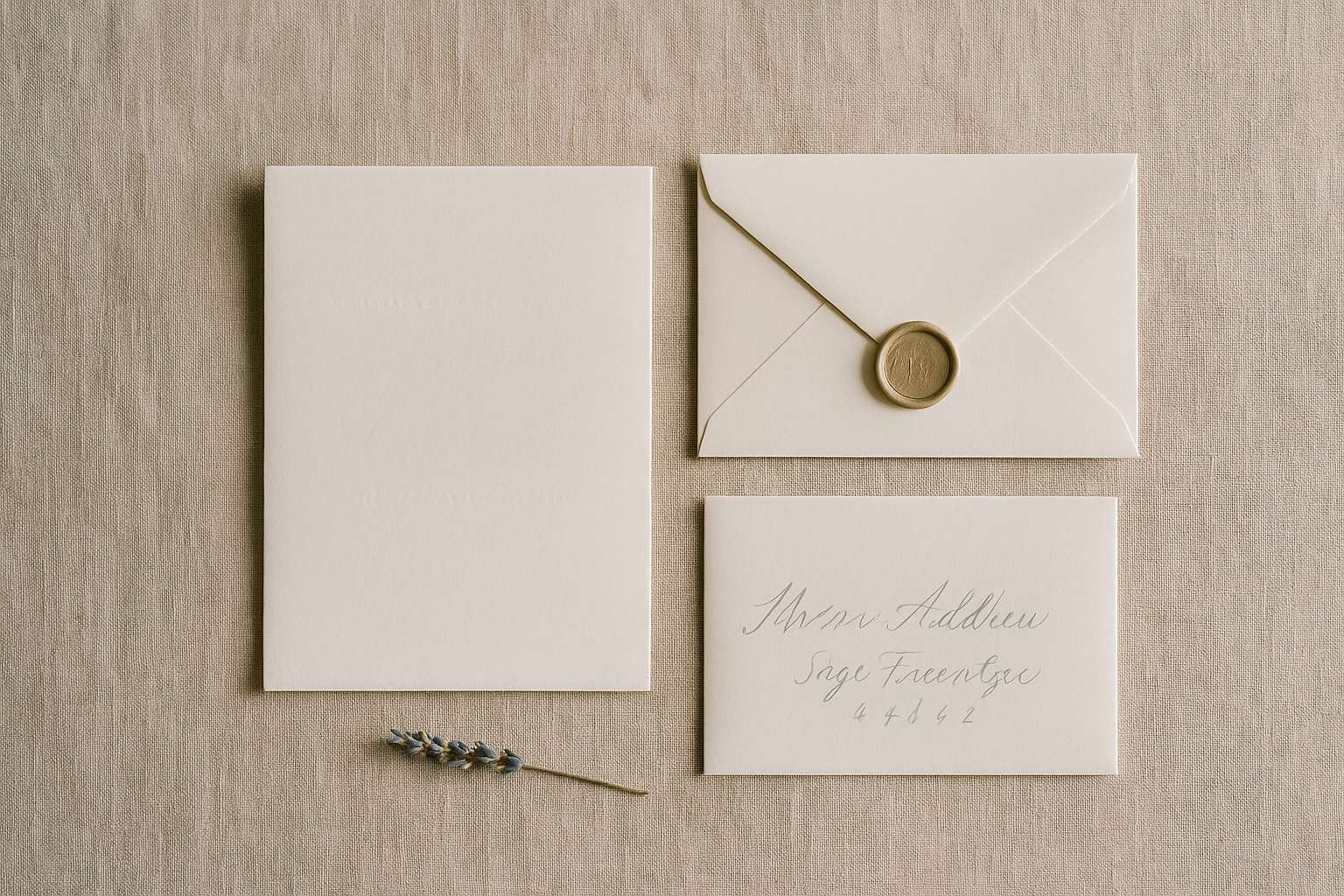
Wedding invitation wording follows a seven-part structure and a small set of enduring rules — 'honour of your presence' for religious ceremonies, 'pleasure of your company' for civil ones, no registry mention ever on the card. Every modern scenario from divorced parents to same-sex couples has a graceful traditional solution.
Your wedding invitation is the first physical artifact your guests will hold — and it does far more work than simply conveying logistics. It signals the formality of the event, the style of the celebration, and the thoughtfulness with which you have considered your guests' experience. A letterpress card with traditional wording and a calligraphed outer envelope communicates something entirely different from a digital invitation, even if both convey the same time and place.
The good news is that traditional wedding invitation wording is not especially complicated — it is a compact set of conventions with clear logic behind each rule. Master the structure, understand the handful of distinctions that matter most, and you will be able to handle any scenario with confidence.
What Are the Seven Parts of a Traditional Wedding Invitation?
The formal invitation card follows a seven-part structure that has remained remarkably stable for more than a century, because it efficiently conveys everything a guest needs to know in a graceful sequence:
- The Host Line — names those hosting and funding the event
- The Request Line — the phrase inviting guests ('honour of your presence' or 'pleasure of your company')
- The Couple's Names — the names of the two people marrying
- The Date and Time — written out fully on formal invitations
- The Ceremony Venue — name, city, and state
- Reception Details — 'Reception to follow' if same venue, or a separate reception card if different
- RSVP Information — deadline and response method
Most modern invitation suites add a wedding website card (widely considered standard in 2026) and an accommodation card for out-of-town guests. These are inserts, not additions to the main card.
What Wording Should You Use? Real Examples for Every Scenario
The examples below follow the Emily Post Institute guidelines, the closest thing to a canonical etiquette authority in the United States.
| Scenario | Request Phrase | Sample Host Line |
|---|---|---|
| Bride's parents hosting; religious ceremony | request the honour of your presence | Mr. and Mrs. Jonathan Reyes |
| Both families hosting; secular ceremony | request the pleasure of your company | Mr. and Mrs. Jonathan Reyes / together with / Mr. and Mrs. George Thornton |
| Couple hosting together; secular | request the pleasure of your company | Together with their families, [Name] and [Name] |
| Divorced parents, bride's mother hosts; secular | request the pleasure of your company | Mrs. Linda Reyes / Mr. Jonathan Reyes (separate lines, no 'and') |
| Same-sex couple, parents hosting; religious | request the honour of your presence | Mr. and Mrs. Jonathan Reyes / together with / Mr. and Mrs. Thomas Park |
| Second wedding, couple hosting; secular | request the pleasure of your company | [Full Name] and [Full Name] (no parental host line) |
Example: Traditional Formal (Religious Ceremony, Bride's Parents Hosting)
Mr. and Mrs. Jonathan Reyes
request the honour of your presence
at the marriage of their daughter
Eleanor Anne
to
James William Thornton
son of Mr. and Mrs. George Thornton
Saturday, the fourteenth of June
two thousand and twenty-six
at half past five in the afternoon
St. Margaret's Church
Charleston, South Carolina
Reception to follow
Example: Modern (Couple Hosting, Secular Ceremony)
Together with their families
Eleanor Reyes and James Thornton
request the pleasure of your company
at their wedding celebration
Saturday, the fourteenth of June, 2026
at five-thirty in the evening
The Inn at Middleton Place
Charleston, South Carolina
Dinner and dancing to follow
The Rules That Still Hold — and Why They Exist
Etiquette rules survive because they have logic behind them. Understanding the reason makes following them feel natural rather than arbitrary.
No registry information on the invitation. This is the most violated rule in contemporary wedding etiquette. Including registry information on the invitation — or on any printed insert in the suite — implies you are expecting a gift. Guests deserve to feel welcomed as guests, not as gift-bearers. The correct home for registry information is your wedding website, bridal shower invitations (where it is entirely appropriate), and word of mouth from close family when asked. Never the invitation.
Spell everything out on formal invitations. No abbreviations (no St. for Street, no Sat. for Saturday), no numerals for date and time. This signals care and formality. Semi-formal and casual formats relax these conventions appropriately — the rule is about matching formality level, not arbitrary strictness.
Divorced parents are never connected with 'and.' They appear on separate lines. This is both technically correct (they are separate households) and gracious (it does not force guests to mentally reconcile a once-dissolved relationship).
The dress code goes on the invitation — not only on the website. A common modern mistake is to put dress code only on the wedding website, assuming guests will find it. List it clearly on the details card insert: 'Black Tie' or 'Garden Party Attire' or 'Cocktail Attire.' Guests who do not consult the website before packing will thank you.
Order 15–20% more invitations than your guest list. Reprinting a short run costs significantly more per unit than including extra in the original order. Extras serve as keepsakes, accommodate errors in addressing, and cover last-minute additions and vendor copies.
The Timing You Need to Know
The standard timeline calls for invitations to be mailed 8–10 weeks before the wedding, with an RSVP deadline of 3–4 weeks before. For destination weddings, extend to 12–16 weeks for invitations and send save-the-dates 10–12 months out. Set your published RSVP deadline one week earlier than the date you actually need your final count — the inevitable late responders will use that buffer without catastrophe.
Save-the-dates go out 6–8 months before a local wedding and 10–12 months before a destination or holiday weekend wedding. They do not need to match your invitation suite, but maintaining a consistent visual identity across both pieces creates a polished guest experience from first impression to wedding day.
Frequently asked
What is the difference between 'honour of your presence' and 'pleasure of your company' on a wedding invitation?
This distinction is one of the most enduring rules in wedding invitation etiquette, endorsed by the Emily Post Institute and virtually every traditional stationery authority. 'Request the honour of your presence' (note the British spelling 'honour,' though 'honor' is acceptable in American usage) is used for ceremonies taking place in a house of worship — a church, synagogue, mosque, or temple. It signals the sacred nature of the ceremony. 'Request the pleasure of your company' is used for civil ceremonies and any event held outside a religious venue, such as a hotel ballroom, garden, or private estate. Using the correct phrase is a quiet signal to well-read guests that the hosts understand etiquette. If you are uncertain which applies, consider: is your officiant clergy and is the venue a religious site? If both answers are yes, use 'honour of your presence.'
How should we handle the host line when divorced parents are involved?
Divorced parents require careful handling because the host line names those who are hosting and contributing financially — and their marital status affects how names are listed. The foundational rule is that divorced parents should never be connected with 'and' on the invitation. Each person appears on their own line. If the bride's parents are divorced and both hosting: Mr. Jonathan Reyes / Mrs. Linda Reyes (or Ms. Linda Reyes if she has reverted to her maiden name, or Mrs. Linda Castillo if she has remarried). If a remarried stepparent is also contributing as a co-host, they may be added: Mr. Jonathan Reyes and Mrs. Susan Reyes (his new wife). The order traditionally places the mother first for the bride's parents. For very complex family situations — multiple remarriages, estrangements, financial contributions from some parties but not others — consulting a professional stationer is worth the investment. They navigate these scenarios regularly and can help craft wording that honors everyone's role with grace.
How do we write the date and time on a formal wedding invitation?
On a formal wedding invitation, dates and times are spelled out entirely — no numerals, no abbreviations. The full traditional format: Saturday, the fourteenth of June, two thousand and twenty-six, at half past five in the afternoon. Note several conventions: the year is written with 'and' only in the traditional British form (two thousand AND twenty-six); American etiquette authorities are divided on this, but both are correct. The time of day is written as 'four o'clock in the afternoon,' 'half after four o'clock,' or 'half past four o'clock in the afternoon.' AM/PM is never written out. The location follows on the next line: the venue name on one line, city and state on the following line. Street addresses are traditionally omitted unless the ceremony is at a private residence; zip codes are never included on formal invitations. Semi-formal and casual invitations have more flexibility with numerals and informal phrasing.
Can we include our wedding registry information on our invitation?
No — this is a firm rule across virtually every etiquette authority, including Emily Post, The Knot, and Martha Stewart Weddings. Registry information does not belong on the invitation itself, not on the main card, not on the RSVP card, not on any printed insert. The reason is simple: including it implies an expectation of gifts, which violates the guest-as-welcome-presence spirit of an invitation. The correct places for registry information: your wedding website (a dedicated registry page linked from the website card in your invitation suite), verbally by close family members when asked, and in bridal shower invitations (shower invitations are the one exception where registry mention is entirely appropriate and expected). If you have a honeymoon fund or cash registry, the wedding website is still the right place: 'We have a wish list at [URL] if you'd like to contribute to our honeymoon.'
What is the correct wording for same-sex couples or gender-nonconforming situations?
Wedding invitation etiquette has evolved gracefully to honor all couples. For same-sex couples, the traditional approach is to list both names alphabetically when there is no designated bride-groom ordering convention — or to choose whichever order flows more naturally when spoken aloud. The host line follows the same structural rules as for any couple: if parents are hosting, list them first; if the couple is hosting jointly, 'Together with their families, [Name] and [Name] request the pleasure of your company at their wedding.' Request language ('the honour of your presence' vs. 'the pleasure of your company') still applies based on venue, not couple gender. For couples where one or both partners prefer they/them pronouns, the invitation can omit gendered honorifics entirely — using full names without Mr./Mrs./Ms. — which is entirely consistent with traditional formal etiquette (names without honorifics on the couple's own names are standard in many traditional formats).
How far in advance should wedding invitations be sent?
The standard timeline calls for invitations to be mailed 8–10 weeks before the wedding date, with an RSVP deadline set 3–4 weeks before the wedding. For destination weddings or those falling on a holiday weekend, the timeline extends to 12–16 weeks for invitations and 10–12 months before for save-the-dates. A practical insider tip: set your published RSVP deadline one full week earlier than the date you actually need the final count — 30–40% of guests will respond after the deadline regardless of how clearly it is communicated. This buffer gives you time to follow up personally without panic. Order invitations at least 4–5 months before the wedding to allow for design, proofing, printing, and addressing. Always order 15–20% more than your guest count: extras are needed for keepsakes, errors, late additions, and vendor copies.