Flowers & Décor
12 Cheap Wedding Flower Ideas That Actually Look Beautiful in 2026
You do not need a $6,000 floral budget to have a stunning wedding. These twelve approaches — from seasonal bloom swaps to DIY bulk-order strategies — deliver real beauty at a fraction of the cost.
Budget FloralsSeasonal FlowersDIY Wedding FlowersGreenery DesignsWholesale BloomsDried Florals
The quick verdict
Seasonal bloom swaps, greenery-forward designs, DIY wholesale sourcing, and repurposing strategies — ranked by impact and savings.
- Best overall
- Seasonal In-Season Blooms from a Farmer-Florist — In-season flowers cost 30–50% less than imports and are at peak quality and freshness. A farmer-florist eliminates the wholesaler markup entirely and typically produces the most beautiful, natural results.
- Best value
- Greenery-Forward Design with Eucalyptus and Ferns — Adding 40–50% more greenery to any arrangement reduces the number of expensive blooms needed by 30% while adding visual richness. Eucalyptus alone is transformative and inexpensive year-round.
- Best for DIY couples who want to save the most
- Wholesale Direct via Flower Moxie or FiftyFlowers — Saves 50–65% versus a full-service florist with florist-quality fresh blooms shipped directly to the couple. Flower Moxie provides step-by-step tutorials for each arrangement type.
How we evaluated
We evaluated these twelve approaches against four criteria: visual impact in person and in photographs; realistic DIY or semi-DIY feasibility for a non-professional; cost savings achievable versus a conventional full-service florist package; and durability across a full wedding day. Pricing references 2025–2026 national averages from The Knot Real Weddings Study, the Zola Wedding Cost Index, the Society of American Florists, and direct vendor pricing from Flower Moxie, FiftyFlowers, and Blooms By The Box. Every approach on this list has been documented in real weddings and real budgets — no theoretical savings that require unrealistic circumstances.
- Visual impact. How beautiful the approach looks in person and in professional photographs — the standard most couples are optimizing for.
- DIY feasibility. Whether a couple or family member with no professional floral training can execute the approach successfully with reasonable preparation.
- Cost savings. The realistic percentage saved versus a conventional full-service florist package in the same market.
- Full-day durability. Whether the flowers hold up from morning getting-ready photos through late-night dancing without wilting, drooping, or losing their visual impact.
Rating scale: Ratings are on a 1–5 scale, where 5 marks the most impactful and accessible approaches and 3.5 marks approaches that require more specific conditions to work well.
Last verified .
At a glance
| # | Name | Rating | Best for | Pricing |
|---|---|---|---|---|
| 1 | Choose In-Season Blooms and Build Around Them | 5.0 | Every couple, at every budget level — this is the foundation of a smart floral plan | No cost premium — this is how you avoid one |
| 2 | Greenery-Forward Design with Eucalyptus, Ferns, and Ivy | 5.0 | Romantic, garden, rustic, bohemian, and maximalist wedding aesthetics | Eucalyptus stems: $0.50–$2 each at wholesale; adds volume without proportional cost |
| 3 | DIY Wholesale Ordering via Flower Moxie or FiftyFlowers | 5.0 | Couples who are detail-oriented, enjoy crafting, and have enthusiastic bridesmaids or family members willing to help assemble | $600–$1,500 for a full DIY package (100 guests); individual stems available by the bunch |
| 4 | Sunflowers, Wildflowers, and Single-Stem Statements | 4.5 | Outdoor, garden, rustic, and bohemian weddings; late spring through fall dates | Sunflowers: $2–$5/stem wholesale; wildflower stems: $0.50–$3 from farm-direct sources |
| 5 | Repurpose Ceremony Flowers at the Reception | 5.0 | All couples, at every budget level — this is pure value creation | No additional flower cost; possible $150–$400 for florist relocation labor |
| 6 | Herbs as Florals: Rosemary, Lavender, and Sage | 4.0 | Rustic, garden, farm, Provence-inspired, and eco-conscious weddings; particularly powerful in late summer and fall | Lavender bundles: $3–$8 from farm-direct; rosemary: $0.50–$2 per sprig at wholesale |
| 7 | Dried Florals and Pampas Grass | 4.5 | Fall and winter weddings; bohemian, rustic, vintage, and cottagecore aesthetics; couples who want a keepsake bouquet | Dried bridal bouquet: $80–$250; full dried package: $400–$900 from specialist studios |
| 8 | Marigold Garlands and Large-Quantity Statement Pieces | 4.0 | Fall weddings; warm-palette aesthetics; South Asian, Latin, and Southwestern celebrations; couples willing to use volume to create impact | $1–$3/stem retail; $0.50–$1/stem for large wholesale orders from farm-direct sources |
| 9 | Potted Plants and Living Centerpieces | 4.0 | Garden, rustic, eco-conscious, and outdoor weddings; spring and summer dates; couples who want zero-waste florals | Mini succulents: $2–$5 each; potted herbs: $4–$10 each; table of 10: $30–$60 total |
| 10 | Carnations, Lisianthus, and Alstroemeria as Feature Blooms | 4.0 | Couples who want the look of peonies, ranunculus, or garden roses at a fraction of the price | Carnations: $0.50–$1.50/stem wholesale; lisianthus: $1–$3/stem; alstroemeria: $1–$2/stem |
| 11 | Trader Joe's and Costco Bulk Flower Purchases | 3.5 | Highly organized DIY couples with reliable helpers and flexibility about exact bloom varieties | $5–$12 per bunch of 10–12 stems at Trader Joe's; bulk rose bundles at Costco $25–$45 |
| 12 | Source from a Local Farmer-Florist via ASCFG | 4.5 | Couples in regions with strong flower farming traditions; summer and fall weddings; those who prioritize local and sustainable sourcing | Varies by market; typically 20–40% below conventional florist pricing for comparable seasonal work |
Choose In-Season Blooms and Build Around Them
The single highest-impact budget decision in wedding florals — and the one most couples overlook.
Editor's pick
Out-of-season flowers cost 30–50% more than in-season equivalents, and some specialty imports reach four times the price of a seasonal substitute. This is the number one budget lever in wedding florals, and it requires only one shift: from specifying a particular flower to specifying a palette, mood, and hero aesthetic, then letting your florist select the most beautiful, freshest, least expensive blooms currently growing. In spring (March–May), peonies, ranunculus, sweet peas, garden roses, and anemones are at peak quality and competitive pricing. In summer (June–August), dahlias (arriving July), sunflowers, lisianthus, and zinnias are abundant. Fall delivers dahlias at absolute peak, chrysanthemums, marigolds, and celosia. Winter brings hellebores, ranunculus (returning by late January), amaryllis, and camellias. A skilled florist given a palette and a mood — 'warm, loose, garden-gathered, with some texture' — will design something more beautiful with in-season materials than with a rigid flower list that requires importing. Ask your florist directly: 'What is at peak quality and lowest cost on my wedding date?' That question opens the best creative conversation you will have in your planning process.
Strengths
- Saves 30–50% on bloom costs versus out-of-season imports
- In-season flowers are at peak quality, freshness, and size
- Supports local and domestic growing when combined with farmer-florist sourcing
Weaknesses
- Requires letting go of a specific flower you may have seen on Pinterest — the palette approach is more flexible than the species-specific approach
- Best for
- Every couple, at every budget level — this is the foundation of a smart floral plan
- Pricing
- No cost premium — this is how you avoid one
Source: The Knot — Inexpensive Wedding Flowers · Visit Choose In-Season Blooms and Build Around Them
Greenery-Forward Design with Eucalyptus, Ferns, and Ivy
More greenery means fewer expensive blooms — and often more beautiful results.
Editor's pick
Lush greenery is one of the most underestimated tools in the budget florist's toolkit. Eucalyptus, ferns, pittosporum, ruscus, and ivy provide volume, texture, and a sense of abundance that requires significantly fewer expensive blooms to achieve fullness. A rule of thumb from experienced florists: adding 40–50% more greenery to any arrangement allows you to reduce the number of expensive blooms by 30% without any loss of visual impact. In photographs — which are ultimately what most couples are optimizing for — greenery-forward arrangements frequently photograph more beautifully than exclusively bloom-heavy designs because the contrast between foliage and flowers creates dimension. Eucalyptus alone is available year-round at very stable, low pricing: seeded eucalyptus, silver dollar eucalyptus, and weeping eucalyptus varieties each contribute differently to an arrangement. For couples going semi-DIY, greenery is also the most forgiving material to work with — it does not bruise as easily as delicate blooms, holds up longer without water, and is remarkably easy to arrange attractively without professional training.
Strengths
- Reduces bloom costs by up to 30% while maintaining visual richness
- Available year-round at stable low pricing
- Forgiving to work with for DIY couples
Weaknesses
- Does not work as well for monochromatic or all-white minimal aesthetics — best for lush, romantic, or garden-gathered styles
- Best for
- Romantic, garden, rustic, bohemian, and maximalist wedding aesthetics
- Pricing
- Eucalyptus stems: $0.50–$2 each at wholesale; adds volume without proportional cost
Source: The Knot — Inexpensive Wedding Flowers · Visit Greenery-Forward Design with Eucalyptus, Ferns, and Ivy
DIY Wholesale Ordering via Flower Moxie or FiftyFlowers
Florist-quality blooms shipped directly to you — at 50–65% less than a full-service florist.
Wholesale-direct wedding flower platforms have transformed DIY wedding florals. Flower Moxie and FiftyFlowers both ship florist-quality fresh blooms directly to the couple, typically arriving three to five days before the wedding with conditioning instructions. Flower Moxie is particularly comprehensive: it offers curated DIY wedding flower packages with step-by-step tutorial videos for every arrangement type in the package, from bridal bouquets to centerpieces to boutonnieres. A full Flower Moxie package for a 100-guest wedding with bridal bouquet, four bridesmaid bouquets, twelve boutonnieres, and ten centerpieces typically runs $600–$1,500 depending on flower selection — compared to $3,500–$6,000 for the equivalent from a full-service florist. FiftyFlowers offers a wide selection of individual stems and pre-made arrangements that also arrive wholesale-fresh. Both platforms require some preparation time and the willingness to assemble arrangements yourself (or with the help of a few enthusiastic bridesmaids the day before the wedding), but produce results that are genuinely comparable to professionally assembled florals when the tutorials are followed carefully.
Strengths
- Saves 50–65% versus a full-service florist
- Florist-quality fresh blooms, not grocery store grade
- Flower Moxie provides detailed step-by-step tutorials for every arrangement
Weaknesses
- Requires time investment — assembly typically takes a full day for the wedding party and helpers
- Arrival timing and conditioning must be managed carefully; a mistake here affects the whole wedding
- Best for
- Couples who are detail-oriented, enjoy crafting, and have enthusiastic bridesmaids or family members willing to help assemble
- Pricing
- $600–$1,500 for a full DIY package (100 guests); individual stems available by the bunch
Source: Flower Moxie — Bulk Wedding Flowers · Visit DIY Wholesale Ordering via Flower Moxie or FiftyFlowers
Sunflowers, Wildflowers, and Single-Stem Statements
Some of the most photogenic wedding flowers are also among the most affordable.
Sunflowers are one of the most cost-effective wedding flowers available, running $2–$5 per stem at wholesale with peak season from June through October. At those prices, even a lush arrangement with 20–25 sunflowers costs $10–$15 in blooms alone. Wildflowers — cosmos, zinnias, lisianthus, bachelor buttons, larkspur — are similarly affordable, abundantly available from local farms in late spring through fall, and photograph with a natural, gathered-from-the-meadow quality that many couples find more beautiful than formal florist arrangements. A single-stem centerpiece approach — one type of flower, in abundance, in a clear glass vessel — is one of the most trend-forward and photogenic options of 2025–2026 (the monofloral design trend is among the most discussed in current editorial coverage). Fifty sunflowers in a large cylindrical vase, or a cluster of cosmos in varying heights in mismatched vintage vessels, creates a statement that looks expensive and is genuinely inexpensive. For couples working with a local farm or farmer-florist, asking specifically for wildflower or monofloral designs in the farm's peak-season offerings is one of the most reliable ways to achieve beauty at the lowest cost.
Strengths
- Sunflowers among the lowest per-stem cost of any wedding flower
- Wildflowers photograph beautifully and feel personal and gathered
- Monofloral designs are a leading trend — looking current is built into the approach
Weaknesses
- Sunflowers have a strong visual identity — they work beautifully for some aesthetics (rustic, garden, country) and feel out of place in others (formal, minimalist, editorial)
- Best for
- Outdoor, garden, rustic, and bohemian weddings; late spring through fall dates
- Pricing
- Sunflowers: $2–$5/stem wholesale; wildflower stems: $0.50–$3 from farm-direct sources
Source: FiftyFlowers — DIY Wedding Centerpieces · Visit Sunflowers, Wildflowers, and Single-Stem Statements
Repurpose Ceremony Flowers at the Reception
Every ceremony arrangement that moves to the reception effectively doubles its value at no additional cost.
Editor's pick
Ceremony-to-reception repurposing is one of the highest-impact, zero-cost strategies in wedding florals — and one of the most underused. Every arrangement moved from the ceremony to the reception effectively pays for itself twice. A ceremony arch becomes the sweetheart table backdrop or cocktail hour statement piece. Ceremony aisle arrangements become supplemental reception centerpieces. Processional florals move to the escort card table or cake table. Pew flowers become bar accents. The key is planning the floral journey of each arrangement at the design stage — with your florist and your planner — rather than trying to improvise it on the day. Coordination is required: someone (typically the florist, a planner, or a designated family volunteer) needs to transport and reset the pieces during cocktail hour, which takes approximately 30–90 minutes depending on quantity and venue distance. Budget $150–$400 for additional labor if your florist handles this; or delegate it to a very capable and trusted family member with a detailed checklist. The visual impact is genuine: couples who plan repurposing strategically frequently report that guests assumed they spent significantly more on florals than they did.
Strengths
- Effectively doubles the visual value of every repurposed piece at no additional flower cost
- Creates a cohesive aesthetic across ceremony and reception
- Guests moving from ceremony to reception see a transformed room — delightful and memorable
Weaknesses
- Requires advance planning and day-of logistics coordination — cannot be improvised successfully
- Best for
- All couples, at every budget level — this is pure value creation
- Pricing
- No additional flower cost; possible $150–$400 for florist relocation labor
Source: Zola — Wedding Florist Cost Guide · Visit Repurpose Ceremony Flowers at the Reception
Herbs as Florals: Rosemary, Lavender, and Sage
Fragrant, beautiful, locally grown almost everywhere, and dramatically inexpensive.
Culinary herbs make genuinely beautiful wedding florals — and they carry deep traditional associations with remembrance, fidelity, and love that add meaning beyond their appearance. Rosemary (for remembrance), lavender (for devotion and calm), sage (for wisdom and long life), thyme, and mint are all visually striking in arrangements, intensely fragrant in a way that fresh flowers rarely are, locally grown from farms across the United States, and dramatically less expensive than specialty blooms. A rosemary sprig costs pennies; a bundle of lavender from a local farm runs $3–$8. Herbs work beautifully as accent elements woven through lush arrangements, as standalone monofloral pieces (a vessel packed with lavender is simple, fragrant, and striking), as bouquet wrapping (rosemary stems bound around the outside of a bouquet), and as table-runner material scattered loosely between bud vases. For late summer and fall weddings in California, Oregon, and the Pacific Northwest, lavender farms frequently sell directly to couples at remarkably low prices for large quantities. The fragrance of herbs at a wedding is one of the sensory memories guests carry for years.
Strengths
- Among the lowest cost per stem of any wedding plant material
- Intensely fragrant — a sensory element expensive blooms often cannot match
- Locally grown almost everywhere, supporting regional farms
Weaknesses
- Not all herbs photograph with the same drama as showy blooms — best used as complement to other materials rather than as the sole floral element
- Best for
- Rustic, garden, farm, Provence-inspired, and eco-conscious weddings; particularly powerful in late summer and fall
- Pricing
- Lavender bundles: $3–$8 from farm-direct; rosemary: $0.50–$2 per sprig at wholesale
Source: The Knot — Inexpensive Wedding Flowers · Visit Herbs as Florals: Rosemary, Lavender, and Sage
Dried Florals and Pampas Grass
No wilting, no logistics stress, and a keepsake bouquet that lasts for years.
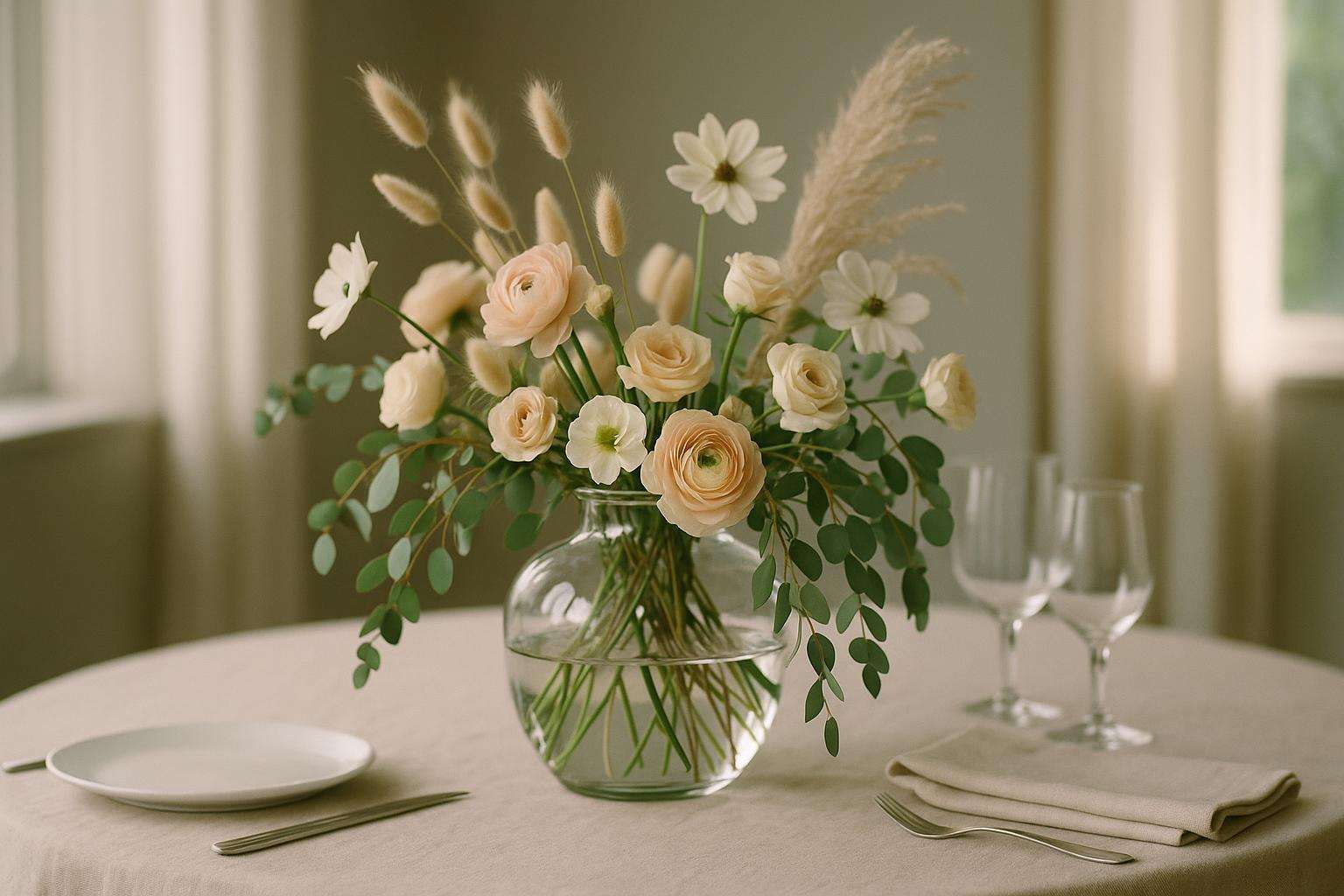
Dried and preserved florals have moved from niche to mainstream in 2025–2026, and for good reason. A dried bridal bouquet from a specialist typically runs $80–$250 — compared to $150–$350 for a fresh equivalent. Dried centerpieces can be assembled weeks in advance, eliminating wedding-week logistics pressure. Pampas grass has become one of the most widely used and recognizable elements of the 2025–2026 aesthetic, working well in earthy, bohemian, and maximalist palettes. Dried cotton stems, bunny tail grass, lunaria (money plant), dried citrus, and seed pods are all available from specialty vendors and Etsy dried flower studios at very low per-stem pricing. The most important consideration with dried arrangements: quality matters more than with fresh flowers, because poorly dried materials look obviously artificial and dusty, while premium-dried materials have a soft, intentional beauty that photographs exceptionally well. Specialist dried flower studios — many accessible through Etsy — produce bridal bouquets and centerpieces of remarkable quality. A full dried flower package (bridal bouquet, four bridesmaid bouquets, ten centerpiece arrangements) from a specialist studio typically runs $400–$900 — a substantial saving over fresh equivalents.
Strengths
- No wilting risk on wedding day — no logistics stress around timing
- Becomes a lasting keepsake without separate preservation costs
- Can be assembled and delivered weeks in advance
Weaknesses
- Fragile in wind and rough handling; outdoor reception centerpieces in exposed locations require extra care
- Does not suit all aesthetics — best for bohemian, rustic, maximalist, and cottagecore styles rather than formal or minimal
- Best for
- Fall and winter weddings; bohemian, rustic, vintage, and cottagecore aesthetics; couples who want a keepsake bouquet
- Pricing
- Dried bridal bouquet: $80–$250; full dried package: $400–$900 from specialist studios
Source: The Knot — Average Cost of Wedding Flowers · Visit Dried Florals and Pampas Grass
Marigold Garlands and Large-Quantity Statement Pieces
When you need volume and impact, marigolds are the most cost-effective flower in existence.
Marigolds are among the most affordable flowers available — $1–$3 per stem, available in warm amber, gold, terracotta, and deep orange tones, and extraordinarily forgiving in heat and humidity. Their cultural significance in South Asian, Mexican, and many Latin wedding traditions is well established, but they have crossed fully into mainstream wedding aesthetics in 2025–2026, where their vivid warmth and texture make them extraordinarily photogenic against ivory and linen tablescapes. The most impactful use of marigolds on a budget: massed quantities. A sweeping marigold garland draped across a ceremony arch, a harvest table, or a welcome signage display creates a visual statement that looks expensive precisely because of its abundance. A single marigold can look almost too simple; fifty marigolds woven into a garland look extraordinary. For large-quantity marigold orders, contact regional wholesale markets or ask your local florist about direct farm sourcing — domestic marigold farms exist across the mid-Atlantic, Southeast, and Pacific Northwest and frequently sell bulk quantities at $0.50–$1 per stem for large orders.
Strengths
- Among the most affordable flowers per stem of any type
- Extraordinary visual impact in volume — garlands and massed arrangements photograph dramatically
- Heat-tolerant and very durable across a full wedding day
Weaknesses
- Strong cultural associations that may not suit all wedding aesthetics; their warm orange-gold palette requires a cohesive color story
- Best for
- Fall weddings; warm-palette aesthetics; South Asian, Latin, and Southwestern celebrations; couples willing to use volume to create impact
- Pricing
- $1–$3/stem retail; $0.50–$1/stem for large wholesale orders from farm-direct sources
Source: FiftyFlowers — DIY Wedding Centerpieces · Visit Marigold Garlands and Large-Quantity Statement Pieces
Potted Plants and Living Centerpieces
Zero waste by design — guests take them home, and your wedding memories live on in them.
Potted plants as wedding centerpieces have grown from a niche eco-conscious choice to a genuine mainstream trend in 2025–2026. Mini succulents ($2–$5 each), potted herbs (rosemary topiary, thyme, lavender — $4–$10 each), small flowering plants (mini orchids, African violets), and seedlings of all kinds can serve as beautiful, living centerpieces that double as guest favors when guests take them home at the end of the evening. A table of ten small potted succulents in terracotta pots, arranged on a wooden board with moss, candles, and a few loose stems of greenery, costs $30–$60 total — and produces a centerpiece that is genuinely beautiful, produces zero floral waste, and sends every guest home with a piece of the wedding. For herb centerpieces, practical identity labeling (rosemary for remembrance, thyme for courage, mint for joy) adds meaning. Many farm and nursery direct-to-consumer operations in California, Oregon, and Florida offer wedding-quantity potted plant orders with advance notice; pricing is significantly below retail for bulk orders.
Strengths
- Zero floral waste — plants leave the venue alive in guests' hands
- Doubles as guest favor, eliminating a separate favor cost
- Genuinely beautiful and increasingly trend-forward
Weaknesses
- Does not suit formal or highly traditional aesthetics; works best in garden, organic, and naturalistic settings
- Best for
- Garden, rustic, eco-conscious, and outdoor weddings; spring and summer dates; couples who want zero-waste florals
- Pricing
- Mini succulents: $2–$5 each; potted herbs: $4–$10 each; table of 10: $30–$60 total
Source: The Knot — Inexpensive Wedding Flowers · Visit Potted Plants and Living Centerpieces
Carnations, Lisianthus, and Alstroemeria as Feature Blooms
Three flowers that are dramatically underrated — and dramatically underpriced.
Carnations, lisianthus, and alstroemeria are the three most underestimated flowers in the wedding industry. All three are available year-round at very stable, low pricing; all three are extraordinarily durable across a full wedding day; and all three — when styled intentionally rather than treated as filler — are genuinely beautiful. Modern carnations are not the ruffled grocery-store blooms of the 1980s: garden-style spray carnations in blush, dusty rose, terracotta, and deep red look contemporary and photogenic in loose, gathered arrangements. Lisianthus (sometimes called the poor man's peony) has ruffled, multi-petaled blooms that closely resemble ranunculus and garden roses at roughly half the cost. Alstroemeria delivers multiple blooms per stem and lasts extraordinarily well — often ten or more days after cutting — making it one of the most economical flowers per visible bloom. For couples who want the look of expensive romantic blooms without the import pricing, asking a florist to design around these three materials (supplemented with greenery) is a highly effective budget strategy.
Strengths
- Dramatically lower cost than the premium blooms they visually resemble
- Year-round availability at stable pricing
- Carnations and alstroemeria have excellent durability across a full event day
Weaknesses
- Lisianthus can be harder to source from farm-direct growers than other options; florist sourcing is typically required
- Best for
- Couples who want the look of peonies, ranunculus, or garden roses at a fraction of the price
- Pricing
- Carnations: $0.50–$1.50/stem wholesale; lisianthus: $1–$3/stem; alstroemeria: $1–$2/stem
Source: The Knot — Inexpensive Wedding Flowers · Visit Carnations, Lisianthus, and Alstroemeria as Feature Blooms
Trader Joe's and Costco Bulk Flower Purchases
The insider secret that experienced DIY brides use to save 40–60% on premium blooms.
Trader Joe's and Costco are among the most reliably cost-effective sources for fresh wedding flowers when a couple is willing to purchase, condition, and arrange flowers themselves in the days before the wedding. Trader Joe's typically sells bunches of 10–12 stems of ranunculus, garden roses, tulips, peonies (in season), and eucalyptus at $5–$12 per bunch — wholesale-comparable pricing available to any shopper. Costco flower departments sell large pre-arranged bundles and individual stems at wholesale pricing; their rose offerings are particularly cost-effective. For a DIY bride purchasing 50 bunches of mixed stems at Trader Joe's for $6–$10 per bunch, the total flower budget for a full wedding's worth of centerpieces and personal flowers comes to $300–$500 — versus $3,000–$6,000 for the same visual result from a full-service florist. The trade-off is substantial commitment: purchasing 3–5 days before the wedding (to allow conditioning time), conditioning flowers in water at room temperature, trimming stems, and assembling arrangements takes serious time and requires help. This approach is best for couples who genuinely enjoy the process and have a team of enthusiastic helpers.
Strengths
- 40–60% savings versus retail florists for comparable fresh blooms
- No minimum order; flexible quantities
- Widely available across the United States
Weaknesses
- Inventory is not guaranteed — you cannot pre-order specific varieties; availability on your shopping trip may vary
- Requires significant time investment for purchasing, conditioning, and arranging
- Best for
- Highly organized DIY couples with reliable helpers and flexibility about exact bloom varieties
- Pricing
- $5–$12 per bunch of 10–12 stems at Trader Joe's; bulk rose bundles at Costco $25–$45
Source: FiftyFlowers — DIY Wedding Centerpieces on a Budget · Visit Trader Joe's and Costco Bulk Flower Purchases
Source from a Local Farmer-Florist via ASCFG
The emerging market of grower-designers who grow and arrange their own flowers — often at prices that surprise couples.
The farmer-florist model — in which a single practitioner both grows cut flowers and designs wedding arrangements — is one of the most exciting developments in American wedding florals. By eliminating the wholesaler entirely, a farmer-florist can often offer premium-quality, freshly harvested flowers at prices that undercut conventional florists by 20–40%, while delivering arrangements that are at their absolute peak quality (harvested days or hours, not weeks, before your wedding). The Association of Specialty Cut Flower Growers (ASCFG) maintains a searchable directory of domestic flower farms at ascfg.org — the most reliable resource for finding a farmer-florist near your venue. Farmer-florists are particularly abundant in regions with strong farming traditions and extended growing seasons: the Pacific Northwest (Oregon and Washington are major dahlia producers), the mid-Atlantic, the Southeast, and Northern California. For couples with a late-summer or fall wedding, connecting with a local dahlia farm can be transformative: dahlias are one of the most wished-for wedding flowers, and at local farm prices in October, they are genuinely affordable.
Strengths
- Freshest possible flowers — often harvested within days of the wedding
- Eliminates wholesaler markup; 20–40% savings versus conventional florists in the same market
- Deeply sustainable: minimal transport miles, often organic or low-spray growing practices
Weaknesses
- Not available in every market; requires finding a qualified farmer-florist within reasonable distance of your venue
- Design aesthetic is often naturalistic and seasonal — not the right fit for highly formal or structured designs
- Best for
- Couples in regions with strong flower farming traditions; summer and fall weddings; those who prioritize local and sustainable sourcing
- Pricing
- Varies by market; typically 20–40% below conventional florist pricing for comparable seasonal work
Source: Association of Specialty Cut Flower Growers — Farm Directory · Visit Source from a Local Farmer-Florist via ASCFG
Frequently asked
What is the most affordable flower for a wedding?
Carnations are consistently among the least expensive options at $0.50–$1.50 per stem at wholesale, followed closely by alstroemeria ($1–$2 per stem, with multiple blooms per stem) and marigolds ($1–$3 per stem). In season, sunflowers ($2–$5 per stem) and wildflowers like zinnias, cosmos, and bachelor buttons are similarly affordable. The critical insight is that per-stem cost only matters in the context of your design: a carnation used thoughtfully in a modern arrangement is beautiful; a carnation in an outdated design looks dated. The lowest-cost approach overall is combining any of these affordable blooms with high-volume greenery (eucalyptus, ferns, ivy), which reduces the total number of expensive stems needed by 30% while adding visual richness.
How much should I budget for wedding flowers in 2026?
The general recommendation is 8–10% of your total wedding budget for florals. At the national average wedding spend of $34,200–$36,000, that translates to roughly $2,700–$3,600. However, with the strategies on this list, couples who go semi-DIY, choose seasonal blooms, and use greenery-forward designs can achieve a full floral look for $1,200–$2,500 even at 150 guests. The most important first step is to decide what your focal points are — typically the bridal bouquet and the ceremony arch — and spend relatively there, while simplifying elsewhere. Per The Knot's data, the average couple spends $2,800 on florals; couples who use at least two of the budget strategies above consistently come in below that figure for equivalent or better visual results.
Can I order flowers from an online wholesaler and assemble them myself?
Yes — and it is one of the most effective budget strategies available. Platforms like Flower Moxie and FiftyFlowers ship florist-quality fresh blooms directly to couples, typically arriving three to five days before the wedding with detailed conditioning and assembly instructions. Flower Moxie in particular is designed specifically for DIY wedding couples and includes step-by-step video tutorials for every arrangement type — from bridal bouquets to centerpieces to boutonnieres. FiftyFlowers offers individual stems and pre-made arrangements with similar freshness. The key success factors are: ordering four to six days before the wedding (to allow conditioning), having a dedicated space to store and arrange flowers in a cool area, and having enthusiastic helpers on assembly day. Couples who follow the tutorials carefully produce results that are genuinely comparable to professionally arranged florals.
What flowers are in season for a spring wedding that are also affordable?
Spring (March through May) is one of the most generous seasons for affordable wedding flowers. Ranunculus, tulips, sweet peas, anemones, and lisianthus are at peak availability and competitive pricing in spring. Peonies peak in May and are at their most affordable and most lush during that window — the one time of year when peonies are not a budget-busting choice. For greenery, spring offers eucalyptus, fern, ivy, and bleeding heart. The important caveat is timing: sweet peas and lilac have very short availability windows and should be confirmed with your florist well in advance. Hyacinth is typically available only through early April. For the most flexibility and the best prices, communicate your wedding date clearly and ask your florist or wholesale supplier what is at peak season on that specific date.
What should I do with wedding flowers after the reception?
Plan ahead rather than improvising at 11 PM when breakdown begins. The best outcomes require coordination: arrange a donation pickup through your florist or directly with an organization like Random Acts of Flowers (randomactsofflowers.org), which coordinates pickup of wedding flowers for delivery to hospitals, care facilities, and hospices. Many florists have established relationships with these organizations; ask at booking. For flowers that cannot be donated, composting is the correct fallback — fresh cut flowers are entirely compostable; remove wire, rubber bands, and any foam before adding. Potted plants or succulents used as centerpieces can be given to guests as they leave. Your bridal bouquet can be professionally preserved — pressed, freeze-dried, or resin-encased — through vendors found on Etsy and through wedding preservation specialists.