Flowers & Décor
Best Edible Wedding Favors for 2026: Ideas Guests Will Actually Love
More than 55% of couples in 2026 are choosing edible favors over keepsakes — and for good reason. Guests take them home, enjoy them, and remember the gesture. Here are the ten best edible wedding favors this year, with real vendors and pricing.
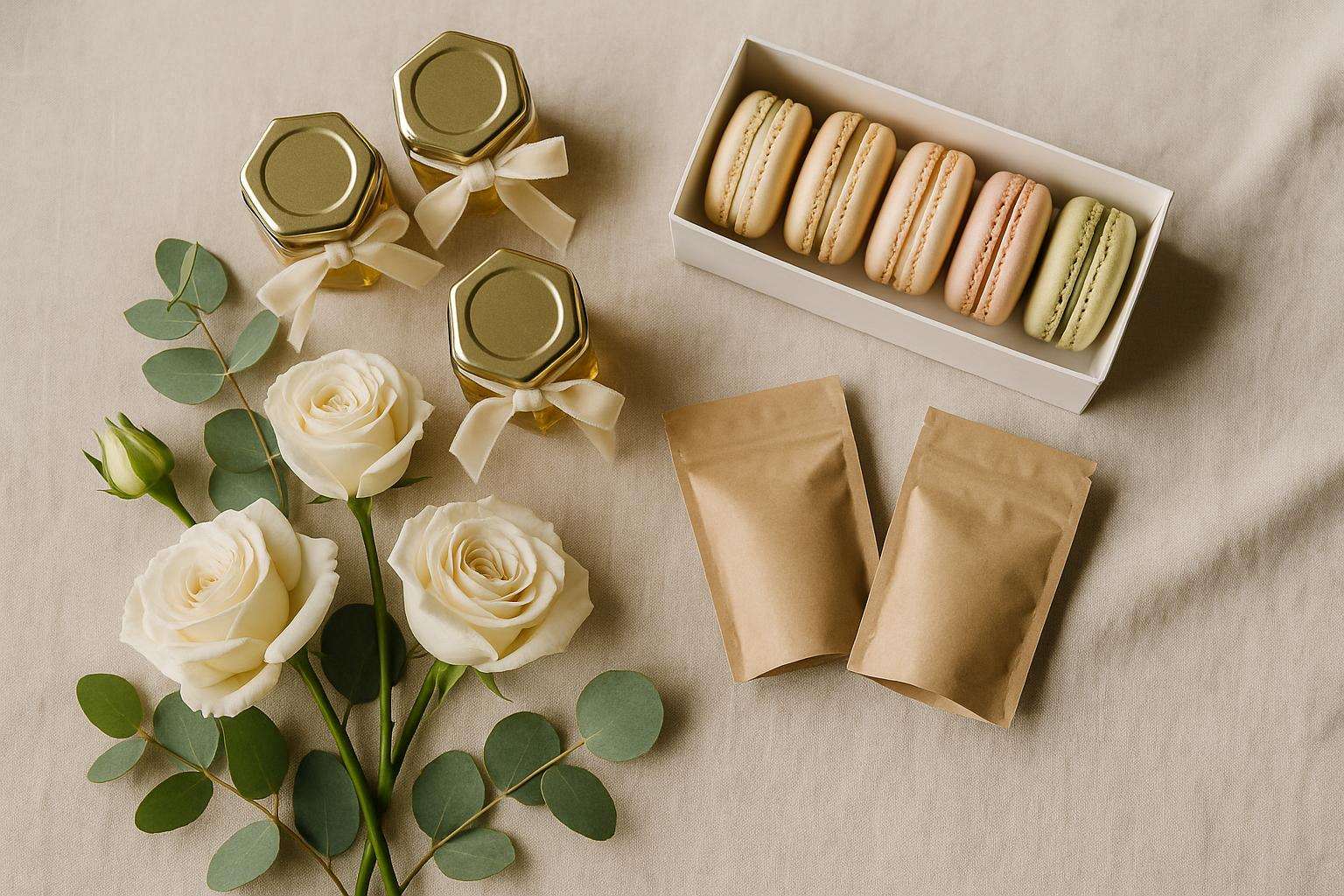
edible wedding favorswedding favors 2026artisan favorslocal vendorsguest favorites
The quick verdict
More than 55% of couples in 2026 choose edible favors — here are the ten best, with real vendors and honest pricing.
- Best overall
- Artisan Honey in Glass Jars — Unbeatable combination of shelf stability, visual elegance, universal appeal, and local sourcing potential
- Best value
- seed-packets — Highest perceived value at under $1.50 per unit; longest lifespan; strongest sustainability story
- Best for Maximum visual impact at the table
- Gourmet Macarons — Color-matched macarons create the most cohesive, photographable place-setting moment of any edible favor
How we evaluated
We ranked these edible wedding favor categories the way a planner actually evaluates them: by whether guests genuinely take the item home and enjoy it, by per-unit cost relative to perceived value, by how well each personalizes without losing take-home appeal, by allergen and dietary accessibility, and by how easily a real vendor can fulfill wedding quantities. Pricing reflects typical 2026 U.S. ranges before custom labeling and shipping, drawn from current vendor listings and editorial sourcing from The Knot, Emmaline Bride, and Minted.
- Guest retention rate. does this item leave the venue with guests, or get left behind?
- Per-unit cost relative. Per-unit cost relative to perceived value at the $2–$7 price point
- Personalization potential without. Personalization potential without over-customization that reduces take-home appeal
- Allergen and dietary. Allergen and dietary accessibility (or clear labeling)
- Ease of vendor. Ease of vendor sourcing at wedding quantities (minimum order of 50–200 units)
Rating scale: Ratings are on a 1-5 scale reflecting guest appeal, value, versatility, and ease of sourcing.
Last verified .
At a glance
| # | Name | Rating | Best for | Pricing |
|---|---|---|---|---|
| 1 | Artisan Honey in Glass Jars | 4.9 | The edible favor with the highest perceived value-to-cost ratio in 2026. | $3–$6 per unit for hexagonal glass jars of 2–4 oz local honey; bulk pricing at 100+ units reduces to $2.50–$4.50 |
| 2 | Custom Artisan Chocolates | 4.8 | Luxury presentation at accessible pricing — when sourced from the right chocolatier. | $4–$8 per unit for individually wrapped artisan chocolates; premium chocolatiers (Compartès, local craft chocolatiers) run $6–$12 per unit for custom-branded packaging |
| 3 | Locally Roasted Coffee in Mini Bags | 4.7 | The favor that keeps performing for weeks after the wedding — every morning. | $3–$7 per unit for 1–2 oz mini kraft bags of specialty roast coffee with custom label; most local roasters offer 50-unit minimums |
| 4 | Custom Lollipops from Artisan Candy Makers | 4.7 | Visually spectacular, fully customizable, and genuinely handcrafted — the favor that doubles as décor. | $3.50–$6 per unit from artisan makers like Sparko Sweets; bulk wedding packages of 100+ units typically reduce per-unit cost by 10–20% |
| 5 | Small-Batch Jam, Preserves, or Fruit Butter | 4.6 | The favor that tells a story — local fruit, family recipe, or a regional specialty that travels home beautifully. | $3–$7 per unit for 2–4 oz jars of artisan jam or preserves; Vermont-based Potlicker Kitchen, regional jam makers, and Etsy artisan producers offer wedding quantity minimums of 50–100 jars |
| 6 | Gourmet Macarons | 4.6 | The Parisian classic that photographs beautifully and tastes even better — when sourced from a skilled patissier. | $3–$6 per macaron from local patisseries; custom-colored macarons in wedding palette colors run $4–$7 per piece with 4–6 weeks lead time and minimum orders of 50–100 |
| 7 | Gourmet Caramel in Individual Wrappers | 4.5 | A handcrafted American confection that travels well, photographs elegantly, and impresses without pretension. | $2.50–$5 per piece for artisan caramels; Montana-based Robin Béquet and similar regional artisan caramel makers offer wedding bulk pricing at 100+ units |
| 8 | Infused Salts and Spice Blends | 4.4 | The most underrated edible favor — used almost daily, tells a culinary story, and travels perfectly. | $3–$6 per unit for 1–2 oz glass bottles or kraft sachets of infused salt or custom spice blend; artisan spice companies and regional salt producers offer wedding quantity pricing |
| 9 | Seed Packets (Edible Herb or Flower Gardens) | 4.3 | The favor at the intersection of edible, sustainable, and genuinely meaningful — for the right guest list. | $0.50–$1.50 per unit for standard seed packets with custom kraft-paper envelope; $1.50–$3 for premium heirloom seed varieties with artisan packaging |
| 10 | Mini Bottles of Local Wine, Spirits, or Craft Beer | 4.2 | The favor that begins the after-party — when sourced locally and presented with intention. | $5–$12 per unit for 187ml mini wine bottles or 50ml spirit minis; local craft brewery canned singles run $3–$7; custom label printing adds $0.50–$1.50 per unit |
Artisan Honey in Glass Jars
The edible favor with the highest perceived value-to-cost ratio in 2026.
Artisan honey in small glass jars has been the most consistently beloved edible favor category for the past three years, and it shows no sign of losing that position in 2026. The reasons are structural: honey is shelf-stable (guests can use it for months), visually elegant even at minimal packaging investment (a hexagonal glass jar with an ivory velvet ribbon is genuinely beautiful), deeply connectable to a place or season (local honey from the wedding region makes guests think of you every time they open it), and free of major allergen complications. The personalization sweet spot is a small custom label with the couple's names, wedding date, and one short phrase — not an essay, not an overly designed sticker that shouts branding. Vendors like Etsy artisan honey sellers and regional beekeeping cooperatives can source in wedding quantities with 4–6 weeks of lead time. For a locally sourced touch, contact a beekeeper within 50 miles of the venue — the ability to say 'honey from bees 12 miles from where we got married' is a genuinely memorable detail that costs nothing extra.
Strengths
- Nearly universal guest appeal — honey crosses every dietary preference and lifestyle
- Shelf-stable for months; no risk of items going stale or melting in a warm venue
- Dual-function as table décor: a row of honey jars at a place setting creates a cohesive tablescape detail
Weaknesses
- Glass jars add weight and fragility for destination weddings where guests are flying — consider switching to food-grade plastic or resin jars for air-travel-heavy guest lists
- Best for
- The edible favor with the highest perceived value-to-cost ratio in 2026.
- Pricing
- $3–$6 per unit for hexagonal glass jars of 2–4 oz local honey; bulk pricing at 100+ units reduces to $2.50–$4.50
Source: The Knot: 45 Trending Wedding Favor Ideas for 2026 · Visit Artisan Honey in Glass Jars
Custom Artisan Chocolates
Luxury presentation at accessible pricing — when sourced from the right chocolatier.
Custom artisan chocolates have moved decisively upmarket in the wedding favor category over the past two years. Los Angeles-based luxury chocolatier Compartès offers wedding favor boxes featuring two elegant pieces handcrafted in small batches — their signature bride-and-groom designs with triple vanilla bean ganache filling have become a sought-after favor option for couples willing to invest at the premium end of the edible favor budget. But artisan chocolates at the $4–$6 price point are also excellent: a craft chocolatier in the wedding's home city, a local bean-to-bar producer, or a curated dark chocolate with a custom-printed wrapper delivers a strongly memorable experience without the luxury price. The key is avoiding mass-market chocolate dressed up in custom packaging — guests can taste the difference. Source from a chocolatier whose product you would be proud to give as a standalone gift, and the packaging almost takes care of itself. Order no-peel-no-stick, heat-stable varieties for summer weddings; chocolate favors at outdoor receptions in July are a risk that should be mitigated with cool storage until distribution.
Strengths
- Universally beloved; one of the few favor categories that consistently generates guest comments and compliments
- Wide price range allows scaling from budget to luxury without changing the concept
- Beautiful visual presentation with minimal packaging effort
Weaknesses
- Temperature-sensitive; outdoor or warm-venue weddings in summer require careful storage and distribution logistics to prevent melting
- Best for
- Luxury presentation at accessible pricing — when sourced from the right chocolatier.
- Pricing
- $4–$8 per unit for individually wrapped artisan chocolates; premium chocolatiers (Compartès, local craft chocolatiers) run $6–$12 per unit for custom-branded packaging
Source: Compartès Chocolatier: Wedding Favors Collection · Visit Custom Artisan Chocolates
Locally Roasted Coffee in Mini Bags
The favor that keeps performing for weeks after the wedding — every morning.
Mini bags of locally roasted specialty coffee have become one of the most distinctively memorable edible favor categories precisely because of their longevity of use: a guest who brews your coffee on a Tuesday morning three weeks after the wedding is thinking about you in a warm, pleasant context that most favors cannot produce. The format also works exceptionally well for couples who are genuinely coffee people — where the favor feels like an authentic expression of who they are rather than a generic gesture. The vendor sourcing strategy is local-first: contact specialty coffee roasters in your wedding city and ask about custom-label mini bags for wedding quantities. Most independent roasters — the kind of operation that sources single-origin beans and roasts in-house — offer wedding packages with the couple's names, date, and a short note on the label. At $4–$6 per unit, this is a favor that projects quality and care at an accessible price point. Decaf options matter more than most couples anticipate — offer a mix of regular and decaf, clearly labeled, particularly for weddings with an older guest demographic or a post-5 PM ceremony.
Strengths
- High repeat-use value — a consumable that guests use daily for 1–3 weeks after the wedding
- Hyper-local sourcing is easy and meaningful; supports small businesses in the wedding community
- Compact and lightweight; no issues with guest travel or transport
Weaknesses
- Not appropriate for all guest demographics — couples whose guest lists skew older or non-coffee-drinking should pair with a second favor option or substitute
- Best for
- The favor that keeps performing for weeks after the wedding — every morning.
- Pricing
- $3–$7 per unit for 1–2 oz mini kraft bags of specialty roast coffee with custom label; most local roasters offer 50-unit minimums
Source: The Knot: 45 Trending Wedding Favor Ideas for 2026 · Visit Locally Roasted Coffee in Mini Bags
Custom Lollipops from Artisan Candy Makers
Visually spectacular, fully customizable, and genuinely handcrafted — the favor that doubles as décor.
Custom lollipops from artisan candy makers have emerged as one of the more visually distinctive favor options in 2026 — and one that consistently surprises guests who expect the typical keepsake favor and find something genuinely handcrafted instead. Los Angeles-based Sparko Sweets has built a specific reputation in the wedding favor space for custom lollipops that can be made in the couple's wedding colors, branded with names and dates, and presented in packaging that functions as a decorative element at the place setting long before anyone unwraps them. The product is sugar candy, so it is broadly accessible from an allergen standpoint and visually immediate — a row of coral-and-ivory lollipops on a table with matching florals reads as intentional, cohesive design, not simply a favor. For couples interested in making a visual statement with the favor as part of the overall table design, custom lollipops offer a level of color-matching and personalization that honey jars and coffee bags cannot achieve. Order with 6–8 weeks of lead time for custom runs; standard designs can often turn in 3–4 weeks.
Strengths
- Maximum visual impact at the place setting; candy colors can match the wedding palette precisely
- Fully personalizable with names, dates, and custom wording on the wrapper
- Artisan handcrafting is visible and authentic — not mass-produced confection in branded packaging
Weaknesses
- Not appropriate for guests with certain dietary restrictions (high-sugar diets, diabetic guests); consider labeling clearly and providing an alternative for guests who request one
- Best for
- Visually spectacular, fully customizable, and genuinely handcrafted — the favor that doubles as décor.
- Pricing
- $3.50–$6 per unit from artisan makers like Sparko Sweets; bulk wedding packages of 100+ units typically reduce per-unit cost by 10–20%
Source: Sparko Sweets: Custom Wedding Lollipops for 2026 · Visit Custom Lollipops from Artisan Candy Makers
Small-Batch Jam, Preserves, or Fruit Butter
The favor that tells a story — local fruit, family recipe, or a regional specialty that travels home beautifully.
Small-batch jam in glass jars occupies a tier of edible favor that feels genuinely artisanal without requiring a significant budget stretch. The category works particularly well for spring and summer weddings where seasonal fruit is a natural part of the celebration — a blueberry lavender jam at a Maine summer wedding, a fig and rosemary preserve at a California fall wedding, a peach butter at a Georgia outdoor reception — these items tell a story about where and when the wedding happened that a generic sweet cannot. Vermont-based Potlicker Kitchen produces craft beer and wine-flavored jams that have become a distinctive option for couples who want something unexpected and conversation-starting. Regional jam makers are available in virtually every U.S. market; a search for farm-to-table or artisan preserves in the wedding city typically surfaces strong local options. Custom labels with the couple's names, date, and a flavor note make the presentation complete. Key ordering note: confirm the jar manufacturer's packaging is airtight and food-safe, and factor in 2–3 inches of storage height per jar when planning transportation to the venue.
Strengths
- Tells a specific place-and-season story that connects guests to the wedding location
- Shelf-stable and long-lasting — guests use these for weeks to months
- Wide range of flavor options accommodates diverse guest palates and cultural backgrounds
Weaknesses
- Glass jars are heavy and fragile for destination weddings with significant air travel; transition to food-safe flexible packaging or consider at-venue distribution only
- Best for
- The favor that tells a story — local fruit, family recipe, or a regional specialty that travels home beautifully.
- Pricing
- $3–$7 per unit for 2–4 oz jars of artisan jam or preserves; Vermont-based Potlicker Kitchen, regional jam makers, and Etsy artisan producers offer wedding quantity minimums of 50–100 jars
Source: The Savory Pantry: Edible Wedding Favors · Visit Small-Batch Jam, Preserves, or Fruit Butter
Gourmet Macarons
The Parisian classic that photographs beautifully and tastes even better — when sourced from a skilled patissier.
Macarons occupy a unique position in the edible favor landscape: they are simultaneously a serious pastry that guests recognize as an investment, a visual element that photographs elegantly in table-setting shots, and a flavor experience with genuine range (lavender, salted caramel, raspberry, pistachio, lemon — endless options that allow couples to tell a flavor story). The best macaron favors come from local French patisseries or dedicated macaron makers who use almond flour and aged egg whites — not commercial or grocery-bakery products that look the part but deliver a gummy, deflated texture. Sourcing locally ensures freshness, which macarons require: they peak at 24–48 hours after completion and begin to decline in texture after 72 hours. Order delivery timed to within 36 hours of the wedding and store in a cool, dry environment. For an extraordinary visual effect, custom-colored macarons in the exact wedding palette placed in individual clear boxes at each place setting create a cohesive, elevated table aesthetic. Offer a common flavor selection (vanilla, chocolate, strawberry) alongside a signature couple's flavor — something meaningful to their story.
Strengths
- Unmatched visual elegance at the place setting; color-matching to the wedding palette is precise and striking
- Genuinely perceived as a luxury item by most guests, regardless of actual per-unit cost
- Wide flavor range allows personalization without over-customization
Weaknesses
- Short shelf life requires precise ordering and storage logistics; not appropriate for venues without climate control or for destination weddings where shipping timing is uncertain
- Best for
- The Parisian classic that photographs beautifully and tastes even better — when sourced from a skilled patissier.
- Pricing
- $3–$6 per macaron from local patisseries; custom-colored macarons in wedding palette colors run $4–$7 per piece with 4–6 weeks lead time and minimum orders of 50–100
Source: Emmaline Bride: 50 Best Wedding Favors for 2026 · Visit Gourmet Macarons
Gourmet Caramel in Individual Wrappers
A handcrafted American confection that travels well, photographs elegantly, and impresses without pretension.
Artisan caramels occupy a distinguished tier in the edible favor world — they are American in origin, deeply satisfying in flavor, and available from exceptional small-batch producers whose product bears no resemblance to commercial wrapped caramels. Montana-based Robin Béquet produces award-winning handcrafted caramels in flavors that rotate seasonally — sea salt, coffee, cinnamon roll, key lime — from small-batch production that prioritizes ingredient quality above throughput. For couples who want a favor with genuine artisan provenance, a Béquet or similar regional caramel maker provides exactly that. The practical advantages over other confections: caramels are highly shelf-stable (2–4 weeks at room temperature, considerably longer refrigerated), individually wrapped without needing additional packaging, more temperature-tolerant than chocolate, and universally recognized as a quality item when presented in simple kraft or wax-paper wrapping. Custom-printed wax paper wrapping with the couple's names and date is an elegant, minimal personalization that does not over-brand the item.
Strengths
- Temperature-stable compared to chocolate; appropriate for outdoor and warm-venue summer weddings
- Shelf-stable for weeks; guests can enjoy at leisure without time pressure
- Small-batch artisan production visible in texture and flavor — clearly not a mass-market product
Weaknesses
- Less visually distinctive than macarons, honey jars, or lollipops at the table; benefits from intentional presentation (a small kraft box, a ribbon, a simple tag)
- Best for
- A handcrafted American confection that travels well, photographs elegantly, and impresses without pretension.
- Pricing
- $2.50–$5 per piece for artisan caramels; Montana-based Robin Béquet and similar regional artisan caramel makers offer wedding bulk pricing at 100+ units
Source: Robin Béquet: Artisan Caramels · Visit Gourmet Caramel in Individual Wrappers
Infused Salts and Spice Blends
The most underrated edible favor — used almost daily, tells a culinary story, and travels perfectly.
Infused salts and custom spice blends are among the most consistently used edible favors in kitchen-oriented households, yet they remain one of the most underutilized favor categories at weddings — which means they feel genuinely surprising and thoughtful to guests who encounter them. A small bottle of fleur de sel with truffle, a lavender finishing salt, a smoked paprika and garlic blend, or a custom 'everything but the bagel' style seasoning mix: these are products that guests reach for in their kitchens for months after the wedding. The sourcing options are excellent: regional artisan salt producers (Jacobsen Salt Co. in Oregon, J.Q. Dickinson Salt Works in West Virginia, Saltworks in the Pacific Northwest), local spice shops, and Etsy producers all offer wedding quantity minimums with custom label options. Packaging in small glass bottles with a cork or dropper cap reads as artisan and premium; kraft paper sachets read as casual and eco-conscious. Both work depending on the aesthetic of the wedding. Unlike coffee, chocolate, or pastry, infused salts have essentially no allergen risk for most guests and an indefinite shelf life.
Strengths
- Virtually unlimited shelf life — guests use these for months, making them the longest-lasting edible favor category
- No significant allergen risk for most products; accessible across nearly all dietary styles
- Lightweight and unbreakable; the most travel-friendly edible favor for destination weddings
Weaknesses
- Less immediately gratifying than sweet favors; guests who are less culinarily oriented may not connect with the gift the way food-focused guests do — consider your specific guest demographic
- Best for
- The most underrated edible favor — used almost daily, tells a culinary story, and travels perfectly.
- Pricing
- $3–$6 per unit for 1–2 oz glass bottles or kraft sachets of infused salt or custom spice blend; artisan spice companies and regional salt producers offer wedding quantity pricing
Source: The Knot: 45 Trending Wedding Favor Ideas for 2026 · Visit Infused Salts and Spice Blends
Seed Packets (Edible Herb or Flower Gardens)
The favor at the intersection of edible, sustainable, and genuinely meaningful — for the right guest list.
Seed packets occupy a unique favor category: they are technically edible (herb seeds, edible flower seeds, vegetable seeds) while also functioning as a living, growing reminder of the wedding that extends well beyond any consumable's lifespan. For couples who are gardeners, sustainability-oriented, or whose wedding aesthetic centers on botanical and natural elements, seed packets are a deeply authentic favor choice. The best seed packet favors use heirloom or heritage seed varieties — basil, lavender, sunflower, wildflower mixes suited to the couple's region — in custom kraft-paper envelopes printed with the couple's names, wedding date, and a short planting note. At $0.50–$1.50 per unit, they are the most budget-accessible edible favor category with genuine quality presentation. The practical limitation is audience fit: guests with gardens, outdoor space, or genuine interest in growing food will treasure these. Urban apartment dwellers may not have a practical use for seeds, which limits the favor's effectiveness for city-heavy guest lists. For weddings where a significant portion of guests are homeowners with outdoor space — suburban and rural weddings particularly — seed packets are an exceptional choice with outstanding perceived value relative to cost.
Strengths
- The most budget-accessible premium-feeling favor category at under $2 per unit
- Outstanding eco and sustainability credentials; generates no waste and grows into something living
- Longest potential lifespan of any favor — a plant grown from wedding seeds can outlast the decade
Weaknesses
- Audience-dependent: guests in urban apartments without outdoor space may have limited practical use for seed packets, reducing take-home value for city-centric guest lists
- Best for
- The favor at the intersection of edible, sustainable, and genuinely meaningful — for the right guest list.
- Pricing
- $0.50–$1.50 per unit for standard seed packets with custom kraft-paper envelope; $1.50–$3 for premium heirloom seed varieties with artisan packaging
Source: Emmaline Bride: 50 Best Wedding Favors for 2026 · Visit Seed Packets (Edible Herb or Flower Gardens)
Mini Bottles of Local Wine, Spirits, or Craft Beer
The favor that begins the after-party — when sourced locally and presented with intention.
Mini bottles of locally sourced wine, craft spirits, or single-serving craft beer have been a wedding favor staple for years, but the 2025–2026 iteration has moved decisively toward local and artisan sourcing — a bottle of wine from a vineyard in the same region as the venue, a craft gin from a distillery the couple actually visits, a single-serve can from the groom's favorite local brewery. This specificity transforms a generic favor into a genuine expression of the couple's taste and their relationship to their community. The logistical considerations are real: verify with your venue that you are permitted to bring in third-party alcohol (many licensed venues have exclusive alcohol service requirements); confirm the state's regulations around alcohol favors (most states permit sealed, labeled products given as individual guest gifts); and plan distribution carefully — individual bottles placed at place settings before guests arrive is cleaner than having a favor table where guests self-select. Custom labels with the couple's names, date, and a short personal note are standard and typically offered by any winery or distillery producing a wedding quantity order. Budget 10–15% more per unit than the base product cost for labeling and packaging.
Strengths
- High perceived value; alcohol favors are consistently among the most appreciated by adult guests
- Local sourcing turns the favor into a venue-and-region story that guests can share
- Custom labels have exceptional keepsake appeal for guests who save wine labels or collect bottles
Weaknesses
- Requires venue permission and careful legal compliance; not appropriate for all venues or all guest demographics (younger couples with many non-drinking guests should reconsider)
- Best for
- The favor that begins the after-party — when sourced locally and presented with intention.
- Pricing
- $5–$12 per unit for 187ml mini wine bottles or 50ml spirit minis; local craft brewery canned singles run $3–$7; custom label printing adds $0.50–$1.50 per unit
Source: The Knot: 45 Trending Wedding Favor Ideas for 2026 · Visit Mini Bottles of Local Wine, Spirits, or Craft Beer
Frequently asked
How much should you spend on edible wedding favors per guest?
The standard benchmark for edible wedding favors in 2026 is $2–$5 per guest for mid-range options, with premium or luxury edible favors running $6–$12 per guest. For a 120-guest wedding, a mid-range edible favor budget runs $240–$600 total. As a percentage of the total wedding budget, most planners recommend allocating 1–2% of your total spend on favors. At a $34,200 average wedding cost (The Knot 2026 Real Weddings Study), that implies a favor budget of $342–$684 — consistent with the $2–$5 per-guest range for 120 guests. One important note on the budget: the per-unit cost is not the total cost. Factor in custom labels or packaging ($0.25–$1.50 per unit), shipping (variable), rush fees if ordering late (25–50% premium), and vendor minimums that may require you to order more than your exact guest count. Build 10% above your confirmed guest count into your order quantity for last-minute additions and damage during setup.
What edible wedding favors work best for outdoor summer weddings?
For outdoor summer weddings — particularly those where temperatures will exceed 75–80°F during the reception — the most important favor characteristic is heat stability. Honey, jam, spice blends, infused salts, seed packets, and individually wrapped caramels (properly wrapped) all perform well in warm conditions. Macarons and chocolate require climate-controlled storage through distribution and are genuinely risky in summer outdoor conditions; a favor that melts or becomes sticky before guests take it home creates a negative impression rather than a positive one. Mini alcohol bottles are fine in the heat when stored out of direct sunlight. Locally roasted coffee holds well at ambient temperature and is unaffected by warmth. If you have your heart set on chocolate or macarons for a summer outdoor wedding, plan a distribution station near the exit at the end of the night — guests pick up their favor as they leave, from a cooled indoor staging area — rather than placing them on the table during the reception.
Do guests actually keep edible wedding favors?
Yes — at significantly higher rates than non-edible keepsakes. Industry data consistently shows that edible favors are taken home by the vast majority of guests who receive them, while non-edible branded or highly personalized keepsakes (engraved glassware, printed bottle openers, photo frames) are frequently left at the table. The clutch test — if a non-edible favor does not fit in an evening bag or jacket pocket, guests will leave it — applies to keepsakes almost universally. Edible favors fail the take-home test mainly when they are poorly executed: chocolate that has melted, cookies that have gone stale, honey jars left in the sun and crystallized. Quality and condition at the moment of distribution matter more than any other factor. A perfectly executed honey jar in a hexagonal glass jar, placed at the place setting before guests arrive, will leave the venue with nearly every guest who attended. The same jar left in a car for three hours in the summer heat before the event, with a lid that does not seal properly, will be left behind by most.
What is the best way to display edible wedding favors?
Edible wedding favors display most effectively at the place setting — one per seat, placed before guests arrive — rather than on a separate favor table where they are easily missed or forgotten. Place-setting distribution ensures every guest engages with the favor visually as part of the tablescape, even before eating it. The table-display approach also allows the favor to function as a décor element: a row of honey jars catches the light beautifully, a macaron in wedding colors coordinates with the floral arrangement, a kraft coffee bag completes a rustic or natural table aesthetic. If a separate favor table is preferred (often for a farewell station at the exit), style it as a dedicated hospitality moment — a beautiful table with a custom sign, a flower arrangement, and clearly displayed extras for guests who want to take additional favors home. Add a brief handwritten note or printed sign that names the vendor and tells the story behind the item ('Local honey from the Blue Ridge Mountains, 12 miles from our ceremony') — this context transforms a favor from a gift into a memory.
How far in advance should you order edible wedding favors?
The ordering timeline depends heavily on the favor category and the level of customization required. Custom-labeled items with vendor-applied personalization — honey jars, coffee bags, jam, infused salts — require 3–4 weeks for standard printing and 6–8 weeks during peak wedding season (May–October). Artisan confections from specialty producers (Compartès chocolates, Robin Béquet caramels, custom lollipops from Sparko Sweets) often require 4–6 weeks for custom wedding quantity runs. Macarons and fresh baked goods should be ordered 2–4 weeks out and delivered within 36–48 hours of the wedding for peak quality. Seed packets are the most lead-time-friendly: 2–3 weeks is sufficient for standard varieties. The universal rule: order 5–10% above your confirmed guest count to account for last-minute RSVP additions, breakage during setup, and vendor packing errors. Never count on rush ordering as a backup strategy; rush fees of 25–50% above standard pricing are common, and vendor availability for rush orders in peak season is not guaranteed.