Flowers & Décor
Wedding Favors Guests Will Actually Love in 2026
Most wedding favors end up on the reception table when guests walk out. These twelve don't — ranked by what guests actually take home, use, and remember, with real costs and the one rule that separates a thoughtful favor from a forgettable one.
wedding favors 2026edible wedding favorsfavors guests keepartisanal wedding favorssustainable favorsunique wedding favor ideas
The quick verdict
Over 55% of couples choose edible wedding favors in 2026 — and guest satisfaction data consistently shows why. The favors on this list share one quality: guests actually take them home.
- Best overall
- Mini Artisanal Honey Jars — Universally loved, locally sourceable, allergy-labelable, and beautiful on any favor table — the single most versatile wedding favor across budgets and aesthetics.
- Best value
- Wildflower Seed Packets — The lowest per-unit cost on this list, zero waste, eco-conscious, and genuinely meaningful — guests can grow something from your wedding day.
- Best for Weddings where the favor also serves as table decor
- Custom Candles in Glass Vessels — A candle that doubles as a centerpiece element reduces two budget line items to one — and guests are far more likely to take home something beautiful that was part of the room.
How we evaluated
We evaluated each favor against four criteria: guest retention rate (based on wedding planner and couple feedback about what guests actually take home), budget per unit at scale for a 130-guest wedding, the over-personalization risk (does heavy engraving or branding reduce the item's usefulness to the guest?), and logistical feasibility for DIY or vendor-ordered production. Cultural traditions are noted where relevant. This is an editorial ranking; we accepted no payment from any vendor mentioned.
- Guest retention. How consistently guests take this item home rather than leaving it on the table.
- Budget per unit. Realistic cost per unit at standard wedding quantities, including packaging and labeling.
- Personalization risk. Whether over-personalization (full names, date) reduces the item's long-term usefulness to the guest.
- Production feasibility. How easily the favor is sourced, assembled, and delivered in the weeks before the wedding.
Rating scale: Ratings are on a 1–5 scale in half-point increments.
Last verified .
At a glance
| # | Name | Rating | Best for | Pricing |
|---|---|---|---|---|
| 1 | Mini Artisanal Honey Jars | 5.0 | Any wedding style — honey jars translate from rustic barn to black-tie ballroom depending on packaging, making them the most versatile favor on this list | $3–$6 per jar (1.5–2 oz); $390–$780 for 130 guests including custom tags |
| 2 | Locally Roasted Coffee Mini-Bags | 4.5 | Couples with a strong personal connection to coffee culture, morning or brunch weddings, and celebrations in cities with notable local roasting scenes | $3–$7 per bag (2 oz); $390–$910 for 130 guests |
| 3 | Custom Candles in Glass Vessels | 4.5 | Evening receptions, fall and winter weddings, and couples who want the decor-to-favor consolidation to justify the higher per-unit cost | $5–$12 per candle; $650–$1,560 for 130 guests |
| 4 | Wildflower Seed Packets | 4.0 | Spring and summer weddings, eco-conscious couples, and garden or outdoor ceremonies where the seed narrative feels authentic to the setting | $0.50–$1.50 per packet including envelope and custom label; $65–$195 for 130 guests |
| 5 | Gourmet Chocolates or Macarons | 4.0 | Couples who want a favor that doubles as a reception dessert accent, or who want zero waste and the highest immediate guest satisfaction | $3–$8 per unit; $390–$1,040 for 130 guests |
| 6 | Small-Batch Jam, Preserves, or Infused Honey | 4.0 | Couples with a connection to a specific region, season, or food culture who want the favor to carry a genuine local provenance narrative | $3–$7 per jar; $390–$910 for 130 guests |
| 7 | Custom Wedding Lollipops | 3.5 | Couples with a playful aesthetic, colorful or maximalist wedding design, or dessert-station focused receptions where the lollipop accent integrates with the broader sweet table | $3–$7 per lollipop; $390–$910 for 130 guests |
| 8 | Jordan Almonds (Traditional Bomboniere) | 4.0 | Couples honoring Italian, Greek, Lebanese, or Syrian heritage, or any celebration where the cultural symbolism of the almond tradition is part of the couple's story | $0.50–$1.50 per five-almond bundle; $65–$195 for 130 guests |
| 9 | Small Succulents with Punned Tags | 3.5 | Garden, rustic, and boho aesthetic weddings where the living organic quality of a plant aligns with the overall wedding design | $3–$6 per succulent including pot and custom tag; $390–$780 for 130 guests |
| 10 | Mini Olive Oil or Infused Salt Bottles | 3.5 | Culinary, Mediterranean, or Tuscan-inspired weddings where the food experience is a central part of the couple's wedding vision | $3–$7 per bottle or jar; $390–$910 for 130 guests |
| 11 | Charitable Donation Card | 4.0 | Couples with a genuine, personal connection to a specific charitable cause who want the favor to reflect their values rather than their aesthetic | Card printing: $0.25–$0.75 per card; donation amount at couple's discretion |
| 12 | Custom Tea Selection Bags or Tins | 3.5 | British-inspired, garden, Japanese-influenced, or wellness-focused weddings where tea is a natural extension of the aesthetic and hospitality narrative | $3–$8 per selection; $390–$1,040 for 130 guests |
Mini Artisanal Honey Jars
The most universally beloved wedding favor — locally sourceable, beautiful on any table, and genuinely useful to every guest
Editor's pick
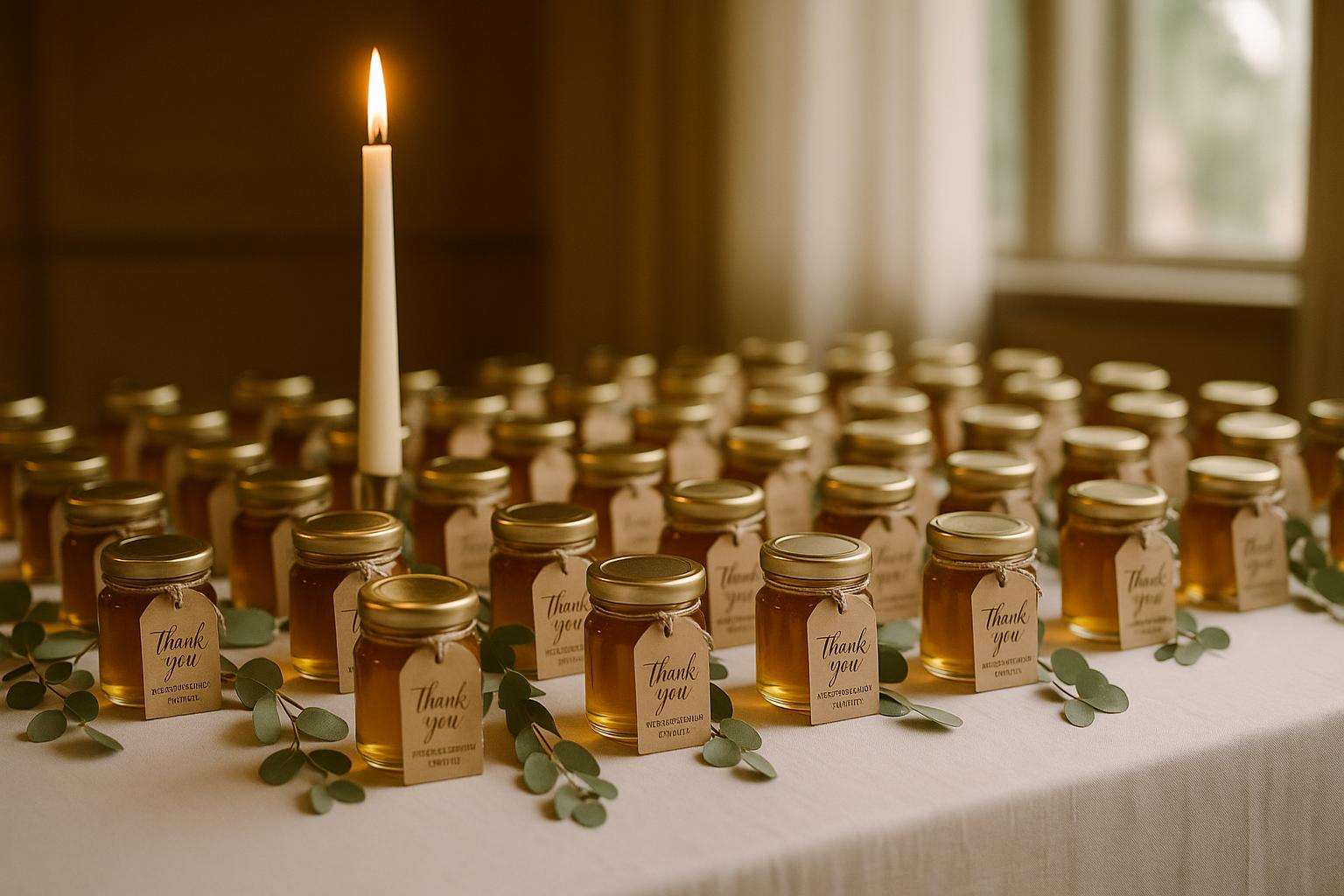
Artisanal honey in small glass jars has become the defining wedding favor of the 2020s, and the reasons are structural rather than trendy. Honey is shelf-stable for years, requires no refrigeration, is enjoyed by nearly every guest regardless of dietary preference, and presents beautifully in glass containers with a custom kraft or ribbon tag. Sourced locally — from a regional apiary near your wedding venue or hometown — it carries a narrative that elevates it above a generic treat: guests leave with a taste of the specific place your wedding occurred, a sensory memory that persists every time they open the jar. Huckle Bee Farms and regional apiaries across the U.S. offer small wedding quantity orders with custom labeling. Cost ranges from $3–$6 per jar at the 1.5–2 oz size most commonly used for favors. At $3–$4 per jar for 130 guests, total favor cost falls between $390–$520 — a mid-tier spend that consistently generates the highest guest satisfaction in favor surveys. The allergy consideration is genuine: honey is not safe for infants under 12 months and carries a small anaphylaxis risk for rare individuals. Label each jar clearly with ingredients. The packaging is also the personalization: a custom tag with a short phrase — 'Bee in love' or simply your names and date in a restrained font — communicates care without over-engraving the item itself. Guests are far more likely to display or use a beautiful jar of honey than a jar with a six-line label asserting whose wedding it came from.
Strengths
- Universally loved, shelf-stable, and locally sourceable — the favor that tells your story through where it came from
- Beautiful presentation in glass that doubles as a small table decor element at each place setting
- Custom kraft tag adds personalization without making the item feel like someone else's wedding souvenir
Weaknesses
- Not safe for infants under 12 months; requires clear ingredient labeling; sourcing lead time from small apiaries can be 4–6 weeks
- Best for
- Any wedding style — honey jars translate from rustic barn to black-tie ballroom depending on packaging, making them the most versatile favor on this list
- Pricing
- $3–$6 per jar (1.5–2 oz); $390–$780 for 130 guests including custom tags
Source: Huckle Bee Farms — Ultimate Guide to Wedding Favors 2026 · Visit Mini Artisanal Honey Jars
Locally Roasted Coffee Mini-Bags
The favor for coffee-loving couples — a small bag of exceptional local coffee that guests use the morning after, and remember
A two-ounce bag of single-origin, locally roasted coffee with a custom label is among the most well-received wedding favors in 2026 — particularly for morning weddings, brunch receptions, and celebrations in cities with strong coffee cultures (Portland, Seattle, Nashville, Austin, New York). Guests who receive a bag of genuinely excellent coffee bring it home, brew it the morning after the wedding, and associate that first cup with the memory of the day. The sourcing strategy is what elevates this above a generic favor: find the best local roaster in your wedding city, arrange a custom small-batch order, and use their label combined with a personal tag. Most independent roasters are delighted to accommodate wedding orders and can advise on bag size, roast selection, and labeling. Cost ranges from $3–$7 per two-ounce bag depending on the roaster and quantity. The one practical consideration: not every guest drinks coffee, and a 130-guest wedding will include some guests for whom the favor has no use. If your guest list skews toward a mixed age and preference range, consider pairing coffee bags with an alternative favor option — a small tea selection or an alternative edible — positioned nearby so non-coffee drinkers have an equally thoughtful choice.
Strengths
- Highly functional — guests brew the coffee the morning after the wedding, creating a direct sensory memory anchor
- Locally sourced narrative elevates the favor from a generic gift to a taste of your wedding location
- Beautiful presentation potential with custom labels and kraft packaging
Weaknesses
- Not useful for non-coffee drinkers — consider an alternative option for guests who prefer tea or decaf
- Best for
- Couples with a strong personal connection to coffee culture, morning or brunch weddings, and celebrations in cities with notable local roasting scenes
- Pricing
- $3–$7 per bag (2 oz); $390–$910 for 130 guests
Source: Emmaline Bride — 50 Best Wedding Favors for 2026 · Visit Locally Roasted Coffee Mini-Bags
Custom Candles in Glass Vessels
The dual-purpose favor that earns its place as both table decor and take-home gift — reducing two budget line items to one
A small custom candle in a branded glass vessel is among the strongest non-edible favor options in 2026, and its competitive advantage is structural: positioned at each place setting or at the center of a table, a beautiful candle is already serving as decor before the favor function activates at the end of the night. When the candle is both a meaningful table element and a take-home gift, you are not adding a budget line item — you are replacing part of your decor budget with something guests actually take home. Select a scent that is connected to your wedding: a coastal or citrus blend for a beach wedding, an amber and cedar profile for a mountain autumn celebration, a fresh floral for a spring garden wedding. Minimize the personalization on the vessel itself — a monogram or a single word ('love,' 'joy,' your wedding year) in a restrained font is the sweet spot. A full-name-and-date label turns a beautiful candle into someone else's memorabilia. Cost ranges from $5–$12 per candle depending on the size and vendor. At $7–$10 per candle for 130 guests, this is a premium-tier favor, but the dual-purpose economics and high guest retention make it one of the most cost-efficient premium options available.
Strengths
- Doubles as table decor and take-home favor — a single budget line covering two functions
- Scent-linked to the wedding location or season creates a lasting sensory memory anchor for guests
- High guest retention: a beautiful, functional candle is taken home far more reliably than any decorative trinket
Weaknesses
- Premium price point ($5–$12 per unit) makes it one of the more expensive favor options; fragrance sensitivity means some guests may prefer not to burn candles indoors
- Best for
- Evening receptions, fall and winter weddings, and couples who want the decor-to-favor consolidation to justify the higher per-unit cost
- Pricing
- $5–$12 per candle; $650–$1,560 for 130 guests
Source: The Knot — 45 Trending Wedding Favor Ideas for 2026 · Visit Custom Candles in Glass Vessels
Wildflower Seed Packets
The most eco-conscious favor on this list — guests grow something from your wedding day, and the cost is as low as $0.50 per guest
A small kraft envelope of wildflower or garden seeds with a custom printed front panel is the lowest-cost, highest-intentionality favor available in 2026 — and among the most consistently well-received, particularly for spring and summer weddings. The appeal is conceptual: guests do not just take home a souvenir, they take home the potential for something living. A wildflower mix planted the following spring produces flowers that carry the memory of your wedding through a full growing season. The production is entirely DIY-friendly: kraft seed envelopes with pre-seeded wildflower or herb mixes can be purchased in bulk, custom labels printed affordably through Minted or Canva-connected print vendors, and assembled in a single afternoon. Cost ranges from $0.50–$1.50 per packet — among the lowest per-unit costs of any quality favor option. For 130 guests, total cost is $65–$195. The environmental alignment is genuine: seed packets leave no waste, no packaging burden, and no unused item in a landfill. The one practical note: if your wedding is in the dead of winter or in a climate where outdoor planting is not feasible for many guests, offer a brief planting card inside the packet with indoor-herb or windowsill-planting instructions so the favor remains actionable for guests in any season.
Strengths
- Lowest per-unit cost of any quality favor option — $0.50–$1.50 per packet for 130 guests
- Fully eco-friendly, zero waste, and zero packaging burden — the most sustainable favor available
- Conceptually meaningful: guests grow something from your wedding day, extending the memory through the growing season
Weaknesses
- Seasonally dependent — winter weddings in cold climates may produce lower follow-through planting unless accompanied by indoor-planting instructions
- Best for
- Spring and summer weddings, eco-conscious couples, and garden or outdoor ceremonies where the seed narrative feels authentic to the setting
- Pricing
- $0.50–$1.50 per packet including envelope and custom label; $65–$195 for 130 guests
Source: Emmaline Bride — 50 Best Wedding Favors for 2026 · Visit Wildflower Seed Packets
Gourmet Chocolates or Macarons
The favor guests eat before they leave the venue — luxurious, immediate, and zero-waste by definition
A single premium chocolate truffle or a pair of macarons in a small branded box or sleeve is a favor guests consume before they even leave the parking lot — which means there is no retention challenge at all. The consumption is the success. Gourmet chocolates from a local chocolatier, packaged in a small box with a custom label or ribbon in your wedding colors, read as generous and considered rather than obligatory. The flavors can be connected to the wedding season (blood orange and dark chocolate in winter, lemon and lavender in spring), the couple's story, or the local food culture of the wedding location. Macarons, when sourced from a genuine French patisserie rather than a bulk supply vendor, are among the most visually stunning edible favors available — and their packaging in small kraft or custom boxes creates a beautiful row of color at each place setting. Cost ranges from $3–$8 per unit depending on the source and packaging. The one honest trade-off: quality matters decisively with gourmet chocolate and macarons. A cheap chocolate in a fancy box is worse than a simple option; guests will remember the flavor. Source from the best local chocolatier or patisserie your budget allows, order samples before committing, and brief the vendor on any required allergen labeling for nuts and dairy.
Strengths
- Zero-waste by definition — guests consume the favor before they leave, eliminating the table-abandonment problem entirely
- Visually stunning at each place setting when macarons are used; beautiful packaging elevates the favor display
- Wide price range from accessible ($3/unit) to genuinely premium ($8+/unit) depending on sourcing
Weaknesses
- Quality varies dramatically by vendor — a subpar chocolate in premium packaging reads as a missed opportunity; allergen labeling (nuts, dairy) is mandatory
- Best for
- Couples who want a favor that doubles as a reception dessert accent, or who want zero waste and the highest immediate guest satisfaction
- Pricing
- $3–$8 per unit; $390–$1,040 for 130 guests
Source: Rocky Mountain Bride — The Edible Favor Trend Taking Over 2026 Weddings · Visit Gourmet Chocolates or Macarons
Small-Batch Jam, Preserves, or Infused Honey
The artisanal pantry favor — regional jam from a local producer connects guests to the wedding's place and season
Small-batch jam, fruit preserves, or herb-infused honey in small glass jars is a natural extension of the honey-jar favor category — with the added narrative dimension of regional produce. A wedding in Virginia wine country might offer a local peach or blackberry jam from a nearby farm stand. A New England celebration in October is a natural fit for apple butter or cranberry preserves. A Southern spring wedding pairs beautifully with a local strawberry or fig jam. The sourcing story is the gift: when the label includes the name of the farm or producer, guests leave with a jar that represents a real place, a real season, and a real craft tradition, rather than a generic grocery-store product in custom packaging. Small-batch jams are available from regional food producers, artisan food markets, and specialty vendors like The Jam Stand and small farmers' market producers across the country. Cost ranges from $3–$7 per jar at the 1.5–2 oz size. The production logistics are similar to honey: order 4–6 weeks in advance to allow for custom label production, and keep all edible favors stored in a cool, dry location until placement on tables the morning of the wedding. Allergen labeling for tree nuts (if processing occurs in a shared facility) should be confirmed with the vendor.
Strengths
- Regional sourcing narrative elevates the favor — a local jam tells the story of where and when the wedding took place
- Shelf-stable, universally appealing, and genuinely useful in guests' kitchens for weeks after the wedding
- Pairs beautifully with the artisanal, locally sourced aesthetic that dominates 2026 wedding design
Weaknesses
- Lead time of 4–6 weeks for small-batch custom orders; must be stored properly until day-of placement; shared-facility allergen labeling requires vendor confirmation
- Best for
- Couples with a connection to a specific region, season, or food culture who want the favor to carry a genuine local provenance narrative
- Pricing
- $3–$7 per jar; $390–$910 for 130 guests
Source: Huckle Bee Farms — Ultimate Guide to Wedding Favors 2026 · Visit Small-Batch Jam, Preserves, or Infused Honey
Custom Wedding Lollipops
The playful, on-trend edible favor that photographs beautifully and satisfies guests of every age — especially at dessert stations
Custom lollipops — in your wedding colors, shaped to reflect your aesthetic, or flavored to match your wedding cake — are a 2026 edible favor trend that balances visual impact with pure consumability. According to Sparko Sweets, custom lollipops are emerging as one of the top edible favors specifically because they are immediately visually distinctive at a place setting: a group of pastel or jewel-toned lollipops in a small container creates a tablescape accent that no other edible favor matches. They work especially well when placed at a dessert station alongside the wedding cake, where guests can pick up a custom lollipop before the reception ends. Flavors can be tied to the season — raspberry and rose for summer, caramel apple for fall, champagne for a formal New Year's celebration — and custom shapes (initials, rings, hearts, seasonal botanicals) elevate the presentation further. Cost ranges from $3–$7 per lollipop in custom orders from specialty confectionery vendors. The one practical consideration: bulk custom lollipops require a 4–6 week production lead time from most specialty vendors, and they are more fragile than other edible favors. Pack and transport carefully, and store at room temperature away from humidity until placement.
Strengths
- Visually distinctive at place settings — custom colors, shapes, and flavors create a tablescape accent no other edible favor matches
- Child-friendly and cross-generational — one of the few favors that lands equally well with a six-year-old and a sixty-year-old
- Photography-ready at dessert stations; custom shapes are immediately recognizable as intentional and personal
Weaknesses
- 4–6 week custom production lead time from specialty vendors; more fragile than other edible favors and require careful transport and storage
- Best for
- Couples with a playful aesthetic, colorful or maximalist wedding design, or dessert-station focused receptions where the lollipop accent integrates with the broader sweet table
- Pricing
- $3–$7 per lollipop; $390–$910 for 130 guests
Source: Sparko Sweets — The Edible Wedding Favor Guests Will Actually Love in 2026 · Visit Custom Wedding Lollipops
Jordan Almonds (Traditional Bomboniere)
The favor with centuries of symbolic meaning — still deeply relevant for Italian, Greek, and Middle Eastern tradition-honoring weddings
Sugar-coated Jordan almonds — known as confetti in Italian tradition, koufeta in Greek Orthodox ceremonies, and mlabbas in Middle Eastern celebrations — carry one of the richest symbolic histories of any wedding favor. The hard sugar coating over a bitter almond represents the bittersweet complexity of married life: sweetness in abundance, with the acknowledgment that difficulty exists and is worth embracing together. In Italian tradition, five almonds per bundle represent health, wealth, fertility, happiness, and longevity. In Greek Orthodox tradition, almonds are distributed in odd numbers — three or five, indivisible by two — symbolizing the couple's unity. The favor is bundled in white or pale pink tulle tied with ribbon or placed in a small decorative box, often personalized with the couple's names and date. For couples honoring Italian, Greek, Lebanese, or Syrian heritage, Jordan almonds are not simply a favor option — they are a tradition that guests from those backgrounds will actively expect and cherish. Cost ranges from $0.50–$1.50 per five-almond bundle, making them among the most affordable tradition-honoring favors available. Source from Italian food specialty vendors or bridal supply companies for authentic quality — the almond inside matters as much as the sugar coating.
Strengths
- Centuries of symbolic tradition across Italian, Greek, and Middle Eastern cultures — not just a favor, but a meaningful ritual
- Among the most affordable options: $0.50–$1.50 per bundle for 130 guests is $65–$195 total
- Beautiful and recognizable presentation that culturally informed guests will receive with warmth and familiarity
Weaknesses
- Primarily meaningful for couples honoring specific cultural traditions — for couples without that heritage, Jordan almonds may read as a generic throwback rather than a considered personal choice
- Best for
- Couples honoring Italian, Greek, Lebanese, or Syrian heritage, or any celebration where the cultural symbolism of the almond tradition is part of the couple's story
- Pricing
- $0.50–$1.50 per five-almond bundle; $65–$195 for 130 guests
Source: The Knot — 45 Trending Wedding Favor Ideas for 2026 · Visit Jordan Almonds (Traditional Bomboniere)
Small Succulents with Punned Tags
The living favor that doubles as table decor — when guests remember to water them, a succulent from your wedding can outlive the marriage in the best way
A small succulent in a two-inch terra cotta or ceramic pot, with a custom tag and a pun ('Thanks for 'succulen-ting' to our wedding,' 'We're 'rooting' for you'), is one of the most visually charming table decor-to-favor options available. When arranged in clusters at the center of each reception table, potted succulents create an organic, living centerpiece that guests take home at the end of the night — eliminating the need for a separate centerpiece element at that table tier. The plants are genuinely hardy: properly potted succulents require almost no care and can thrive on a windowsill for years, which means guests who remember to water them occasionally carry a living remnant of your wedding day for a season or more. Cost ranges from $3–$6 per planted succulent including the pot and custom tag. The production logistics require early ordering: confirm your succulent vendor 4–6 weeks out, as small nurseries and plant-based favor vendors have limited inventory windows. The honest limitation: approximately 30–40% of guests will leave succulents at the table rather than transporting them home, either because the plant is fragile for their commute or because they did not realize they were meant to take it. Use a small table card — 'This succulent is yours to take home' — to communicate the favor intention clearly.
Strengths
- Living plant doubles as a table centerpiece element, reducing decor and favor to a single budget line
- Genuinely long-lasting — well-cared-for succulents can survive for years, making them the most durable favor on this list
- Visually charming and immediately recognizable as an intentional, personal favor choice
Weaknesses
- A meaningful percentage of guests (30–40%) leave succulents at the table rather than transporting them; requires a 'please take me home' card to communicate the favor intention clearly
- Best for
- Garden, rustic, and boho aesthetic weddings where the living organic quality of a plant aligns with the overall wedding design
- Pricing
- $3–$6 per succulent including pot and custom tag; $390–$780 for 130 guests
Source: Emmaline Bride — 50 Best Wedding Favors for 2026 · Visit Small Succulents with Punned Tags
Mini Olive Oil or Infused Salt Bottles
The pantry-staple favor that feels genuinely luxurious — especially for Mediterranean, Tuscan, or culinary-themed weddings
A small bottle of premium extra-virgin olive oil — sourced from a California, Greek, or Italian producer — or a small jar of artisan infused sea salt is a favor that lives in the guest's kitchen and gets used. It occupies the same emotional category as the honey jar (functional, edible, locally or regionally connected) with a slightly more sophisticated target audience. For couples planning a Tuscany-inspired wedding, a Mediterranean celebration, or a food-focused reception where the menu is itself a statement, olive oil is a favor that reinforces the evening's culinary identity. Infused salts — smoked salt, herb-flecked sea salt, truffle salt — occupy the same functional lane with an even higher perceived premium quality at a moderate price point. Cost ranges from $3–$7 per 50ml bottle for olive oil or $3–$7 for a small salt jar. As with honey and jam, the label should be minimal and beautiful rather than over-personalized: the name of the producer and your monogram or wedding year is sufficient. Include a brief note on what dishes pair well with the oil or salt — this small addition transforms the favor from a beautiful object into an invitation to cook and remember.
Strengths
- Pantry-functional and genuinely used — unlike decorative trinkets, olive oil and salt are consumed and associated with the pleasure of cooking
- Elevated perceived quality relative to cost; small bottles with premium labels feel genuinely luxurious
- Reinforces a culinary or Mediterranean wedding theme when paired intentionally with the menu
Weaknesses
- Narrower appeal than honey — not every guest cooks regularly, and the functional value depends on the guest's kitchen habits
- Best for
- Culinary, Mediterranean, or Tuscan-inspired weddings where the food experience is a central part of the couple's wedding vision
- Pricing
- $3–$7 per bottle or jar; $390–$910 for 130 guests
Source: The Knot — 45 Trending Wedding Favor Ideas for 2026 · Visit Mini Olive Oil or Infused Salt Bottles
Charitable Donation Card
The most meaningful non-edible favor — a donation to a named cause on behalf of guests, with a beautiful card at each setting
A beautifully designed card at each place setting announcing that the couple has made a charitable donation in honor of their guests is consistently rated by wedding guests as one of the most moving favor choices available — particularly when the cause is connected to the couple's story. A couple who met while volunteering at an animal shelter, honoring a parent who passed from cancer, or celebrating a marriage rooted in a shared faith or community commitment can make a donation to a meaningful organization and communicate it with a card that feels personal and intentional rather than generic. The card should be brief, beautiful, and specific: name the organization, describe the connection briefly, and include a sentence from the couple about why this cause matters to them. The production cost is essentially zero beyond the card printing; the donation amount is entirely at the couple's discretion. At $100–$500 to a meaningful cause, this is frequently the lowest-cost and highest-impact option in the favor budget. The one limitation to name honestly: guests who prefer a tangible take-home item will appreciate the gesture but may not feel the same sensory satisfaction as opening a jar of honey. For couples who are genuinely committed to a cause, this is not a limitation worth adjusting; for couples who are considering it primarily as a budget move, a low-cost edible option likely serves guests better.
Strengths
- Consistently rated as one of the most meaningful favor gestures, particularly when the cause is personally connected to the couple's story
- Among the lowest production costs of any favor option; the donation amount is fully at the couple's discretion
- Generates no waste, no packaging, and no table-abandonment problem — the card is the favor
Weaknesses
- Guests who prefer a tangible take-home item may appreciate the gesture without experiencing the same sensory satisfaction as an edible or usable favor
- Best for
- Couples with a genuine, personal connection to a specific charitable cause who want the favor to reflect their values rather than their aesthetic
- Pricing
- Card printing: $0.25–$0.75 per card; donation amount at couple's discretion
Source: Huckle Bee Farms — Ultimate Guide to Wedding Favors 2026 · Visit Charitable Donation Card
Custom Tea Selection Bags or Tins
The caffeine-inclusive edible alternative — a beautifully packaged tea selection that appeals to the guests who would leave the coffee bag at the table
A small selection of premium loose-leaf tea or three to four individually bagged specialty teas in a custom-labeled tin or kraft envelope is the most elegant caffeine-inclusive edible favor option — and one that specifically serves the guests who would not bring home a coffee bag. Sourced from a specialty tea purveyor like Harney and Sons, Rishi Tea, or a regional British or Japanese importer, a small curated tea selection feels genuinely thoughtful and culturally sophisticated rather than generic. The packaging does significant emotional work here: a small tin with a custom label, or a kraft pocket envelope with a ribbon-tied tea collection inside, is beautiful at a place setting and beautiful on a kitchen shelf afterward. Seasonal flavor pairing makes the favor more personal: a chamomile-and-lavender blend for a spring wedding, a chai or cinnamon-spiced blend for a fall celebration, a delicate white tea for a summer morning ceremony. Cost ranges from $3–$8 per selection depending on the vendor, quantity, and packaging format. As with all edible favors, include allergen information if any blends contain ingredients like nuts or dried fruit.
Strengths
- Serves tea-drinking guests with the same thoughtfulness that coffee bags offer coffee drinkers — the inclusive edible complement to any coffee-favor strategy
- Beautifully packaged tins have a long shelf life as a display object even after the tea is consumed
- Wide range of flavor profiles allows genuine seasonal and thematic personalization
Weaknesses
- Narrower universal appeal than honey or chocolate — may benefit from being offered alongside rather than instead of a higher-appeal edible option at larger weddings
- Best for
- British-inspired, garden, Japanese-influenced, or wellness-focused weddings where tea is a natural extension of the aesthetic and hospitality narrative
- Pricing
- $3–$8 per selection; $390–$1,040 for 130 guests
Source: Emmaline Bride — 50 Best Wedding Favors for 2026 · Visit Custom Tea Selection Bags or Tins
Frequently asked
Are wedding favors required by etiquette?
Etiquette does not require wedding favors, and a growing number of wedding planners actively advise couples to skip them when the budget is tight or when a genuinely meaningful option is not available. Guests consistently report noticing a poor or generic favor far more than noticing the absence of one. If you choose not to offer a physical favor, a charitable donation in the couple's honor with a brief note at each place setting is a gracious alternative that generates genuine guest appreciation. The question worth asking is not 'should we have a favor?' but 'do we have something we genuinely love to give?' If the honest answer is no, redirecting that budget toward the guest experience — extended open bar, late-night snack station, upgraded dessert — consistently produces higher guest satisfaction than a $2 trinket no one takes home.
When should we order personalized wedding favors?
For standard vendor-personalized items — custom labels, printed packaging, branded glass or ceramics — place your order a minimum of six to eight weeks before the wedding date. For large-scale luxury or bespoke orders, three to four months is the appropriate window. Rush orders, defined as delivery within four weeks, typically add a 25 to 50 percent premium to the unit cost, which can meaningfully inflate the total favor budget for a 130-guest wedding. Confirm exact production lead times with your specific vendor before placing a deposit — not the vendor's published estimate, but the actual current production queue for your order type. Order five to ten percent above your confirmed guest count for breakage, late RSVPs, and vendor minimum order requirements. For edible favors with custom packaging, build in a final proof review before the full production run begins — a single label error on 130 honey jars requires either a full reprint or a hand-correction that becomes a wedding-week task you do not need.
How do we avoid the over-personalization trap with wedding favors?
The over-personalization trap is specific and widely documented: engraving or printing the couple's full names and wedding date on a physical item — a glass, a ceramic dish, a silver frame — that guests are expected to display in their home. Guests almost universally report not displaying other couples' personal milestones in their living spaces, which means the over-personalized favor ends up in the back of a cabinet or donated to a charity shop. The sweet spot is a monogram, a short meaningful phrase, or your wedding year on the packaging — not on the item itself. A jar of honey with a custom kraft tag bearing your initials and the year is deeply personal; a jar with your full names, date, and a scrolling script is someone else's wedding memento. Apply the same filter to any non-edible favor: would the guest use or display this item if it had no names on it? If yes, minimal personalization on the packaging is sufficient. If no, choose a different item.
What is the best favor for a destination wedding?
The best favor for a destination wedding is one that connects to the place — and that guests can either consume before they leave or pack easily in luggage. A small jar of local honey from the wedding region, a packet of locally sourced coffee from a regional roaster, a small bottle of local olive oil or a regional hot sauce, or a beautifully packaged selection of local sweets carries the narrative of where you chose to celebrate without creating a luggage burden. Avoid anything fragile, anything that cannot clear customs if international guests are traveling home, and anything that requires refrigeration. For guests flying long distances, the maximum favor volume that fits in a zip-lock bag and goes into a carry-on is the practical ceiling — anything larger simply will not travel. A small card with a local restaurant recommendation or a map of the region is a zero-cost, zero-luggage addition that many destination wedding guests rank among their most appreciated take-home items.
How do we display wedding favors at the reception?
The most effective favor display is one that communicates clearly and effortlessly that the item is meant to be taken home. Placement at each individual place setting — one favor per guest or per household depending on your choice — is the most reliable method because it removes any ambiguity about whether the item is part of the decor or a personal gift. A small handwritten or printed card reading 'For you — please take me home' eliminates the most common reason favors are left behind: guests assumed the item was table decor. Favor tables — a central display where guests self-select as they arrive or depart — work well for informal receptions and buffet-style service, but require more active signage and a coordinator check at the end of the evening to distribute remaining favors rather than packing them back up. Succulents, candles, and any decor-to-favor item benefit especially from a place-setting placement strategy since their dual function creates genuine ambiguity without explicit communication.
Should we give the same favor to all guests or offer options?
One thoughtfully chosen favor for all guests is almost always the better choice over multiple options for several reasons: it presents a unified aesthetic at each table setting, simplifies ordering and assembly, and avoids the signal that some guests received a 'better' option than others. The exception worth considering is an allergy-driven alternative: if your primary favor is a food item with a common allergen — nuts, tree nuts, or dairy — having a clearly labeled alternative available for guests with known dietary restrictions is a genuine hospitality gesture, not a complication. For very large weddings or celebrations with meaningfully different guest demographics — say, an outdoor tent wedding with 50 young children — consider offering a simple non-edible alternative near the children's favor placement so parents are not handing a small honey jar to a toddler. Beyond those cases, one favor, executed beautifully and communicated clearly, serves guests better than a choice architecture that requires decision-making at the end of a long and emotional night.