Flowers & Décor
Wedding Tent Styles Explained: Pole, Sailcloth, Clear-Span & More
Every tent type produces a completely different atmosphere. Before you book, here is what you need to know about the five main wedding tent styles — their look, their limitations, and what they actually cost.
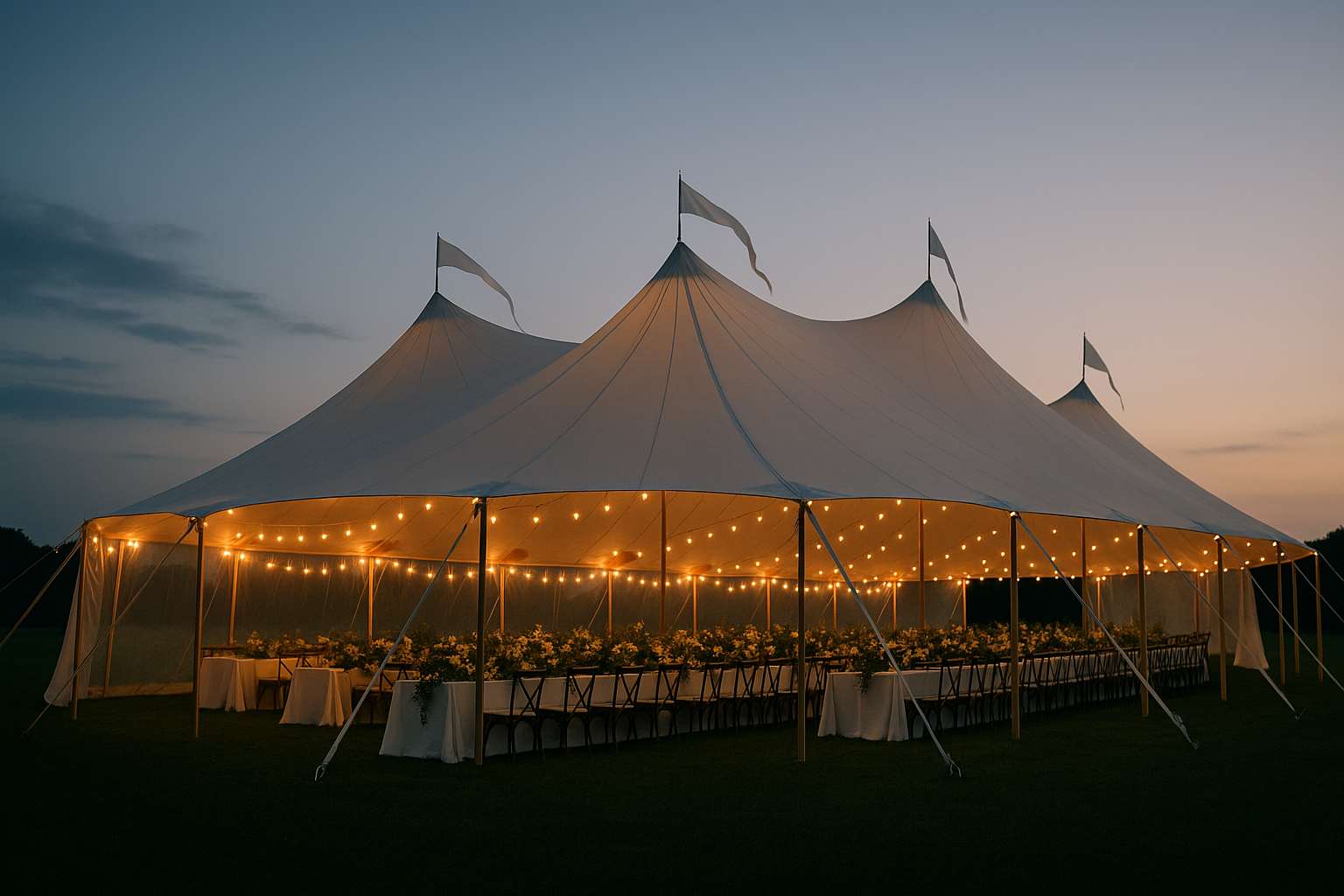
The five main wedding tent styles — pole, sailcloth, frame, clear-span, and clear-top — differ significantly in appearance, weather protection, floor plan flexibility, and cost. Sailcloth produces the most beautiful light and photographs best; clear-span offers the most structural freedom; pole tents are the most affordable. The right choice depends on your venue's surface, your climate, and your budget for the full infrastructure package.
The tent does not just shelter your reception — it defines the atmosphere. A sailcloth tent with Edison bulb chandeliers and soft candlelight produces something that feels genuinely magical: translucent white canvas glowing at dusk, peaked profiles silhouetted against the evening sky, a warmth of light that no other structure replicates. A clear-span aluminum tent, by contrast, is a blank canvas: industrial infrastructure that requires decoration and lighting to transform into a celebration. Neither is better in the abstract. The right tent is the one that matches your venue, your climate, your aesthetic, and your budget — including the full infrastructure costs that the tent itself is only a starting point for.
Most couples who go over budget on tent rentals do so for one reason: they price the tent and forget the floor, the lighting, the sidewalls, and the climate control. According to Zola's 2025 wedding cost data, the average couple spends $425 to $1,000 on the tent structure itself — but a fully outfitted tented reception for 150 guests, including flooring, lighting, climate control, and necessary infrastructure, realistically costs $8,000 to $25,000. Understanding what you are actually buying when you book a tent is the essential first step.
What are the five main wedding tent styles and how do they differ?
| Tent Style | Approximate Rental Range (basic, 100 guests) | Interior Poles | Works on Hardscape | Best For |
|---|---|---|---|---|
| Pole Tent | $800–$2,000 | Yes — center and perimeter poles | No — requires ground stakes | Budget outdoor receptions on grass; classic aesthetic |
| Sailcloth Tent | $2,500–$8,000 | Perimeter poles only — open interior | No — requires ground stakes | Elevated aesthetic, dusk photography, lawn or garden venues |
| Frame Tent | $1,200–$3,000 | No — fully open interior | Yes — weight ballast anchoring | Patios, decks, hardscape surfaces; rectangular footprints |
| Clear-Span | $2,500–$6,000+ | No — open modular aluminum structure | Yes — weight ballast anchoring | Large formal receptions; winter weddings; irregular venues |
| Clear-Top / Vista | $3,000–$10,000+ | Varies by subtype | Varies by subtype | Stargazing effect; outdoor setting with weather protection |
Pole tents are the traditional wedding tent: tall center and perimeter poles create dramatic peaks and sloping roof lines. They are the most affordable option and are widely available from general rental companies. The constraint is the center poles, which interrupt the interior and require layout planning to integrate gracefully — placing a sweetheart table, a floral installation, or a bar against a center pole can actually turn the structural necessity into a design feature. Pole tents require ground stakes and are unsuitable for hardscape surfaces.
Sailcloth tents are the premium tier of fabric tent. Made from translucent cotton canvas stretched over elegant wooden poles, they produce a warm, glowing aesthetic unlike any other tent type. Sperry Tents, one of the category's leading companies, notes that the fabric takes on a golden hue from within at dusk that has made sailcloth tents the near-universal first choice for editorial wedding photography. The open interior (no center poles) allows free-flowing floor plans. Because sailcloth tent inventory is limited and demand is high, availability typically goes first on peak-season dates — booking six to twelve months in advance is standard practice.
Frame tents use a steel or aluminum framework that distributes load without interior poles or ground stakes — making them the default choice for hardscape venues. They can be weight-anchored with ballast systems on concrete, asphalt, and wood decks. The interior is fully open, layout is flexible, and the modular structure accommodates irregular shapes. Frame tents are a practical workaround for non-grass surfaces but lack the romantic aesthetic of sailcloth.
Clear-span tents are essentially modular permanent-structure alternatives: rigid aluminum frames with no interior supports, capable of spanning very large widths without columns. They handle high winds and significant precipitation better than any fabric tent and can be fully enclosed and climate-controlled, making them the choice for winter weddings or venues where weather risk is real. The trade-off is aesthetic — the interior reads as an industrial event space that requires significant decor investment to feel celebratory.
Clear-top tents (also called vista or stargazing tents) use transparent or semi-transparent panels that allow natural light during the day and stargazing effects at night. They create a genuinely beautiful atmosphere when skies are clear. They are also among the most expensive options and come with the constraint that their climate control requirements are substantial — unshaded transparent panels create greenhouse heat in summer sun and require significant HVAC investment. They work best for late-evening events or temperate shoulder seasons.
Which wedding tent style is right for your venue and climate?
The choice of tent is rarely a pure aesthetic decision — it is constrained first by your venue's surface and your climate, and only then by your taste and budget. Start with the ground. If your reception sits on a lawn, garden, or field with firm, stakeable soil, every style is on the table, and a sailcloth or pole tent can deliver the romantic, peaked silhouette so many couples want. If you are on concrete, pavers, a deck, a rooftop, or any hardscape, pole and sailcloth tents are immediately ruled out — they depend on deep ground stakes — and you are choosing between a frame tent and a clear-span structure, both of which anchor with weighted ballast instead.
Climate is the second filter. For summer weddings in hot, sunny regions, a fully transparent clear-top tent can turn into a greenhouse by mid-afternoon, so reserve it for evening receptions or pair it with substantial air conditioning. For winter dates or anywhere with real weather risk, a clear-span structure is the safest choice: it seals completely, withstands high wind and heavy rain better than any fabric tent, and accepts HVAC without compromise. American Tent's guidance on pole versus frame tents underscores the same point — the anchoring method and structural rating, not the look, should drive the short list.
Only after surface and climate have narrowed the field should aesthetics and budget make the final call. If you have a grass venue, a temperate evening, and the budget to match, sailcloth wins on light and photography. If you need maximum layout freedom for a large, formal seated dinner, the open interior of a clear-span or frame tent matters more than the canvas profile. And if cost is the binding constraint, a classic pole tent on a lawn delivers the most square footage per dollar, with center poles you can dress into the design rather than hide. Walk your actual surface, name your real climate risk, and let those two facts protect you from booking a beautiful tent your venue cannot physically support.
What does a fully outfitted wedding tent actually cost once you add the infrastructure?
The tent structure is the starting point, not the total. Most couples discover this mid-planning when they receive an itemized quote. Here is a realistic breakdown of what a complete tented reception infrastructure for 150 guests requires:
Flooring: Grass is uneven, muddy in rain, and uncomfortable in heels. A padded hardwood or carpet dance floor and subflooring typically runs $1,500 to $5,000 depending on square footage. Many venues and tent companies require flooring as part of their rental contract. Budget for it from the beginning.
Climate control: Tents are not naturally climate-controlled environments. For summer events, portable air conditioning units run $500 to $2,500 and require electrical infrastructure. For cool or cold months, radiant heaters and forced-air systems run $500 to $3,000. Clear-top and sailcloth tents can become uncomfortably hot in direct midday sun; clear-span tents are the most easily climate-controlled because they seal fully.
Lighting: The tent shell itself provides structure but no atmosphere. Edison bulb installations, pendant chandeliers, uplighting, and string light canopies typically run $500 to $5,000 or more depending on the scale and complexity of the installation. Lighting is often the single largest line item after the tent structure, and it has the most visible impact on the final atmosphere. Do not underestimate it.
Sidewalls: Most tent rentals quote the canopy only. Sidewalls — panels that close off the perimeter — add $300 to $1,500 and are essential for rain protection and evening temperature management. Clear sidewalls are typically $50 to $100 more per panel than opaque sidewalls and allow views while providing full weather protection.
When to book: Mahaiwe Tent and most industry sources recommend confirming your tent rental as soon as your venue is secured — ideally six to twelve months before a peak-season date. Sailcloth tent companies are the most time-sensitive. Tent companies also conduct mandatory site visits before final quotes, which adds lead time. Confirming tent availability early is not merely logistical prudence — it often determines whether your venue choice is actually feasible as a tented reception site.
Frequently asked
What is the most popular wedding tent style in 2026?
Sailcloth tents are the most requested wedding tent style among couples planning elevated outdoor events in 2025–2026. Their translucent natural cotton canvas allows warm natural light to filter through during the day and glows beautifully from within when lit with Edison bulbs or chandeliers at night. The graceful peaked profile photographs exceptionally well and requires no interior center poles, leaving the floor plan fully open for creative table arrangements. Sperry Tents, a leading sailcloth tent company, notes that the fabric itself takes on a golden hue at dusk that no other tent replicates. That said, sailcloth tents carry a 50 to 100 percent premium over basic pole or frame tents of the same square footage — the elevated aesthetic comes at a real cost — and they require firm, staked ground, ruling them out for rooftops, concrete patios, and many urban venues.
How much does a wedding tent rental cost in 2026?
Zola's 2025 wedding data shows most couples spend between $425 and $1,000 on tent rental for a 100-guest outdoor wedding, but total tent-related costs — including flooring, lighting, climate control, and sidewalls — frequently reach $3,500 to $12,000 or more depending on tent style, region, and add-ons. The tent itself is typically the smallest line item once complete infrastructure is accounted for. A basic 40x80-foot pole tent rents for $800 to $2,000; an equivalent clear-span aluminum structure runs $2,500 to $6,000; a sailcloth tent for the same footprint runs $2,500 to $8,000. Add a hardwood or padded floor ($1,500 to $5,000), climate control ($500 to $2,500), and lighting ($500 to $5,000+), and a fully outfitted tented wedding venue for 150 guests easily runs $8,000 to $25,000 before catering. Always request an itemized quote that separates the tent from its infrastructure.
What is a clear-span tent and when should I choose it?
A clear-span tent (also called a clearspan or aluminum structure tent) uses a rigid modular aluminum frame with no interior poles, walls, or supports — the entire interior is open and unobstructed. This makes it the most flexible option for large, formal receptions where layout freedom matters, or for venues with irregular footprints where poles would obstruct views or table configurations. Clear-span tents are also the most weather-resistant option short of a permanent structure; they handle high winds and heavy rain better than pole or sailcloth tents. They are the practical choice for winter weddings or events in unpredictable climates when paired with proper flooring and HVAC. The trade-off is aesthetic: the aluminum frame structure is more industrial-looking than a sailcloth tent, and the interior typically needs more decoration to feel warm and intimate. They are also the most expensive tent type to rent.
Can I put a tent on a deck or concrete surface?
Yes, but not all tent styles allow it. Frame tents and clear-span tents can be anchored using weighted ballast or water barrels rather than ground stakes, making them the correct choice for hardscape surfaces including concrete, pavers, asphalt, decks, and rooftops. Pole tents and sailcloth tents require deep ground stakes and are therefore incompatible with hardscape surfaces — attempting to use them in these conditions creates structural risk. Before booking any tent, walk your venue coordinator through the exact surface and confirm in writing that the tent company's equipment is rated for that anchor method. If the venue has underground utilities, irrigation systems, or a hardscape surface, communicate that to your rental company before a site visit. Weight-anchored setups require significantly larger footprints around the tent perimeter to accommodate the ballast equipment.
How far in advance should I book a wedding tent rental?
For peak-season dates (May through October in most of the U.S.), tent rental companies at most venues recommend booking six to twelve months in advance. Sailcloth tent inventory is particularly limited — there are far fewer sailcloth tent companies than standard tent rental companies, and their calendars fill earliest, often a full year in advance for popular autumn dates. Confirm availability as soon as your venue is booked rather than waiting until other elements are confirmed. Most reputable tent rental companies require a site visit before final quote and contract, which adds lead time. Booking late — within three to four months of a peak-season date — typically means either accepting whatever tent type remains available or paying a premium for expedited logistics. Off-season dates (November through April) offer more flexibility, though regional demand varies.