Food & Drink
Inclusive Wedding Menu Planning: What Every Couple Should Know
Up to 30 percent of your guests have dietary needs you did not plan for — here is how to design one menu that genuinely works for everyone, from celiac guests to halal requirements.
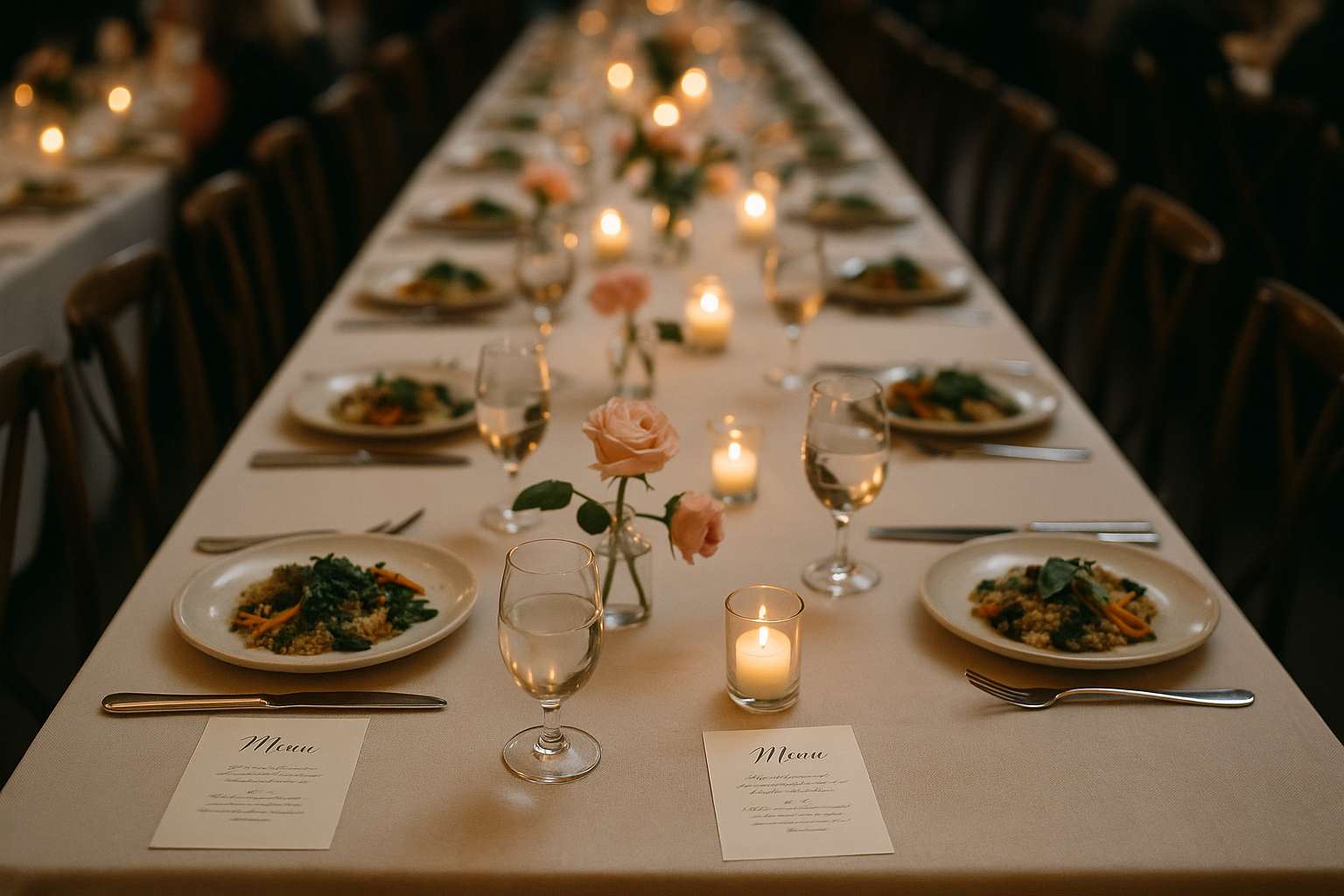
An estimated 15–30% of your wedding guests have dietary needs — allergies, religious requirements, or lifestyle choices. The most effective approach is to design one naturally inclusive main menu rather than 12 separate plates, collect RSVP data six weeks out, and deliver a organized written brief to your caterer three weeks before the wedding.
The hospitality a couple extends to their guests is nowhere more tangible than at the table. A guest who spends your wedding reception anxious about whether the food is safe — or who sits in front of a plate they cannot eat — carries that experience home. A guest who is seen, anticipated, and nourished carries something else entirely. The difference between those two outcomes lies almost entirely in one thing: whether dietary accommodations were treated as a design consideration or an afterthought.
According to the CDC's 2024 National Health Interview Survey, approximately 6.7 percent of U.S. adults have a diagnosed food allergy — representing roughly 32 million Americans. Factor in intolerances, religious requirements, and lifestyle choices, and the number of guests at a typical 100-person wedding with meaningful dietary needs easily reaches 20 to 35 people. This is not an edge case. It is a significant portion of every guest list.
How do you know what your guests need — and when?
The foundation is the RSVP. Every RSVP form — physical card, wedding website, or digital survey — should include a clear dietary question, and it should be framed as a gesture of care rather than administrative box-checking. A warm phrasing works better than a clinical one: "Please share any food allergies or dietary requirements so we can make sure the kitchen is prepared for you."
Set the RSVP deadline at least five to six weeks before the wedding — not the standard two to three weeks. Kosher catering requires sourcing from certified suppliers; halal meat requires a certified preparation process. Neither can be arranged in a week. Collecting dietary information late is the single most common mistake couples make, and it cascades into every subsequent planning step.
Once responses are in, categorize them by severity and type — life-threatening allergy, medical necessity, religious requirement, and preference — and compile a clean spreadsheet organized by table. Color-code or flag high-priority guests. Deliver this document to your caterer in writing and follow up with a scheduled phone call to walk through it together. Do not rely on a long email thread.
| Tier | Guest Profile | Approach Required | Typical Cost Impact |
|---|---|---|---|
| Core menu redesign | Gluten-sensitive, dairy-free, most vegetarians | Build naturally inclusive from the start | None when planned proactively |
| Ingredient swaps | Vegan, egg-free, nut-free | Minor modifications; inform caterer in advance | +$5–$20 per plate |
| Dedicated plated meal | Celiac disease, severe multiple allergies, strict vegan | Individually prepared; labeled and tracked by seat | +$10–$25 per plate |
| Specialist caterer or supplier | Full kosher, full halal | External certified vendor or certified kitchen required | +20–40% for kosher; comparable for halal |
How do you build a wedding menu that works for most guests at once?
The most experienced catering professionals share a consistent insight: the goal is not to build twelve separate menus. It is to build one main menu that is naturally inclusive, then make targeted additions for guests whose needs cannot be met any other way. This approach is more elegant, more economical, and more hospitable than an archipelago of special plates.
The architecture of an inclusive core menu looks like this:
- Proteins served with sauces on the side — a grilled chicken breast or roasted fish becomes naturally gluten-free, dairy-free, and nut-free when the accompanying sauce is not applied in the kitchen
- Grain bases of rice or quinoa rather than wheat pasta — these cover gluten-sensitive guests, many vegetarians, and several religious requirements simultaneously
- Vegetable-forward sides seasoned with olive oil and herbs — inherently vegan, gluten-free, dairy-free, and nut-free: one dish covering four common restrictions
- Salads with dressing served separately — prevents hidden allergen exposure and allows guests to self-regulate
- A genuinely substantial vegan entrée option — not grilled vegetables with no protein, but something nourishing: a mushroom risotto, a stuffed pepper with lentil filling, or a grain bowl with roasted chickpeas and tahini
The 2026 trend in wedding catering is plant-forward by design, not as a concession — vegetarian and vegan dishes increasingly appear as centerpiece options alongside proteins, not separated into a "special meal" category. Interactive stations — build-your-own taco bars, grain bowls, and mezze spreads — allow guests with restrictions to self-select safely when components are clearly labeled, and they bring an energy to the cocktail hour that plated service cannot match.
What does proper labeling look like at a wedding buffet or station?
Clear labeling is the final layer of safety and courtesy that makes all the upstream planning visible to guests. Every dish at a buffet or station should carry a small, permanent card identifying its dietary profile:
- V — Vegetarian
- VG — Vegan
- GF — Gluten-Free
- DF — Dairy-Free
- NF — Nut-Free
Any dish containing one of the nine major allergens recognized by the FDA since 2023 — peanuts, tree nuts, milk, eggs, wheat, shellfish, fish, soy, and sesame — must be explicitly identified. "May contain traces of" language is appropriate wherever cross-contamination exists. Write labels from the guest's perspective, not the chef's: "contains tree nuts" is more useful than "prepared with almond oil."
Dessert tables deserve particular attention. Pastries and sweets are high-risk for hidden allergens: butter in pastry dough, eggs in cake, nut oils in chocolate, wheat in seemingly simple cookies. A clear sign at each item is not optional — it is the difference between a celebratory dessert experience and a guest quietly going without. Gluten-free wedding cakes and vegan tiered cakes are now standard offerings at most mid-to-large bakeries, not specialty-only items.
At minimum, designate one informed catering staff member during service whose role is to answer dietary questions from guests. This person must know the menu thoroughly, not simply read from a list. A guest with a life-threatening allergy deserves to speak with someone who can actually confirm what is in a dish — not someone who says, "I think it's probably fine."
Frequently asked
How many wedding guests typically have dietary restrictions?
Industry planners estimate that at a typical American wedding, 15–30 percent of guests have some form of dietary need — ranging from lifestyle preferences to life-threatening allergies. According to the CDC's 2024 National Health Interview Survey, approximately 6.7 percent of U.S. adults have a diagnosed food allergy, representing roughly 32 million Americans. At a 150-person wedding, that translates to approximately 10 guests with true allergies, plus additional guests with religious dietary requirements (kosher, halal, Hindu vegetarian), medical intolerances (celiac disease, lactose intolerance), and lifestyle choices (veganism, vegetarianism, pescatarianism). The encouraging reality: couples who plan proactively find that accommodating these needs is far less complicated than they feared, especially when the menu is designed with inclusion in mind from the start rather than retrofitted after the fact.
What is the best way to collect dietary restriction information from guests?
Include a clear, open-ended dietary question in your RSVP — whether on a physical card, a wedding website form, or a digital survey. Suggested phrasing: 'Please share any food allergies or dietary requirements so we can make sure the kitchen is prepared for you.' Set the RSVP deadline at least five to six weeks before the wedding, not the standard two weeks, to allow time for your caterer to source specialty items, particularly for kosher or halal requirements. Once responses are collected, categorize them by type: life-threatening allergy, medical intolerance, religious requirement, and preference. Flag guests with severe allergies — particularly anaphylaxis-risk conditions such as tree nut, peanut, or shellfish allergies — for a personal follow-up call or email. Your caterer needs this information in an organized spreadsheet, sorted by table, at least three weeks before the event.
How do you design a wedding menu that works for most dietary needs without creating separate meals?
The most experienced catering professionals consistently share one insight: the goal is not to build twelve separate menus — it is to build one naturally inclusive menu that requires only targeted modifications for specific guests. Begin with dishes that are inherently free of the most common allergens: grilled or roasted proteins with sauces served on the side, grain dishes based on rice or quinoa rather than wheat, vegetable-forward sides that are vegan and gluten-free by default, and fresh salads with dressing served separately. When sauces, dressings, and garnishes are offered on the side rather than applied in the kitchen, a single dish can satisfy a wide range of needs simultaneously. Reserve plated special meals — individually prepared and labeled — for guests whose requirements genuinely cannot be met by the main menu: strict celiac, severe multiple allergies, and guests requiring certified kosher or halal service.
What is the cost difference between standard and dietary-accommodating wedding catering?
For most common accommodations, the cost impact is modest or zero. Vegetarian modifications to an existing menu carry virtually no surcharge when designed from the start. Vegan plates run approximately $5–$20 per person more depending on ingredient complexity. Gluten-free plated meals typically add $5–$15 per person. Halal catering for the full reception is generally comparable in cost to conventional catering when a certified caterer is engaged from the beginning. Kosher catering carries the most significant premium: typically 20–40 percent above standard catering costs, plus $15–$30 per hour for a required mashgiach (kosher supervisor) during meat service. In major metropolitan areas like New York and Los Angeles, full kosher catering can run $75–$175 per person for a seated dinner. A dignified alternative for mixed observance groups is sealed, certified kosher meals sourced from an approved supplier and delivered to kosher-observant guests at their seats.
How should dietary restrictions be labeled at buffets and food stations?
Every dish at a buffet or food station should carry a small card identifying its dietary profile using standard abbreviations: V for vegetarian, VG for vegan, GF for gluten-free, DF for dairy-free, NF for nut-free. Dishes containing any of the nine major allergens recognized by the FDA — peanuts, tree nuts, milk, eggs, wheat, shellfish, fish, soy, and sesame — should be explicitly identified, and any dish that may contain traces due to shared preparation surfaces should carry a 'may contain' notation. From the guest's perspective, 'contains tree nuts' is more useful than 'prepared with almond oil.' Labels should be permanent (tented cards, not handwritten notes that blow away) and confirmed by the catering captain before service begins. At minimum, designate one staff member whose sole job during service is to answer dietary questions from guests — this person must know the menu thoroughly, not just read from a list.
How far in advance do you need to tell your caterer about dietary restrictions?
Provide your caterer with a complete, organized dietary summary — name, table number, restriction type, and severity level — at least three weeks before the wedding, and follow up with a scheduled phone call (not just email) to walk through the list together. For kosher or halal requirements, begin the conversation at your initial menu planning meeting, 12–16 weeks before the wedding — certified caterers in some markets have limited availability and require more lead time to source properly. Severe allergies warrant direct communication between the couple, the caterer's head chef, and ideally the guest themselves. A brief personal note to a guest with a severe allergy — letting them know you have spoken with the kitchen specifically about their needs — is one of the most thoughtful gestures of hospitality and one they will remember long after the food is forgotten.
What are the most common dietary mistakes couples make at their wedding reception?
The most common and consequential errors follow predictable patterns. First, collecting dietary information too late — asking at two weeks out leaves no time for kosher or halal sourcing. Second, treating all restrictions as equally flexible: a preference for gluten-free is not the same as celiac disease, and the kitchen protocols required are entirely different. Third, forgetting the cocktail hour: passed appetizers and cheese boards are often the most allergen-dense part of the evening (crab cakes, shrimp cocktail, bread), and guests with restrictions spend cocktail hour anxious rather than celebrating when no information is available. Fourth, planning careful dinner accommodations and then serving a wedding cake that cannot be eaten by vegan or gluten-free guests. Fifth, placing one vegan option on the menu that consists of grilled vegetables with no protein and no sauce — a side dish disguised as an entrée is not inclusion.