Food & Drink
Wedding Bar Guide: Everything You Need to Know for 2026
From open bar vs. beer-and-wine to signature cocktails, quantities, permits, and zero-proof options — the complete planning guide for your wedding bar in 2026.
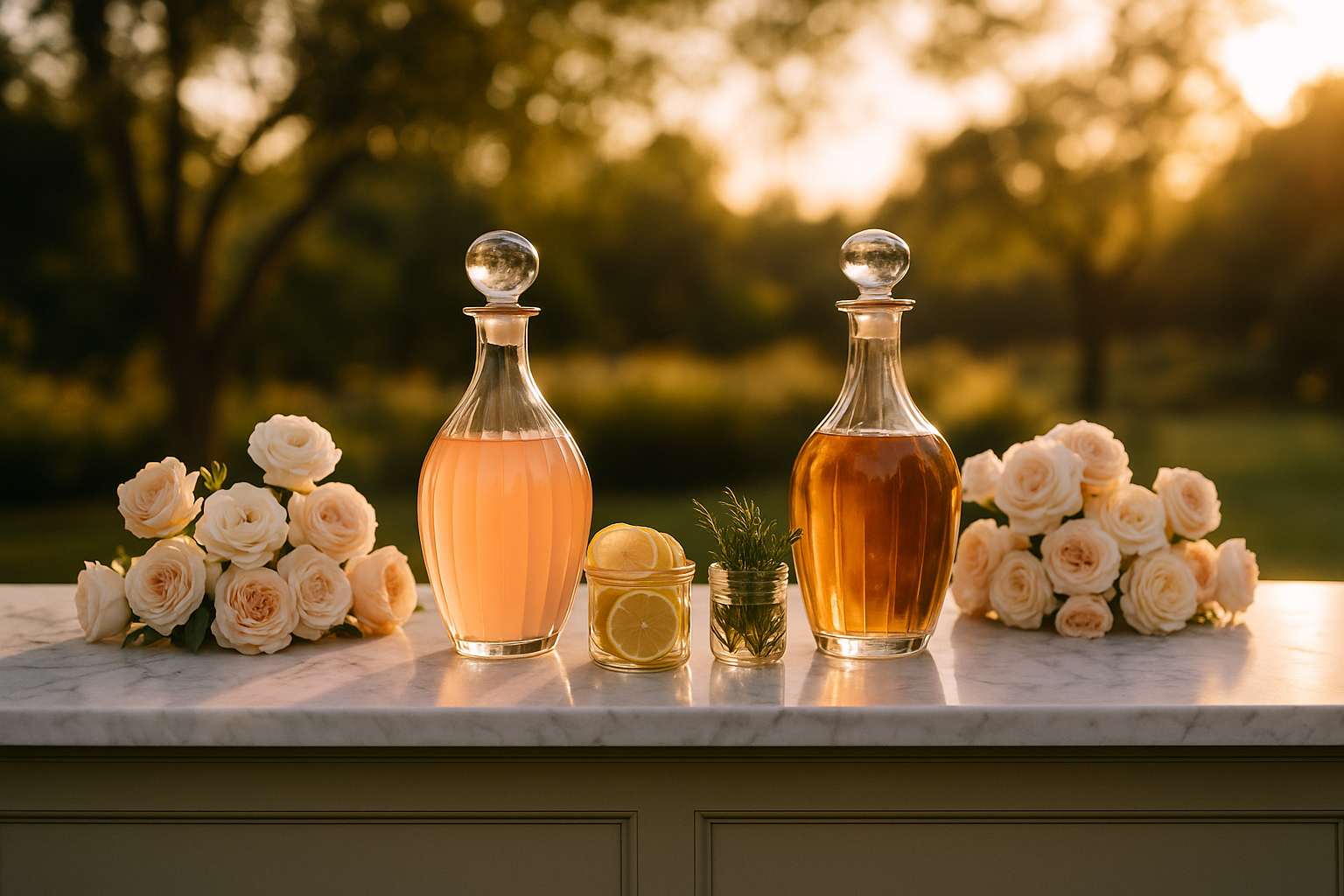
Your wedding bar shapes the entire mood of your reception and typically represents 10 to 15 percent of your total budget. The right bar for you balances genuine hospitality with smart financial choices — and in 2026, that almost always means pairing a curated signature cocktail with a thoughtful zero-proof program that welcomes every guest at the table.
Ask any couple who has been through a reception what guests remember most, and the answer is rarely the centerpieces. It is the moments: the first round of cocktails passed on silver trays during golden hour, the specific drink someone ordered when the dance floor opened, the late-night espresso martini that felt like the whole evening exhaling. The bar is not a logistical line item. It is the heartbeat of the party.
According to The Knot's 2025 Real Weddings Study, alcohol and bar service represent approximately 10 to 15 percent of total wedding spending, with the national average open bar cost landing at $5,541. But the dollar figure alone tells only part of the story. How you structure your bar — what you offer, how you present it, and how thoughtfully you plan the logistics — determines whether your guests feel celebrated or managed.
This guide covers every decision you will face, in the order you will need to make them.
What Are the Different Types of Wedding Bars, and Which Is Right for You?
The first and most consequential decision is bar structure. There are four main options, each carrying different cost implications and different hospitality signals.
Open Bar. An open bar means you cover all drinks for the duration of your reception, or for a defined window of time. It is the American wedding standard and the expectation at most formal receptions. Per-guest costs range from $15 to $30 for a basic tier (house wine, domestic beer, well spirits) up to $50 to $90 for a premium tier (top-shelf liquor, craft cocktails, curated wine list). For 100 guests at the standard mid-tier, most couples spend $4,000 to $6,500 — with dramatic regional variation. The same package that costs around $4,375 in a mid-size Midwestern market can exceed $14,000 in Manhattan.
Beer and Wine Only. Limiting your bar to beer and wine without full spirits saves 40 to 50 percent compared to a full open bar, and the trade-off is smaller than it sounds: industry data consistently shows that 70 to 80 percent of guests gravitate toward beer and wine anyway. This approach is particularly elegant at daytime weddings, garden celebrations, and rustic or bohemian aesthetics where a thoughtful wine and craft beer selection feels intentional rather than limited.
Limited Bar. A limited bar pre-pays a set number of drinks or hours, then transitions — typically shifting to cash bar or closing bar service after the open window ends. If you take this route, communicate the transition clearly on your wedding website and in your reception signage. Guests who are caught off-guard by an unexpected shift to cash bar feel misled; guests who know the structure in advance appreciate the generosity you did provide.
Dry Bar. A dry wedding serves no alcohol. Approximately 8 percent of American couples host them, and that figure is growing: a 2023 Gallup survey found only 62 percent of adults under 35 drink alcohol, down from 72 percent in 2001. Faith traditions including Islam, Latter-day Saints (Mormon), some evangelical and Baptist communities, and Seventh-day Adventist communities commonly observe dry weddings. With the right beverage program — more on that in a moment — a dry reception is not a compromise. It is a hosting philosophy.
| Bar Type | Per-Guest Cost | 100-Guest Estimate | Hospitality Signal | Best For |
|---|---|---|---|---|
| Full Open Bar (Basic) | $15–$30 | $1,500–$3,000 | Generous | Budget-conscious couples who want open service |
| Full Open Bar (Standard) | $30–$50 | $4,000–$6,500 | Warm, celebratory | Most formal evening receptions |
| Full Open Bar (Premium) | $50–$90 | $7,000–$12,000 | Luxurious | Large or upscale celebrations |
| Beer and Wine Only | $10–$25 | $1,500–$3,000 | Warm, curated | Daytime, garden, or intimate weddings |
| Dry Bar (Mocktail Program) | $8–$18 | $800–$2,000 | Intentional, inclusive | Faith-based or sober-conscious couples |
How Do You Calculate How Much Alcohol to Order?
The reliable planning formula used by caterers and event professionals across the industry: two drinks per guest in the first hour, then one drink per guest per hour after that. For a five-hour reception, that is six to seven drinks per guest — or 600 to 700 drinks for 100 guests.
Two refinements matter: first, subtract roughly 15 to 20 percent for guests who do not drink alcohol at all. Second, the cocktail hour is your highest-consumption window, so front-load your staffing and your stocked quantities for that period.
For a 100-guest, five-hour open bar, here is a practical starting point:
- Red wine: 12–15 bottles
- White wine: 10–12 bottles
- Rosé: 6–8 bottles (rosé has become a year-round staple, not a trend)
- Champagne or Prosecco (toast): 20–25 bottles (a 750ml bottle yields 4–5 flutes)
- Beer (assorted): 8–10 cases
- Vodka: 3–4 liters (roughly 17 drinks per 750ml bottle at a 1.5 oz pour)
- Whiskey or Bourbon: 2–3 liters
- Gin, Rum, Tequila: 1–2 liters each
- Ice: 100–150 lbs
Purchase 10 to 15 percent above your estimate. Zola's wedding bar planning guide notes that major retailers including Total Wine & More, Costco, and BevMo typically allow returns on unopened bottles — this strategy eliminates the risk of running dry at 9 PM without tying up money in excess inventory. If you are buying your own alcohol, always verify your venue's corkage policy first. Corkage fees of $10 to $25 per bottle or $5 to $15 per guest can erode the savings; run the math before purchasing retail.
What Makes a Signature Cocktail Worth Remembering?
A signature cocktail does two things at once: it tells your story as a couple, and it simplifies bar service by reducing the number of individual orders the bar team must handle. A well-designed signature cocktail photographs beautifully, creates a memorable guest moment, and — when batched correctly — is often less expensive per serving than a fully stocked premium open bar.
The cocktails that endure in guests' memories are rooted in something true. Named for the location of a first date or engagement proposal. Built around a spirit the couple has always loved. Flavored with something seasonal that maps onto the wedding's color palette. The Golden Hour Spritz. The First Chapter. The Alpine Rose. The name should be easy to say and easy to order from memory after seeing it once on the menu card.
Design for batching from the start. Meet with your caterer's bartender or an independent mixologist at least three to four months out to develop and taste-test the recipe under batching conditions. What works elegantly in a kitchen with precise measurement can fall apart when a bartender is making 200 in an evening. Pre-batched cocktails served from glass decanters or dispensers not only speed service — they photograph beautifully as bar decor.
2026 signature cocktail trends to know:
- Espresso martini stations: The most requested single bar moment at 2026 receptions. Pre-batch using quality cold brew concentrate — single-shot espresso machines create a service bottleneck. Stage the station as a late-night dessert-hour moment for maximum impact.
- Botanical and herb-forward drinks: Lavender gin spritzes, rosemary-infused vodka tonics, basil-muddled citrus drinks — these photograph with beautiful color and pair naturally with floral wedding aesthetics.
- Spritz bars: Aperol, Lillet, and elderflower-based spritzes served tableside or from self-serve stations during cocktail hour. Highly Instagram-friendly and light enough for afternoon celebrations.
- Cocktail flights: Three miniature signature drinks presented on a small tray, each named and described — especially popular for cocktail hour when guests want to explore before committing.
- Cultural heritage cocktails: Palomas, Caipirinhas, Yuzu sours, sake cocktails — reflecting either your heritage or a place the two of you love.
How Do You Build a Zero-Proof Program That Every Guest Will Love?
The sober-curious movement has permanently shifted what wedding guests expect from a non-alcoholic beverage program. In 2026, roughly one in four guests asks for a non-alcoholic option at some point during the evening. Offering only water and a soda gun is no longer a neutral choice — it is a visible statement about whose experience you prioritized.
The bar for zero-proof programming has risen, and so have the ingredients. Three brands have become the foundation of sophisticated non-alcoholic wedding bars:
- Seedlip — The brand that essentially created the modern botanical non-alcoholic spirits category. Seedlip holds 67 percent of search share in the non-alcoholic spirits category and ranks as the No. 1 best-selling non-alcoholic spirits brand globally. Its four expressions — Garden 108, Spice 94, Grove 42, and Notas de Agave — provide a full flavor palette for bartenders building complex mocktail menus.
- Lyre's — The most awarded non-alcoholic drink brand in the world, receiving eight awards at the Low & No Masters 2026. Lyre's produces alcohol-free equivalents of bourbon, tequila, coffee liqueur, triple sec, and vermouth — making it possible to build genuinely accurate espresso martinis, margaritas, and Manhattans with zero proof.
- Athletic Brewing Co. — The brand that forced the beer industry to take zero-proof brewing seriously, producing actual IPAs and stouts rather than watered-down lagers. Athletic's Upside Dawn and Run Wild IPA belong on any wedding bar serving craft beer drinkers.
The most important detail in your zero-proof program: serve non-alcoholic cocktails in the same quality glassware as your alcoholic offerings, and give them names and a story. Positioning the mocktail as the afterthought poured in a plain highglass while the cocktail arrives in a coupe with a dried citrus garnish — that disparity is visible and felt. Equal glassware, equal presentation, equal care.
What Do You Need to Know About Permits, Licensing, and Liability?
The legal layer of wedding bar planning is the one most couples leave until too late. Whether you need a permit depends on three variables: your state, the nature of your venue, and how alcohol is being provided.
A private reception at a venue that already holds a liquor license — most hotels, restaurants, and dedicated wedding venues — typically requires no additional permit from you. The moment you move to a non-licensed space (a barn, an estate, an art gallery, a park pavilion) or purchase and serve your own alcohol, your state's ABC board may require a special event or banquet permit.
State permit examples from official sources:
- Washington State: A Banquet Permit from the WA Liquor and Cannabis Board costs $25 per day and allows service at private, invitation-only events in public spaces. Liquor must be provided at no charge to guests.
- North Carolina: A Limited Special Occasion Permit from the NC ABC Commission costs $50 and must be applied for at least 14 days in advance.
- New York: A One-Day Alcohol Event Permit requires a minimum of 15 business days' lead time and costs $36 per point of sale per day.
- South Carolina: Events selling alcohol after 5 PM must carry a liquor liability insurance policy with $500,000 total coverage.
Apply at least 60 days before your wedding. Processing delays are common, and some states' new mobile bar operator licenses take 30 days to six months. For personal wedding-use permits, most states process in two to four weeks, but the buffer is worth it.
Host liquor liability insurance — covering you personally in the event a guest is over-served and causes harm — costs approximately $100 to $500 for event-day coverage through most homeowners or event insurance providers. Many venues require it contractually regardless of who is pouring.
Finally, hire certified bartenders. Both TIPS (Training for Intervention ProcedureS) and ServSafe Alcohol, developed by the National Restaurant Association, train bartenders in preventing intoxication, recognizing over-service, and managing guest situations safely. As of 2025, states including California, Illinois, Michigan, Nevada, Oregon, Utah, and Washington mandate alcohol server training. Ask any bartender candidate for proof of certification before booking.
Seven Smart Moves That Reduce Your Bar Budget Without Reducing Hospitality
- Limit to beer, wine, and one signature cocktail. Studies consistently show 70 to 80 percent of wedding guests choose beer or wine over full spirits anyway. A curated selection served generously reads more thoughtfully than a stocked full bar served carelessly.
- Shorten the open bar window strategically. Cover the cocktail hour and dinner (three to four hours), then shift to a limited or cash bar for the late-night dancing period when consumption naturally slows.
- Choose mid-tier spirits for mixed drinks. In batched cocktails or even individual mixed drinks, guests cannot distinguish well and mid-shelf spirits from premium. Reserve the premium budget for the wine selection, where quality is more perceptible.
- Swap Champagne for Prosecco or Cava. At a standard toast pour, most guests cannot distinguish Champagne from a quality Prosecco. The price difference is substantial and the visual impact is identical.
- Buy retail when your venue permits — but calculate corkage first. Total Wine & More offers complimentary wedding consultations with certified wine professionals. Costco, the largest wine retailer in the United States, carries Kirkland Signature private-label spirits (Kirkland bourbon and rum are produced by Jim Beam; Kirkland vodka is made by Grey Goose's distillery) at significant savings. BevMo offers periodic buy-one-get-one promotions on wine. Before purchasing retail, verify your venue's corkage policy: at $15 or more per bottle, the venue package frequently wins on total cost.
- Batch the signature cocktail. Pre-batching reduces per-drink cost, speeds service, and creates beautiful bar decor when stored in glass decanters.
- Budget gratuity from the start. Standard bartender tips are $50 to $150 per bartender or 15 to 20 percent of the total bar tab. Pre-prepare cash envelopes before the wedding day — this detail falls through the cracks more often than couples realize.
Common Bar Mistakes — and How to Avoid Them
One bartender for 100 or more guests. The industry standard is one bartender per 50 to 75 guests, moving toward one per 50 for a full open bar with cocktails. Under-staffing the bar is the single most reliable predictor of long lines, frustrated guests, and a reception that loses energy during cocktail hour. If your venue or caterer is recommending fewer, push back.
A complex signature cocktail untested at volume. A beautiful layered drink that requires precise individual preparation may take 45 seconds per glass. At 100 guests, that is a 75-minute line. Design for speed: two ingredients shaken and poured is often more elegant than six ingredients muddled and floated, and it serves 10 times faster.
Ignoring non-alcoholic guests until the day-of. Building a non-alcoholic program as a last-minute addition — a pitcher of lemonade and a can of sparkling water on a folding table — communicates exactly how much thought went into it. Plan your zero-proof menu with the same lead time as your full bar.
Failing to communicate bar details in advance. If you are offering a limited bar, a dry bar, or any deviation from the open bar expectation, note it on your wedding website. Guests who plan their evening around an expectation they arrive to find unmet feel misled — and that impression is stickier than almost any other reception detail.
Frequently asked
Is it rude to have a cash bar at a wedding?
Most etiquette experts and wedding planners consider asking guests to pay for their own drinks at a reception a breach of traditional hospitality — guests have already invested in travel, attire, and a gift. That said, context shapes perception: a casual backyard celebration communicated as low-key is received very differently from a formal seated dinner where guests arrive expecting full service. If budget is the real driver, the far better alternative is beer and wine at no charge rather than a cash bar. You significantly reduce your spend while keeping guests feeling genuinely welcomed. The one non-negotiable: if you do offer a cash bar or a limited bar, note it clearly on your wedding website so there are no surprises on the day.
How much does a wedding open bar cost per person in 2026?
In 2026, open bar pricing ranges from roughly $15 to $90 per guest depending on the tier you choose, your location, and whether you are purchasing through a venue package or a separate bar service. A basic tier — house wine, domestic beer, well spirits — typically runs $15 to $30 per guest. A standard tier with mid-shelf spirits and a broader beer and wine selection is $30 to $50 per guest. A premium tier with top-shelf liquor, craft cocktails, and a curated wine list runs $50 to $90 per guest. For 100 guests at a standard open bar, most couples spend $4,000 to $6,500 nationally, though the same service costs dramatically more in New York City or San Francisco than in smaller markets. Nationally, the average open bar cost sits at approximately $5,541 according to current wedding industry data.
How much alcohol do I need for 100 wedding guests?
The reliable planning formula: two drinks per guest in hour one, then one drink per hour after. For a five-hour reception, plan six to seven drinks per guest — roughly 600 drinks for 100 guests. Subtract about 15 percent for non-drinkers. For a full open bar, that translates to approximately 12 to 15 bottles of red wine, 10 to 12 of white, 6 to 8 of rosé, 20 to 25 bottles of Prosecco for toasts, 8 to 10 cases of beer, 3 to 4 liters of vodka, 2 to 3 of whiskey, and 1 to 2 liters each of gin and tequila. Buy 10 to 15 percent above your estimate from Total Wine & More or Costco, which generally allow returns on unopened bottles. Always check your venue's corkage fee before buying retail — at $15 or more per bottle, the venue package often wins.
Do I need a permit to serve alcohol at my wedding?
Whether you need a permit depends on your state, venue type, and how alcohol is being provided. A private reception at a venue that already holds a liquor license typically requires no additional permit. If you are renting a non-licensed space — a barn, estate, gallery, or park pavilion — or serving your own alcohol, your state's ABC board may require a special event permit. Examples: Washington State's banquet permit costs $25 per day; New York charges $36 per point of sale and requires 15 business days' lead time; North Carolina's Limited Special Occasion Permit costs $50 with a 14-day minimum. Apply at least 60 days out to allow buffer time for processing delays, and verify your state's requirements directly with its ABC authority before the wedding.
What is the most popular wedding bar trend for 2026?
The espresso martini station continues to be the most requested single bar moment at 2026 weddings, particularly as a late-night dessert-hour feature. Couples are pre-batching espresso martinis using quality cold brew concentrate to ensure speed and consistency for 200-plus servings — single-shot espresso machines create a service bottleneck that batching eliminates. Beyond espresso martinis, the leading trends are personalized signature cocktails with a story behind the name, spritz bars featuring Aperol or Lillet served tableside or from a self-serve station, and — critically — mocktail parity, where every signature alcoholic cocktail is matched by an equally thoughtful zero-proof version served in the same beautiful glassware. Roughly one in four guests at a 2026 reception asks for a non-alcoholic option at some point during the evening, making inclusive beverage programming no longer optional.
How do I create a signature cocktail for my wedding?
The most memorable signature cocktails are rooted in your story as a couple: named for the city where you got engaged, inspired by a shared love of a particular spirit or a place you traveled together, or built around seasonal flavors that match your wedding's color palette. Begin by meeting with your caterer's bartender or an independent mixologist at least three to four months before the wedding to develop and taste-test the recipe. Critically, design for batching — a drink that works beautifully when made individually by a bartender can fall apart when scaled to 200 servings if it requires last-minute muddling or precise layering. Pair every signature cocktail with a matching mocktail version using a zero-proof spirit like Seedlip Grove 42 or Lyre's in the analogous flavor profile. A printed cocktail card at the bar telling the drink's story turns a beverage into a memorable guest-experience detail.
Should I hire a certified bartender for my wedding?
Yes — and the certification matters both legally and practically. Look for bartenders who hold TIPS (Training for Intervention ProcedureS) or ServSafe Alcohol certification. TIPS is a nationally recognized program designed specifically to prevent intoxication, underage drinking, and drunk driving; ServSafe Alcohol is developed by the National Restaurant Association and covers the same core competencies. Beyond the legal protection these certifications provide — in many states they are a condition of insurance coverage — certified bartenders are simply better at managing service pace, recognizing when a guest should be cut off, and executing efficiently under pressure. As of 2025, states with mandatory alcohol server training requirements include California, Illinois, Michigan, Nevada, Oregon, Utah, Washington, and Wisconsin, among others. Ask any bartender you are considering to show proof of certification before booking.