Food & Drink
Wedding Cake Trends 2026: The Styles Every Couple Is Talking About
From Lambeth piping revivals to sculptural architectural tiers and botanical sugar work, the most beautiful wedding cakes of 2026 are anything but ordinary. We break down the trends, the bakers pioneering them, and what each approach actually costs.
2026 TrendsCake DesignFlavorsBudget Guide
The quick verdict
From Lambeth piping revivals to sculptural architectural tiers — the most beautiful cakes of 2026 and what they cost
- Best overall
- Lambeth Piping Revival — The most dramatic and customizable trend of 2026 — elaborate Victorian buttercream scrollwork in bold modern colors that is extraordinarily photogenic and works across budget levels.
- Best value
- Cakescaping with a Small Cutting Cake — A relatively simple cake surrounded by a fresh-botanical cakescape achieves dramatic, editorial-worthy impact from a moderate cake budget, with a small cutting cake preserving the traditional cake moment.
- Best for Maximalist floral and black-tie weddings where the cake is a centerpiece
- Botanical Sugar Florals — For maximalist floral and black-tie weddings, hand-sculpted sugar florals deliver gallery-quality, heirloom-keepsake craft that needs no florist coordination and is unconstrained by flower seasonality.
How we evaluated
Trends were identified through a review of leading wedding publications including Brides, Martha Stewart Weddings, and The Knot; portfolio analysis of top U.S. wedding cake studios; and conversations with bakers active in the wedding market in 2025 and 2026. Pricing represents ranges observed across regional and metropolitan markets.
- Visual impact and photographic quality. How striking the trend is in person and how well it reads in wedding photography.
- Alignment with 2025-2026 wedding aesthetic trends. How closely the trend fits the dominant wedding design directions of the current season.
- Accessibility across bakery tiers and budgets. Whether the trend can be achieved by skilled local bakers as well as high-end studios.
- Flavor compatibility and tasting notes. How the design pairs with the flavor profiles couples are choosing in 2026.
- Labor and logistics considerations for couples. The lead time, vendor coordination, and day-of handling each trend requires.
Rating scale: Ratings reflect overall trend impact, versatility across wedding styles, and value relative to cost. Scale of 1 to 10.
Last verified .
At a glance
| # | Name | Rating | Best for | Pricing |
|---|---|---|---|---|
| 1 | Lambeth Piping Revival | 5.0 | Garden weddings, cottage-core aesthetics, maximalist florals, couples who want a show-stopping cake with historic craft | $1,200 – $3,500 for a three-tier cake; additional $300 – $800 premium over equivalent plain buttercream |
| 2 | Sculptural and Architectural Wedding Cakes | 5.0 | Modern and minimalist weddings, art-forward couples, industrial or gallery venue spaces, receptions where the cake is a centerpiece | $2,000 – $6,000 for regional bakers; $10,000 – $30,000+ at Ron Ben-Israel Cakes (NYC) |
| 3 | Cakescaping | 5.0 | Garden, outdoor, and rustic weddings; couples who want maximum visual impact from a moderate cake budget; floral-forward aesthetics | $600 – $1,800 for the cake; additional $200 – $600 for the floral cakescape component |
| 4 | Botanical Sugar Florals | 5.0 | Black-tie and formal weddings, couples who value artisanal craft, those who want a keepsake piece, maximalist floral aesthetics | $2,500 – $8,000+ for a sugar floral-covered cake; Mini Melanie and Ron Ben-Israel at the upper range |
| 5 | Non-Traditional Flavors and Flavor-Forward Design | 5.0 | Couples with strong personal food preferences, farm-to-table receptions, smaller and more intimate weddings, modern-casual aesthetics | $400 – $1,200 for Milk Bar-style cakes; $1,000 – $3,500 for artisan studio cakes with seasonal flavors |
| 6 | Metallic Accents and Gilded Finishes | 5.0 | Black-tie weddings, candlelit ballrooms, late autumn and winter receptions, couples who love Old Hollywood glamour | $800 – $2,500 for metallic-accented cakes; mirror glaze and full gold leaf coverage at premium pricing |
Lambeth Piping Revival
Victorian buttercream scrollwork returned in bold modern colors
Editor's pick
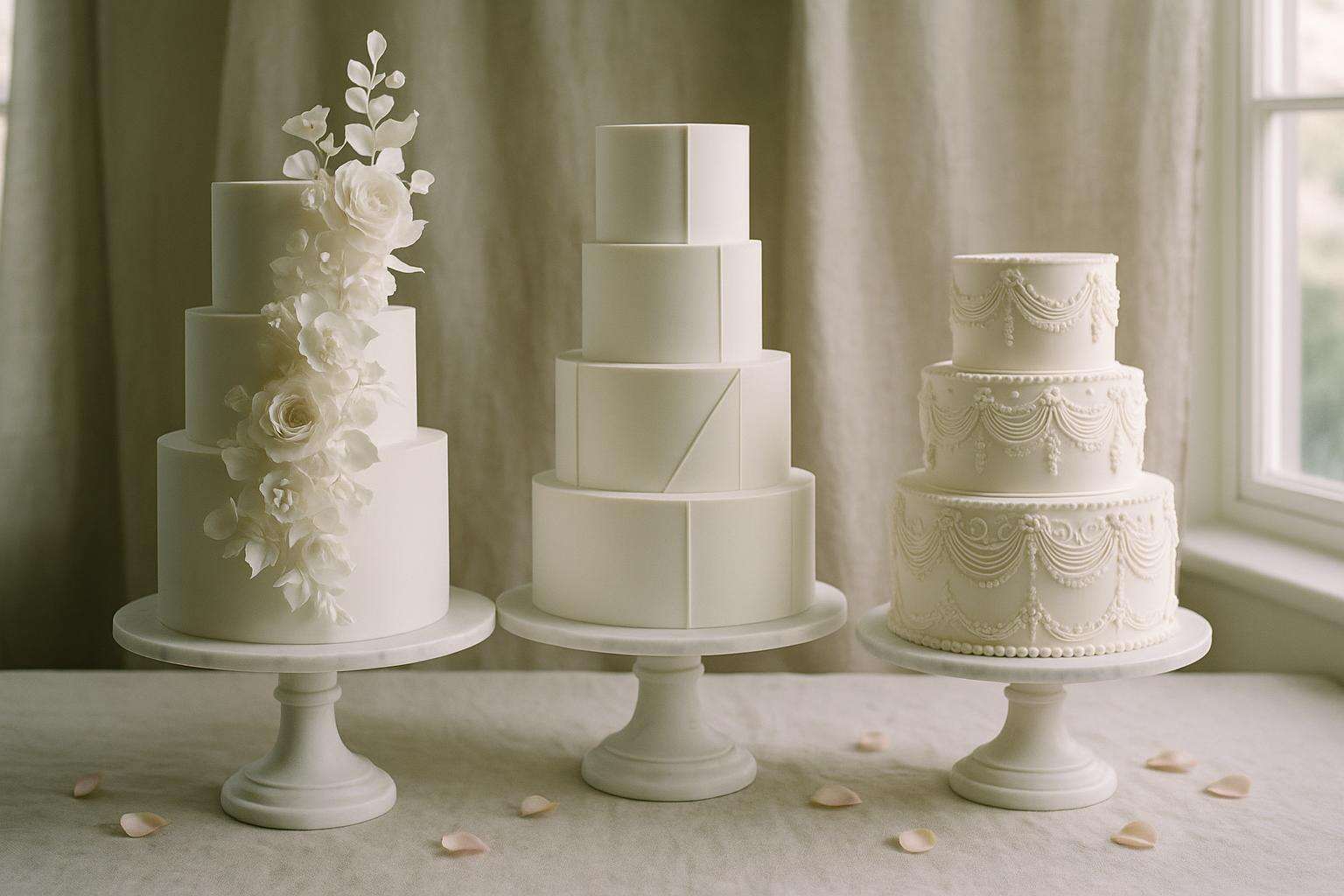
Lambeth piping — the elaborate layered buttercream scrollwork named for pastry instructor Joseph A. Lambeth — vanished almost entirely from wedding cakes during the minimalist era of the 2010s. Its return in 2024 and 2025 has been one of the most dramatic aesthetic reversals in wedding design in years, and it shows every sign of accelerating through 2026. The contemporary interpretation differs meaningfully from the original: while classic Lambeth work was rendered in ivory-on-ivory with shell borders and fleur-de-lis, modern bakers are executing the technique in dusty sage, warm terracotta, soft lavender, and deep plum — often against a contrasting background — creating a maximalist effect that reads as both nostalgic and distinctly contemporary. The technique requires genuine skill: Lambeth piping demands a baker with strong piping control and the patience to layer elements precisely. Expect to see it on three-tier cakes where each tier features a different Lambeth border pattern — scallop shells at the base, intricate scrollwork at the middle, and a chandelier-style overhang at the top tier. It pairs naturally with the cottage-core and garden-party aesthetics that have dominated wedding planning since 2022. Bakeries known for this work include specialists found via the Instagram hashtag community around #lambethcake and broader cake artistry communities.
Strengths
- Extraordinarily photogenic — every angle offers visual interest
- Deeply personal — color choices and pattern combinations are highly customizable
- Works at multiple budget levels — from skilled local bakers to high-end studios
- Pairs naturally with the cottage garden, English countryside, and maximalist floral aesthetics dominant in 2025-2026
Weaknesses
- Labor-intensive technique commands a significant price premium over simpler buttercream designs
- Requires a baker with specific Lambeth piping expertise — not all custom cake studios offer it
- In high humidity or heat, delicate buttercream scrollwork can soften — outdoor summer receptions require climate control
- Best for
- Garden weddings, cottage-core aesthetics, maximalist florals, couples who want a show-stopping cake with historic craft
- Pricing
- $1,200 – $3,500 for a three-tier cake; additional $300 – $800 premium over equivalent plain buttercream
Source: Brides · Visit Lambeth Piping Revival
Sculptural and Architectural Wedding Cakes
Cakes designed as edible sculpture — geometric, asymmetric, and striking
Sculptural wedding cakes treat the confection as a three-dimensional art object, not simply a tiered dessert. This category encompasses a range of approaches: geometric cakes with angular tiers and faceted surfaces; asymmetric stacks where tiers are offset, cantilevered, or dramatically varied in scale; elongated infinity cakes where a single narrow column of tiers rises to dramatic height; and purely sculptural forms that depart from the traditional tier format entirely. Ron Ben-Israel Cakes in SoHo, New York — whose founder Ron Ben-Israel is widely considered one of the most influential figures in American wedding cake artistry — has long pioneered the concept of the wedding cake as a gallery-quality object. His work, along with a generation of bakers trained in fine arts and culinary arts, has pushed the category into genuine sculptural territory. The architectural approach pairs naturally with modern minimalist weddings, industrial or converted venue spaces, and celebrations where visual art plays a central role in the aesthetic vision. Pricing for truly sculptural work is commensurate with its complexity: a Ron Ben-Israel cake commands $10,000 to $30,000 and above for large receptions, while talented regional bakers can achieve compelling architectural work in the $2,000 to $5,000 range.
Strengths
- Unrivaled visual impact — a sculptural cake becomes a genuine focal point of the reception
- Highly distinctive and personal — the design is collaborative and unique to each couple
- Translates beautifully in photography, particularly in minimalist or modern reception spaces
- Ron Ben-Israel and similarly trained bakers offer a true craft-art experience
Weaknesses
- Among the most expensive wedding cake categories — budget must accommodate specialized artistry
- Structural complexity requires expertise in internal support systems; choose a baker with architectural cake experience specifically
- Design consultation timeline is longer — allow 12 to 18 months for top-tier sculptural bakers
- Best for
- Modern and minimalist weddings, art-forward couples, industrial or gallery venue spaces, receptions where the cake is a centerpiece
- Pricing
- $2,000 – $6,000 for regional bakers; $10,000 – $30,000+ at Ron Ben-Israel Cakes (NYC)
Source: Ron Ben-Israel Cakes · Visit Sculptural and Architectural Wedding Cakes
Cakescaping
Fresh botanicals cascade over and around the cake in a living installation
Cakescaping is the practice of treating the wedding cake as the center of a botanical installation — surrounding, cascading over, and partially framing the cake with fresh flowers, dried botanicals, fruit, greenery, herbs, or ornamental grass. The effect is visually spectacular and extraordinarily photogenic: a cakescape transforms the dessert table or sweetheart table into a lush, living display that integrates the cake into the broader floral vision of the reception. The technique rose to prominence around 2022 and 2023 and has continued to grow through 2026, particularly for outdoor, garden, and rustic celebrations where the visual language of abundance and organic beauty already dominates. A well-executed cakescape typically features a cake of three to four tiers — often with a relatively simple cake design, since the botanicals do much of the visual work — surrounded by a curated arrangement of seasonal flowers and greenery that spills off a raised platform or cake board. Some designs incorporate dried pampas grass, eucalyptus, or pressed flowers on the cake itself. The key logistical consideration: cakescaping requires close coordination between your cake baker and your florist. Both must understand the final vision, and the installation typically happens on the wedding day itself, requiring both vendors to be present or to communicate precisely about timing and placement.
Strengths
- Among the most photogenic cake presentations in current wedding design — social media and editorial-worthy
- Allows a smaller, less expensive cake to achieve dramatic impact through floral abundance
- Deeply integrated with overall wedding florals — creates visual cohesion across the reception
- Versatile across seasons — dried botanicals work for winter and fall; fresh for spring and summer
Weaknesses
- Requires coordination between two vendors (baker and florist), which adds logistical complexity
- Not all florists have cakescaping experience — vet your florist specifically for this
- Fresh flowers on or near a cake must be food-safe and properly prepared; confirm with both vendors
- Best for
- Garden, outdoor, and rustic weddings; couples who want maximum visual impact from a moderate cake budget; floral-forward aesthetics
- Pricing
- $600 – $1,800 for the cake; additional $200 – $600 for the floral cakescape component
Source: Martha Stewart Weddings · Visit Cakescaping
Botanical Sugar Florals
Hand-sculpted sugar flowers of breathtaking realism and delicacy
Editor's pick
Sugar florals — individual flowers and botanicals hand-sculpted from gum paste or sugar paste to closely resemble real blooms — represent perhaps the oldest and most technically demanding form of wedding cake artistry, and they have experienced a dramatic resurgence at the highest tier of the market. Ron Ben-Israel Cakes is perhaps the most cited name in American sugar flower work; each petal is sculpted, textured, hand-painted with edible powder and gel colors, and wired to achieve the natural droop and curve of a living flower. Mini Melanie in Brooklyn — whose founder Melanie Moss won on the Food Network's Chopped and whose studio has been recognized by the Michelin Guide — produces extraordinarily refined petit fours and cakes with sugar work that rivals the craft of the finest European patisseries. The 2026 botanical moment has pushed sugar florals toward greater variety: where the mid-2010s favored sugar peonies and roses in blush and white, current sugar work features anemones, sweet peas, ranunculus, hellebores, and even wild grasses and seed pods — any botanical form that can be captured in sugar. The investment is significant: sugar flower work is billed by the piece at top studios, with a single lifelike sugar peony ranging from $15 to $60 depending on size and complexity. A cake decorated with a full cascade of sugar flowers can easily represent $1,000 to $3,000 in floral work alone, before the cake itself.
Strengths
- Heirloom quality — sugar flowers can be preserved after the wedding as a keepsake
- No coordination with a florist required — the entire installation is the baker's craft
- Botanicals are not limited by season or availability — any flower can be created in sugar
- Ron Ben-Israel, Mini Melanie, and similarly skilled bakers deliver work that is genuinely gallery-quality
Weaknesses
- Among the most expensive decorative approaches — top-tier sugar flower cakes command premium pricing
- Requires a specialist baker; not all custom cake studios have the training for high-level sugar work
- Sugar flowers are delicate and can be affected by humidity — handling and transportation require care
- Best for
- Black-tie and formal weddings, couples who value artisanal craft, those who want a keepsake piece, maximalist floral aesthetics
- Pricing
- $2,500 – $8,000+ for a sugar floral-covered cake; Mini Melanie and Ron Ben-Israel at the upper range
Source: Mini Melanie · Visit Botanical Sugar Florals
Non-Traditional Flavors and Flavor-Forward Design
Pistachio, Earl Grey, yuzu, and olive oil replace default vanilla
The flavor trend in wedding cakes for 2026 is as significant as any visual shift: couples are moving decisively away from default vanilla buttercream and standard chocolate, and toward sophisticated flavor combinations that reflect their personal taste. The trend is led partly by bakeries like Milk Bar — Christina Tosi's New York-based brand, now with locations nationally — whose unconventional approach to wedding cakes (crumbly, crunchy, and referencing nostalgic American flavors like birthday cake and Crack Pie) has normalized a non-traditional flavor conversation. Equally influential are artisan baker studios like New June in Philadelphia, where baker Noelle Blizzard works with seasonal and locally-sourced ingredients to create cakes with flavor profiles that read more like fine dining desserts than conventional wedding fare. The dominant flavor pairings of 2026 include: pistachio cake with rose water buttercream; Earl Grey chiffon with bergamot curd and honey mascarpone; yuzu curd with white chocolate Swiss meringue; brown butter almond cake with salted caramel and praline; and olive oil cake with rosemary honey syrup and lemon curd. These pairings are genuinely delicious and pair naturally with the seasonal, locally-sourced, farm-to-table reception philosophy that has increasingly influenced wedding catering over the past decade. Most reputable cake studios offer tastings — always book a tasting appointment before finalizing any flavor selection.
Strengths
- Creates a genuinely memorable and personal dessert experience for guests
- Flavor-forward cakes pair naturally with farm-to-table and seasonal catering philosophies
- Milk Bar and similar studios offer accessible pricing for distinctive, personality-driven cakes
- Pistachio, Earl Grey, and yuzu flavor profiles photograph beautifully when incorporated into ombre or marbled cross-sections
Weaknesses
- Unusual flavors may not appeal to every guest demographic — consider your guest list when choosing
- Some flavor combinations have shorter shelf life; confirm timing and storage requirements with your baker
- Milk Bar's aesthetic is deliberately casual and counter-cultural — it does not suit every wedding style
- Best for
- Couples with strong personal food preferences, farm-to-table receptions, smaller and more intimate weddings, modern-casual aesthetics
- Pricing
- $400 – $1,200 for Milk Bar-style cakes; $1,000 – $3,500 for artisan studio cakes with seasonal flavors
Source: Milk Bar · Visit Non-Traditional Flavors and Flavor-Forward Design
Metallic Accents and Gilded Finishes
Gold leaf, silver lustre, and brushstroke metallic for timeless glamour
Metallic finishes on wedding cakes — gold leaf application, silver lustre dust, bronze and copper brushstroke effects, and hand-painted metallic watercolor panels — have been part of the wedding cake vocabulary for nearly a decade, but their execution and integration with other design elements has grown considerably more sophisticated in 2025 and 2026. The current expression is less about overall gilded coverage and more about metallic as a strategic accent: a single tier sheathed in gold leaf, brushstroke metallic on a textured buttercream base, a geometric hexagonal tier with copper veining over white marble fondant, or delicate gold leaf pressed into the surface between sugar florals. Disco Sugar, the Rochester, New York bakery operated by baker Ali Gala, has built a following around dramatic, personality-driven cake design that frequently incorporates bold metallic and mirror-glaze effects. At the luxury end, painterly gold leaf and platinum application by bakers like those trained at Ron Ben-Israel's studio produces a finish of extraordinary refinement and visual warmth. Metallic finishes are particularly well-suited to black-tie, New Year's Eve, late-autumn, and winter weddings, and to receptions in spaces with warm candlelight, which brings out the depth of gold and bronze tones. The technique is adaptable across budget tiers — gold leaf is relatively inexpensive as a material and can be applied by most skilled cake decorators.
Strengths
- Adaptable across budget tiers — gold leaf is achievable at mid-range price points
- Works beautifully in candlelit reception spaces; warmth and depth of gold tones is unmatched
- Combines naturally with sugar florals, Lambeth piping, and marble fondant textures
- Timeless aesthetic that photographs beautifully in both natural and artificial light
Weaknesses
- Mirror glaze (a dramatic, reflective metallic finish) requires very specific environmental conditions and transport logistics
- Heavy all-over gold coverage can look dated quickly; the more refined partial-application approach is preferable
- Not well suited to bright, casual, or outdoor daytime weddings where the formality of metallics may feel out of place
- Best for
- Black-tie weddings, candlelit ballrooms, late autumn and winter receptions, couples who love Old Hollywood glamour
- Pricing
- $800 – $2,500 for metallic-accented cakes; mirror glaze and full gold leaf coverage at premium pricing
Frequently asked
How much does a wedding cake cost in 2026?
Wedding cake pricing in 2026 ranges dramatically based on design complexity, bakery reputation, and your market. A simple two-tier buttercream cake from a local bakery might start at $400 to $600. Mid-range custom cakes with fondant or detailed piping typically run $800 to $2,000 for 100 guests. Highly artistic designs — particularly sculptural architectural cakes, elaborate sugar florals, or cakescaping installations — can reach $3,000 to $8,000 or more at premium bakeries. In major metropolitan markets like New York or Los Angeles, expect to add a significant premium. Ron Ben-Israel Cakes in SoHo New York, for example, creates heirloom-quality sugar flower work at the highest tier of the market. For most couples, budgeting $10 to $15 per slice for a custom cake from a reputable local baker is a reasonable starting point, with pricing rising from there based on complexity and reputation.
What flavors are trending for wedding cakes in 2026?
The era of default vanilla buttercream with raspberry filling is giving way to much more sophisticated flavor combinations. Pistachio and rose water is perhaps the most-requested pairing of 2025 and 2026 — it offers a floral, nutty elegance that photographs beautifully and pairs naturally with both Middle Eastern-influenced celebrations and classic European styling. Earl Grey and bergamot buttercream brings a subtle citrus-floral note. Yuzu and white chocolate is beloved for spring and summer celebrations for its brightness. Olive oil cake with rosemary honey is popular for Italian countryside aesthetics. Brown butter almond with salted caramel is a perennial trend that continues strong. Matcha and black sesame appeals to couples seeking Asian-inspired flavor profiles. Tasting appointments are standard at most reputable wedding cake studios — always book at least one before committing to a flavor combination.
What is Lambeth piping on a wedding cake?
Lambeth piping is a Victorian-era decorating technique characterized by elaborate, layered buttercream scrollwork, overlapping shells, and intricate border patterns piped directly onto the cake surface. Named for Joseph A. Lambeth, whose 1934 instructional book codified the style, the technique fell out of fashion in the minimalist era of the 2010s and has returned with remarkable force in the mid-2020s. Modern Lambeth piping often departs from the original ivory-on-ivory tradition — bakers are applying the technique in dusty sage, warm terracotta, and deep burgundy, creating a maximalist effect that reads as both nostalgic and contemporary. The technique is labor-intensive and therefore commands a premium: expect to add $300 to $800 to a standard cake quote when requesting Lambeth piping. Bakers with Instagram presence specifically around the technique — search the hashtag #lambethcake — are worth seeking out as specialists.
What is cakescaping and is it worth the cost?
Cakescaping is the practice of treating the wedding cake as a floral and greenery installation rather than a standalone confection — surrounding, cascading over, and sometimes partially obscuring the cake tiers with fresh or dried botanicals, fruit, herbs, or even candles and moss. The effect is dramatic and extraordinarily photogenic: a cakescape can anchor a dessert table or reception corner as a visual centerpiece that guests remember as much as the flowers. The cost premium is real: cakescaping requires coordination between your cake baker and your florist, additional labor, and often same-day installation. Budget an additional $200 to $600 for the floral component beyond your cake quote, and ensure your florist has cakescaping experience — not every floral designer is comfortable working with a finished cake. If the budget is a consideration, a smaller cake with an elaborate cakescape installation can be more cost-effective than a large tiered cake with intricate sugar decoration.
Do I need a wedding cake, or are dessert alternatives acceptable in 2026?
Dessert alternatives are not only acceptable in 2026 — they are genuinely popular, practical for certain venue and guest-count configurations, and often a meaningful budget lever. Cupcake towers remain beloved for their ease of serving and variety. Dessert bars featuring miniature pastries, macarons, tarts, and cookies from a specialty baker like Mini Melanie in Brooklyn can feel more celebratory and personalized than a large tiered cake. Milk Bar's iconic naked cakes and Crack Pie have developed their own dedicated following among couples who want a distinctive, non-traditional cake moment. Tiered croque-en-bouche or macaron towers are popular for French-inspired celebrations. The one thing most couples do keep — regardless of what else they serve — is a small cutting cake for the ceremony moment and photographs, even if the primary dessert service is a different format. A two-tier cutting cake from $300 to $600 plus a separate dessert station is often the most pragmatic and financially efficient approach.