Food & Drink
Wedding Catering Styles: Plated vs. Buffet vs. Stations Compared
The service format you choose determines your staffing costs, your timeline, your floor plan, and a significant portion of how guests experience your reception — here is how each style actually works, what it costs, and which fits your wedding.
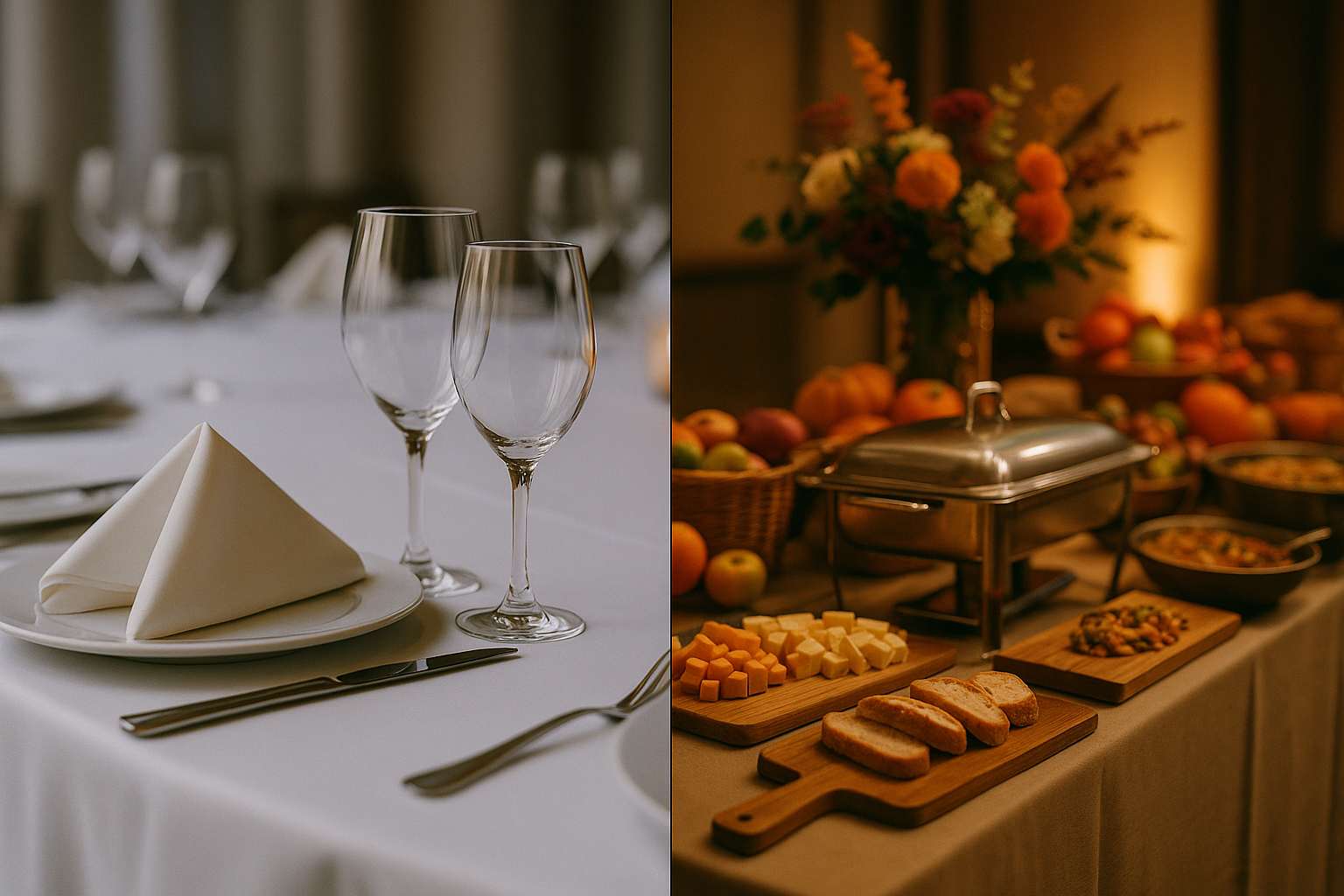
Wedding catering style — plated dinner, buffet, food stations, or family style — is the most consequential structural decision in your reception planning. It determines labor cost, timeline control, guest flow, and floor plan requirements. In 2026, buffets ($50–$90/person) and interactive food stations run significantly below plated dinners ($80–$150/person), while family style ($70–$120/person) offers the warmest communal experience. Hybrid approaches — plated first course, stations for the entrée — have become the consensus recommendation among high-volume planners for receptions above 100 guests.
Most couples choose a catering service style based on aesthetics — plated feels formal, buffet feels relaxed — without fully accounting for how the format affects staffing, cost, floor plan, and the entire experience of the dinner hour. This is the decision that downstream affects nearly everything: the number of servers in your contract, the table configuration, the timeline of the evening, and the difference between a $50 and a $150 per-person catering quote. Understanding the real mechanics behind each style makes the choice clear rather than intuitive.
Industry data from 2026 shows a notable shift in couple preferences: buffets and interactive food stations have overtaken traditional plated dinners in booking frequency, particularly in California and across the Southeast, according to catering professionals quoted in Kanteen SF's 2026 wedding catering trends report. The shift is driven by cost, social atmosphere, and dietary inclusivity — stations make it far easier to accommodate the full range of dietary needs without the stigma of a visibly different plate.
What Are the Real Cost Differences Between Catering Styles?
The cost differential between catering styles is primarily a labor story, not a food story. Ingredients cost roughly the same regardless of whether they are plated individually or served from a buffet line. What changes dramatically is the staffing ratio required to execute each format.
A plated dinner requires approximately one server per 8 to 10 guests to deliver courses simultaneously, clear between courses, and manage the choreography of serving 150 or 200 people in coordinated waves. At a wedding of 150 guests, that means 15 to 20 servers. A buffet at the same guest count requires one server per 25 to 30 guests — five to six servers for replenishment, management, and guest assistance. The labor cost differential between these two staffing ratios, at typical server rates of $25 to $40 per hour across a four-hour dinner service, represents $3,000 to $6,000 in labor alone before any food cost is calculated.
| Style | Typical Cost Per Person (est.) | Staffing Ratio | Best Guest Count | Key Strength |
|---|---|---|---|---|
| Plated (sit-down) | $80–$150 | 1 server per 8–10 guests | Any; most controlled at 50–200 | Timeline control; elegance; reduced waste |
| Buffet | $50–$90 | 1 server per 25–30 guests | 75–250; two lines for 150+ | Cost efficiency; dietary variety |
| Food Stations | $65–$130 | 1–2 staff per station | 100+; requires ample square footage | Social flow; interactive experience; variety |
| Family Style | $70–$120 | 1 server per 12–15 guests | 50–150; table width minimum 36 inches | Communal warmth; on-trend at rustic venues |
| Heavy Hors d'Oeuvres | $35–$70 | 1 server per 20–25 guests | 50–150; best for 3–4 hour receptions | Lowest cost; most flexible format |
Note: All cost ranges are U.S. national estimates for 2026, food and service labor only, before venue service charges (18–22%) and sales tax (6–10%). Regional variation is significant; San Francisco-area plated dinners run $160–$280 per person; Midwest buffets often fall below $60 per person.
How Does Each Catering Style Affect Guest Experience and Reception Flow?
Beyond cost, each service format creates a fundamentally different guest experience — and the right choice depends on what you most want guests to feel during the dinner hour.
Plated dinners offer the tightest control over the evening's rhythm. When every guest is served simultaneously, the coordinator and caterer can time courses to the minute, ensuring that a toast, first dance, or entertainment transition occurs exactly when planned. This predictability is the primary reason most formal and black-tie receptions favor plated service regardless of its higher cost. The trade-off is choice: guests select entrées at RSVP and receive what they ordered, which requires meticulous tracking and can create operational complexity when guests change their minds or last-minute dietary restrictions emerge.
Buffets feel abundant and generous — a long, beautifully styled display signals hospitality and plenty in a way that a controlled plated service cannot replicate. The social dynamic is different too: when guests rise from their tables to collect food, they interact with guests from other tables in ways that a seated dinner does not facilitate. The operational challenge is the opening rush. For a 150-guest wedding with a single service line, the first 20 minutes of buffet service can produce a queue that makes the room feel chaotic. The solution is dual parallel lines, staggered table releases (table by table rather than opening to all guests simultaneously), and confirmed timing with the caterer for exactly how the line management will be handled.
Food stations provide the most socially dynamic dinner experience of any format. When a pasta station in one corner, a carving station near the terrace, and a global street food concept by the bar are operating simultaneously, guests move naturally through the space, discover new combinations, and spend the dinner hour socializing rather than waiting. For venues with the square footage to spread stations generously — at least 400 to 600 square feet per station cluster — this format dramatically outperforms a buffet in pacing and outperforms a plated dinner in social energy. Interactive stations with a chef present (pasta made to order, guacamole prepared tableside, carving done in view) add a theatrical element that consistently becomes one of the most-discussed moments of the evening.
The hybrid approach that planners increasingly recommend for weddings above 100 guests: a plated or passed first course (soup, salad, or a small appetizer) that establishes an elegant, unhurried tone while guests settle and welcome speeches are delivered, followed by buffet or stations for the main course. This structure preserves timeline control at the beginning of dinner while delivering the cost efficiency, dietary flexibility, and social flow benefits of self-service formats for the entrée. It is not a compromise — it is a deliberate design choice that performs better in most receptions than a commitment to either pure format.
Which Catering Style Best Accommodates Dietary Restrictions in 2026?
Dietary accommodation has become one of the most significant practical considerations in wedding catering as the prevalence of vegetarian, vegan, gluten-free, and allergen-specific diets continues to grow. Industry data suggests that 10 to 15 percent of wedding guests have some dietary restriction, with gluten sensitivity, lactose intolerance, and vegetarian preferences being the most common.
Food stations are the most naturally accommodating format: each station can be clearly labeled with allergen information, vegetarian and vegan options can occupy their own distinct station rather than being a single modified plate, and guests self-select without any interaction with staff that might feel stigmatizing. Buffets offer similar advantages with slightly more management complexity — dishes need clear labeling and staff need to be briefed on cross-contamination prevention.
Plated dinners require the most administrative precision: entrée pre-selection at RSVP must capture every dietary requirement, the serving team must match modified plates to the correct guests without error, and last-minute changes create real operational pressure. For receptions where dietary inclusivity is a priority — or where a meaningful share of guests have restrictions — stations or buffet formats are the more forgiving operational choice.
Forward-thinking caterers in 2026 are designing menus that are naturally free from the top allergens across most dishes, rather than creating a few modified plates for accommodation. This approach, described in The Knot's 2026 catering trend coverage, eliminates the two-tier dynamic entirely and allows every guest to eat from the same menu with confidence. When interviewing caterers, ask directly: 'How do you handle dietary accommodations? Do you design menus to be naturally inclusive, or do you prepare separate modified plates?' The answer reveals significant information about how the caterer thinks about hospitality.
Sources: Event Plan With Me — Wedding Catering Cost 2026; LD Events Decor — Plated vs. Buffet Wedding; Kanteen SF — Wedding Catering Menus 2026.
Frequently asked
What is the least expensive wedding catering style in 2026?
Buffet service is consistently the most budget-accessible wedding catering style, typically running $50 to $90 per person nationally in 2026, compared to $80 to $150 per person for plated dinners. The cost differential comes from staffing: a buffet requires roughly one server per 25 to 30 guests, while a plated dinner requires one server per 8 to 10 guests — a three-fold difference in labor cost that compounds significantly at larger guest counts. At 150 guests, the labor cost differential between buffet and plated service can represent $3,000 to $6,000 before food costs are even calculated. Heavy hors d'oeuvres or cocktail-style receptions (no seated dinner, only passed bites and stations) typically cost $35 to $70 per person and are the most budget-friendly format overall, though they require clear communication on invitations so guests arrive with appropriate expectations about the meal format.
What is the difference between a buffet and food stations at a wedding?
Both formats involve guests approaching a display to serve themselves, but the layouts and experiences differ meaningfully. A buffet is a linear or perimeter arrangement where all food categories — proteins, sides, salads, and bread — are presented along one continuous display, and guests move through a single line. Food stations scatter themed culinary concepts across different areas of the venue: a pasta bar at one corner, a carving station near the windows, a taco cart by the outdoor patio. The key experiential difference is social flow — stations disperse guests throughout the space, eliminating single-line congestion and encouraging natural movement and conversation. Food stations typically require more floor space than a buffet and often cost more per person due to the larger total quantity of food prepared across multiple concepts. For venues with good spatial flow and guest counts above 100, stations often outperform buffets in both guest experience and pacing.
Does a plated dinner always feel more formal than a buffet?
A plated dinner creates a more inherently formal visual register — the table is fully set, courses arrive in sequence, and no guest ever leaves their seat to serve themselves — but the formality perception depends significantly on execution, not merely service style. A well-styled buffet with polished linens, floral arrangements framing the display, properly uniformed servers, and premium serving vessels can feel genuinely elegant. A plated dinner served on chipped rental plates at unclothed tables does not feel formal regardless of service structure. The more meaningful distinction for most couples is timeline control: a plated dinner gives the caterer and coordinator precise control over the evening's pacing, making it the preferred format for receptions with tightly choreographed toasts, first dances, and entertainment transitions. Buffets and stations allow more organic guest flow but require more deliberate effort to manage timeline transitions.
What is family-style service, and who is it best suited for?
Family-style service places large platters of food at each table, and guests pass dishes among themselves — a format that is warm, communal, and increasingly popular at farm-to-table, garden, and rustic wedding venues. It typically costs $70 to $120 per person, positioning it between buffet and plated pricing while offering a mid-level labor requirement (fewer servers than plated, but more attentive oversight than a buffet). The primary logistical constraint is table width: family-style service requires at least 36 inches of unobstructed table surface per linear foot to accommodate platter passing without displacing centerpieces, glassware, and place settings. This makes it incompatible with very narrow farmhouse tables or with elaborate floral centerpieces that consume most of the table surface. For the right venue — a wide-table barn reception, a garden dinner, or an Italian-inspired celebration — family-style service creates the most genuinely intimate dining experience of any catering format.
How do you choose between catering styles when planning a large wedding?
For weddings above 150 guests, service pace becomes the dominant decision factor. A single plated service for 200 guests requires approximately 20 servers working simultaneously and precise kitchen coordination — a logistical lift that reflects in the labor cost. Buffet service at the same scale can create 40-person lines at opening if not managed with dual parallel lines and staggered table releases. Food stations, when the venue has adequate square footage to place six to eight distinct station areas, handle large guest counts most smoothly — guests self-select based on preference and proximity, eliminating the synchronous rush. Many experienced planners recommend a hybrid approach for large weddings: a plated or passed first course that sets an elegant tone, followed by stations or buffet for the entrée service. This structure provides timeline control at the beginning of dinner while allowing the flexibility and variety that large guest counts benefit from during the main course.
What hidden costs should you watch for in catering contracts regardless of service style?
Three hidden cost categories appear in virtually every catering contract and are rarely emphasized during the sales conversation. First, the service charge: most caterers add an automatic 18 to 22 percent service charge to the food and labor subtotal, and many also add sales tax on top of that combined figure — on a $12,000 catering contract, this can add $3,000 to $3,600. Second, rental fees for linens, chargers, glassware, and serving vessels, which are billed separately when not provided by the venue — typically $15 to $45 per person. Third, cake-cutting fees ($2 to $8 per guest), which are charged when the couple provides their own cake from an outside bakery rather than the caterer. Request an itemized quote that includes all taxes, service charges, rental fees, and any additional charges before comparing proposals from multiple caterers — the base per-person food cost is not a comparable number without these additions.