Photography & Film
Golden Hour Wedding Portraits: How to Protect the Best Light of Your Day
That 20-minute window of warm, directional sunset light is the highest-return photography opportunity of your wedding — and the most commonly lost. Here is exactly how to protect it, schedule it, and make it unforgettable.
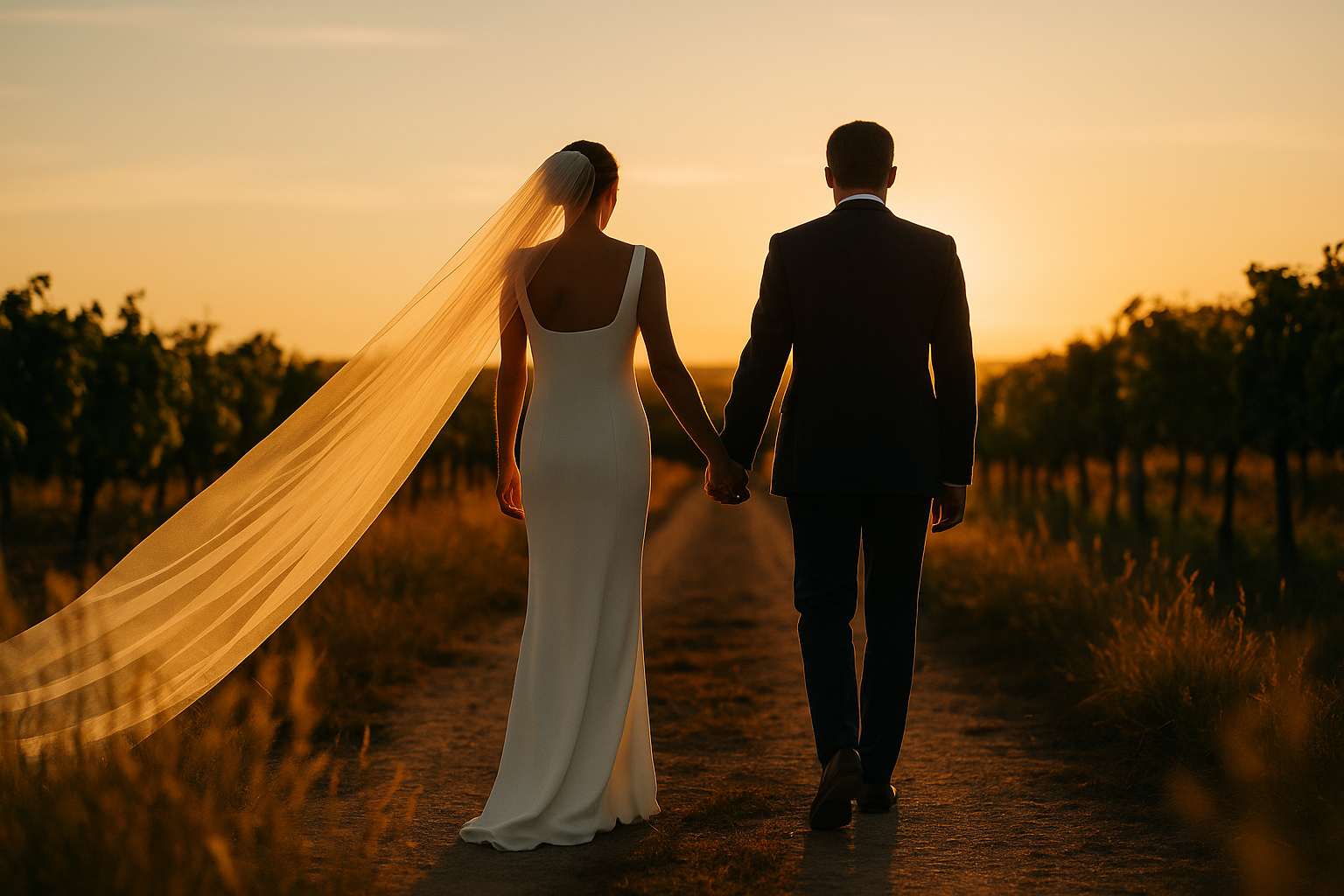
Golden hour — the 30 to 60 minutes before sunset — produces the warmest, most flattering natural light of the entire wedding day. Protect it by scheduling your couple portrait session to begin 45 minutes before sunset, pre-assigning a coordinator to extract you from formalities at that exact moment, and briefing your entire vendor team on the plan in advance.
Why is golden hour the most important photography window of your wedding day?
Of all the decisions that affect the quality of your wedding photographs, the one that carries the highest impact per minute is the simplest: whether or not you protect time for golden hour portraits.
The science behind the light is straightforward. As the sun descends toward the horizon, its rays pass through significantly more of Earth's atmosphere than they do at midday, scattering short blue wavelengths and allowing warm oranges, ambers, and golds to dominate. The light arrives from a low angle rather than overhead, which means it wraps around the contours of a face, illuminates subjects from the side and behind, and creates the rim-lighting effect on hair and shoulders that is essentially impossible to replicate artificially. It is simultaneously the most flattering and the most distinctive natural light condition available to a photographer on dry land.
For wedding photography specifically, golden hour does something else: it creates a natural backdrop. A vineyard at noon is an attractive setting. The same vineyard at golden hour, with the sky behind you in graduated amber and the vines glowing, is a backdrop that makes images feel like editorial art. According to The Knot's wedding photography guide, approximately 60 percent of couples who did not schedule golden hour portraits later wished they had — a figure that reflects how often couples only understand the value of this window after seeing a friend's wedding gallery or, more painfully, after looking at their own.
How do you find your exact golden hour window and build it into your timeline?
Finding the window is the easy part. Managing the discipline to protect it is where most couples fall short.
Start with TimeandDate.com — enter your wedding date and venue city to get the precise sunset time. Your photographer should also confirm this early in the planning process; experienced wedding photographers build every day-of timeline backward from sunset. The golden hour window begins approximately 45 to 60 minutes before sunset and reaches its peak in the final 20 to 30 minutes before the sun drops below the horizon.
| Season | Approximate Sunset | Begin Portrait Session | Peak Light |
|---|---|---|---|
| June / July | 8:00–8:45 PM | 7:15–8:00 PM | 7:45–8:45 PM |
| September / October | 6:30–7:30 PM | 5:45–6:45 PM | 6:15–7:30 PM |
| April / May | 7:30–8:15 PM | 6:45–7:30 PM | 7:15–8:15 PM |
| December / January | 4:30–5:15 PM | 3:45–4:30 PM | 4:15–5:15 PM |
One critical nuance: official sunset times assume an open, unobstructed horizon. If your venue is flanked by hills, tall trees, a tree line to the west, or urban buildings, effective golden light can disappear 5 to 15 minutes before the listed sunset time. Ask your photographer — if they have worked your venue before, they will know exactly when the light arrives and exactly when it goes. If they are new to the venue, request a site visit before the wedding day. This is a completely reasonable ask and a sign of thorough preparation.
Building the window into your timeline requires making it a named, protected commitment on your written day-of schedule — not a vague aspiration. Write it as: 6:45 PM — Coordinator escorts couple for golden hour portraits (25 minutes). Returns to reception by 7:10 PM. Share that line item with your photographer, coordinator, DJ or band leader, and caterer. When every vendor knows the plan, it is nearly impossible for a toast to run long, a cake cutting to drift, or a conversation with a relative to consume the window unnoticed.
What locations and venue features produce the most beautiful golden hour portraits?
Golden hour amplifies whatever is already beautiful about a location, but certain features do the work more generously than others.
Open western horizons are the most valuable feature a venue can offer for golden hour portraits. A vineyard, a meadow, a beach, a rooftop, or a hillside that faces west allows the low sun to illuminate subjects from the front as well as from behind, giving photographers maximum flexibility in angle and composition. Venues surrounded by tall vegetation or walls to the west lose direct golden light earlier than the official sunset time.
Architectural frames work beautifully in golden hour light — a stone archway, a covered bridge, a wooden gate, or a heritage barn doorway creates strong compositional framing while the warm light fills the scene. These features allow a photographer to alternate between wide environmental portraits and intimate close-up work without moving far.
Natural texture and depth — rows of vines, paths through tall grass, allées of trees, garden beds in full summer bloom — create a layered background that golden light transforms into something almost painterly. Venues that feel flat and visually simple at noon come alive in this light simply because the low angle creates long shadows that add dimension to otherwise plain surfaces.
Water features — a lake, a river bend, a reflecting pool — catch golden light in a way that amplifies warmth across the entire scene. Portraits made near water at golden hour frequently have a quality of light that appears almost luminous, as both the sky and its reflection contribute to the ambient glow.
For the couple's part: wear something that catches warm light rather than diffusing it. A gown in silk charmeuse, crepe, or satin will glow in golden hour light in ways that matte fabrics do not. Cathedral and chapel-length veils create dramatic trailing effects in this light that are genuinely difficult to replicate at any other time of day.
How do you make sure golden hour actually happens instead of being swallowed by formalities?
The single most common wedding photography regret — stated consistently across every photographer survey and newlywed reflection — is that golden hour was lost to family formals that ran long, a speech that extended past its planned end, or a first dance that slid late. The light does not negotiate. It arrives and leaves on its own schedule, and the reception does not pause for it unless you have planned specifically for that pause.
The practical defense is a coordinator who has been explicitly briefed. Share the golden hour time, the portrait location, and the 25-minute duration with your coordinator at least two weeks before the wedding. Give them clear authority to extract you from any conversation, dinner service delay, or lingering toast at the designated moment. This is not rudeness to your guests; it is the planned and necessary movement that your entire vendor team is expecting.
The second defense is front-loading formalities. Cluster the first dance, parent dances, and toasts into a single continuous block early in the reception — ideally completed by 90 minutes after the reception begins. This creates a clean runway into golden hour without the risk of a running-late chain reaction from multiple scattered events. The dinner service sneak-away strategy works particularly well when formalities have been completed: step away during dinner service, capture the portraits, and return before the dance floor opens.
Brief your DJ or bandleader as well. They can fill the sneak-away window gracefully with a curated playlist and warm MC commentary without drawing attention to your absence. A DJ who knows you will be back in 25 minutes can manage the room beautifully; a DJ who is caught off guard may create an awkward energy gap.
Finally, pre-scout with your photographer. Walking the portrait locations together — even 30 minutes before the ceremony — means that when the golden window opens, you move directly and confidently to the spot, set up quickly, and spend every minute of the available light making photographs rather than making decisions. The couples with the most beautiful golden hour galleries are almost always the couples who prepared the most specifically for those 20 minutes.
Frequently asked
What exactly is golden hour, and why does it matter so much for wedding portraits?
Golden hour is the period of approximately 30 to 60 minutes immediately before sunset — and, less commonly used in weddings, the equivalent window after sunrise. During this time, the sun sits at a low angle on the horizon, producing light that is warm in color temperature, soft in quality, and directional rather than overhead. That combination of warm, diffused, angled light is uniquely flattering to human subjects: it illuminates faces evenly without creating harsh under-eye shadows, wraps around the contours of a gown with a natural glow, and produces a rim-lighting effect on hair and shoulders that no studio light can replicate. Portraits made in this window have a quality of warmth and intimacy that flat midday or indoor light simply cannot achieve. According to a survey cited by The Knot, approximately 60 percent of couples who did not schedule dedicated golden hour portraits later wish they had.
How do I find out when golden hour occurs on my specific wedding date and at my venue?
The starting point is a reliable sunset calculator. TimeandDate.com allows you to enter any city and specific date to get the precise sunset time; PhotoPills is the professional photographer's tool of choice, with a sun-tracking augmented reality view that lets you visualize exactly where the sun will be at any location at any moment. Your photographer should already have this information for your venue and date — ask them at your first planning meeting to confirm it. One important nuance: the official sunset time assumes an open, flat horizon. If your venue is surrounded by hills to the west, tall trees, or urban buildings, the effective golden light may arrive and end 5 to 15 minutes earlier than the official time. A photographer who knows your venue from previous experience can tell you exactly how the light behaves there. If your photographer is new to the venue, request that they visit it before your wedding day.
How long do we actually need for golden hour portraits?
A skilled wedding photographer needs 15 to 25 minutes of dedicated golden hour time to produce a strong, varied gallery of couple portraits. That is enough for several distinct setups — backlit walking shots, a quiet intimate close-up, a wider environmental frame showing the venue, and perhaps a silhouette against the sky. Some couples and photographers prefer a full 30-minute window to allow for moving between two or three different spots. More than 35 minutes rarely yields meaningfully better results and cuts into dinner or dancing time in ways that your guests will feel. The quality of the session depends far more on how intentionally those 20 minutes are used than on extending the window. A photographer who has pre-scouted the location and knows exactly where to go arrives ready to capture beautiful images immediately, without spending your golden window walking and looking.
What is the 'sneak away' strategy, and how do we pull it off gracefully?
The sneak away — also sometimes called a portrait escape — is the practice of stepping away from your reception for 15 to 25 minutes during dinner service to capture golden hour portraits. The logic is elegant: guests are focused on their meals, the formalities have been completed or paused, and your absence during a dinner-service window is far less noticeable than disappearing during cocktail hour or dancing. The key to making it feel graceful rather than abrupt is briefing your wedding coordinator and your DJ or band leader in advance. Your coordinator ensures the dinner flow continues without you; your entertainment keeps the atmosphere warm during the window. Most couples who have used this strategy report that guests either did not notice they were gone or simply assumed they were taking a short photography break — which is exactly what it is. Share with your photographer in advance the location you will visit, and have your coordinator ready to cue the transition at precisely the right moment.
What happens if it is cloudy on our wedding day — do we lose golden hour entirely?
Overcast skies do not eliminate beautiful portrait opportunities, and many experienced wedding photographers argue that soft cloud cover actually produces superior light for certain styles of portrait work. Clouds act as a natural giant softbox, distributing light evenly across the scene and eliminating harsh shadows and bright hot spots. The specific warm, directional quality of true golden hour light is reduced on overcast days, but the softness can produce portraits with a gentle, painterly quality that some couples prefer to the higher-contrast look of a clear-sky golden hour. What matters most is that you keep the portrait window in your timeline regardless of the weather forecast. If the light cooperates, you will get spectacular images. If it does not, your photographer adapts — and you still have a quiet, intentional moment together away from the reception, which has value entirely separate from the photography.
What should we actually do during golden hour portraits — are we just posing the whole time?
The most beautiful golden hour portraits almost never come from static posing. The images that couples treasure most from this window are almost always captured during motion — walking together and letting your hands swing naturally, whispering something real to each other, laughing at an actual joke, looking at the view rather than the camera. A skilled photographer prompts authentic engagement rather than manufactured poses. Before the session, tell your photographer two or three things that feel genuinely like you as a couple: a song you both love, a place you always walk together, a joke only the two of you share. That context produces direction that generates real emotion, which the camera captures faithfully. You do not need to be models. You need to be present and willing to let the session breathe rather than rushing it.