Photography & Film
35 Wedding Detail Shots Your Photographer Must Capture
Detail shots are the editorial anchors of your wedding album — the images that give the eye moments of rest between portraits and document the investment you made in objects that will not be seen again after the wedding day.
Wedding Detail ShotsPhotography Shot ListWedding Flat LayGetting-Ready PhotosEditorial Wedding Photography
The quick verdict
The complete checklist for every detail image category — from getting-ready suite to reception decor — with timing guidance and 2026 trend notes.
- Best overall
- Both rings together on a styled surface with bouquet — The single image most brides say they treasure most — rings, florals, and light together in one frame.
- Best value
- Dress hanging in natural window light — Requires no props, no setup, and produces the most time-efficient high-impact detail image of the entire morning.
- Best for Brides with heirloom jewelry or sentimental objects
- Heirloom piece styled with contemporary bouquet details — The generational visual narrative this image creates is irreplaceable and among the most emotionally resonant in any wedding gallery.
How we evaluated
This checklist was built from the intersection of two sources: the photographic criteria that experienced wedding photographers consistently identify as producing the highest-impact album images, and the objects brides most frequently report wishing they had documented better. Items are ranked by a combination of emotional resonance, frequency of request, and visual versatility — the photographs that matter most in the album, perform best across album formats, and are most commonly missed when a brief is not provided. Every item is achievable within a standard wedding photography timeline. The 35 items on this list reflect what a thorough, detail-focused photographer will complete in a 60-minute detail window with proper preparation. Items requiring additional setup or coordination (drone overhead, reception details before guests enter) are flagged accordingly.
- Emotional resonance. How frequently this shot is cited by brides as among the most treasured images in their final gallery.
- Visual impact. How effectively the image communicates the quality and intention of the wedding's details at album scale.
- Timeline feasibility. Whether the image can be captured within a standard pre-ceremony detail window without disrupting other coverage.
- 2026 relevance. Alignment with current editorial trends in wedding photography — film aesthetic, macro detail, styled flat-lay formats.
- Missed-shot frequency. How often this image is absent from wedding galleries without an explicit brief, based on wedding photography community feedback.
Rating scale: Ratings are on a 1–5 scale in half-point increments, reflecting combined editorial impact and emotional significance.
Last verified .
At a glance
| # | Name | Rating | Best for | Pricing |
|---|---|---|---|---|
| 1 | Both rings together on a styled surface | 5.0 | The most treasured single detail image in most wedding galleries | No additional cost — standard part of detail coverage |
| 2 | Wedding dress hanging in natural window light | 5.0 | The establishing image of every getting-ready sequence | No additional cost — standard first sequence of photographer arrival |
| 3 | Invitation suite styled flat-lay | 4.5 | The paper record of your wedding's visual identity | No additional cost; set aside a pristine spare invitation for photography use |
| 4 | Bridal bouquet — full face and macro bloom detail | 4.5 | The floral investment documented at its peak | No additional cost; coordinate bouquet delivery timing with florist |
| 5 | Wedding shoes — soles up, heels together, with bouquet | 4.0 | The classic bridal detail that never stops being beautiful | No additional cost; prepare soles the evening before the wedding |
| 6 | Heirloom jewelry or sentimental object | 5.0 | The most irreplaceable detail shot in any gallery | No additional cost; requires written brief to photographer 3–4 weeks before wedding |
| 7 | Veil — draped and in motion | 4.0 | The most ethereal detail shot available to the bridal suite | No additional cost; time within the first 30 minutes of photographer arrival |
| 8 | Ceremony venue — wide establishing shot before guests arrive | 4.5 | The architectural record of where your vows were spoken | No additional cost; requires coordination of timing window with venue coordinator |
| 9 | Reception tablescape — before guests enter | 4.5 | The designed dining room, documented at its intended best | No additional cost; requires 10–15 minute protected window in day-of timeline |
| 10 | Wedding cake — full view and sugar flower close-up | 4.0 | The centerpiece of the reception's sweetest moment | No additional cost; coordinate placement timing with catering team |
Both rings together on a styled surface
The most treasured single detail image in most wedding galleries
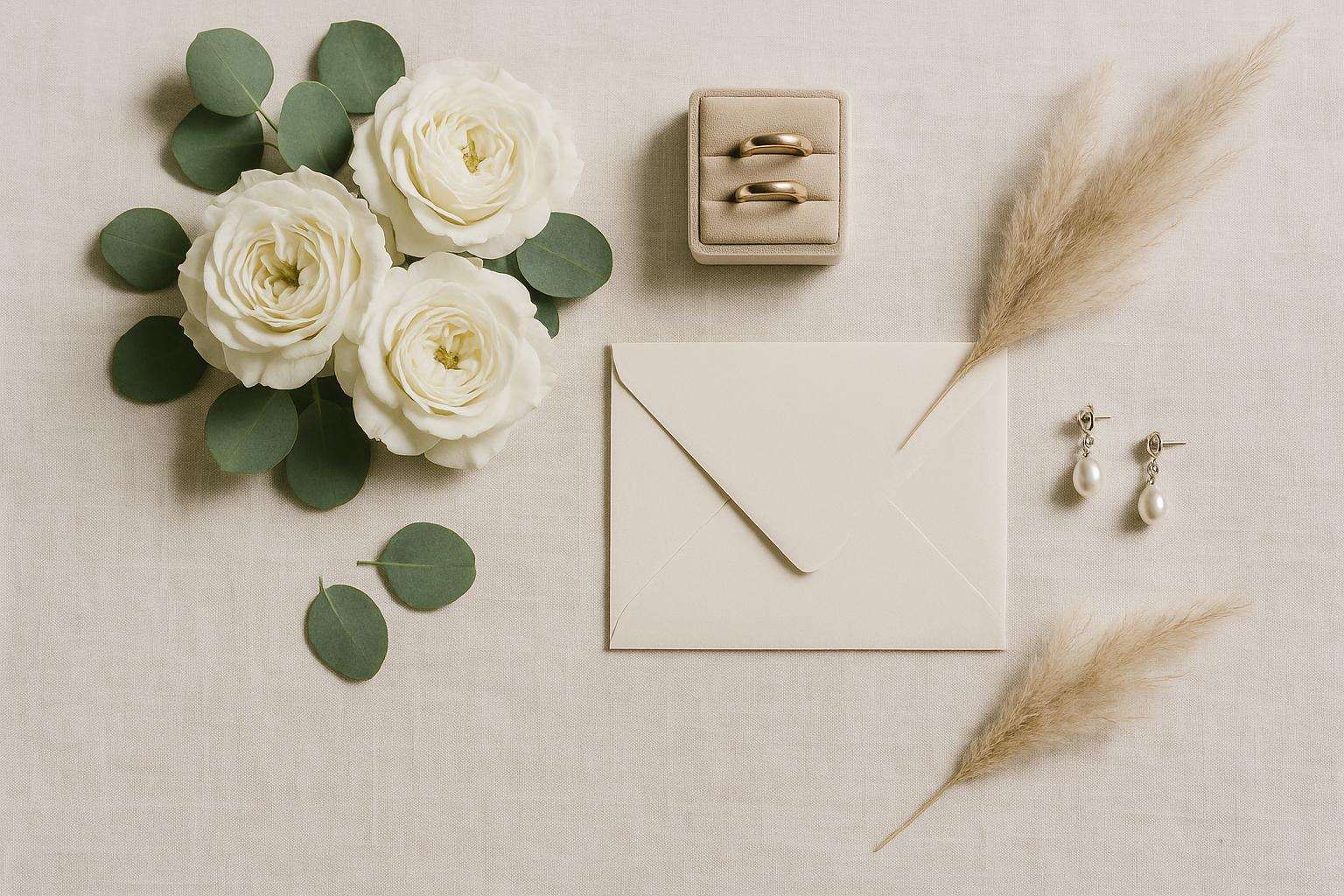
Both wedding bands together — engagement ring included if worn — on a carefully chosen surface: the invitation card, a clean marble or wood background, nestled in the ring box with its lid open, or placed on a soft floral element from the bouquet. The photographer uses a macro lens and prioritizes the ring engraving if present, the metal's reflective quality in available light, and the relationship between the two bands as objects. This is the detail shot brides cite most frequently as a gallery essential and the one most commonly referenced in album design. The best versions are taken in natural, directional light — near a window, not under room artificial light — and styled with enough simplicity that the rings are the undisputed subject. Ask your photographer specifically about macro capability: not all lenses can produce the ring close-up quality that makes this image work at album spread scale.
Strengths
- Highest emotional resonance of any detail shot across all wedding styles
- Versatile for album spreads, social media, and framed prints
- Works in any natural light quality, morning through afternoon
Weaknesses
- Requires a macro or close-focus lens — not all photographers carry one; confirm at booking
- Best for
- The most treasured single detail image in most wedding galleries
- Pricing
- No additional cost — standard part of detail coverage
Source: The Knot
Wedding dress hanging in natural window light
The establishing image of every getting-ready sequence
The wedding gown, hanging on a beautiful hanger (provided by the bride — a padded or custom monogrammed hanger photographs far better than the plastic dry-cleaning version), positioned near the best available natural light source in the getting-ready suite. The photographer captures the silhouette, the backlit translucency of the fabric, and any detail elements — lace, buttons, embroidery, train length — that the bride chose this dress for. The clean room brief matters enormously here: a wall hook near a window in a clutter-free background produces a dramatically better image than the same dress hanging from a bathroom door. Most photographers will set up this shot before any human subjects are present — it is typically the first detail captured after arrival. Variants: dress hung from a vintage door handle or meaningful architectural detail at the venue; train laid on the floor in its full dimension; close-up of the bodice embroidery, buttons, or lace pattern.
Strengths
- Requires no prop styling or additional setup — just light and a clean background
- Documents the gown's investment and design in a way portraits cannot fully replicate
- Provides the visual anchor for the getting-ready chapter of the album
Weaknesses
- Highly dependent on getting-ready suite light quality — brief your coordinator to identify the best window early
- Best for
- The establishing image of every getting-ready sequence
- Pricing
- No additional cost — standard first sequence of photographer arrival
Source: Artifact Uprising
Invitation suite styled flat-lay
The paper record of your wedding's visual identity
The complete invitation suite — outer envelope, invitation card, all enclosures, RSVP card — arranged in a composed flat-lay with complementary styling elements: a small floral detail, wax seal, ribbon, or pen. This image documents the stationery investment, establishes the visual identity of the wedding for the album's opening spreads, and is among the most frequently shared and saved detail photographs from any wedding. The flat-lay format has become the dominant editorial style for this image in 2026, replacing the earlier convention of propped-against-a-surface shots. Clean, even overhead light is ideal — the composition should be simple enough that the invitation's typography and design remain legible and prominent. Tip: bring a spare invitation specifically for photography — the one that goes to the photographer should not be the one that has traveled to and from vendor meetings in your bag. A practical tip from working photographers: shoot the suite both flat overhead and at a slight three-quarter angle, because the overhead frame reads cleanest in an album spread while the angled frame shows paper texture, letterpress depth, and any deckled or beveled edge. If your suite includes a wax seal, vellum overlay, or hand-calligraphed envelope, point those out in the brief so they are featured rather than cropped out.
Strengths
- Documents the stationery design that guests first experienced from the wedding
- Flat-lay format is highly versatile for album, digital, and print use
- Pairs naturally with bouquet and jewelry for a comprehensive opening spread
Weaknesses
- Requires a clean, styled surface and decent flat-lay composition skill — not all photographers prioritize this category equally
- Best for
- The paper record of your wedding's visual identity
- Pricing
- No additional cost; set aside a pristine spare invitation for photography use
Source: Aftershoot
Bridal bouquet — full face and macro bloom detail
The floral investment documented at its peak
Two distinct bouquet images serve different narrative functions. The full-face shot captures the complete bouquet design — shape, color palette, bloom variety, trailing elements — in a way that communicates the florist's vision and the overall floral investment. The macro shot moves in close to a single bloom, petal, or detail element — a ranunculus head in full unfurl, a trailing ribbon's texture, a tucked-in heirloom brooch — for an intimate, editorial image that pairs differently in the album layout. Both are ideally captured in the first hour of photography, before the bouquet has been handled extensively by multiple people. Morning light on florals is exceptional: the soft, directional quality brings out color saturation and petal translucency in ways that midday overhead light rarely matches. If your florist will deliver bouquets to the getting-ready location, request delivery timed to arrive within the first hour of photography. Ask whether your photographer carries a dedicated macro lens, such as a 100mm macro, because the texture of a single petal or the dew-like sheen on a fresh bloom only renders at that magnification. Coordinating the bouquet's arrival within the first photography hour is the single most common scheduling miss, so confirm the delivery time with your florist in writing the week of the wedding.
Strengths
- Documents the floral investment at its freshest and most composed
- Two-format coverage (full and macro) provides album layout versatility
- Florals change over the day — morning images capture peak bloom quality
Weaknesses
- Timing-dependent: requires bouquet delivery to align with photography arrival window
- Best for
- The floral investment documented at its peak
- Pricing
- No additional cost; coordinate bouquet delivery timing with florist
Source: The Knot
Wedding shoes — soles up, heels together, with bouquet
The classic bridal detail that never stops being beautiful
The wedding shoe detail shot exists in multiple forms, each producing a distinct image. Soles facing up — a classic orientation that shows the shoe's profile against a styled background — is the most enduring format and has remained consistent across wedding photography trends for over a decade. Heels together with the bouquet resting between them creates a composed still-life that connects footwear and florals in a way that reads naturally in album spreads. A third option: shoes styled with another meaningful detail object (the invitation, a piece of heirloom jewelry, the veil). The most important preparation: clean the soles before the wedding morning, particularly if the shoes are new. A fresh sole mark or sticker residue in a beautifully styled photograph is the kind of small, avoidable detail that diminishes the image. New shoes should be styled with accessories that add visual interest; worn shoes (particularly vintage or borrowed pieces with personal significance) benefit from a closer, more intimate crop that honors their history.
Strengths
- Versatile across multiple styling orientations
- Documents an accessory that is visible throughout portraits and ceremony coverage
- Clean soles provide a neutral, composable background element
Weaknesses
- Sticker residue and scuffs on new soles are highly visible in close-up photography — prep in advance
- Best for
- The classic bridal detail that never stops being beautiful
- Pricing
- No additional cost; prepare soles the evening before the wedding
Source: Artifact Uprising
Heirloom jewelry or sentimental object
The most irreplaceable detail shot in any gallery
If you are wearing your grandmother's pearl earrings, your mother's bracelet, a brooch from your great-aunt's collection, or carrying any object with a specific generational story — a handkerchief, a prayer book, a locket with a photograph — this image requires an explicit brief, not a general detail list. The photographer needs to know what the object is, why it matters, and how you want it documented: worn in context during a portrait, styled in the flat-lay with other details, or captured in a specific setting that honors its history. This is the detail shot most frequently reported as absent from wedding galleries when no brief was provided, and the one whose absence brides most consistently mourn in the years that follow. Write it on the shot list by name. Include a note explaining its significance. The photograph of your grandmother's engagement ring resting beside yours is worth more than any trend-forward editorial image.
Strengths
- Highest long-term emotional value of any detail category
- Irreplaceable — the specific object in its wedding-day context cannot be recreated
- Provides the generational narrative thread that makes wedding albums meaningful across decades
Weaknesses
- Entirely dependent on an explicit brief — will not be captured without a named, specific instruction
- Best for
- The most irreplaceable detail shot in any gallery
- Pricing
- No additional cost; requires written brief to photographer 3–4 weeks before wedding
Source: Kelly Photo and Design
Veil — draped and in motion
The most ethereal detail shot available to the bridal suite
The veil is one of the most photogenic detail elements in the entire getting-ready sequence — its translucency in natural light, its movement in a slight breeze from a window, its cascade against the dress create images that are simultaneously editorial and intimate. Two categories of veil shot serve different purposes. The styled static image — veil draped over a chair or hanger, catching window light — captures the fabric's quality and embellishment detail (embroidered edge, lace trim, cathedral length). The motion image — veil being placed by a bridesmaid or family member, or lifted slightly to create movement — captures the emotion of preparation and is a natural transition image between the detail and getting-ready sequences. If you are wearing a cathedral or chapel-length veil, a single wide shot that shows its full length against the dress in the dressing room is an image that functions as a stunning album opener. Request it explicitly.
Strengths
- Translucency in natural light creates some of the most ethereal photography available in the morning sequence
- Static and motion variants serve different album layout purposes
- Length documentation is particularly valuable for long and cathedral-length styles
Weaknesses
- High-quality veil photography requires excellent natural light — works less well under overhead artificial light
- Best for
- The most ethereal detail shot available to the bridal suite
- Pricing
- No additional cost; time within the first 30 minutes of photographer arrival
Source: The Knot
Ceremony venue — wide establishing shot before guests arrive
The architectural record of where your vows were spoken
A wide-angle shot of the ceremony space — whether a church nave, a garden arbor, a beach pavilion, or a courthouse courtyard — taken before any guests have arrived and the space is at its most composed and uncrowded. This is the establishing image of the ceremony chapter: it contextualizes every subsequent ceremony photograph by showing the space in its designed and intended state. For elaborately decorated ceremonies with floral arches, aisle petal runners, or draped fabric installations, this image also documents the florals and décor investment at their peak, before any movement or wear from the ceremony itself. The shot is most commonly taken by the second photographer while the primary is still with the bridal party, or in the 15-minute window before guests begin to be seated. It requires coordination with the venue coordinator and ceremony team to protect the window. Worth requesting explicitly in the timeline brief.
Strengths
- Provides the narrative establishing context for the entire ceremony chapter
- Documents ceremony décor investment at its most pristine
- Accessible without additional cost or equipment
Weaknesses
- Timing-dependent — requires the space to be completed and empty before guest arrival
- Best for
- The architectural record of where your vows were spoken
- Pricing
- No additional cost; requires coordination of timing window with venue coordinator
Source: WedPicsQR
Reception tablescape — before guests enter
The designed dining room, documented at its intended best
The 10 to 15 minutes immediately before guests enter the reception room represent the only window in which the entire tablescape — linens, centerpieces, place settings, menu cards, escort cards, table numbers, chargers — can be photographed in its complete, undisturbed state. After guests arrive, chairs are moved, linens are shifted, and centerpieces are touched and adjusted. This window requires proactive timeline planning: the reception space needs to be accessible and complete 15 minutes before doors open, and the photographer needs to be released from other coverage (typically wrapping up cocktail hour candids) to document it. The images from this window are among the most useful for the couple's memory and for vendor use (florists and planners frequently request these images for their portfolios). Request explicitly in your timeline that this window is protected. It is one of the most commonly lost opportunities on wedding days and one of the easiest to protect with planning.
Strengths
- Documents the complete reception design investment at peak condition
- Highly valuable to floral, planning, and venue vendors for portfolio use
- Provides album layout material for the reception chapter opening
Weaknesses
- Requires explicit timeline protection — lost forever once guests enter the room
- Best for
- The designed dining room, documented at its intended best
- Pricing
- No additional cost; requires 10–15 minute protected window in day-of timeline
Source: Aftershoot
Wedding cake — full view and sugar flower close-up
The centerpiece of the reception's sweetest moment
Two distinct cake images serve the album differently. The full view — cake on its stand, in context with its table styling, ideally with the reception room visible in the background — documents the complete cake design and its scale. The close-up — a single tier, a sugar flower cluster, a cascade of fresh blooms, the monogram topper or ribbon detail — creates an intimate image for the album's detail pages. Both are ideally captured before the cake cutting, when the design is intact and the surface is uncut. Coordinate with your catering team on when the cake will be displayed: it should be in place and styled at least 30 minutes before guests enter the reception room to allow documentation in the early reception photography window. The full-view image also provides the cake designer with their primary portfolio photograph — a consideration that often motivates excellent cake placement and styling from the vendor's side.
Strengths
- Documents a significant budget investment in the reception design
- Two-format coverage provides album layout versatility
- Full-view image serves vendor portfolio purposes as well as album use
Weaknesses
- Lighting quality at the cake table varies significantly by venue; position away from direct sunlight
- Best for
- The centerpiece of the reception's sweetest moment
- Pricing
- No additional cost; coordinate placement timing with catering team
Source: The Knot
Frequently asked
When should wedding detail shots be photographed during the day?
Detail shots are almost always captured in the first 30 to 60 minutes after your photographer arrives, while you are still in hair and makeup and the getting-ready space is calm. This early window matters for two reasons. Natural morning light through a window is the most flattering light of the entire day for still-life images, and the objects — rings, invitation suite, shoes, jewelry, bouquet once delivered — are pristine and unhandled. To make the most of it, gather every detail item into one place before the photographer arrives, or ask your maid of honor to do it, so no time is lost hunting for a missing earring or the second wedding band while the good light slips away.
How many detail shots should I expect in my final wedding gallery?
Most full-day wedding galleries include somewhere between 25 and 50 detail images, though the exact number depends on how many meaningful objects you have and how much time is protected in the timeline. A thorough, detail-focused photographer working from a brief can capture roughly 35 distinct detail frames in a 60-minute window. Quality matters far more than volume here. Five beautifully styled, well-lit detail images of your rings, invitations, shoes, bouquet, and an heirloom piece will serve your album better than thirty rushed snapshots taken in poor light. Ask to see full galleries from past weddings so you can judge how consistently a photographer delivers detail coverage, not just their highlight reel.
What should I prepare so my photographer can style the detail shots?
Assemble a small detail kit and have it ready before the photographer arrives. Include both wedding bands and the engagement ring, the invitation suite with envelope and any enclosures, the bouquet once it is delivered, your shoes with the soles cleaned, perfume, jewelry, the veil, and any heirloom or sentimental object. Many photographers also appreciate a few neutral styling props — a ring box, a length of silk ribbon, or a small sprig from the florals. A padded or wooden hanger for the dress photographs far better than the plastic one it came home on. Clearing visual clutter from the getting-ready room, especially near the best window, is the single most valuable thing you can do to elevate every detail image.
How do I make sure heirloom or sentimental pieces get photographed?
Heirloom and sentimental objects are the detail images couples most often wish they had, and the ones most frequently missed without an explicit instruction. A photographer cannot know that the brooch pinned inside your bouquet was your grandmother's, or that the handkerchief belonged to your mother, unless you tell them. Write each meaningful object on your shot list by name, add a one-line note about why it matters, and mention how you would like it captured — worn in a portrait, styled in the flat-lay, or photographed alone. Send this brief three to four weeks before the wedding so it can be planned into the timeline rather than improvised in the rush of the morning.
Do detail shots cost extra, or are they included in standard coverage?
Detail shots are part of standard wedding photography coverage and almost never carry an additional fee. What they require is not money but time and preparation. The most common reasons detail images are missing from a gallery are a getting-ready room that was too cluttered to shoot, a bouquet that arrived after the detail window had closed, or reception décor that guests disturbed before it could be photographed. Each of these is solved with planning rather than budget. Protect a 10 to 15 minute window before guests enter the reception so the tablescape can be captured intact, coordinate bouquet delivery to the first photography hour, and brief your coordinator to tidy the prep space early.