Wedding Planning
Wedding DIY Ideas to Save Money: 12 Projects That Actually Make a Difference
Strategic DIY can save a couple $2,000–$8,000 on their wedding — but only when applied to low-risk projects. These twelve ideas are the ones worth attempting, with honest guidance on the projects that are best left to professionals.
budget wedding DIYDIY centerpiecesDIY stationerywedding savings tipshow to save money on a wedding
The quick verdict
Strategic DIY can save $2,000–$8,000 on a wedding — but only when applied to the right projects. Here are twelve that deliver real savings with manageable risk.
- Best overall
- DIY Centerpieces Using Whole-Foods and Afloral Sources — Centerpieces represent the largest DIY savings opportunity at a typical wedding — $1,100 to $4,500 for a 100-guest event — with risk that is genuinely manageable through a design-and-practice session four weeks out.
- Best value
- Canva-Designed Digital Stationery — The gap between professionally printed stationery ($800–$2,000) and a Canva-designed set printed through a local print shop ($100–$350) is almost entirely cost — the design quality of Canva's current wedding template library matches what most local print studios would produce.
- Best for Couples with limited time but maximum budget pressure
- Signage DIY (Welcome Board, Seating Chart, Bar Menu) — Signage requires the fewest materials, the least lead time, and the lowest skill floor of any meaningful DIY project — and professional calligraphy signage is consistently priced at $400–$1,200 for a set most couples can replicate beautifully.
How we evaluated
These twelve projects were selected based on: documented savings potential, execution feasibility for non-professionals with 2–4 weekends of preparation, low catastrophic-failure risk (a project that could not be rescued if it went wrong was excluded), and breadth across the decorative, stationery, and experience categories most relevant to a 2026 wedding.
- Documented savings potential. Does this project save a meaningful amount — at least $300 for a 100-guest wedding — relative to the professional alternative?
- Non-professional feasibility. Can a couple with standard crafting competency execute this with 2–4 weekends of effort and 4–8 weeks of lead time?
- Low catastrophic-failure risk. If this goes wrong, can it be recovered — either redone, purchased professionally, or adapted? Projects with no recovery path were excluded.
Rating scale: Ratings on a 1–5 scale reflecting overall savings-to-effort ratio for a 100-guest wedding.
Last verified .
At a glance
| # | Name | Rating | Best for | Pricing |
|---|---|---|---|---|
| 1 | DIY Centerpieces Using Grocery Store and Wholesale Stems | 4.9 | Couples with one weekend available for a practice session 4 weeks out, a helper or two for assembly day, and storage space for vessels | $40–$90 per table DIY versus $200–$540 professional; savings $1,100–$4,500 for 10 tables |
| 2 | Canva-Designed and Locally Printed Stationery Suite | 4.8 | Semi-formal through casual weddings; couples comfortable with digital design tools; any wedding where the budget benefit outweighs the formal tradition consideration | $100–$350 total for full suite versus $800–$2,000 professional; savings $700–$1,650 |
| 3 | Hand-Lettered or Vinyl-Cut Wedding Signage | 4.8 | Every couple — this is the most universally accessible DIY project with the best effort-to-savings ratio | $40–$150 in materials versus $400–$1,200 professional; savings $360–$1,050 |
| 4 | Homemade or Sourced-in-Bulk Wedding Favors | 4.6 | Couples who enjoy a craft project and have storage space; particularly well-suited to rustic, garden, and farmhouse wedding aesthetics | $80–$200 total for 100 guests versus $300–$700 professional; savings $220–$500 |
| 5 | DIY Photo Booth with Printed Backdrop and Props | 4.7 | Casual through semi-formal receptions; particularly effective for younger guest demographics who will share to social media | $50–$200 total versus $700–$1,500 professional rental; savings $650–$1,300 |
| 6 | Fabric or Greenery Table Runners | 4.6 | Long farm tables or rectangular tables; garden, bohemian, and rustic wedding aesthetics; couples who want lush visual impact without individual centerpiece complexity | $8–$40 per table DIY versus $15–$200 professional; savings vary significantly by approach |
| 7 | Digital RSVP and Wedding Website | 4.5 | All couples with a digitally comfortable guest list; the free tier from Zola or The Knot is genuinely sufficient for most weddings | Free (Zola, The Knot, Joy); versus $150–$400 for traditional printed RSVP cards and postage |
| 8 | Printed or Folded Ceremony Programs | 4.4 | All couples; particularly straightforward for couples already designing their stationery suite in Canva | $10–$40 home-produced versus $200–$500 professionally printed; savings $160–$460 |
| 9 | Dried Flower or Pampas Grass Ceremony Arch | 4.5 | Bohemian, garden, and organic-modern wedding aesthetics; couples with storage space for a large structure | $140–$330 total versus $800–$3,000 professional; savings $460–$2,670 |
| 10 | Bulk Votive and Pillar Candle Installations | 4.7 | All wedding aesthetics; particularly powerful in barn venues, historic buildings, garden tents, and any space with limited existing ambient lighting | $150–$350 for a full candle installation versus $800–$2,000 professional; savings $650–$1,650 |
| 11 | Hire a Day-of Coordinator Instead of a Full Planner | 4.8 | Every DIY-forward couple who wants professional support for execution without full-service planning cost | $800–$2,500 for day-of coordination versus $3,000–$10,000 full service; savings $2,000–$7,500 |
| 12 | Curated Food and Dessert Stations Over Plated Service | 4.5 | Casual through semi-formal weddings; cocktail-reception format; couples with a wholesale club membership and a willing assembly team | $11–$21 per head DIY grazing and dessert versus $90–$150 plated service; savings $70–$130 per head |
DIY Centerpieces Using Grocery Store and Wholesale Stems
The biggest savings opportunity in wedding décor
Editor's pick
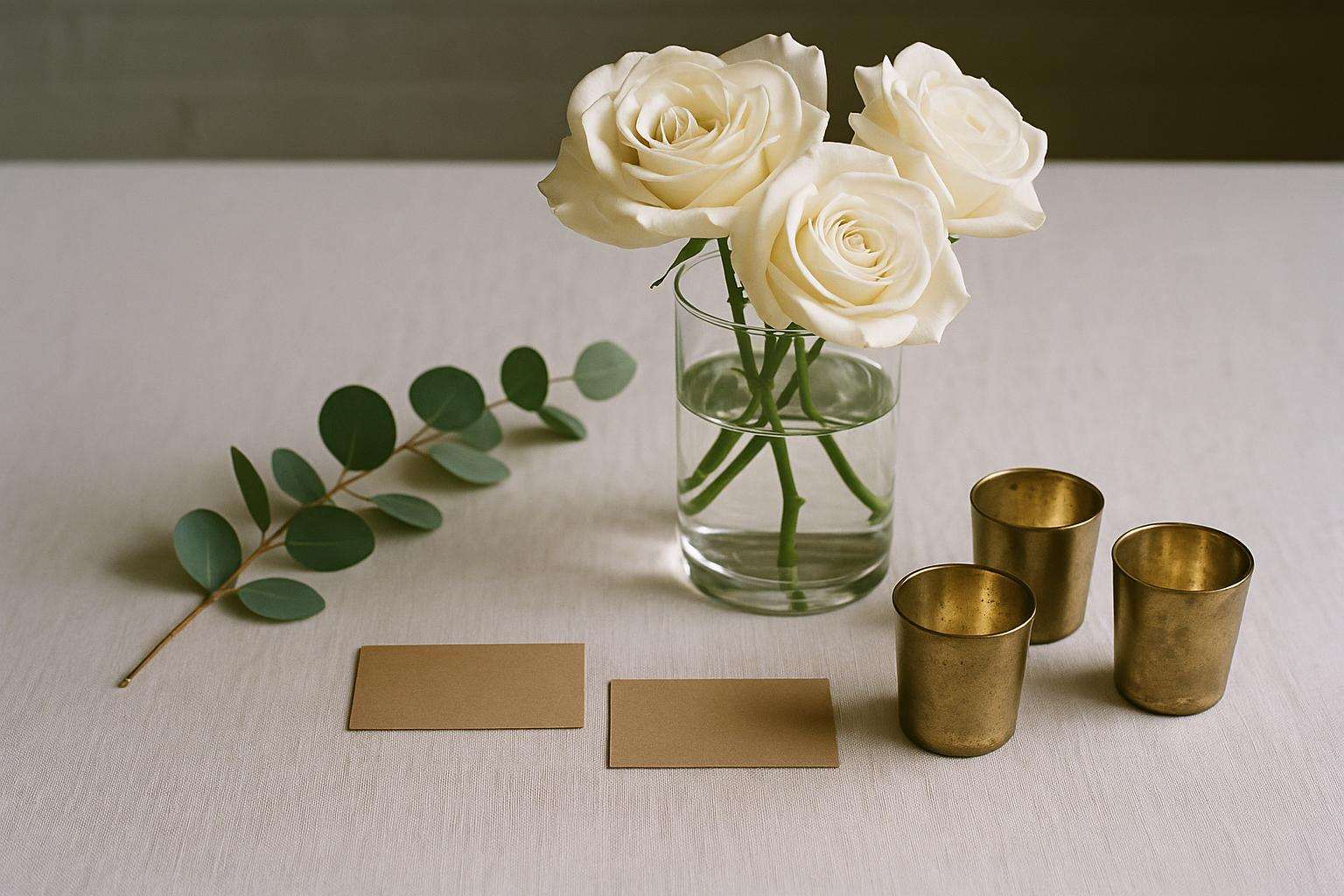
Professionally designed and installed centerpieces are among the largest line items in a wedding florals budget — $200–$540 per table for a full-service florist, totaling $2,000–$5,400 for a 10-table wedding. DIY centerpieces using wholesale or grocery store stems can bring this to $40–$90 per table, a savings of $1,100–$4,500 that no other single DIY project approaches. The design strategies that work best for non-professional arrangers: single-stem minimalism (5–7 stems of one variety, such as white garden roses, in a clear glass cylinder — structured, modern, and nearly impossible to execute poorly); potted plant centerpieces (herbs, succulents, or small seasonal plants that double as guest favors); candle-forward designs where greenery plays a supporting role (a ring of eucalyptus and votives creates a warm, romantic table with minimal floral skill required); or bud vase clusters (three to five small vases of varying heights, each with 2–3 stems — the asymmetry hides imperfection). Sources for wholesale stems: Afloral.com for dried and silk; Costco and Trader Joe's for fresh at favorable per-stem pricing; local wholesale flower markets for brides in major metro areas. Commit to your design 8 weeks out and complete a practice arrangement 4 weeks out with your actual vessels and stems. Photograph it and compare to your inspiration images.
Strengths
- Largest single DIY savings opportunity in the wedding budget — $1,100–$4,500 for a 100-guest wedding versus professional florals
- Design strategies like single-stem minimalism and candle-forward arrangements are genuinely achievable without professional floral training
- Grocery store and wholesale stem sources (Costco, Trader Joe's, Afloral) make materials accessible at fair pricing nationwide
Weaknesses
- Fresh floral centerpieces must be assembled the day before or morning of the wedding, requiring dedicated workspace and support team — this is a real logistical demand on the wedding week
- Best for
- Couples with one weekend available for a practice session 4 weeks out, a helper or two for assembly day, and storage space for vessels
- Pricing
- $40–$90 per table DIY versus $200–$540 professional; savings $1,100–$4,500 for 10 tables
Source: Best DIY Wedding Ideas That Will Save You Money — The Knot · Visit DIY Centerpieces Using Grocery Store and Wholesale Stems
Canva-Designed and Locally Printed Stationery Suite
Professional design quality at print-shop pricing
Editor's pick
Wedding stationery — invitations, envelopes, RSVP cards, programs, menus, escort cards — can cost $800–$2,000 from a professional stationer or premium online provider. A Canva-designed suite printed at a local print shop or through an online printer (Canva Print, Minted, Artifact Uprising) costs $100–$350 for the same quantity and comparable paper quality. The design gap has narrowed dramatically in the past three years: Canva's current wedding template library includes designs that genuinely match the aesthetics of boutique stationers at a fraction of the cost. The approach that works: browse Pinterest for stationery aesthetics you love, save 5–10 images, then search Canva templates for matching styles. Customize with your fonts, colors, and details. Order a single test print before committing to the full run — paper quality and color rendering vary by printer, and testing saves reprinting costs. Practical note: programs and menus can be printed at home on standard cardstock as a cost-reduction within the cost-reduction; save the professional-quality paper for the pieces guests will photograph (invitations, place cards).
Strengths
- Canva's 2026 wedding template library genuinely matches boutique stationer quality for most design aesthetics
- Savings of $700–$1,650 on stationery that guests appreciate but rarely scrutinize at the level that would reveal a design skill gap
- Digital invitation option (Zola, The Knot) eliminates printing costs entirely and is now socially accepted for most casual-to-mid-formal weddings
Weaknesses
- Ultra-formal weddings (black-tie, large guest lists with older guests) may face social expectations for engraved or thermographic printing that digital and home-print alternatives cannot satisfy
- Best for
- Semi-formal through casual weddings; couples comfortable with digital design tools; any wedding where the budget benefit outweighs the formal tradition consideration
- Pricing
- $100–$350 total for full suite versus $800–$2,000 professional; savings $700–$1,650
Source: Budget-Friendly DIY Wedding Ideas — Zola · Visit Canva-Designed and Locally Printed Stationery Suite
Hand-Lettered or Vinyl-Cut Wedding Signage
The fastest path from $0 investment to $400–$1,200 in savings
Editor's pick
Wedding signage — welcome boards, seating charts, bar menus, dessert table signs, directional arrows — is priced by professional calligraphers and signage artists at $400–$1,200 for a full set for a 100-guest wedding. The DIY equivalent costs $40–$150 in materials and 6–10 hours of effort. Two approaches depending on skill level: hand-lettering with a brush pen on kraft paper, watercolor paper, or a chalkboard (practice the font on printer paper first; imperfect letterforms read as charming at scale); or digital printing via Canva followed by professional printing on foam board or acrylic. A third option gaining traction: vinyl letter sets (Cricut, Brother ScanNCut) applied to mirrors, foam board, or glass for a clean typographic look that requires no freehand lettering skill. The welcome board and seating chart are the two highest-visibility pieces and the most worth the effort; menus, bar signs, and directional signs are simple enough to complete in an evening. IKEA RIBBA frames and Hobby Lobby mirrors are the most commonly sourced sign substrates at accessible price points.
Strengths
- The lowest skill floor of any meaningful DIY category — vinyl letters and digital prints require no artistic training
- Savings of $360–$1,050 for what is effectively an afternoon of effort and $40–$150 in materials
- High photographic visibility — welcome boards and seating charts appear consistently in wedding galleries and on social media
Weaknesses
- Large seating charts (80+ guests) are time-consuming to letter by hand and benefit from digital production rather than calligraphy
- Best for
- Every couple — this is the most universally accessible DIY project with the best effort-to-savings ratio
- Pricing
- $40–$150 in materials versus $400–$1,200 professional; savings $360–$1,050
Source: Best DIY Wedding Ideas That Will Save You Money — The Knot · Visit Hand-Lettered or Vinyl-Cut Wedding Signage
Homemade or Sourced-in-Bulk Wedding Favors
The project guests actually notice — and keep
Wedding favors professionally sourced through wedding retailers typically run $3–$7 per guest ($300–$700 for 100 guests). Homemade or bulk-sourced alternatives come in at $0.80–$2.00 per guest ($80–$200 total). The favors with the best reception are edible or functional: small-batch jam or honey (Mason jar supplies from Michaels, fruit or honey purchased in bulk from Costco, labels designed in Canva — total $1.50–$2.50 per favor); seed packets in kraft envelopes with a handwritten label ('Grow your own garden'); custom matches in a branded matchbox; small bottles of local hot sauce with a punny label; or a bag of specialty coffee or tea. The production approach: batch-produce 4–6 weeks before the wedding to allow for storage. Enlist bridesmaids or family for a production evening with wine and music — most people enjoy the craft element when it is a social occasion rather than a solo project. Practical note: if the favor-making prospect genuinely does not appeal to you, skip favors entirely — studies consistently show guests' most common favor behavior is leaving them behind, and the savings from elimination are real.
Strengths
- Edible and functional favors (jam, honey, seeds, coffee) are kept and used by guests at dramatically higher rates than decorative items
- Batch production 4–6 weeks ahead eliminates last-minute stress; bridesmaids and family often enjoy participating in a production session
- Per-guest savings of $1.50–$5.00 add up to $150–$500 for a 100-guest wedding
Weaknesses
- Requires storage space for 100+ items 4–6 weeks ahead of the wedding, which can be logistically complicated for couples in small apartments
- Best for
- Couples who enjoy a craft project and have storage space; particularly well-suited to rustic, garden, and farmhouse wedding aesthetics
- Pricing
- $80–$200 total for 100 guests versus $300–$700 professional; savings $220–$500
Source: 30 Creative DIY Wedding Ideas for Every Style — Brides · Visit Homemade or Sourced-in-Bulk Wedding Favors
DIY Photo Booth with Printed Backdrop and Props
One of the highest-ROI entertainment investments at a reception
A professional photo booth rental — equipment, attendant, printing — runs $700–$1,500 for a four-hour reception. A DIY photo booth costs $50–$200 in materials and produces photos guests genuinely love taking. The setup: a fabric or paper backdrop (Amazon, Oriental Trading, or a length of inexpensive muslin painted or dyed to your color palette); a ring light ($30–$60) for flattering illumination; a selection of simple props (signs with phrases, oversized sunglasses, flower crowns — sourced from Dollar Tree or made); and a dedicated Bluetooth camera or an iPad on a tripod set to a shared album. The key design decision: make the backdrop photograph well. A simple, consistent, solid-color or textured backdrop produces more Instagram-shareable images than a busy custom printed one. Set a shared Google Photos or iCloud album with a QR code displayed prominently so guests can access images without printing. This replaces 80% of the value of a professional booth at 10% of the cost.
Strengths
- Replaces 80% of professional booth value at roughly 10% of the cost — one of the best savings ratios in DIY wedding projects
- A shared digital album via QR code is now preferred by most guests over printed strips, simplifying the setup significantly
- The project requires very little artistic skill — backdrop selection and lighting placement are the only meaningful design decisions
Weaknesses
- Requires someone to manage the setup and prompt reluctant guests to use it — an unattended booth is often underused
- Best for
- Casual through semi-formal receptions; particularly effective for younger guest demographics who will share to social media
- Pricing
- $50–$200 total versus $700–$1,500 professional rental; savings $650–$1,300
Source: Budget-Friendly DIY Wedding Ideas — Zola · Visit DIY Photo Booth with Printed Backdrop and Props
Fabric or Greenery Table Runners
Transformative visual impact at minimal cost
Table runners — a strip of fabric, greenery, or mixed elements running the length of a reception table — create one of the most striking visual impacts in a reception space relative to their cost. Professional installation of greenery runners runs $100–$200 per table; fabric runners in quality linen or satin from wedding rental companies run $15–$40 per table with linen rental. DIY options: a lush greenery runner using bulk eucalyptus, ferns, and small accent florals assembled the morning of the wedding ($20–$40 per table in wholesale materials); a macramé or woven fabric runner (purchasable in bulk from Etsy or Amazon at $8–$15 each); a dried flower and pampas grass runner that can be assembled weeks ahead without wilting concerns; or a purely candle-based runner with pillar candles and votives of varying heights spaced along a piece of simple burlap or kraft paper. The dried and candle options have the significant advantage of advance assembly — they require no wedding-morning logistics.
Strengths
- Greenery runners create visual impact disproportionate to their cost, transforming a bare table into a designed tablescape
- Dried flower and candle runners can be assembled weeks ahead, eliminating the time pressure of fresh floral arrangements
- Bulk Etsy sourcing for macramé and woven runners brings the per-table cost to $8–$15 — comparable to the rental fee alone
Weaknesses
- Fresh greenery runners require assembly within 24 hours of the wedding — a meaningful logistical commitment during the most time-pressured days of wedding prep
- Best for
- Long farm tables or rectangular tables; garden, bohemian, and rustic wedding aesthetics; couples who want lush visual impact without individual centerpiece complexity
- Pricing
- $8–$40 per table DIY versus $15–$200 professional; savings vary significantly by approach
Source: Best DIY Wedding Ideas That Will Save You Money — The Knot · Visit Fabric or Greenery Table Runners
Digital RSVP and Wedding Website
The most seamless wedding task to take entirely in-house
A dedicated wedding website with digital RSVP functionality is now available for free through Zola, The Knot, Joy, and Squarespace, and the quality of the free tier design options has improved to the point that most couples find no meaningful reason to pay for the premium tier. The savings over traditional RSVP card printing and mail processing are $150–$400 in printing and postage alone, plus the substantial administrative labor of manually transcribing paper RSVPs into a guest list spreadsheet. The digital RSVP process is significantly more efficient — guests respond in real time, meal preferences and dietary restrictions are captured in a structured form, and the list is immediately up-to-date in the platform's seating chart tool. One practical note: some older guests find digital RSVP unfamiliar. Include a clearly printed URL card in the physical invitation suite and designate a family member or coordinator as the resource for guests who need to RSVP by phone.
Strengths
- Free on Zola, The Knot, and Joy — zero cost for a professionally designed digital product that saves $150–$400 in printing and postage
- Real-time RSVP updates and structured meal preference collection eliminate manual spreadsheet transcription
- Wedding website serves as the single source of truth for accommodation, directions, schedule, and vendor details throughout the planning process
Weaknesses
- A small portion of older guests will need a phone-call RSVP alternative — plan for this and assign a family member to handle it
- Best for
- All couples with a digitally comfortable guest list; the free tier from Zola or The Knot is genuinely sufficient for most weddings
- Pricing
- Free (Zola, The Knot, Joy); versus $150–$400 for traditional printed RSVP cards and postage
Source: Budget-Friendly DIY Wedding Ideas — Zola · Visit Digital RSVP and Wedding Website
Printed or Folded Ceremony Programs
The stationery piece that is easiest to produce at home
Ceremony programs are among the most straightforward stationery items to produce at home: they are typically single-page or bifold, printed in quantity of one per guest, and read once. Professional custom programs cost $2–$5 per piece ($200–$500 for 100 guests); home-printed programs on quality cardstock cost $0.10–$0.25 per page plus the paper investment ($10–$25 per 100 sheets of quality cardstock). Canva has a strong program template library and the design process typically takes 2–3 hours including customization. Print at home on 100 lb cardstock for a substantial, premium feel; or send to a local copy shop for a sharper print at low cost. A specific cost-reduction within the cost-reduction: a single folded half-letter program (5.5 × 8.5 inches, printed two-up on letter paper) uses half the paper, folds neatly, and photographs just as well as a full-size program. For weddings with short, traditional ceremony structures, a bookmark-style program (2 × 7 inches) is a trendy alternative that uses minimal paper and requires no folding.
Strengths
- Home production cost is $10–$25 versus $200–$500 professionally printed — the highest percentage savings of any stationery category
- Canva templates reduce design time to 2–3 hours; a partner or friend can assist with folding assembly in under an hour for 100 pieces
- Bookmark-format programs are a 2026 trend that reduces material cost further while being visually distinctive
Weaknesses
- Home inkjet printing on cardstock can produce slightly inconsistent color rendering on large print runs — a local copy shop provides more reliable results for minimal additional cost
- Best for
- All couples; particularly straightforward for couples already designing their stationery suite in Canva
- Pricing
- $10–$40 home-produced versus $200–$500 professionally printed; savings $160–$460
Source: Budget-Friendly DIY Wedding Ideas — Zola · Visit Printed or Folded Ceremony Programs
Dried Flower or Pampas Grass Ceremony Arch
The project you can build six weeks early and enjoy indefinitely
A ceremony arch or altar backdrop is one of the most-photographed elements of any wedding — and professionally designed arches using fresh florals can cost $800–$3,000 depending on scale. A dried flower and pampas grass arch built on a purchased metal or wooden frame ($40–$80) can be assembled in 4–6 hours at a materials cost of $100–$250, and crucially, it can be assembled 4–6 weeks before the wedding without any deterioration. Dried pampas grass, dried flowers, bunny tail grass, eucalyptus pods, and cotton stems are available at Afloral.com, Amazon, and wholesale craft stores and hold their appearance indefinitely. The assembly technique: attach a chicken-wire grid to the arch frame and weave or wire stems into it systematically, working from the denser base material outward to lighter accent stems. The result photographs beautifully, with a romantic, organic quality that suits the dominant wedding aesthetic direction of 2026. Post-wedding, the arch serves as a statement home decoration — one of the few DIY wedding projects that has ongoing utility.
Strengths
- Assembly 4–6 weeks ahead eliminates any wedding-week time pressure — the single most important advantage over fresh floral alternatives
- Photographs beautifully and suits the dominant 2026 bridal aesthetic (pampas, dried botanicals, organic textures)
- Post-wedding the arch becomes a home decoration — one of few wedding DIY projects with lasting utility beyond the day
Weaknesses
- Requires storage space for a 6–8 foot structure for 4–6 weeks before the wedding, which is impractical for couples in small living spaces
- Best for
- Bohemian, garden, and organic-modern wedding aesthetics; couples with storage space for a large structure
- Pricing
- $140–$330 total versus $800–$3,000 professional; savings $460–$2,670
Source: 30 Creative DIY Wedding Ideas for Every Style — Brides · Visit Dried Flower or Pampas Grass Ceremony Arch
Bulk Votive and Pillar Candle Installations
The fastest way to transform a venue into a romantic, magazine-worthy space
Candles are among the most powerful and underutilized tools in DIY wedding décor — they are inexpensive in bulk, require no skill to install, and create a warmth and romance in a reception space that no other decorative element achieves as efficiently. A reception space with 200–300 votive candles in glass holders placed at varying heights across every surface — tables, window sills, mantles, bars, staircases — looks dramatically more designed and expensive than the material investment warrants. Costco sells bulk votive candle sets at favorable pricing; Amazon bulk LED votives provide a flame-free alternative for venues with open-flame restrictions. Design principle: more is more. A sparse candle installation reads as incomplete; a generous, abundant candle installation reads as intentional and luxurious. Combine pillar candles of varying heights on brass or silver holders in a central table column with votive scatter for depth. Cost for a full candle installation: $150–$350 in materials versus $800–$2,000 for a professional installation using the same materials. The skill gap is essentially zero — placement is intuitive.
Strengths
- Creates warm, romantic atmosphere that photographs beautifully and flatters guests — one of the highest-impact per-dollar décor investments
- Zero skill required — placement is intuitive and takes approximately 45 minutes with a helper
- LED option available for all venues with open-flame restrictions; quality LED votives now photograph nearly indistinguishably from real flame
Weaknesses
- Open-flame candles require venue approval — always confirm the venue policy before committing to a real-flame installation
- Best for
- All wedding aesthetics; particularly powerful in barn venues, historic buildings, garden tents, and any space with limited existing ambient lighting
- Pricing
- $150–$350 for a full candle installation versus $800–$2,000 professional; savings $650–$1,650
Source: Best DIY Wedding Ideas That Will Save You Money — The Knot · Visit Bulk Votive and Pillar Candle Installations
Hire a Day-of Coordinator Instead of a Full Planner
The one professional investment that makes all other DIY possible
Editor's pick
This entry is different from the others: it is not a DIY project but a strategic professional service choice that makes the rest of your DIY viable. A full-service wedding planner costs $3,000–$10,000 and manages the entire planning process. A day-of or month-of coordinator costs $800–$2,500 and manages only the execution: vendor communication, timeline management, setup coordination, and problem resolution on the wedding day itself. For DIY-forward couples who want to manage their own planning process, the day-of coordinator is the professional investment that de-risks the wedding day execution — they ensure your DIY centerpieces are installed correctly, your handmade signage is in the right place, and your schedule stays on track while you enjoy getting ready. Without this role, even well-executed DIY projects can fail at the installation stage when the bride is in the chair and no one is managing the venue. According to industry surveys, 89% of couples who hired a day-of coordinator reported it was the single best investment they made in their wedding budget.
Strengths
- De-risks the execution of all other DIY projects — ensures they are installed correctly while the bride is unavailable
- Costs $800–$2,500 versus $3,000–$10,000 for full-service planning — saves $2,000–$7,500 while preserving the most important professional support
- Allows the couple to manage all planning themselves while delegating only the high-stakes execution day
Weaknesses
- Not a free or materially cost-free option — at $800–$2,500 it is a real budget item that replaces but does not eliminate a professional line item
- Best for
- Every DIY-forward couple who wants professional support for execution without full-service planning cost
- Pricing
- $800–$2,500 for day-of coordination versus $3,000–$10,000 full service; savings $2,000–$7,500
Source: Budget-Friendly DIY Wedding Ideas — Zola · Visit Hire a Day-of Coordinator Instead of a Full Planner
Curated Food and Dessert Stations Over Plated Service
Shift from per-head service to self-service — and save thousands
Transitioning from a plated, served dinner to a curated station or family-style service model is one of the most meaningful structural budget reductions available, and it can be executed with a DIY staging layer that adds visual interest. Catered stations — a pasta bar, a carving station, a grazing table — run $40–$65 per head at most mid-tier caterers, compared to $90–$150 per head for a fully plated service with waitstaff. The DIY layer: the grazing table, also called a charcuterie and cheese board installation, is the visual centerpiece of a cocktail hour or dessert reception and can be assembled by the couple or a small team on the wedding morning. Wholesale cheese, charcuterie, seasonal fruit, olives, crackers, and bread from Costco or a local wholesale market creates a stunning visual installation at $8–$15 per guest. The dessert table — a curated display of two-bite items like macarons, mini cupcakes, brownies, and cookies — can be sourced from wholesale bakeries or Costco and staged on tiered stands at $3–$6 per guest. Combined, these station approaches can reduce food and beverage costs by $30–$90 per head.
Strengths
- Per-head savings of $30–$90 versus plated service — the largest structural cost reduction available in wedding catering
- Grazing and dessert tables create beautiful visual installations that are among the most photographed elements of a modern reception
- Costco and wholesale grocery sourcing at $8–$15 per head for grazing versus $45–$90 catered equivalent
Weaknesses
- Requires a team to assemble the grazing table on the wedding morning and a coordinator to monitor and replenish it during the event — factor this into your staffing plan
- Best for
- Casual through semi-formal weddings; cocktail-reception format; couples with a wholesale club membership and a willing assembly team
- Pricing
- $11–$21 per head DIY grazing and dessert versus $90–$150 plated service; savings $70–$130 per head
Source: 30 Creative DIY Wedding Ideas for Every Style — Brides · Visit Curated Food and Dessert Stations Over Plated Service
Which should you choose?
Couple planning a $15,000–$20,000 wedding · Budget-forward couple with significant DIY motivation and a 6-month engagement
Goal:Maximize savings without visible compromise in the photographs
Centerpieces, Signage, and Stationery — These three categories together save $2,500–$7,200 with the lowest execution risk and the highest photographic visibility — meaning the savings are invisible in the wedding gallery.
Bride with limited free time before the wedding · Busy professional with a 4-month engagement and minimal weekend availability
Goal:Meaningful savings with the smallest possible time investment
Digital RSVP, Candle Installation, and Canva-Printed Stationery — These three require the fewest total hours of effort — a combined 4–8 hours — while delivering $1,000–$2,500 in savings.
Couple hosting at a raw or nontraditional space · Couple renting a barn, warehouse, or outdoor venue that requires full décor
Goal:Fill a large, underdressed space on a tight décor budget
Candle Installation, Table Runners, and Dried Flower Arch — These three projects are specifically designed for transforming large, underdressed spaces through abundance and visual warmth — and all three can be assembled weeks ahead without fresh-floral logistics.
Frequently asked
How much can you realistically save by DIYing your wedding?
Realistic savings from a strategic DIY approach — concentrating effort on centerpieces, stationery, signage, favors, and a photo booth — range from $2,000 to $8,000 for a 100-guest wedding. The higher end of that range requires a significant personal time investment across 4–8 weekends and benefits from a genuine support team for assembly and logistics. The lower end is accessible to nearly any engaged couple with 2–4 focused weekends and organizational discipline. The important framing: DIY saves the most money when applied to the decorative, stationery, and entertainment categories — not the vendor service categories. Attempting to DIY photography, catering, or wedding cake without professional expertise is the category of DIY that most reliably produces regret. The research on post-wedding survey data consistently shows couples most wish they had spent more on a photographer and less on florals and décor — which is exactly where DIY delivers its best return.
What should you never DIY at a wedding?
Three categories should almost never be DIYed regardless of skill confidence: photography and videography (the only record of the day — skill level is essentially impossible to self-assess accurately until the photographs come back); officiating (while a friend obtaining an officiant license is popular and often beautiful, script and timing execution requires rehearsal and preparation that is frequently underestimated); and food service requiring health permits (any DIY catering involving cooked food at scale requires health department compliance in most jurisdictions and carries genuine liability if a guest becomes ill). Also worth a serious reality check: full floral design. Individual centerpieces and simple greenery work are achievable DIY projects. Bridal bouquet, ceremony altar florals, and full-venue floral design require significant skill and usually more time and materials than non-professionals estimate.
How early should I start on wedding DIY projects?
The general principle: begin projects as early as their material constraints allow, and complete everything that can be completed more than two weeks before the wedding at least two weeks before the wedding. Dried and fabric projects (arch, table runners, signage, favors, dried centerpieces) can and should be completed 4–8 weeks before the wedding — this removes them from the already-compressed wedding week entirely. Stationery design and production should be complete 8–10 weeks before send date. Fresh floral centerpieces and greenery installations are the exception — they are assembled 12–24 hours before the wedding and require a logistics plan for that specific day. The worst DIY pattern is starting everything in the final two weeks: the time compression produces lower quality, higher stress, and the genuine risk that a project is incomplete or done poorly on the wedding day when there is no time to address it.
Can I DIY my own wedding flowers?
Yes, with important qualifications. The DIY floral projects with the best success rates for non-professionals: simple centerpieces using a single variety in a clear vessel; greenery-forward designs where filler (eucalyptus, ferns, ivy) does most of the visual work; candle-plus-greenery installations where the candles are the focal point; and single-stem bud vase clusters. The DIY floral projects with the highest failure rate for non-professionals: the bridal bouquet (much harder to create a tight, round, professional-looking bouquet than tutorials suggest), large ceremony installations like floral arches (scale and structural stability are professional skills), and mixed-variety arrangements with multiple bloom types at different stages (requires understanding of flower conditioning and timing). A practical middle path: hire your florist to provide only the bridal bouquet, boutonnieres, and ceremony flowers — the high-skill, high-visibility pieces — while you DIY the reception centerpieces. This hybrid approach captures most of the savings while protecting the highest-stakes florals.
What DIY projects photograph best at a wedding?
The projects that appear most in professional wedding photography — and therefore deliver the most visible return on your DIY effort — are: the ceremony backdrop or arch (in nearly every ceremony gallery); the welcome sign (frequently photographed as a detail shot and used in social shares); the centerpieces (table details are standard in most wedding galleries); the seating chart (often photographed with guests gathered around it during cocktail hour); and the dessert or grazing table (one of the most-photographed elements of a modern reception). Prioritize these five for your best effort and your highest-quality materials. The favor, photo booth, and stationery suite are lower photography priority — they are noticed and appreciated by guests but appear less consistently in the wedding gallery.
Is it worth hiring a day-of coordinator if we're doing a lot of DIY?
Yes — more so than for a traditionally planned wedding. The value proposition of a day-of coordinator increases proportionally with the amount of DIY in a wedding, because DIY projects have more execution variables and require more active coordination than vendor-handled elements. A professional florist installs their own centerpieces and knows exactly how to do it. Your friends assembling DIY centerpieces need clear direction, organized materials, and someone monitoring the process. A day-of coordinator manages all of this — along with vendor arrivals, timeline adherence, and the inevitable small problems that arise — while you are in hair and makeup. At $800–$2,500, the day-of coordinator is the professional investment that protects your larger DIY savings from unraveling during execution. Industry survey data consistently places it among the top two or three 'best money spent' items for couples who used one.