Reception & Parties
How to Handle Divorced Parents' Wedding Seating (Without the Drama)
Navigating seating for divorced parents — whether amicable, estranged, or openly hostile — requires a clear plan made months before the wedding day, not improvised decisions in the final hour.
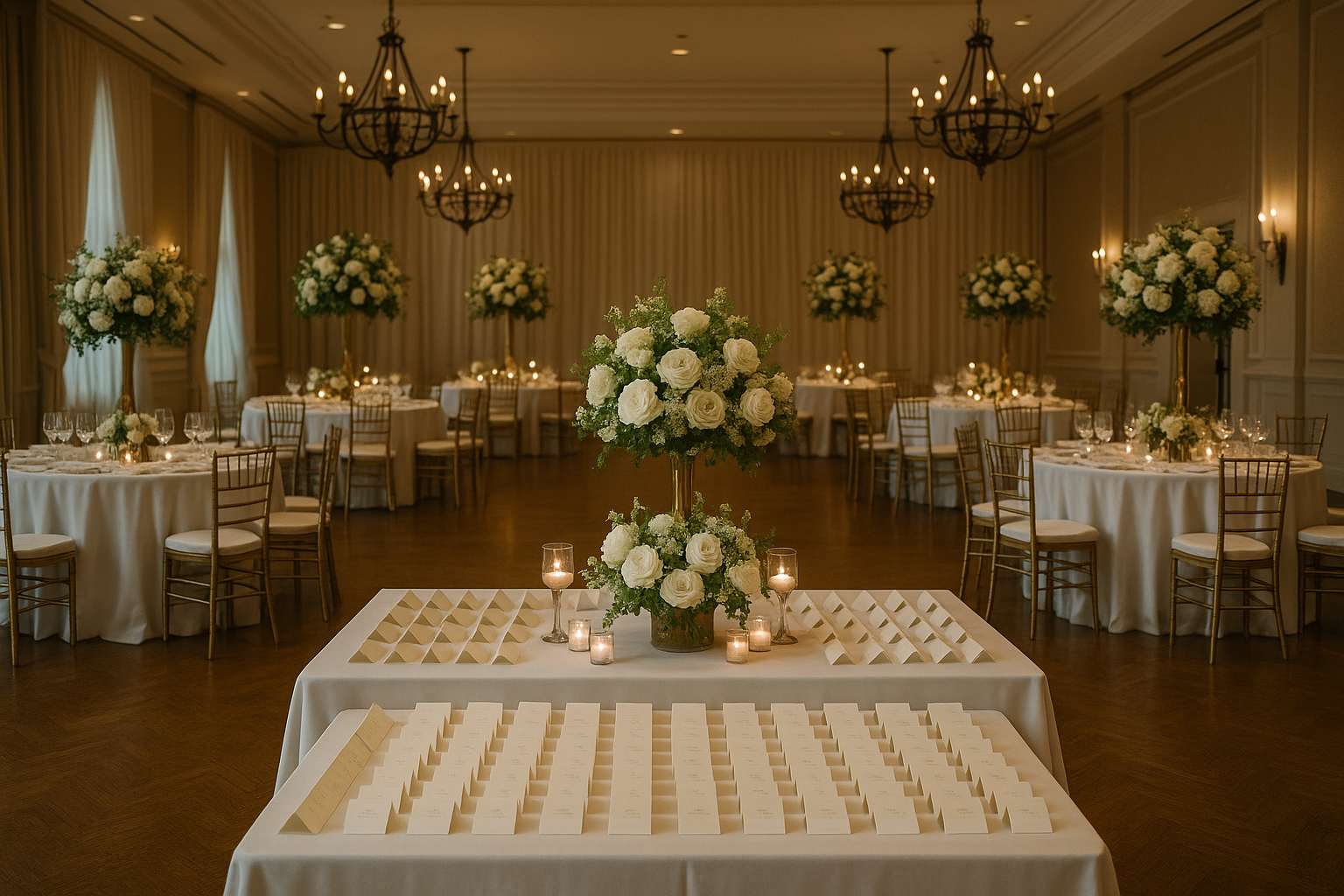
Seat divorced parents at separate tables of equal prominence, mirror-positioned on opposite sides of the room — not in a hierarchy that places one clearly closer to the couple. The sweetheart table removes the head table flashpoint entirely. Make the conversation with each parent weeks before the wedding, not hours before.
Divorced-parent seating is one of the most emotionally charged logistics decisions a couple makes in the months before their wedding. Done well, it is invisible: guests enjoy the reception, both sets of parents feel honored and comfortable, and the couple never has to manage a family incident on their wedding day. Done poorly — or left unplanned until the morning of — it is the source of the most common family conflict at receptions. According to The Knot's guide to seating divorced parents, seating chart decisions that position one parent's table as clearly more prominent than the other's are the single most reliably combustible planning error couples make with divorced families.
This guide covers every divorce scenario, from amicable to hostile, with specific tactical guidance for the ceremony, the reception, and the head table question that derails otherwise-smooth seating plans.
What is the standard approach to seating divorced parents at a wedding?
The foundational principle for all divorced-parent seating is symmetry. Each parent — with their respective new partner, spouse, and immediate family — occupies a table of equal prominence, positioned at an equal distance from the couple on opposite sides of the reception room. Neither table is positioned as 'first' or 'better'; both are positioned as honored family.
This mirrors the ceremony seating convention: in a traditional setup, the bride's family sits on the left and the groom's family on the right. When the bride's parents are divorced, her mother and her father sit with their respective households on the same side of the aisle — her mother typically in the front row, her father in the second row (or the opposite configuration if the relationship is entirely amicable and they have agreed to be seated apart simply for logistical clarity). The key principle is that neither parent is made to sit beside the other when they would prefer not to, and neither is made to sit so far from the front that the positioning reads as a demotion.
The same logic applies to the reception: two tables of equal size, equal floral and centerpiece arrangements, equal distance from the dance floor or couple's table, and equal access to clear lines of sight. A parent who is visibly seated at a less desirable table — near the kitchen, at the back, with a blocked sightline to the couple — will notice, will remember, and in some cases will make that fact known during the reception itself.
| Relationship Dynamic | Ceremony Seating | Reception Table Strategy | Head Table Recommendation |
|---|---|---|---|
| Fully amicable | Same row or adjacent rows if desired | Single shared family table or separate tables both front-of-room | Both parents may be included if all parties agree |
| Politely cordial | Separate sections, both honored rows | Separate tables, mirror placement | Sweetheart or king's table eliminates the question |
| Tense but manageable | Opposite sides of aisle, clear visual separation | Separate tables, 3–4 tables of physical distance | Sweetheart table strongly recommended |
| Openly hostile / no contact | Staggered arrival times for ceremony | Each parent hosts their own family cluster, maximum separation | Sweetheart table only — no shared head table under any circumstances |
Should you have a head table when divorced parents are involved?
The head table is the single greatest source of divorced-parent seating conflict at receptions, and eliminating it is the single most reliable solution to the conflict it creates. The traditional head table seats the wedding party in a row facing the room, with the parents of the bride and groom adjacent. The moment divorced parents and their new spouses are assigned positions along this table, at least one of the following conflicts emerges: who sits closest to the couple, whether a stepparent is included or excluded, and whether an ex-spouse is positioned in clear view of the other ex-spouse for the entirety of the reception.
The sweetheart table — a small table for two that seats only the couple — removes this question entirely. The couple dines together, facing their guests, and both sets of parents are honored at equally prominent family tables without any comparative positioning at a shared head table. According to seatplan.io's divorced-parent seating guide, the sweetheart table is the most common solution adopted by couples navigating complex divorced-family dynamics precisely because it is not a choice between competing parents — it is a choice that eliminates the competition entirely.
If a sweetheart table is not in keeping with the couple's vision for the reception, a king's table — a long rectangular table that seats the full wedding party but not the parents — achieves a similar result. Parents are at their own family tables, honored and comfortable, without being positioned in a comparative hierarchy at the main table.
How do you handle genuinely hostile divorced parents at a wedding?
When parents are not merely uncomfortable with each other but genuinely hostile — a restraining order, active litigation, an unresolved affair, or longstanding hurt that has not been processed — the seating strategy shifts from symmetry to physical separation. Three to four tables of physical distance between the two parents' tables is the baseline for tense situations; for genuinely hostile situations, maximum distance across the room, with the couple's table positioned between them, is more appropriate.
For hostile situations, each parent effectively hosts their own family cluster: the parent, their new partner if applicable, their closest family, and their friends. The two clusters are on opposite sides of the reception space with no natural proximity. The seating chart should be designed so that neither parent's path to the bar, buffet, dance floor, or restrooms routinely crosses the other's territory.
Staggered arrival and departure logistics also reduce conflict in hostile situations. If one parent is scheduled to arrive 30 minutes before the other, with a designated usher responsible for each parent's arrival experience, the ceremony begins without the two families navigating shared entry. This level of logistical detail feels excessive until the alternative — two hostile ex-spouses arriving at the same moment, in front of all their guests, with no one managing the moment — materializes on the wedding day.
The conversation with each parent about the seating plan should happen individually, privately, and well in advance — six to eight weeks before the wedding is appropriate. 'We have designed the seating to make sure you and your family are comfortable and in a great position to celebrate with us' is the framing. Presenting the plan as done — final, considered, not subject to negotiation — rather than offering it as a draft for feedback prevents the conversation from becoming a lobbying exercise. Both parents should be told the same information, independently, so neither feels that the other received preferential treatment in the conversation.
What about stepparents and new partners in the seating plan?
Stepparents and new partners are seated with their spouse or partner, at that parent's family table. This is the only logistically and emotionally clean approach. A stepparent who is told they must sit at a different table from their spouse because 'it's easier' will experience the wedding as a demotion; a new partner who is placed at a distant friends' table rather than with the parent is being told, through the seating chart, that their relationship is not recognized by the couple. Neither outcome serves the couple's goal of a peaceful, celebratory reception.
The one exception is a stepparent with whom the couple has a close personal relationship — a stepparent who raised the partner alongside the biological parent, for instance. In this case, the stepparent may be included in the wedding party or honored with a family table seat that reflects the actual relationship. The biological parent is informed of this placement in advance, privately, with the same matter-of-fact framing: 'We love [Stepparent] and wanted her to be with us at the family table. We've planned [other parent's] table to be equally honored.' No apology, no lengthy explanation — simply a direct and warm statement of the plan.
The Emily Post Institute's guidance on reception seating is clear: new spouses and partners of divorced parents are always seated with their partners, and the couple's role is to present this as the natural, expected arrangement rather than a negotiated compromise.
Frequently Asked Questions
Do divorced parents have to sit at the same table at a wedding?
No — and for most divorced couples, separate tables are the more comfortable and logistically sensible approach. The goal of divorced-parent seating is equal prominence and equal honor, not physical proximity. Two separate tables, mirror-positioned on opposite sides of the room with equal quality of placement, centerpieces, and sightlines to the couple, are the standard recommendation from every major wedding etiquette authority. Forcing divorced parents who are not on friendly terms to share a table — out of a misguided desire to demonstrate family unity — nearly always produces exactly the opposite of its intended effect. The only exception is parents who are genuinely amicable and have explicitly expressed that they would enjoy being seated together, in which case a single shared family table is appropriate.
How do you seat divorced parents at the ceremony when there is a traditional family-side layout?
For a traditional ceremony with family on the left and right sides of the aisle, divorced parents of the same person sit on the same side. The parent who raised the partner or who has the closer relationship typically takes the front row; the other parent sits in the second row. If the parents are genuinely amicable, they may choose to share the front row. If the ceremony is non-traditional with open seating — guests may sit anywhere — the parents are simply escorted to designated reserved seats in the front section, with each parent's family cluster grouped naturally around them. The key logistics detail: each divorced parent should have a designated usher who greets them at the door, escorts them to their seat, and prevents the two parents from arriving and being seated simultaneously if their relationship makes that uncomfortable. Staggered arrival escorts — parent A arrives five minutes before parent B — are a simple and effective logistical tool for tense situations.
What do you do when one parent refuses to attend if the other is present?
This situation is rare but real, and it requires the couple to make a clear-eyed decision about their own priorities before attempting to negotiate a resolution. If both parents' presence at the wedding genuinely matters to the couple, the first step is a direct, private conversation with the refusing parent: 'We love you and we want you there. We have planned the seating so that you will not need to interact with [other parent] at any point during the day. Will you let us show you the plan?' In many cases, a detailed and specific seating and logistics plan — showing exactly how physically separated the two parents will be, and confirming that no shared moments are required — resolves the threat. If it does not, the couple must decide whether the refusing parent's ultimatum reflects a genuine level of distress that deserves accommodation or a negotiating posture. Neither answer is wrong; what is unhelpful is allowing the refusal to remain unaddressed in the weeks before the wedding, because last-minute negotiations on this point produce the most stress with the least resolution time.
Should you tell divorced parents about the seating plan in advance?
Yes — six to eight weeks before the wedding. Both parents should be informed individually, privately, and in the same conversation, so neither feels that the other received the information first or had more input into the plan. Present the plan as complete and considered: 'Here is where we've placed you and your family — we're really happy with how everything has come together.' Do not present it as a draft seeking feedback, because that framing opens a negotiation that rarely improves the plan. Parents who have specific concerns will raise them regardless of how the plan is presented; the difference is that a firmly presented plan produces one specific objection to address rather than a full renegotiation of the seating chart. Most divorced parents, when shown a plan that genuinely honors them with a prominent, beautifully appointed table and a clear sightline to their child, respond with relief rather than complaint. The couple's confidence in presenting the plan — calm, warm, final — is itself reassuring to parents who may have been anxious about how the day would be managed.
What if divorced parents bring new partners or spouses — does that affect table sizing?
Yes, and it should be planned for from the start of the seating chart process. Each divorced parent's 'family table' may include the parent, their current spouse or partner, the parent's siblings or close family, and the parent's close friends. If both parents have new partners, each table may need to seat eight to ten people comfortably. The seating chart tool Zola Seating Chart, as well as standalone tools like AllSeated, both support family cluster planning with drag-and-drop table arrangement that makes it easy to model each parent's table at its correct size before assigning any individual guests. The important principle: both parents' tables should be the same size (or within one seat of the same size). A parent who looks across the room and sees the other parent's table is noticeably larger — more people, more flowers, more prominently positioned — will experience that as a statement, regardless of whether the couple intended it as one.
What seating chart tools are best for managing complex divorced-family layouts?
For couples navigating complex divorced-family dynamics, visual seating tools that allow guest clustering and table arrangement before individual assignment are significantly more useful than spreadsheet-based seating lists. Zola's built-in seating chart tool allows guests to be color-coded by family group, which makes it easy to see at a glance whether both parents' family clusters are symmetrically distributed around the room. AllSeated offers a floor-plan-accurate room layout with drag-and-drop table placement, which is particularly useful for confirming that the two parents' tables are actually at equal distances from the dance floor and the couple's table — not just in theory but on the actual floor plan of the venue. For couples who prefer a more guided approach, seatplan.io offers a dedicated divorced-family seating planning mode. All three tools allow the couple to experiment with multiple seating configurations before committing — a significant advantage when the goal is to achieve genuine symmetry and equal prominence rather than simply separating two people.
Frequently asked
Do divorced parents have to sit at the same table at a wedding?
No — and for most divorced couples, separate tables are the more comfortable and logistically sensible approach. The goal of divorced-parent seating is equal prominence and equal honor, not physical proximity. Two separate tables, mirror-positioned on opposite sides of the room with equal quality of placement, centerpieces, and sightlines to the couple, are the standard recommendation from every major wedding etiquette authority. Forcing divorced parents who are not on friendly terms to share a table — out of a misguided desire to demonstrate family unity — nearly always produces exactly the opposite of its intended effect. The only exception is parents who are genuinely amicable and have explicitly expressed that they would enjoy being seated together, in which case a single shared family table is appropriate.
How do you seat divorced parents at the ceremony when there is a traditional family-side layout?
For a traditional ceremony with family on the left and right sides of the aisle, divorced parents of the same person sit on the same side. The parent who raised the partner or who has the closer relationship typically takes the front row; the other parent sits in the second row. If the parents are genuinely amicable, they may choose to share the front row. If the ceremony is non-traditional with open seating, the parents are simply escorted to designated reserved seats in the front section, with each parent's family cluster grouped naturally around them. The key logistics detail: each divorced parent should have a designated usher who greets them at the door, escorts them to their seat, and prevents the two parents from arriving and being seated simultaneously if their relationship makes that uncomfortable. Staggered arrival escorts are a simple and effective logistical tool for tense situations.
What do you do when one parent refuses to attend if the other is present?
This situation is rare but real, and it requires the couple to make a clear-eyed decision about their own priorities before attempting to negotiate a resolution. If both parents' presence at the wedding genuinely matters to the couple, the first step is a direct, private conversation with the refusing parent that affirms your love for them and shows that the seating has been planned so they will not need to interact with the other parent at any point during the day. In many cases, a detailed and specific seating and logistics plan resolves the threat. If it does not, the couple must decide whether the refusing parent's ultimatum reflects a genuine level of distress that deserves accommodation or a negotiating posture. Neither answer is wrong; what is unhelpful is allowing the refusal to remain unaddressed in the weeks before the wedding, because last-minute negotiations on this point produce the most stress with the least resolution time.
Should you tell divorced parents about the seating plan in advance?
Yes — six to eight weeks before the wedding. Both parents should be informed individually, privately, and in the same conversation, so neither feels that the other received the information first or had more input into the plan. Present the plan as complete and considered rather than as a draft seeking feedback, because that framing opens a negotiation that rarely improves the plan. Parents who have specific concerns will raise them regardless of how the plan is presented; the difference is that a firmly presented plan produces one specific objection to address rather than a full renegotiation of the seating chart. Most divorced parents, when shown a plan that genuinely honors them with a prominent, beautifully appointed table and a clear sightline to their child, respond with relief rather than complaint. The couple's confidence in presenting the plan — calm, warm, final — is itself reassuring to parents who may have been anxious about how the day would be managed.
What if divorced parents bring new partners or spouses — does that affect table sizing?
Yes, and it should be planned for from the start of the seating chart process. Each divorced parent's family table may include the parent, their current spouse or partner, the parent's siblings or close family, and the parent's close friends. If both parents have new partners, each table may need to seat eight to ten people comfortably. Seating chart tools such as Zola's built-in seating tool and standalone tools like AllSeated both support family cluster planning with drag-and-drop table arrangement that makes it easy to model each parent's table at its correct size before assigning any individual guests. The important principle: both parents' tables should be the same size, or within one seat of the same size. A parent who looks across the room and sees the other parent's table is noticeably larger will experience that as a statement, regardless of whether the couple intended it as one.
What seating chart tools are best for managing complex divorced-family layouts?
For couples navigating complex divorced-family dynamics, visual seating tools that allow guest clustering and table arrangement before individual assignment are significantly more useful than spreadsheet-based seating lists. Zola's built-in seating chart tool allows guests to be color-coded by family group, which makes it easy to see at a glance whether both parents' family clusters are symmetrically distributed around the room. AllSeated offers a floor-plan-accurate room layout with drag-and-drop table placement, which is particularly useful for confirming that the two parents' tables are actually at equal distances from the dance floor and the couple's table. For couples who prefer a more guided approach, seatplan.io offers a dedicated divorced-family seating planning mode. All three tools allow the couple to experiment with multiple seating configurations before committing — a significant advantage when the goal is to achieve genuine symmetry and equal prominence rather than simply separating two people.