Reception & Parties
How to Make a Wedding Playlist
A complete, segment-by-segment guide to building a wedding playlist that reflects your relationship, moves your guests, and gives your DJ or band the direction they need to make the dance floor unforgettable.
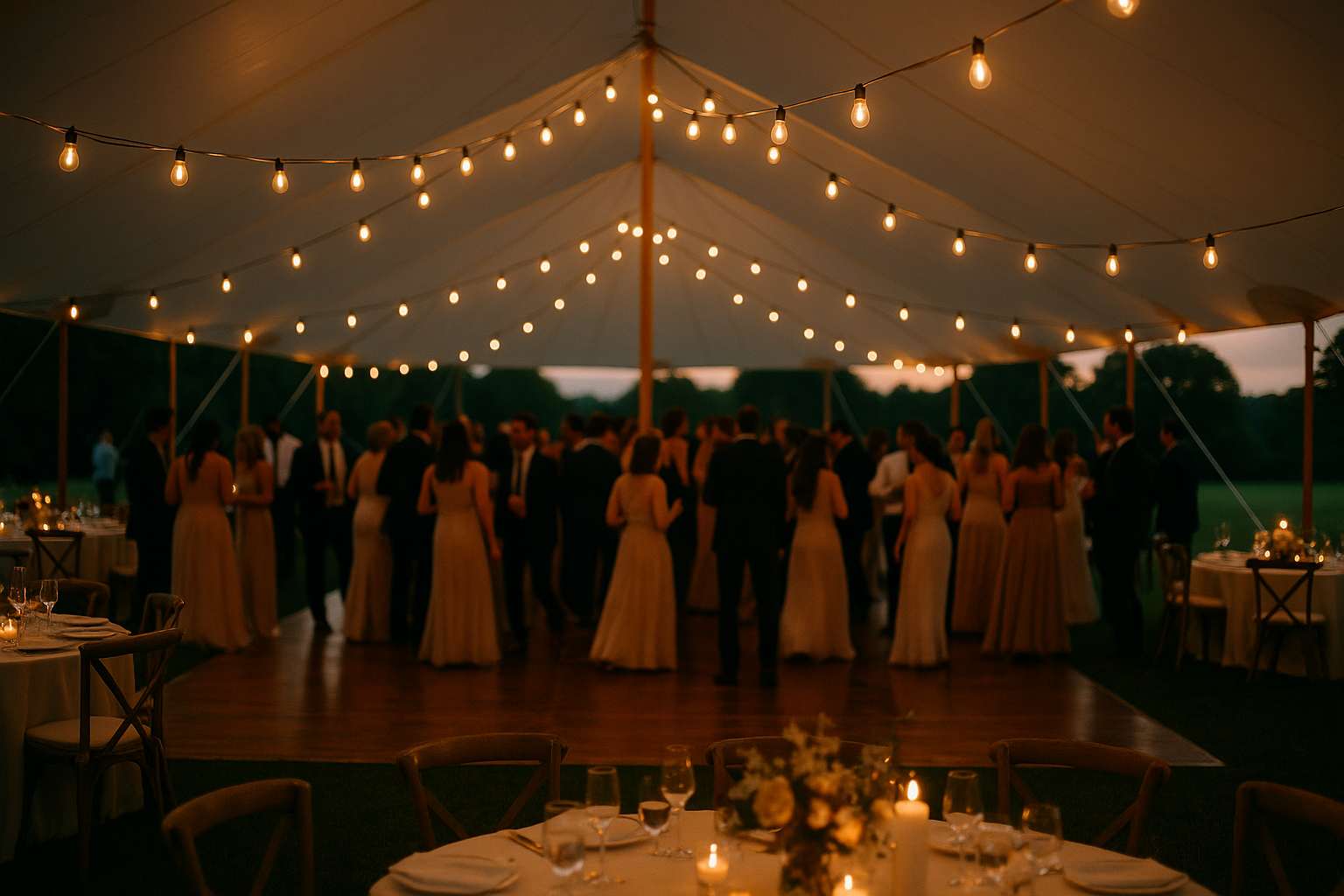
Build your wedding playlist segment by segment — ceremony, cocktail hour, dinner, special dances, and open dancing — providing your DJ with eight to fifteen must-plays, a short do-not-play list, and a clear sense of your crowd's demographics. Trust your entertainer to read the room in real time; that adaptability is what turns a playlist into an unforgettable dance floor.
According to The Knot's 2025 Real Weddings Study, approximately seventy percent of couples hire a professional DJ for their reception, while a meaningful minority invest in live bands or a hybrid format. Across all entertainment formats, one truth holds constant: the quality of music planning that couples do in advance is the single strongest predictor of whether their dance floor stays full. A skilled DJ with good direction will outperform a skilled DJ with none every time — not because direction replaces expertise, but because it focuses it.
This guide builds a wedding playlist from first principles: understanding the emotional arc of the full day, determining the right number of songs for each segment, constructing the must-play and do-not-play lists that frame your entertainer's judgment, and applying the 2026 landscape to a playlist that feels both personal and irresistibly danceable.
What are the six musical segments of a wedding day — and what does each one need?
A wedding's music does not follow a single sustained arc; it unfolds across six distinct acts, each serving a different emotional function and requiring different musical choices.
| Segment | Recommended Songs | Duration | Emotional Purpose |
|---|---|---|---|
| Prelude (guest arrival) | 5–8 | 20–30 min | Welcome; set tone; "something beautiful is beginning" |
| Processional | 2–4 | 5–10 min | Anticipation; solemnity; the bride's entrance |
| Ceremony interludes | 3+ | As needed | Sacred pauses; unity rituals; readings |
| Recessional + postlude | 3–4 | 12–17 min | Pure joy; transition to celebration |
| Cocktail hour | 15–20 | 60–90 min | Social warmth; conversation; sophisticated ease |
| Dinner | 15–20 | 60–90 min | Atmospheric background; warmth; gentle energy build |
| Special dances | 3–5 | ~15 min | Intimate, emotional spotlight moments |
| Open dancing | 30–50 | 2–2.5 hrs | Celebration; energy; collective joy |
The most overlooked segment in wedding music planning is consistently the prelude — the twenty to thirty minutes during which guests arrive, find their seats, and form their first impression of the ceremony space. This is the first music guests hear; it sets the emotional register for everything that follows. Dismissing it as background filler misses an opportunity. A carefully chosen prelude — acoustic covers of meaningful songs, a live string quartet performing contemporary pieces, or a curated jazz set — tells guests something true about who you are before a single word of the ceremony is spoken.
How do you build a must-play list that actually works?
The must-play list is your primary creative communication to your DJ or band. Eight to fifteen songs is the professional ideal: specific enough to convey your taste clearly, concise enough to leave room for the expertise and real-time adaptation that you are paying your entertainer to provide.
Each must-play entry should specify the artist and the exact recording — original versus live version versus acoustic cover — because these are meaningfully different musical experiences. If a song is a must-play because of a particular live performance or a specific arrangement you love, say so. A DJ who does not know the difference between Taylor Swift's original "Love Story" and "Love Story (Taylor's Version)" will make the right call if you tell them; they cannot make it if you do not.
Alongside the must-play list, provide a like-play list of fifteen to twenty-five songs that represent your taste and your crowd's range without requiring specific placement. This list is permission, not instruction: it tells your DJ the territory they are working in. A good DJ treats the like-play list as a musical vocabulary — a set of signposts about the genres, tempos, and eras that resonate with your specific community of guests.
What makes a wedding dance floor stay full — and what empties it?
The mechanics of a thriving dance floor are well understood by experienced wedding entertainers and worth knowing in advance, because the planning decisions you make weeks before the wedding determine the energy architecture of the night.
The single most powerful variable is the couple's own presence on the floor. Your energy is contagious in a way that no playlist choice can replicate. Couples who spend time dancing — who get back on the floor after the formalities, who pull friends and family in with them — consistently maintain fuller dance floors than couples who retreat to their sweetheart table. This is not a burden; it is an invitation to enjoy the celebration you have spent months planning.
The structural enemy of a thriving dance floor is delayed open dancing. Industry consensus is firm on this point: formalities (toasts, cake cutting, special dances) should be clustered together and completed by nine o'clock for a typical evening reception, with open dancing beginning immediately after. Guests who sit for more than ninety minutes without dancing rarely return to the floor. The sequencing of your reception timeline is, functionally, a music planning decision.
Slow songs are powerful tools that can also drain a dance floor if overused. Outside of the formal special dances, limit slow songs during open dancing to one or two over the course of a two-hour set. The energy recovery from a slow-song break takes several songs; a second consecutive slow song can empty a floor that takes fifteen minutes to refill.
How do you collaborate with your DJ without micromanaging them?
The relationship between a couple and their wedding DJ is genuinely collaborative, and the most successful versions of it are built on specific direction combined with genuine trust. Your DJ's most valuable skill — more valuable than any equipment or song library — is their ability to read a room in real time and adapt. Overcurating (submitting fifty or more specific must-play tracks) removes this capability and turns a skilled entertainer into a jukebox.
The communication framework that works: provide your must-play list (eight to fifteen songs), your like-play list (fifteen to twenty-five songs), your do-not-play list (five to ten entries, specific and focused), a written day-of timeline including key moments and their cue times, and a brief description of your guest demographics (age range, geographic distribution, any cultural considerations). Then schedule a thirty-to-forty-five-minute consultation at least four weeks before the wedding to discuss the vision and ask your DJ specific questions: How do you typically build energy through an open-dance set? What do you do when the floor empties? How do you handle guest requests? Their answers will tell you whether you can trust them with the room — and the conversation itself builds the rapport that makes the night-of execution smoother.
According to DJ professionals cited by Fresh Entertainments' 2026 guide, couples who build a shared playlist with their partner throughout the engagement — adding songs as they discover them, noting which ones create strong reactions — arrive at the DJ consultation with a much clearer sense of their collective musical identity than couples who try to construct the list from scratch four weeks out. The engagement period itself is a playlist-building opportunity.
What songs are filling wedding dance floors in 2026?
The 2026 reception landscape rewards familiarity. The songs that most reliably fill dance floors across varied demographics are those that create a shared cultural moment — songs that guests of different ages and backgrounds recognize and respond to together. That shared recognition is the foundation of a thriving floor.
The anchors of the 2026 dance floor: Earth Wind and Fire's "September" (multigenerational, irresistible, an automatic floor-filler across virtually every demographic), Beyoncé's "Crazy in Love" and "Single Ladies," Usher's "Yeah!" and "Yeah! (More)," and "Mr. Brightside" by The Killers — currently the most universally requested singalong at any wedding regardless of theme, region, or formality level. These songs are well-known and well-proven for good reason; including them is not capitulating to cliché but acknowledging the reality of how shared experience works on a dance floor.
For the contemporary layer: "Until I Found You" by Stephen Sanchez anchors the current generation of romantic slow songs. "Flowers" and "Espresso" (Sabrina Carpenter) represent the TikTok-inflected pop that most guests under thirty already know by heart. The late-night "throwback set" — a sustained block of 90s and early-2000s R&B, pop, and hip-hop approximately ninety minutes into open dancing — has become a standard reception structure because it reliably produces a second energy peak after the mid-reception lull.
Build your playlist in thirty-minute blocks with intentional energy variation — peaks and valleys that prevent guest fatigue and keep people returning to the floor across the full arc of the evening. The goal is not a uniformly high-energy set that burns everyone out in forty minutes, but a sustained, living experience that gives guests reasons to get up and reasons to catch their breath and come back.
Frequently asked
How many songs should a wedding playlist have?
For a full wedding day spanning ceremony through reception, plan for roughly 80 to 120 songs across all segments. Breaking that down by segment: five to eight songs for the prelude (guest arrival), two to four for the processional, one to three for ceremony interludes, one for the recessional, two to three for the postlude, fifteen to twenty for cocktail hour, fifteen to twenty for dinner, three to five for special dances (first dance, parent dances), and thirty to fifty for open dancing. The largest category — open dancing — spans roughly two to two and a half hours and demands the most careful curation. If you are working with a professional DJ, you do not need to supply every single song; the DJ's role is to fill the gaps based on their read of the crowd. Your job is to supply the must-plays, the do-not-plays, and an honest sense of your taste and your guests' demographics.
How many must-play songs should I give my DJ?
Eight to fifteen must-play songs is the professional standard for a reason. This number gives your DJ a clear, specific picture of your taste and your non-negotiables while leaving the room for real-time crowd reading that separates a skilled DJ from a jukebox. A list of more than thirty specific must-play songs effectively removes your DJ's greatest asset — their ability to pivot, build energy, and read the room in the moment. Industry experience is clear on this: the dance floors that stay full for two-plus hours are almost always the product of a DJ who was given direction and then trusted to execute. Supply your artist's name, the specific recording you want (original, live, acoustic), and if there is a specific version that is meaningful to you — your DJ cannot read your mind, but they can honor specificity that you provide in writing.
What is a wedding do-not-play list and what should go on it?
A do-not-play list is a short written document — ideally five to ten specific entries — that identifies songs your DJ must avoid regardless of guest requests. What belongs on it: songs with strong negative personal associations (a former partner's song, a family member's funeral hymn), any song whose lyrics or themes conflict with your values or those of key guests, genre-level restrictions you feel strongly about ("no heavy metal" or "no songs with explicit content"), and any individual songs you find genuinely offensive or upsetting. What does not belong on it: songs you are simply indifferent to, songs that would fill the dance floor even if you personally find them cheesy, or a sprawling list of forty tracks that ties your DJ's hands. Keep it focused and functional. The do-not-play list is an act of creative direction, not comprehensive control — and a DJ who receives a focused, purposeful list will respect and honor it far more reliably than one handed a document that amounts to micromanagement.
How should I structure the music for cocktail hour at a wedding?
Cocktail hour music has one primary job: create an atmosphere that feels warm, sophisticated, and social without demanding attention. The volume should sit around sixty-five to seventy decibels — audible ambiance that enhances conversation rather than competing with it. The ideal format is a curated DJ set of jazz, bossa nova, or indie acoustic, or a live two-to-three-piece acoustic ensemble (guitar and bass, keys and vocals, or a jazz duo) if your budget allows. Plan for fifteen to twenty songs for a sixty-minute cocktail hour, and build a ninety-minute set even if you only expect sixty minutes — caterers and photographers regularly run long, and running out of cocktail-hour music is a common and entirely avoidable problem. The stylistic vibe of the cocktail hour should bridge gracefully from the ceremony's emotional register to the social energy of the reception; a jarring stylistic shift — from a classical string quartet to hip-hop — breaks the narrative flow of the day.
What are the most popular wedding reception songs in 2026?
The 2026 dance-floor landscape is dominated by a familiar but effective mix of 90s and early-2000s nostalgia, contemporary pop, and multigenerational crowd-pleasers. Earth Wind and Fire's "September" and Beyoncé's "Crazy in Love" consistently anchor the opening of open-dance sets. "Mr. Brightside" by The Killers is currently the most universally requested singalong across all wedding demographics — it functions as a crowd-reset button when the floor needs an energy injection. Taylor Swift's presence on wedding playlists has grown dramatically; industry sources estimate that nearly half of 2026 couples include at least one Taylor Swift song, with "Love Story (Taylor's Version)" and "Lover" among the most requested. For slower moments, Stephen Sanchez's "Until I Found You" and "Yours" by Post Malone lead the contemporary ballad category. The strongest playlists in 2026 blend these crowd-tested anchors with personal songs that reflect the couple's actual musical identity — the ratio that works most reliably is roughly sixty percent crowd-pleasers, twenty percent personal taste, ten percent nostalgia, and ten percent slow or intimate.
Should we take song requests from guests at our wedding?
Including a song request field on your RSVP card has become one of the most popular and effective guest engagement strategies in wedding planning — and for good reason. It gives guests a sense of ownership and involvement in the celebration, surfaces songs the couple might not have thought to include, and occasionally produces a genuinely unexpected moment of shared joy when a surprising song plays and a dozen guests spontaneously rush the dance floor. The practical implementation: collect requests on your RSVP, review them before submitting your playlist to your DJ, and add the ones that genuinely fit your vision to your like-play list. Give your DJ written permission to use professional judgment on night-of requests — a gracious "I'll see what I can work in" response from the DJ manages guest expectations without making a promise that might conflict with the energy arc the DJ is managing in real time. Do not feel obligated to play every request; the list exists to inform the DJ's judgment, not to override it.