Reception & Parties
Sweetheart Table vs. Head Table: Which Is Right for Your Wedding?
Your choice of couple's table shapes more than aesthetics — it affects your wedding party's logistics, your photography, your parents' feelings, and the one quiet moment you will have together all day. Here is every consideration, honestly compared.
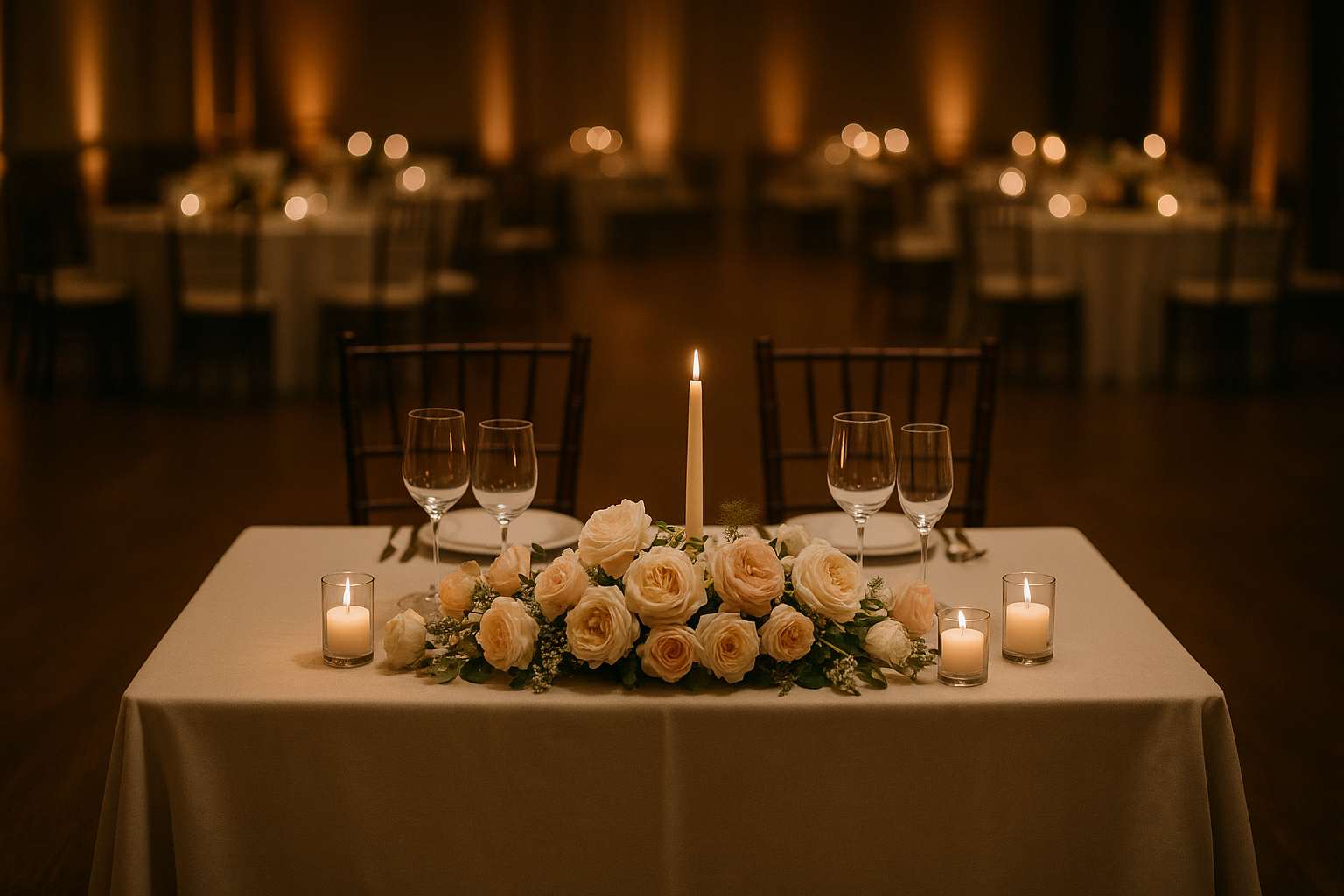
The sweetheart table seats just the two of you — intimate, photography-forward, and ideal for navigating divorced-parent seating. The head table surrounds you with your wedding party — communal, traditional, and beloved by couples who want their closest friends beside them at dinner. The king's table gives you both. All three formats are beautiful; choose by how you want to experience the meal.
What Are the Real Differences Between a Sweetheart Table and a Head Table?
The choice between these two formats is not simply aesthetic — it shapes the social architecture of your entire reception. Your couple's table determines where the photographers spend the most time during dinner, which family members feel elevated or overlooked, and whether your wedding party is seated with their dates or split from them for the meal.
Here is a direct comparison of all three formats that couples choose in 2025 and 2026:
| Feature | Sweetheart Table | Head Table | King's Table |
|---|---|---|---|
| Seats | Couple only (2) | Couple + wedding party (6–14) | Couple + wedding party + dates (12–24+) |
| Intimacy level | Highest | Social / communal | Festive and inclusive |
| Photography access | Excellent — couple always visible | Good — couple flanked by party | Good — couple at head position |
| Plus-one logistics | Simple — party seats with guests | Complicated — partners displaced | Solved — everyone together |
| Divorced-parent dynamics | Cleanest — neither parent elevated | Complex — which parent sits here? | Clean — neither parent elevated |
| Space requirement | Minimal | Moderate to high | Very high |
| Décor investment | Concentrated, high-impact | Linear, requires more florals | Dramatic floral runner opportunity |
| Best for | Intimate, photography-forward, or complex family weddings | Traditional, tight-knit bridal parties | Inclusive, editorial, large party with established partners |
Why Is the Sweetheart Table the More Popular Choice in 2026?
Wedding venue coordinators and planners across the country report that the sweetheart table has moved from a modern alternative to the dominant choice. Several practical forces are driving this shift.
The plus-one problem is real. A traditional head table places the maid of honor beside the groom's best man and the bridesmaids beside the groomsmen — a format that effectively separates every wedding party member from their date or partner for the duration of the meal. For wedding parties where several members are in committed relationships, this arrangement can feel isolating rather than celebratory. The sweetheart table dissolves this problem entirely: wedding party members are distributed among guest tables where they sit naturally with their partners and the guests who know them best.
Photography benefits are significant. According to Inside Weddings, a sweetheart table provides photographers with unobstructed access to the couple throughout dinner from multiple angles — candid moments, intimate exchanges, the first sip of champagne together. At a head table, the couple is framed by six to twelve attendants in every frame, which limits the intimacy of dinner portraits.
Styling a small table is more economical and more dramatic. The sweetheart table becomes a concentrated jewel at the front of the room: a lush floral arrangement, candles, fine linens, and fine glassware applied to one small surface creates a stunning focal point at a fraction of the floral cost of dressing a ten-person head table. Many couples allocate the cost difference to florals elsewhere in the room.
Divorced-parent dynamics are cleaner. This benefit deserves its own section, but the practical reality is this: when neither parent sits at the couple's table, neither parent feels demoted. Both receive their own equally positioned family table. The sweetheart table is widely recognized by experienced wedding planners as the most graceful architectural solution to one of the reception's most common interpersonal pressures.
When Does a Head Table Make More Sense?
The head table is not an outdated choice — it is the right choice for specific couples. If you are deeply energized by being surrounded by people during social events, the sweetheart table's intimacy may feel more isolating than restorative. If your wedding party is small — four people or fewer — and no one has a significant other who would be displaced, a head table is genuinely simple and lovely. If your family has strong traditional expectations around the communal bridal party dinner and you value honoring that expectation, the head table is the dignified choice.
The head table also creates an excellent platform for toasts: the maid of honor and best man are already positioned adjacent to the couple, microphone logistics are clear, and the entire party is visible in a single camera frame. If your reception includes a significant toasting ceremony — multiple speakers, personalized remarks — the head table provides the clearest visual and logistical stage for that moment.
The King's Table: The Best of Both Worlds?
The king's table — a long rectangular arrangement with the couple at the head and the entire wedding party plus their dates seated on either side — has grown substantially in popularity as editorial wedding photography has shifted toward communal feasting imagery with lush floral runners and candlelight. Venue coordinators at Revel Center note that the king's table requests have increased meaningfully in the past two seasons, driven by couples who want both the inclusion of the head table and the plus-one resolution it typically lacks.
The practical requirements are significant, however. A king's table for a wedding party of eight couples — the couple plus six attendants and their six partners — requires seating for 14 people at a single table arrangement. That demands floor space that not all venues can accommodate without materially affecting guest table placement. If your venue is compact or your wedding party is large, discuss the floor plan implications with your venue coordinator before committing to this format. The king's table is most successful at venues with high ceilings, long rectangular floor plans, and guest counts under 120, where the drama of the long table registers without dominating the entire room.
Practical Questions to Answer Before You Decide
These four questions tend to surface the right answer clearly:
- Are your parents divorced or is their relationship complicated? If yes, the sweetheart table eliminates the most common family seating flashpoint.
- Do wedding party members have established partners who will be at the reception? If most do, the sweetheart table (or king's table) is the more considerate option for those partners.
- Is photography a top priority for your reception? If yes, the sweetheart table provides significantly more editorial access throughout dinner.
- How do you want to feel during your reception meal? Cocooned in intimacy with your partner, or animated by the people you love most surrounding you? Neither feeling is wrong — but they are genuinely different experiences, and your honest answer to this question is the clearest guide.
Frequently asked
What is the main difference between a sweetheart table and a head table?
A sweetheart table is a small table — typically a 48-inch round or a compact bistro-style rectangle — set for just the two of you at the front or center of the reception room. It is a private, intimate setting within a public celebration: you have each other's undivided attention during the meal, and your guests have an unobstructed view of you from every angle. A head table is a long rectangular table, often elevated on a riser, where the couple sits alongside their wedding party — typically six to fourteen people. It is the traditional, communal format that keeps you surrounded by the people closest to you throughout dinner. The choice reflects two genuinely different philosophies about how to spend your reception meal: alone together, or surrounded by your people.
Which option is more popular in 2025 and 2026?
The sweetheart table has grown to become the more popular choice among couples planning weddings in 2025 and 2026, driven by three converging factors: the simplified logistics of not seating the wedding party (and their plus-ones) in a single row, the photography advantage of having the couple visible and accessible throughout dinner, and the growing preference for intimate moments within large celebrations. Wedding venue coordinators consistently report that the sweetheart table now accounts for the majority of couple's table requests at properties they manage. However, the head table retains strong appeal among couples with large, tight-knit wedding parties and among families for whom the communal dinner moment carries traditional significance. Neither option is more correct — both are widely practiced, and your venue will accommodate either with equal ease.
How does a sweetheart table help with divorced parents?
The sweetheart table is widely recognized by wedding planners as the single most effective tool for navigating divorced and remarried parent dynamics at the reception. When you use a head table, the question of which parent sits at the elevated, photographically prominent position becomes charged — placing one parent there and not the other can feel like a ranking of their importance. The sweetheart table elegantly removes this dynamic: neither parent sits at the couple's table. Each can be honored at their own family table, positioned symmetrically in the room, with their respective family and close friends. Both receive equal standing. Your wedding planner or venue coordinator can position these tables so neither reads as more prominently placed than the other. Real couples in complex family situations frequently cite this aspect of the sweetheart table as the most practically useful benefit.
What is a king's table, and who is it best for?
A king's table — sometimes called a feasting table — is a long rectangular arrangement that seats the couple at the head, with all wedding party members and their dates or plus-ones on either side. It functions as a head table that resolves the head table's primary weakness: no partner is displaced to a guest table. Everyone the couple loves most, along with their significant others, sits together at one long, lushly decorated surface. The visual result is dramatic and editorial — particularly with a low floral runner down the center — and it creates a warm, festive dinner among the couple's inner circle. The considerations: a king's table for a wedding party of eight couples requires roughly 20 to 24 people at one table, demands significant floor space, and needs a microphone plan for toasts since speakers will be spread across the table's length. It is best suited to couples with large, tight-knit wedding parties whose plus-ones are well-integrated into the friend group.
How should I decide which option is right for my wedding?
Answer these four questions honestly and the decision tends to become clear. First: are you an introvert or an extrovert in large social situations? Introverts often find the sweetheart table's contained intimacy genuinely restorative during what can be an overwhelming day; extroverts are energized by being surrounded by their closest people. Second: how many people are in your wedding party, and do they all have significant others? Large wedding parties with established partners often benefit from the king's table that seats everyone together. Third: are divorced or remarried parents involved, and is their relationship complex? The sweetheart table is the cleanest solution. Fourth: is photography a top priority? Sweetheart tables produce distinctly more editorial couple portraits during dinner. There is no wrong answer — choose the format that reflects how you want to experience your own reception meal.
Can we combine the sweetheart table with a head table?
Yes, and some couples use exactly this hybrid. One approach: use a sweetheart table during dinner for the intimacy and photography benefit, then join the wedding party at a designated long table for toasts and the first portion of dancing. Another approach used by some couples: sit at the sweetheart table for the first half of the meal, then move freely among guest tables for the second half, spending ten minutes at each table. This unstructured version of table-hopping — less choreographed than a formal receiving line — is warm, personal, and ensures every guest has a moment with you. Communicate any hybrid format to your venue coordinator and your wedding planner so the timeline and staffing reflect the plan. The sweetheart table setup remains in place; it just is not the only location you occupy during the reception.