Reception & Parties
Types of Wedding Photo Booths: The 2026 Guide
73% of couples include a photo booth in their wedding, and the options have never been more varied — from nostalgic enclosed strips to cinematic 360-degree video and AI-enhanced experiences. Here is every type ranked, priced, and matched to the right wedding.
wedding photo booth 2026360 photo booth rentalAI photo booth weddingphoto booth rental costmirror booth weddingopen-air photo booth
The quick verdict
73% of couples include a photo booth in their wedding. The options span $250 selfie kiosks to $3,500 AI-enhanced video platforms. Here is every type, priced and matched to the right wedding.
- Best overall
- Open-Air DSLR Booth — Best balance of image quality, aesthetic flexibility, and price — works at nearly every wedding style and guest count.
- Best value
- Selfie Station / iPad Kiosk — Under $500 for a fully functional digital experience; right for casual events and tight budgets.
- Best for Couples who are active on Instagram and TikTok
- 360-Degree Video Booth — Produces cinematic slow-motion Reels-ready clips that standard booths cannot replicate — the single strongest social media content driver in the category.
How we evaluated
We evaluated each photo booth type on six criteria relevant to weddings: image or video quality, guest experience and accessibility across age groups, aesthetic fit for formal and informal venues, space and technical requirements, cost and value, and social media shareability. Pricing reflects 2026 U.S. national averages from vendors including Bark, Firefly Photo Booth, Pix Wedding, and Event Brothers Co. — with adjustments noted for high-cost markets. This is an independent guide: no vendor paid for placement, and every type on this list earns at least one honest weakness.
- Image / video quality. High — the output is the whole point
- Guest accessibility. High — booths attended only by younger guests are a wasted investment
- Aesthetic fit. Medium — must match the visual vocabulary of the wedding
- Space and technical requirements. Medium — venue constraints often override preference
- Cost and value. Medium — ranges from $250 to $3,500+ for the same 3-4 hour window
- Social media output. Low to high — irrelevant for some couples, central for others
Rating scale: Ratings are on a 1-5 scale.
Last verified .
At a glance
| # | Name | Rating | Best for | Pricing |
|---|---|---|---|---|
| 1 | Open-Air DSLR Photo Booth | 4.7 | The workhorse. The most versatile, best-looking, and most reliable photo booth format for most weddings. | $800–$1,200 for a 3–4 hour wedding package; additional hours at $100–$150/hr |
| 2 | 360-Degree Video Booth | 4.6 | The reception statement piece. Produces cinematic slow-motion video optimized for social media — nothing else in the category competes for shareable output. | $1,200–$3,000 for a 3–4 hour wedding package; premium markets and setups reach $3,500–$4,500 |
| 3 | Mirror Photo Booth | 4.4 | Elegant, interactive, and inherently upscale. The best booth choice for formal and black-tie weddings. | $800–$1,200 for a 3–4 hour rental; glam upgrades add $100–$300 |
| 4 | AI-Enhanced Photo Booth | 4.2 | The technology-forward choice. Real-time background removal, digital retouching, and custom avatars — the future of the category, right now. | $1,200–$3,500 for a 3–4 hour rental; premium AI setups in major markets reach $4,000+ |
| 5 | Glam Photo Booth | 4.1 | Studio-quality beauty output. The dedicated vanity filter booth — designed to make every guest look their most polished. | $1,100–$2,300 for a 3–4 hour rental |
| 6 | Enclosed Classic Photo Booth | 4.0 | Nostalgic, intimate, and universally understood. The original format still earns its place at the right wedding. | $600–$950 for a 3–4 hour rental; lower end reflects older equipment in some markets |
| 7 | Roamer / Wander Booth | 3.8 | The booth that comes to the guests. A mobile camera experience that catches candid moments everywhere in the reception. | $300–$600 for a 4–5 hour coverage window |
Open-Air DSLR Photo Booth
The workhorse. The most versatile, best-looking, and most reliable photo booth format for most weddings.
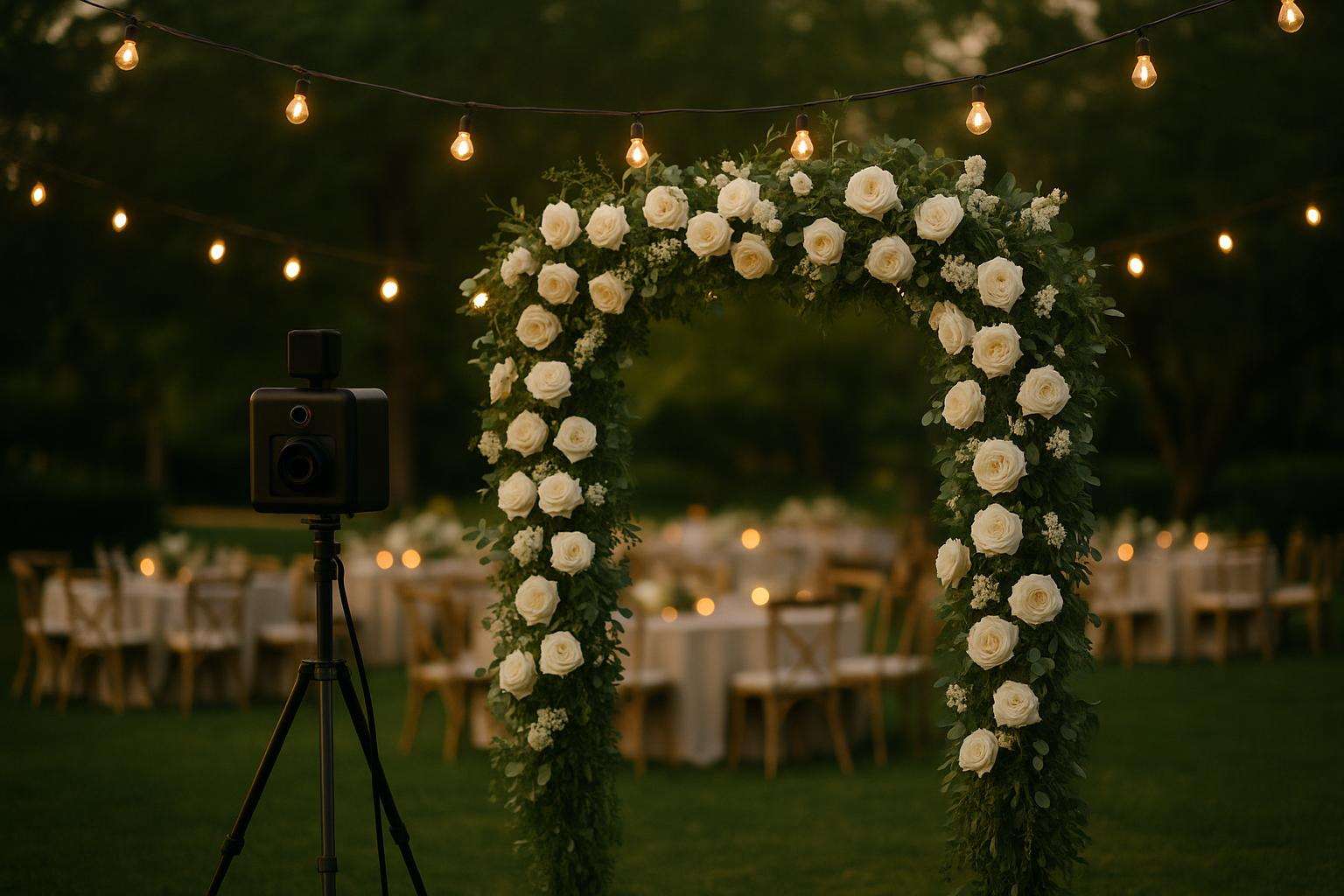
An open-air DSLR photo booth places a professional-grade camera on a stand — not a tablet, not a consumer camera — in front of a backdrop of your choice, operated by an on-site attendant. Groups of any size step in front of the lens; the attendant helps with posing and triggers the shutter. The open-air format allows guests to see each other and communicate during the experience, which creates more natural expressions and more energy than an enclosed booth. The backdrop is the primary aesthetic driver: couples can specify a white floral arch, a custom fabric in their wedding palette, a framed chalkboard sign, or a simple neutral panel that disappears into the venue design. Because the camera is a genuine DSLR rather than a tablet or phone, image quality is significantly better than any digital-only setup — sharper, better in low light, and more flattering at all ages. For a standard 3–4 hour wedding package, expect to pay $800–$1,200, inclusive of the attendant, unlimited sessions, a custom overlay, and a digital gallery delivered within 48 hours. Many open-air vendors also offer print capabilities for an additional $75–$200. This is the foundation against which every other booth type is evaluated.
Strengths
- Superior image quality versus tablet-based setups — meaningful difference in low-light reception venues
- Backdrop is fully customizable to match the wedding's aesthetic, making the booth invisible-as-a-booth in photography
- Works for any group size, any age, any level of familiarity with technology — the attendant removes every friction point
Weaknesses
- Does not produce video output — no Reels, no TikTok clips, only still photographs
- Best for
- The workhorse. The most versatile, best-looking, and most reliable photo booth format for most weddings.
- Pricing
- $800–$1,200 for a 3–4 hour wedding package; additional hours at $100–$150/hr
Source: How Much Does a Photo Booth Cost? 2026 — Captured Celebrations
360-Degree Video Booth
The reception statement piece. Produces cinematic slow-motion video optimized for social media — nothing else in the category competes for shareable output.
The 360-degree video booth is the single fastest-growing sub-segment of the photo booth market, with the 360 category alone valued at approximately $890 million in 2025 and expected to double by 2034. The mechanics are memorable: guests step onto a circular platform (6–8 feet in diameter), and a camera arm mounted at the edge orbits around them at speed, capturing 10–20 seconds of slow-motion video. Vendors can add confetti bursts, fog machines, and synchronized LED rings to enhance the visual drama. The resulting clip is delivered to the guest's phone by text or email within 2–3 minutes and plays beautifully as an Instagram Reel or TikTok — the output is designed for exactly these formats. For couples who are active on social media and want their guests to generate authentic, high-quality shareable content, no other booth type produces equivalent results. The practical requirements are significant: a 10x12 foot minimum clear footprint, a dedicated 15–20 amp circuit, and ideally two attendants (one operating the arm, one managing guest flow and delivery). Full-event packages run $1,200–$3,000 in most markets, with additional hours at approximately $300/hr. Premium setups with custom LED surrounds, fog, and branded templates in major markets like New York or Los Angeles can exceed $3,500–$4,500. Book early: 360 booths have fewer vendors per market than standard booths and sell out on peak Saturday dates 9–12 months in advance.
Strengths
- Produces cinematic slow-motion video clips that guests share immediately — no other booth type generates comparable organic social media content
- Becomes a visual centerpiece of the reception; the spectacle draws guests who might ignore a standard booth
- Each session is a memorable, full-body experience rather than a passive pose-and-print
Weaknesses
- Requires 10x12 ft of clear floor space — a meaningful footprint in smaller venues that may conflict with dance floor or seating
- Higher cost and longer per-session time (2–4 minutes per group) means fewer total groups served per hour than a standard booth
- Best for
- The reception statement piece. Produces cinematic slow-motion video optimized for social media — nothing else in the category competes for shareable output.
- Pricing
- $1,200–$3,000 for a 3–4 hour wedding package; premium markets and setups reach $3,500–$4,500
Source: 360 Photo Booth Rental Cost and Pricing in 2026 — Firefly Photo Booth
Mirror Photo Booth
Elegant, interactive, and inherently upscale. The best booth choice for formal and black-tie weddings.
The mirror booth is a full-length interactive display — typically 6 feet tall — that guests stand in front of, touch to interact with, and pose for while a built-in camera captures the image. The experience is inherently more theatrical than a standard booth: the mirror greets guests with animations, offers prompt overlays, and allows guests to sign their names digitally on the screen before the photo prints. The full-length form factor is its distinguishing quality — it shows the complete outfit, making it a natural fit for black-tie weddings where guests have invested in their appearance. The aesthetic is sophisticated and refined in a way that most kiosk-format booths are not, which is why it has become the go-to choice for upscale venues and design-forward couples. The mirror also functions as a statement piece in its own right: its large format is visually striking and draws guests in throughout the evening. Standard 3–4 hour rental packages run $800–$1,200, competitive with premium open-air setups. Custom branded overlays, rose-gold or chrome frames, and premium prop kits are available as upgrades. The mirror requires a standard power outlet and a footprint of approximately 6x8 feet — less demanding than the 360 booth but more than a compact open-air kiosk.
Strengths
- Intrinsically formal aesthetic that fits black-tie and upscale venue environments without requiring custom styling
- Full-length capture shows complete outfits — particularly relevant for weddings where guests have invested significantly in their attire
- Interactive touchscreen experience is novel and engaging without requiring any technical knowledge from guests
Weaknesses
- The touch-screen interaction adds 30–60 seconds per session versus a standard open-air booth, reducing the number of groups served per hour
- Best for
- Elegant, interactive, and inherently upscale. The best booth choice for formal and black-tie weddings.
- Pricing
- $800–$1,200 for a 3–4 hour rental; glam upgrades add $100–$300
AI-Enhanced Photo Booth
The technology-forward choice. Real-time background removal, digital retouching, and custom avatars — the future of the category, right now.
AI-enhanced photo booths integrate machine-learning technology directly into the capture and output experience. Current capabilities in the 2026 market include real-time background removal and replacement without a green screen (allowing any venue background to be substituted with a custom digital scene), instant digital retouching (smoothing, exposure correction, and skin-tone balancing applied before the guest sees the image), themed filter suggestions based on the couple's aesthetic profile, custom avatar generation from a single photo, and emotion detection for 'best frame' selection from a burst sequence. AI and AR integration is projected to account for 40% of new photo booth sales by 2026, and the quality gap between AI-enhanced output and standard booth output has narrowed significantly over the past two years. For brides interested in this category, the critical evaluation criterion is actual AI quality in live conditions: demo the booth in a dim venue environment before booking, because AI background removal and retouching performance varies considerably between vendors. Marketing samples are universally polished; live performance is what matters. Rental costs run $1,200–$3,500, roughly parallel to 360 booths, reflecting the higher technology investment. Always ask vendors for RAW files in addition to processed outputs so you have the originals if the AI results are inconsistent.
Strengths
- Background replacement without a physical backdrop eliminates the most aesthetically challenging element of a standard booth — no curtain or panel to clash with the venue
- Instant retouching means guests receive flattering images without posing expertise or flattering lighting — particularly meaningful for older guests who are self-conscious on camera
- Technology novelty creates genuine conversation and interest among guests, especially in age groups 25–45 who are digitally native
Weaknesses
- AI output quality varies significantly between vendors and can be inconsistent in low-light conditions; always test in person before booking rather than relying on portfolio samples taken under ideal conditions
- Best for
- The technology-forward choice. Real-time background removal, digital retouching, and custom avatars — the future of the category, right now.
- Pricing
- $1,200–$3,500 for a 3–4 hour rental; premium AI setups in major markets reach $4,000+
Source: Photo Booth Rental Cost for Weddings: 2026 Pricing Guide — Pix Wedding
Glam Photo Booth
Studio-quality beauty output. The dedicated vanity filter booth — designed to make every guest look their most polished.
The glam booth is a specialized variant of the open-air or enclosed format, distinguished by a built-in skin-softening beauty filter applied during capture and processing. The filter smooths skin texture, subtly brightens eyes, corrects exposure, and produces output that resembles professional retouched portrait photography rather than a candid snapshot. The result is images that guests genuinely want to save and share — the most common guest complaint about standard booths is that the harsh built-in flash is unflattering, and the glam booth addresses this directly through both filter technology and softer lighting equipment. For weddings with a glamorous, fashion-forward, or high-design aesthetic — late-evening receptions, New Year's Eve celebrations, milestone birthday weddings — the glam booth delivers output that matches the aspirational energy of the event. Standard glam packages include the beauty filter, custom overlays, digital delivery per session, and an attendant; some vendors include a printed metallic photo strip. Rental costs run $1,100–$2,300 for a 3–4 hour window, reflecting the premium filter technology and additional lighting equipment. Unlike AI booths, the glam filter is applied consistently to every image without the variability risk of machine-learning-based retouching.
Strengths
- Consistently flattering output regardless of age or how guests look at hour nine of a wedding reception — broadly appreciated by guests of all generations
- Printed output (metallic or standard) is a physical keepsake that guests take home — more memorable than a digital-only delivery
- Softer lighting equipment and an applied beauty filter solve the most common guest complaint about standard booths — the harsh, unflattering built-in flash
Weaknesses
- Beauty filter has a specific aesthetic that does not fit every couple's vision — if your wedding aesthetic is rustic, bohemian, or documentary-naturalistic, the hyper-polished output may feel incongruous
- Best for
- Studio-quality beauty output. The dedicated vanity filter booth — designed to make every guest look their most polished.
- Pricing
- $1,100–$2,300 for a 3–4 hour rental
Source: Photo Booth Rental Cost in 2026: Real Prices by Type — Event Brothers Co.
Enclosed Classic Photo Booth
Nostalgic, intimate, and universally understood. The original format still earns its place at the right wedding.
The enclosed photo booth — a curtained or doored cabinet, typically seating 2–4 guests in a tight strip — is the original format and remains beloved for what no open-air setup can replicate: genuine intimacy and privacy. When guests step inside a closed booth together, the velvet curtain draws the world away, laughter is louder, poses are less self-conscious, and the resulting strip of four images often captures a genuinely unguarded expression that the social visibility of an open-air setup tends to suppress. The photo strip itself is the defining output — a series of 3–4 sequential poses printed on a wallet-sized strip — and it functions as one of the most persistently cherished wedding keepsakes of the last thirty years. Grandparents know exactly what to do. Children are delighted. The mechanic requires zero explanation. In a market that has pushed heavily toward novelty, the classic enclosed booth occupies an honest and durable niche for family-heavy weddings, mid-century-modern or vintage aesthetics, and couples who want an affordable, time-tested experience rather than a technology showcase. Standard 3–4 hour rental packages run $600–$950, making it the most affordable professional booth option on this list. The limitation is real: group size is constrained to 4–5 maximum, the enclosed space feels claustrophobic to some guests, and premium markets have shifted away from this format significantly — finding a quality vendor with maintained equipment can require more vetting in 2026 than it did five years ago.
Strengths
- Creates genuine privacy and intimacy that eliminates the self-consciousness of being photographed publicly — produces more authentic expressions than open-air formats
- Photo strip is a universally recognized, deeply nostalgic keepsake that guests save for years
- Most affordable professional booth option — leaves budget available for other reception elements
Weaknesses
- Group size limited to 4–5 maximum — extended family groupings and large table groups cannot use the booth together, which limits whole-table participation moments
- Best for
- Nostalgic, intimate, and universally understood. The original format still earns its place at the right wedding.
- Pricing
- $600–$950 for a 3–4 hour rental; lower end reflects older equipment in some markets
Roamer / Wander Booth
The booth that comes to the guests. A mobile camera experience that catches candid moments everywhere in the reception.
A roamer booth — sometimes called a wander booth or roaming photographer experience — is a portable camera unit carried by a vendor attendant who moves through the reception capturing impromptu moments at tables, on the dance floor, and in corners of the room that a stationary booth would never reach. The output is typically digital-only, delivered to guests via text or a shared gallery link, and ranges from standard still photography to short video clips depending on the vendor's setup. The roamer's defining advantage is coverage: a stationary booth captures only the guests who actively seek it out, which in most weddings is 50–70% of the guest list. A roamer reaches tables of older guests who would not think to queue up, captures the grandmother who has been laughing all night, and documents the moment between the flower girl and the ring bearer that no one staged. Some roamer vendors use iPad-mounted cameras; others use professional mirrorless cameras for significantly better quality. Rental costs run $300–$600 for a 4–5 hour coverage window, making it the most affordable coverage option on this list. Its limitation is real: there is no physical keepsake, no branded output, and the quality of a roamer's images is often noticeably lower than a stationary DSLR setup. Many couples use a roamer alongside a stationary booth rather than instead of one — the roamer drives coverage breadth while the stationary booth delivers quality output.
Strengths
- Reaches guests who would not queue at a stationary booth — particularly older guests, seated family groups, and shy attendees — dramatically broadening photographic coverage
- Most affordable professional photo-capture option on this list; excellent complement to a stationary booth within a combined budget
- Captures unstaged, candid moments across the entire room — dance floor, tables, and quiet corners a fixed booth never reaches
Weaknesses
- No physical keepsake and often lower image quality than a DSLR stationary setup; better as a complement to than a replacement for a primary booth
- Best for
- The booth that comes to the guests. A mobile camera experience that catches candid moments everywhere in the reception.
- Pricing
- $300–$600 for a 4–5 hour coverage window
Frequently asked
How much does a wedding photo booth cost in 2026?
The cost of a wedding photo booth in 2026 varies significantly by type and market. Standard open-air DSLR booths run $600–$1,200 for a 3–4 hour rental. Mirror booths cost $800–$1,200. The 360-degree video booth — the most popular premium option — runs $1,200–$3,000 or more for a full-event package, with additional hours at approximately $300/hour. AI-enhanced booths are priced similarly at $1,200–$3,500. Glam booths with beauty-filter technology run $1,100–$2,300. Most couples in 2026 pay $700–$1,500 for a professional wedding photo booth rental, inclusive of an on-site attendant, unlimited sessions during the rental window, and a digital gallery delivered after the event. In high-demand markets like New York, Los Angeles, and Houston, prices run 20–25% above national averages. Always confirm what is included: setup and takedown, a prop kit, a custom overlay, and digital delivery are standard in most mid-range packages.
What is the difference between a 360 photo booth and a traditional photo booth?
A traditional photo booth — whether open-air or enclosed — captures still photographs, typically producing a printed strip of 3–4 frames or a single posed image. The experience is immediate, physical, and familiar. A 360 photo booth captures short-form slow-motion video: guests stand on a circular platform while a camera arm orbits around them at speed, producing a 10–20 second cinematic clip optimized for Instagram Reels and TikTok. The output is fundamentally different — shareable video rather than a printed keepsake — and the booth itself is a reception statement piece, drawing crowds and creating energy throughout the evening. The 360 booth requires significantly more space (a 10x12 foot clear footprint minimum), costs more ($1,200–$3,000+ vs. $600–$1,200 for a standard booth), and benefits from two attendants rather than one. For couples who are active on social media and want their reception coverage to live beyond the event, the 360 booth delivers content that a traditional booth simply cannot.
How long should I rent a photo booth for at my wedding?
Most wedding receptions benefit from a 3–4 hour photo booth window. The optimal structure is to open the booth during cocktail hour (1 hour), when guests are relaxed and social energy is at its peak, and then continue through the main reception (2–3 additional hours). Booth activity typically peaks in the first hour of use and again after dinner, when guests are energized from the meal and dancing has started. A 2-hour minimum is rarely sufficient for a full wedding — the math works out to very short windows that guests miss. For a 360 booth, each session takes 2–4 minutes including setup and delivery, giving you roughly 15–25 groups per hour; ensure your rental window accommodates your guest count comfortably. Most vendors charge $100–$300 per additional hour, so book the window you actually need from the start.
What should a standard wedding photo booth rental package include?
A well-structured mid-range wedding photo booth rental package should include: setup and teardown (typically 1–1.5 hours before guests arrive), an on-site attendant for the full rental period, unlimited sessions during your rental window, a standard prop kit, one backdrop of your choice (confirm the options), a custom overlay with your names and wedding date, and a digital gallery or download link delivered within 24–72 hours after the event. Common add-ons that cost extra include printed photo strips, premium prop kits, a custom or upgraded backdrop, a guest book with printed photos, a second attendant, extended hours, video output (GIFs, boomerangs, or Reels-format clips for standard booths), same-day digital delivery per session, and branded templates. Ask for the complete add-on menu in writing before signing your contract so there are no surprises on the invoice.
Which type of photo booth is best for a formal or black-tie wedding?
For formal and black-tie weddings, the booth choice should match the aesthetic and atmosphere of the event — meaning the setup itself should not look like a carnival attraction dropped into an elegant ballroom. The best options for formal weddings are the open-air DSLR booth with a minimal, design-forward backdrop (white floral, gold sequin, or custom fabric in your wedding palette), the mirror booth (which has an inherently sophisticated full-length form factor), and high-end AI-enhanced booths that offer custom branded overlays and clean digital output. Avoid neon-lit, heavily branded kiosks with garish prop bins — these clash with formal environments visually and tonally. Most premium booth vendors offer custom wraps and neutral setups specifically for upscale events; request these explicitly. The 360 booth can work beautifully at formal events if its platform and surround are styled to match, but confirm this with the vendor before booking.
Should I hire a photo booth or a wedding content creator — or both?
They serve genuinely different purposes and can work together. A photo booth gives every guest an equal-access, interactive experience with keepsake outputs — whether printed strips or digital video clips. Every guest at the booth gets the same format: posed, intentional, with a backdrop. A wedding content creator, by contrast, captures behind-the-scenes and candid content across the entire day — getting ready, ceremony transitions, first dances, candid moments at tables — using mobile devices and short-form social-media-native formats. The creator delivers curated content that tells the full story; the booth delivers a specific interactive moment. For couples active on social media who can afford both, they are complementary. On a tight budget, prioritize based on your goals: if you want an interactive guest experience and physical or digital keepsakes, the booth is the stronger choice. If you want content that captures the full emotional arc of the day for social media, a content creator is a better investment.