Reception & Parties
Wedding Dance Floor Size: How Big Does It Need to Be?
A dance floor that is too small kills the energy by midnight; one that is too large leaves guests too spread out to dance. Here is the formula, the size chart, and everything you need to get it exactly right.
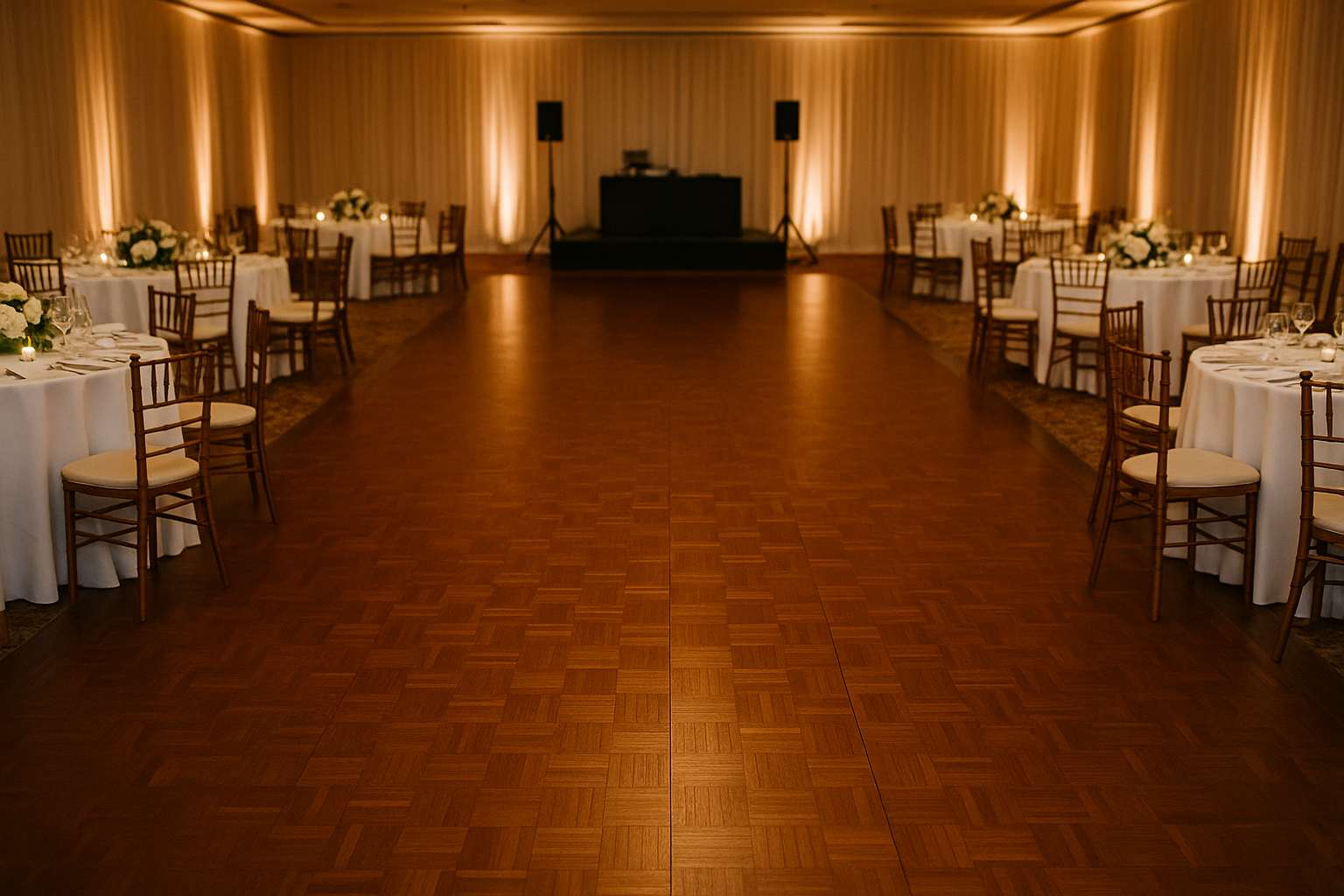
Plan for 30–50% of your guests dancing at peak time, multiply that number by 4.5 square feet per dancer, and you have your dance floor size. For 100 guests, a 15×15-foot floor (225 sq ft) is the sweet spot for most weddings. For high-energy cultural celebrations, size up by 20–30%.
Why Getting the Dance Floor Size Right Matters More Than You Think
The wedding dance floor is the emotional heart of the reception. When it is the right size — slightly full, energetic, pulling more guests in throughout the evening — the entire room feels alive. When it is too small, guests become physically uncomfortable and retreat; when it is too large, the floor looks emptier than it is and the energy deflates. Neither of these is a minor aesthetic issue: they determine whether guests leave saying the reception was unforgettable, or merely fine.
The good news is that dance floor sizing is one of the most calculable elements of reception planning. The formula is simple and reliable; the mistakes are predictable and avoidable. Here is everything you need.
What Is the Formula for Sizing a Wedding Dance Floor?
The industry-standard approach used by professional event planners has two components:
- Estimate peak participation: How many guests will be on the floor at the same time? For most weddings, this is 30–50% of total guests. High-energy receptions skew toward 50–70%.
- Multiply by 4.5 square feet per dancer: This allows comfortable social dancing without crowding. Traditional ballroom dancing uses 5–6 sq ft per person; casual reception dancing at 4–4.5 sq ft is the most common professional benchmark.
According to Top Dance Floor's sizing guide, the formula in practice: 100 guests × 40% participation = 40 dancers × 4.5 sq ft = 180 sq ft, corresponding to approximately a 14×13-foot floor. For 150 guests at the same participation rate: 60 dancers × 4.5 sq ft = 270 sq ft, or roughly an 18×15-foot floor.
What Size Dance Floor Do You Need By Guest Count?
| Guest Count | Recommended Floor Size | Approximate Sq Ft | High-Energy Upsize |
|---|---|---|---|
| 50–75 guests | 10×12 ft to 12×14 ft | 120–170 sq ft | 14×16 ft (224 sq ft) |
| 75–100 guests | 14×14 ft to 15×15 ft | 196–225 sq ft | 16×18 ft (288 sq ft) |
| 100–125 guests | 15×16 ft to 16×18 ft | 240–288 sq ft | 18×20 ft (360 sq ft) |
| 125–175 guests | 18×18 ft to 18×22 ft | 324–396 sq ft | 20×24 ft (480 sq ft) |
| 175–250 guests | 20×22 ft to 20×28 ft | 440–560 sq ft | 24×28 ft (672 sq ft) |
The 20×20-foot floor (400 sq ft) is the single most popular dance floor rental size for weddings overall, reflecting that it functions well across a wide range of guest counts from 100 to 175 — the most common range for American weddings in 2026. Ventura Rentals notes that the average rental they deliver for weddings falls in the 15×15 to 20×20-foot range, covering the majority of reception needs.
Where Should the Dance Floor Be Placed?
Placement is as important as size. The five principles that professional planners apply consistently:
- Visible from the majority of dining tables. Watching others dance is part of the social experience — guests at their tables should have clear sightlines to the floor. Hidden floors lose energy.
- DJ or band stage at one end, not center-wall. A performer facing the floor across its full length creates a clear stage dynamic and better sightlines for both dancers and tables.
- Not at the entrance. A dance floor at the room's entrance creates a bottleneck and removes the sense of anticipation. Place it at the far end of the room so guests discover it as the evening progresses.
- Adjacent to at least one bar station. Dancers refresh and return; a nearby bar keeps the energy loop tight rather than dispersing guests across the room.
- Tables at least 5–6 feet from the floor edge. This buffer zone protects seated guests from the sound and physical energy of the dance floor and creates a natural transition zone between the dining and dancing areas.
Rental Costs and Floor Type Options
Portable dance floor panels are assembled in interlocking sections, typically 3×3 or 4×4 feet each. Panel cost at rental typically runs $1–$3 per square foot for standard hardwood-look floors; $3–$8 per square foot for LED, light-up, or custom-printed surfaces. A standard 15×18-foot floor (270 sq ft) at mid-range pricing: approximately $400–$800 including delivery and setup. Always confirm delivery, installation, and teardown fees with the rental company — these are typically charged separately and can add $100–$300 to the base rental.
Before renting, confirm with your venue coordinator whether the existing floor surface is suitable for dancing. Many beautiful hardwood venue floors are perfect as-is; carpeted ballrooms may need a rental overlay for smooth dancing. Built-in venue dance floors eliminate the rental cost entirely.
Special Considerations for Cultural and High-Energy Celebrations
Standard participation rate estimates assume a mixed-age, broadly American crowd with moderate dancing enthusiasm. Several celebration types consistently exceed these baselines and require intentional upsizing:
Jewish receptions with a hora: The hora requires a large, open central floor for multiple concentric circles, with the couple and parents lifted on chairs and carried around the perimeter. Size for 70–80% participation minimum; for 100 guests, plan for at least 20×20 feet.
South Asian receptions: Bhangra, garba, and sangeet celebrations can see near-universal participation at peak moments — size generously. The stage-centric floor plan common at South Asian receptions also means the floor must be positioned with visibility from the elevated couple's platform.
Latin celebrations: Cumbia, salsa, and merengue draw participation from guests across age ranges who might not otherwise dance. Position the floor centrally, adjacent to the DJ, and ensure it is visible from all tables — Latin dancing is as much spectator sport as participation.
According to Collective Event Group, cultural dances including the hora and line dancing require 6+ square feet per dancer — use the higher end of the range when sizing for these celebrations.
Frequently asked
How do I calculate the right wedding dance floor size?
The industry-standard formula has two steps. First, estimate how many guests will be dancing at peak time — for most weddings, 30–50% of the total guest count. High-energy receptions with a younger crowd, a live band, or culturally dance-intensive traditions (Jewish hora, South Asian sangeet, Latin celebrations) may see 60–70% peak participation. Second, multiply that number of dancers by 4.5 square feet per person — the standard professional allowance for social dancing with comfortable movement. Example: 120 guests, 40% participation = 48 dancers × 4.5 sq ft = 216 sq ft, corresponding to approximately a 15×15-foot floor. When uncertain, err slightly larger — a moderately oversized floor still feels energetic, while a too-small floor creates physical discomfort that discourages dancing by hour two.
What dance floor size do I need for 100 guests?
For 100 guests at a typical wedding with moderate to good dance participation (35–40%), plan for a dance floor of approximately 160–200 square feet — corresponding to a 12×14 or 14×15-foot floor. If you are hosting a high-energy celebration where 50% or more of guests are likely to dance (a younger crowd, a live band, or a culturally dance-intensive reception), size up to 200–250 square feet (approximately 15×15 feet). The 15×15-foot (225 sq ft) floor is one of the most commonly rented sizes in this guest range precisely because it works well whether the floor is 60% full or 90% full — it always looks appropriately lively rather than awkwardly empty or claustrophobically cramped. Rental cost for this size typically runs $300–$700 for a standard hardwood-look panel floor in most U.S. markets.
Where should the dance floor be positioned in the reception room?
Dance floor placement is one of the most consequential reception layout decisions, and the principles are clear. The floor should be centrally visible from the majority of guest tables — watching others dance is part of the social experience, and a hidden floor loses energy quickly. Place the DJ or band stage at one end of the floor (not in the middle of a wall) for clear sightlines between performers and dancers. Position at least one bar station adjacent to the dance floor — refreshment loops keep the energy high. Keep guest dining tables at least 5–6 feet from the dance floor edge to provide a sound and movement buffer. One critical mistake to avoid: placing the dance floor at the entrance of the room. This creates an immediate bottleneck for arriving guests and removes the sense of anticipation that comes from discovering the dance floor as the evening progresses.
What does it cost to rent a wedding dance floor?
Portable dance floor rental costs vary significantly by market and floor type. Standard hardwood-look panel floors (the most popular option) typically rent for $1–$3 per square foot in most U.S. markets. For a standard 15×18-foot floor (270 sq ft), expect $270–$810 before delivery and installation fees. Premium floors — LED light-up panels, custom-printed graphic floors, or high-end dark hardwood finishes — range from $3–$8 per square foot, putting the same floor size at $810–$2,160. Most rental companies charge delivery, setup, and teardown fees of $100–$300 additionally. Built-in venue floors eliminate this rental cost entirely — always ask your venue coordinator whether the ceremony space has a permanent dance floor and what its dimensions are before renting. If the venue floor is carpeted or unsuitable for dancing, a rental overlay is worth every dollar of investment.
Should I size my dance floor larger for a Jewish, South Asian, or Latin wedding?
Yes, definitively. For receptions that include culturally dance-intensive traditions — the Jewish hora, South Asian bhangra or garba, Latin cumbia and salsa, Greek circle dances — standard participation rate estimates significantly undercount actual peak usage. The hora in particular requires a large open central floor for multiple concentric circles, with the couple lifted on chairs and carried around the perimeter. Plan for 70–80% participation rate during the hora, and size the floor accordingly — for a 100-guest Jewish reception, a 20×20-foot (400 sq ft) floor is a comfortable minimum, not a luxury. South Asian receptions benefit from an even larger floor given the energy of bhangra and the number of guests typically in formal attire who still dance enthusiastically. For Latin receptions, the floor size itself matters less than its positioning: it must be centrally visible from all tables and adjacent to the DJ, as Latin dancing draws spectators who become participants when the energy is right.
What happens if the dance floor is too big or too small?
The consequences are real and affect the entire reception energy. A floor that is too small creates physical discomfort — guests bump into each other, couples retreat to the edges, and the floor empties out early as the experience becomes frustrating rather than joyful. Crowding also raises the noise level in ways that push non-dancers further from the party rather than drawing them in. A floor that is too large creates a visual void: even 50 people dancing enthusiastically on a 30×30-foot floor looks sparse and deflates the atmosphere the couple and DJ worked to build. Guests on the floor feel self-conscious; those watching feel reluctant to join. The sizing formula exists precisely to thread this needle — use it as your starting point and confirm final dimensions with your venue coordinator before placing a rental order.