Reception & Parties
Wedding Reception Floor Plan: The Complete 2026 Guide
Your floor plan is the invisible architect of your reception evening — it shapes traffic flow, sightlines, energy, and accessibility. Here is how to design yours with confidence.
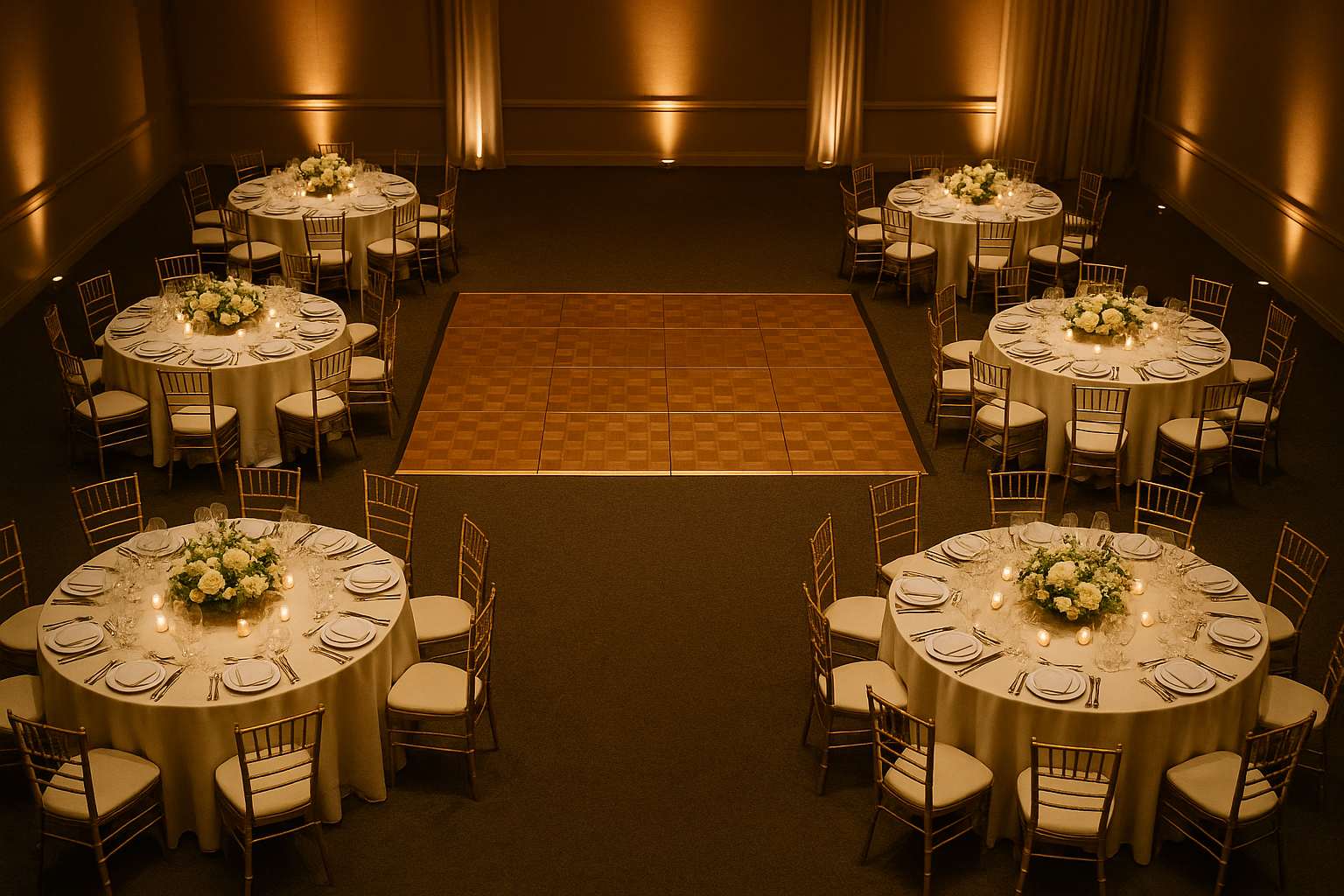
Your wedding reception floor plan shapes traffic flow, sightlines, energy, and guest comfort from the moment the first guest arrives to the last dance. The most common mistakes — undersizing the dance floor, placing bars at the entrance, ignoring accessibility — are all avoidable with a clear framework, the right tools, and a 10–12 week planning window.
There is a reason experienced wedding planners spend significant time on floor plans weeks before the first flower arrives. Every element of your reception — how naturally guests drift toward the dance floor, whether your grandmother navigates to her seat without difficulty, whether the room feels alive or cavernous — is shaped by decisions made on a scaled diagram long before the wedding day.
A thoughtful floor plan is invisible when it works. A poor one is the reason guests spent twenty minutes finding their seats, the bar line never moved, and the dance floor sat empty for the first hour. This guide gives you the framework to build one that works.
How much space do you actually need?
Start with your guest count and your venue's square footage. The planning benchmark for a full wedding reception — dinner plus dancing plus a four-to-six-hour evening — is 18–21 square feet per guest. The International Building Code sets 15 square feet as the minimum for tables-and-chairs occupancy, but this minimum does not account for the movement, service, and flow of a real wedding evening.
| Reception format | Square feet per guest | Notes |
|---|---|---|
| Cocktail / standing reception | 8–10 sq ft | Minimal furniture; guests circulate freely |
| Seated dinner, no dancing | 12–14 sq ft | Tables and chairs only; no entertainment zone |
| Full reception (dinner + dancing) | 15–20 sq ft | Standard planning target for most weddings |
| Luxury or formal reception | 20–25 sq ft | Lounge seating zones, wider aisles, generously spaced tables |
Quick calculation for 150 guests at a full reception: 2,700 sq ft dining + 400 sq ft dance floor + 200 sq ft bar zone + 200 sq ft stage + 150 sq ft specialty stations + approximately 550 sq ft service circulation = approximately 4,200 sq ft total. Add 15% buffer — venue square footage consistently underestimates actual consumption once chairs are pulled out and guests are moving.
Which table shape is right for your reception?
The table shape you choose affects conversation, photography, room flow, and available floor space. Here is a practical comparison:
Round tables (60-inch = 8–10 guests; 72-inch = 10–12 guests) remain the enduring standard. They encourage eye contact, group conversation, and pack efficiently into most room shapes. Allow 100–120 square feet per round table including service aisle. The 60-inch round is preferred over the 72-inch: guests at a five-foot table connect easily; guests at a six-foot round strain to hear each other across the width.
Rectangular banquet tables (6 ft = 6–8 guests; 8 ft = 8–10 guests) suit barn venues, industrial spaces, and communal dining aesthetics. Long communal configurations create an intimate, convivial atmosphere and work well in narrow rooms.
Serpentine tables — curved sections in S or wave configurations — are the defining layout trend of 2025–2026, replacing the once-standard all-round or all-rectangular room. Plan 15–20% more floor space than an equivalent straight configuration, but the visual payoff is dramatic and the photography is exceptional.
Mixed configurations — the dominant approach in elevated event design today — combine shapes intentionally: long family-style tables for immediate family, rounds for guests, a serpentine or rectangular head arrangement. Consistent linens and florals are what make disparate shapes read as a unified design.
How do you size and place the dance floor?
The standard formula: dance floor area = (guest count ÷ 2) × 4.5 square feet, assuming 50% peak participation. For 150 guests, this yields approximately 338 square feet — a floor of roughly 18 × 19 feet.
Adjust upward for culturally dance-intensive celebrations (South Asian, Latin, Greek, Nigerian receptions routinely see 70–80% participation). When uncertain, err larger. A full dance floor builds energy; an empty one deflates the room in a way no other element can reverse.
Placement principles: visible from the majority of guest tables; DJ or band stage at one end rather than floating in the middle of a wall; not the first thing guests see upon entering (create anticipation, not an immediate arrival point); tables at least five to six feet from the dance floor edge as a sound and movement buffer; adjacent to at least one bar station.
Portable dance floor rentals run $1–$3 per square foot for standard hardwood panels; premium LED or custom-printed floors range $3–$8 per square foot. A standard 18 × 18-foot floor costs approximately $300–$1,000 depending on your market.
Bar placement: the five rules
Where you put the bar matters as much as what is in it. The five principles that experienced event designers apply:
- Never at the entrance. A bar at the door creates an immediate bottleneck. Position bars at least 15–20 feet into the space to draw guests inward.
- Use bars to direct traffic. A bar in an underused corner pulls guests into that space, distributing energy throughout the room.
- One station per 75–100 guests. Multiple bars prevent lines and spread activity evenly.
- One bar near the dance floor. Dancers refresh and return — this is a high-traffic circulation zone that needs service nearby.
- Ensure visibility. Guests should be able to see at least one bar from anywhere in the room.
Traffic flow: designing the guest journey
Every reception follows a logical progression: arrival → escort card display → cocktail area → dinner → dancing → bar loops → departure. Design your floor plan so each transition feels intuitive — guests should never need to backtrack or navigate through dense clusters to reach the next zone.
Key placement notes: escort card display adjacent to entrance with a six-foot buffer for arriving guests; gift table near entrance, against wall; cake table visible from dining area and away from direct sunlight; photo booth in a perimeter corner (50–100 square feet); dessert and coffee station between dining and dancing zones.
Primary guest aisles should be a minimum of 60–72 inches (five to six feet). Chair-back clearance for full pull-out requires 36 inches. Service corridors from kitchen to tables need 36–48 inches — never block a catering entrance.
Accessibility: designing for every guest
Accessibility is a fundamental expression of hospitality, not an afterthought. All primary pathways at 60 inches minimum; guests using mobility aids need table spacing of 42 inches plus 24–30 additional inches on pathways they will use. Reserve aisle-adjacent seats for guests who have indicated mobility needs. Seat elderly and hearing-impaired guests 25–40 feet from speakers — a DJ at close range can reach 85–100 decibels, which is genuinely harmful for hearing-aid users over a four-hour evening.
Digital tools: how to build your floor plan
Prismm (formerly AllSeated, rebranded in 2024) is the industry standard — a free, cloud-based tool used by over 5,500 venues, hotels, and planners that offers 2D and 3D visualization, a furniture library, guest list management, and real-time collaboration. Most established venues have their floor plans pre-loaded in Prismm, so couples can begin designing immediately after booking. A 3D walkthrough feature lets you virtually tour the room as it will be set up, catching flow problems before the wedding day.
For couples working without a professional coordinator, Prismm is available free at prismm.com. Zola and The Knot also include basic seating and layout tools within their broader wedding planning platforms.
Timeline: when to do what
Begin your floor plan framework 10–12 weeks before the wedding. Finalize and distribute it to all vendors at least three weeks out. The common mistake is treating the floor plan as a last-minute logistics task rather than a design decision that affects every other vendor — your florist, your caterer, your entertainment vendor, and your day-of coordinator all need the same final version, printed. Commit assignments only after 80%+ of RSVPs are confirmed; leave five to ten percent overflow capacity per seating cluster to absorb last-minute changes.
Frequently asked
How much space do I need per guest at a wedding reception?
The answer depends on the event format. For a cocktail or standing reception, plan for 8–10 square feet per guest. For a seated dinner without dancing, 12–14 square feet is the standard. For a full wedding reception with dining and a dance floor, 15–20 square feet per guest is the planning target. The International Building Code sets 15 square feet as the minimum for tables-and-chairs occupancy, but in practice, for a four-to-six-hour evening where guests are moving between dining, dancing, and the bar, 18–21 square feet per guest produces a noticeably more comfortable experience. For 150 guests at a full reception, this translates to approximately 2,700 square feet for dining, plus 400 square feet for the dance floor, plus bar, stage, escort card display, and circulation space — roughly 4,200 square feet total. Always add 15% buffer to venue square footage estimates, as furniture placement consumes more space than the raw numbers suggest.
Which table shape is best for a wedding reception?
Each shape has distinct advantages, and the best choice depends on your aesthetic, venue shape, and guest count. Round tables — the 60-inch five-foot round seats 8–10 guests — are the enduring standard for good reason: they encourage eye contact, group conversation, and pack efficiently into most room shapes. Rectangular banquet tables suit barn venues, industrial spaces, and communal dining concepts; they work well in narrow rooms. The defining trend of 2025–2026 is the mixed configuration: long family-style tables for immediate family, rounds for guests, and serpentine (wave-shaped) tables for a sweetheart arrangement. Serpentine tables require 15–20% more floor space than straight equivalents but are visually dramatic and photograph beautifully. Whatever shapes you choose, consistent linens and florals across different table shapes are what make a mixed room feel intentional rather than assembled.
How big should the wedding dance floor be?
The standard formula is: dance floor area = (guest count divided by 2) multiplied by 4.5 square feet. This assumes 50% peak participation. For a 150-guest wedding, this calculates to approximately 338 square feet — a floor of roughly 18 by 19 feet. Adjust upward for culturally dance-intensive receptions: South Asian, Latin, Greek, and Nigerian celebrations commonly see 70–80% participation and warrant a larger floor. When uncertain, err larger — a slightly crowded dance floor builds energy and creates the feeling of a party; an empty one deflates the room. Portable dance floor rentals typically cost $1–$3 per square foot for standard hardwood-look panels, and $3–$8 per square foot for premium LED or custom-printed floors. A standard 18-by-18-foot floor rents for approximately $300–$1,000 in most markets.
Where should the bar be placed at a wedding reception?
Bar placement is a traffic-flow decision with a few clear rules. Never place the bar directly at the entrance — it creates an immediate bottleneck as arriving guests cluster before moving deeper into the space. Pull bars at least 15–20 feet into the room to draw guests inward. Use bar placement strategically to direct energy: a bar in a less-used corner pulls guests into that space, distributing activity through the room. Place one bar near the dance floor — dancers refresh and return, and this is a high-traffic zone. Plan for one bar station per 75–100 guests. At the standard one-bartender-per-35–50-guests ratio, a 150-guest wedding needs a minimum of three bartenders plus a barback. Bar service averages approximately $5,000–$5,500 nationally (Zola 2025 Wedding Cost Index), roughly 11% of the average total wedding budget.
What digital tools do wedding planners use to design floor plans?
Prismm (formerly AllSeated, rebranded in 2024) is the industry-leading floor plan software used by over 5,500 venues, hotels, and planners. It is free for couples to use and offers 2D and 3D visualization, a comprehensive furniture library, guest management integration, and real-time collaboration. Most established venues already have their floor plans loaded in Prismm, which means couples can begin designing immediately after booking. For couples planning without a professional coordinator, Zola and The Knot both include built-in seating chart and floor plan tools within their wedding planning platforms. For complex layouts or large guest counts requiring the most sophisticated spatial visualization, Prismm's 3D walkthrough feature — which allows couples and planners to virtually tour the room as it will be set up — is genuinely valuable for identifying flow issues before the wedding day.
How do I design a floor plan that works for guests with mobility limitations?
Accessibility is a baseline hospitality expectation, not an afterthought. All primary pathways should be a minimum of 60 inches wide; 36 inches is the ADA minimum but is too narrow for comfortable passage in a dressed room with chairs pulled out. Table spacing should be 42 inches minimum on primary pathways; guests using wheelchairs or walkers need 24–30 additional inches. Reserve aisle-adjacent seats for guests who have indicated mobility needs, and note these placements on both your seating chart and your venue coordinator's copy. Floor level transitions — especially portable dance floor edges — should be marked and gently beveled to avoid tripping hazards. Seat elderly and hearing-impaired guests 25–40 feet from any speaker: a DJ at 10 feet can reach 85–100 decibels, which is uncomfortable and potentially damaging for hearing-aid users. A well-designed accessible floor plan is almost always better for everyone.