Reception & Parties
Wedding Toast Order and Etiquette: Everything Couples Need to Know
Who speaks, in what order, for how long, and when — the complete guide to planning a toast program that moves the room without stalling the reception.
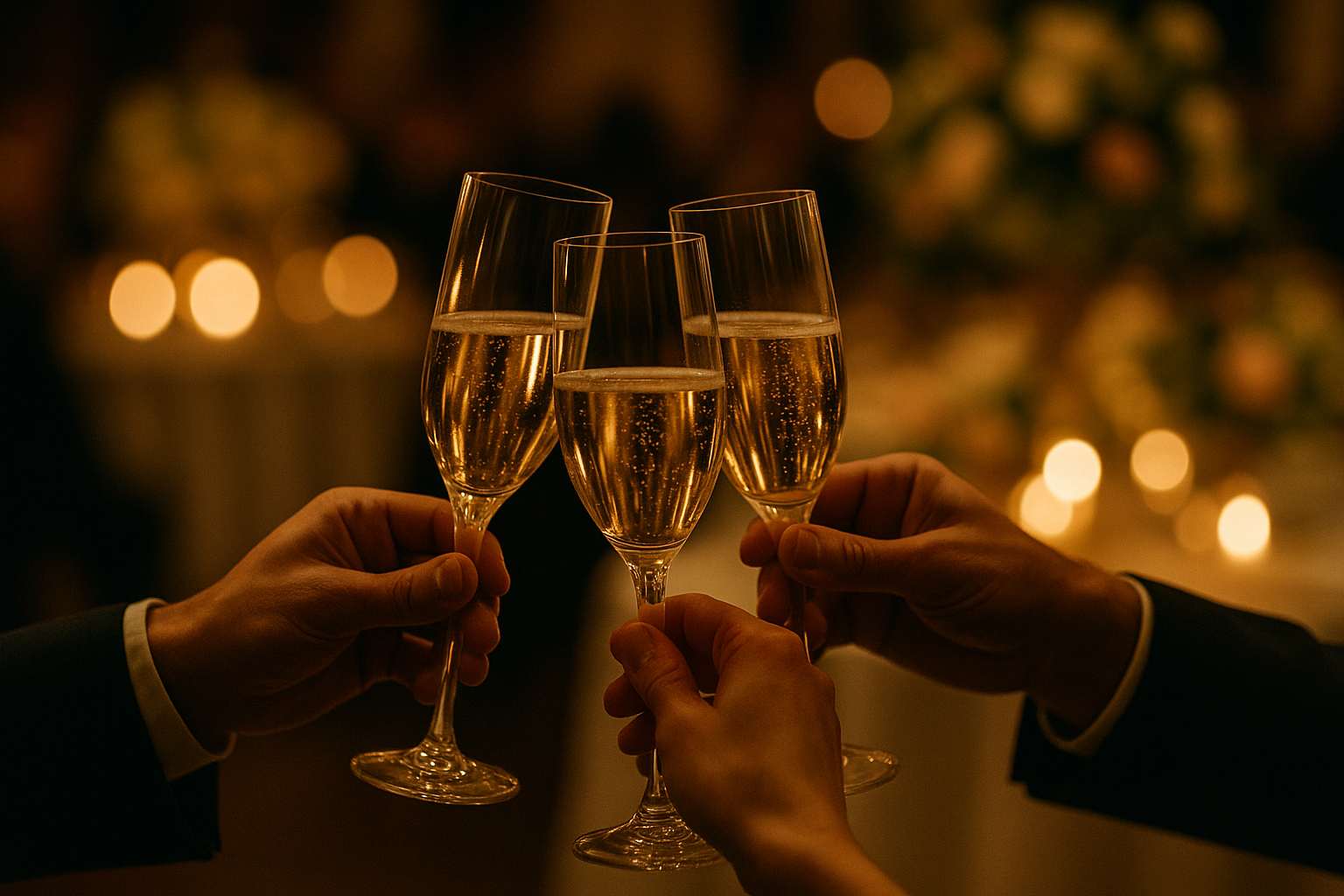
The recommended modern toast order is: father of the bride, best man, maid of honor, groom, then bride. Each speech should run three to five minutes; the entire program for four to five speakers should fit within eighteen to twenty-eight minutes. Toasts work best after guests are seated but before dinner plates arrive — when champagne is poured and attention is at its peak.
Wedding toasts are the most emotionally charged program element of any reception. Done well, they transform a beautiful event into a deeply personal one — the room laughs, cries, and raises its glasses as one. Done carelessly, they stall momentum, exhaust the crowd, and leave the wedding planner quietly making eye contact with the caterer about cold entrées.
The bride's job in managing this aspect of the reception is equal parts love and logistics: curating the right speakers, setting clear expectations, coordinating AV, and designing a program that moves the room without overstaying its welcome. Here is everything you need to know.
Who speaks at a wedding reception, and in what order?
The traditional American toast order emerged from a combination of British wedding custom and American family culture, and it remains a reliable framework even as modern weddings adapt it freely.
Traditional order:
- Father of the bride — or the parent of the bride's choosing — opens the program with a welcoming, emotionally grounding tone. He has the honored position of formally celebrating his child and welcoming the new family being formed.
- Best man — traditionally the headliner of the toast program; his speech should balance genuine humor with authentic heart. The best speeches tell one specific story, draw one meaningful observation about the couple, and close with a toast line the room will remember.
- Maid or matron of honor — warmth, personal story, and a perspective on the bride that no one else in the room can provide. Her speech is the emotional counterweight to the best man's humor.
- Groom's parents (optional, but standard at many multicultural and Southern American weddings) — brief, warm, and welcoming to the bride's family.
- Groom — heartfelt thanks to the bride, both families, the wedding party, and guests. This is the appropriate moment for vendor acknowledgments (if any) rather than a verbal listing mid-toast.
- Bride — increasingly the emotional peak of the entire program. According to The Knot's 2025 reception planning guide, the bride's speech is now considered a near-standard element of the modern American wedding toast program, and guests universally respond with warmth and genuine appreciation.
| Speaker | Position | Ideal Length | Absolute Maximum |
|---|---|---|---|
| Father of the bride | First | 3–5 minutes | 7 minutes |
| Best man | Second | 4–6 minutes | 8 minutes |
| Maid / matron of honor | Third | 3–5 minutes | 7 minutes |
| Groom's parent(s) | Fourth (optional) | 2–3 minutes | 4 minutes |
| Groom | Fifth | 2–4 minutes | 6 minutes |
| Bride | Sixth (closing) | 2–5 minutes | 7 minutes |
When in the reception should toasts be scheduled?
The placement of the toast program within the reception timeline is one of the most impactful structural decisions you make — and it is one that couples frequently get wrong by defaulting to convention without asking whether it serves their specific event.
Option 1 — After seating, before dinner: The most tested and reliable placement. Guests are seated, champagne is poured, energy is high but focused. The room has not yet been distracted by food service. This placement gives the toast program its strongest possible audience and typically produces the most emotionally responsive crowd. The risk is that if toasts run long, dinner service is delayed and guests grow restless — brief your caterer with a realistic estimate and build in a five-minute buffer.
Option 2 — Between courses: A brief pause between the salad and entrée is a well-regarded alternative that ensures guests are no longer hungry and slightly more relaxed. Two to three speakers work well here; a full five-speaker program between courses creates catering timeline pressure and risks cooling the remaining food.
Option 3 — During cocktail hour: Some couples, particularly those with large wedding parties, now schedule a dedicated thirty-minute toast window during the second half of cocktail hour — separating the toast program entirely from dinner service. This keeps dinner flowing beautifully and catches guests at peak energy. It requires thoughtful guest management (some guests may still be in the photo booth or at the bar) but works well at venues with strong flow between cocktail and reception spaces.
Whatever timing you choose, communicate it to your caterer in writing as part of the official run-of-show. They need to hold hot food, ensure glasses are filled before the program begins, and cue service staff to stand down during speeches.
What makes a wedding speech genuinely memorable?
Most people have never written or delivered a wedding toast, and providing your speakers with structural guidance is one of the most generous things you can do as a bride.
Share this framework with every designated speaker:
Part 1 — Open with a specific story (30–60 seconds): Not "I've known [Name] for twenty years" — something vivid and particular. The first time you witnessed the couple together and knew this was real. The moment you understood what kind of person the groom is. A specific memory that no one else in the room has.
Part 2 — The heart (two to three minutes): What this person means to you, what you observe about their relationship, what you believe this marriage will be and build. One observation, not seven.
Part 3 — Close with a wish and a toast (30–45 seconds): A sincere wish for the marriage. A memorable, quotable closing line. A clear invitation to raise glasses. Then stop.
Ask speakers to practice aloud at least three times — silent reading is a notoriously poor predictor of actual delivery time, which runs 40 to 60 percent longer. Written notes on paper or cards are preferable to phones: paper does not glow blue in low light, does not die mid-speech, and does not look like the speaker is reading a text message. Confirm with each speaker one week before the wedding that they are prepared and know the logistics — where to stand, who hands them the microphone, and the expected approximate length.
What AV details determine whether the toast program succeeds?
The most overlooked element of the toast program is not who speaks or what they say — it is whether the room can hear them. A beautiful speech delivered to a room that cannot hear the words is a wasted gesture.
Designate a single person — your MC, DJ, or a family member — as the microphone manager. The protocol: the MC introduces each speaker by name, hands the microphone directly to the speaker (never sets it on a table), receives it back after applause, and introduces the next. Never assume the mic will be passed spontaneously; fumbled handoffs kill momentum.
For outdoor venues, tented receptions, or any space with more than 150 guests, budget $200 to $600 for dedicated ceremony and reception AV if it is not included in your package. According to WeddingWire's reception planning resources, inadequate sound is one of the top-cited reception regrets among couples reviewing their weddings. A lapel microphone ($50 to $200 add-on) is worth considering for grandparents or elderly speakers who may speak softly or have difficulty holding a handheld mic comfortably.
Schedule a brief sound check with every speaker during cocktail hour or the venue walkthrough — not on the day, not two minutes before toasts begin. Confirm each speaker knows how to hold the microphone (four to six inches from the mouth, angled slightly down, never cupping the ball), how to project, and where to stand for optimal acoustics.
Frequently asked
What is the traditional order of wedding toasts?
The traditional American order begins with the father of the bride, who sets a warm welcoming tone and formally introduces the couple to the gathered room. The best man typically follows with a speech that balances humor and genuine sentiment. The maid or matron of honor speaks next. Some receptions include remarks from the groom's parents at this point, particularly at multicultural or Southern American weddings where both families expect a formal voice. The groom then offers his heartfelt thank-you toast to the bride, family, and guests, and the bride — increasingly the emotional highlight of the modern toast program — closes the sequence. The exact sequence is a framework, not a rule: couples adjust it constantly based on their family structure, who is most comfortable speaking, and the particular emotional tone they want the program to carry.
How long should each wedding speech be?
The ideal speech length by role: father of the bride, three to five minutes with a maximum of seven; best man, four to six minutes with a maximum of eight; maid or matron of honor, three to five minutes with a maximum of seven; groom, two to four minutes with a maximum of six; bride, two to five minutes with a maximum of seven; additional parents or other speakers, two to three minutes with a maximum of four. Most experienced event planners use three minutes as the universal sweet spot for any single speaker. At average speaking pace — 120 to 150 words per minute — three minutes is roughly 400 to 450 words, sufficient to tell one story, make one meaningful point, and close with a heartfelt toast. Beyond five minutes, guest attention fades perceptibly. Beyond eight minutes, most guests are genuinely uncomfortable. The entire toast program for two to three speakers should run ten to eighteen minutes; four to five speakers, eighteen to twenty-eight minutes.
When in the reception should wedding toasts happen?
The most common and well-tested placement for wedding toasts is after guests are seated but before plates are served — champagne poured, guests settled, energy high but focused. This gives the toast program the room's undivided attention at the moment when emotion runs highest. A second strong option is scheduling toasts after the entrée is cleared: guests are fed and relaxed, the program is shorter and tighter with two to three speakers, and the energy shift into the dancing portion of the evening follows naturally. The least effective placement is during the first course, when servers are circulating and guests are distracted. Whatever timing you choose, communicate it precisely to your caterer — they need to hold hot food during toasts, ensure glasses are filled beforehand, and cue service staff to stand down.
Does the bride give a speech at her own wedding?
In contemporary American weddings, the bride's speech has become one of the most celebrated and emotionally anticipated moments of the entire reception program. It is now a strong majority norm — not an exception. If you wish to speak, you absolutely should, and your guests will receive it with warmth and genuine appreciation. If nerves are a concern, the solution is practice: write your remarks fully, then convert them to brief bullet notes and practice aloud until the words feel like your own. Most brides who speak at their own weddings describe it as one of the most meaningful moments of the day — the only moment in the wedding when you speak directly to the people you love most, in your own voice, about what this day means to you. There is no etiquette reason you must speak. But there is also no etiquette reason you should not.
What are the etiquette rules speakers must follow at a wedding toast?
The fundamental rules: prepare in advance — the speech that sounds improvised is almost always the one that runs long and meanders. Speak to both partners, not only the one you are closer to. Keep content appropriate for all ages and all contexts; stories involving exes, past substance use, family conflict, or anything that would embarrass either partner or their families are never acceptable in any form, not even disguised as a joke. Face the couple and the room alternately — speaking exclusively to the audience ignores the people being honored. End clearly with an invitation to raise glasses and a specific, punchy closing line. Sit down immediately when applause begins. And if you are a guest rather than a designated speaker: hold all side conversations, keep phones pocketed, and applaud warmly for every speaker — giving a wedding speech is a genuinely vulnerable act and deserves your full attention and generosity.
What should we do if a wedding speaker goes significantly over time?
Brief your MC, DJ, or wedding coordinator in advance with an explicit instruction: at the five-minute mark, give the speaker a gentle visual signal — a raised card, a hand gesture, a quiet approach to within the speaker's line of sight. Most experienced MCs have a polished, warm way of reclaiming the microphone that guests find reassuring rather than awkward. A script like 'Let's give [Name] a wonderful round of applause as we thank them for those beautiful words' is clear and gracious. The key is to pre-authorize your MC to intervene — an MC who hasn't been explicitly told they can step in will hesitate. The couples who regret their toast program almost universally did not address the over-time scenario in advance. The couples whose programs flowed beautifully almost universally did.