Invitations, Registry & Gifts
Digital vs. Paper Wedding Invitations: The Complete 2026 Guide
Paper suites cost $500–$1,200 for 150 guests; digital platforms start at $0. But cost is only one dimension. Here is the honest comparison — aesthetics, formality, RSVP tracking, and the hybrid strategy that gives you both.
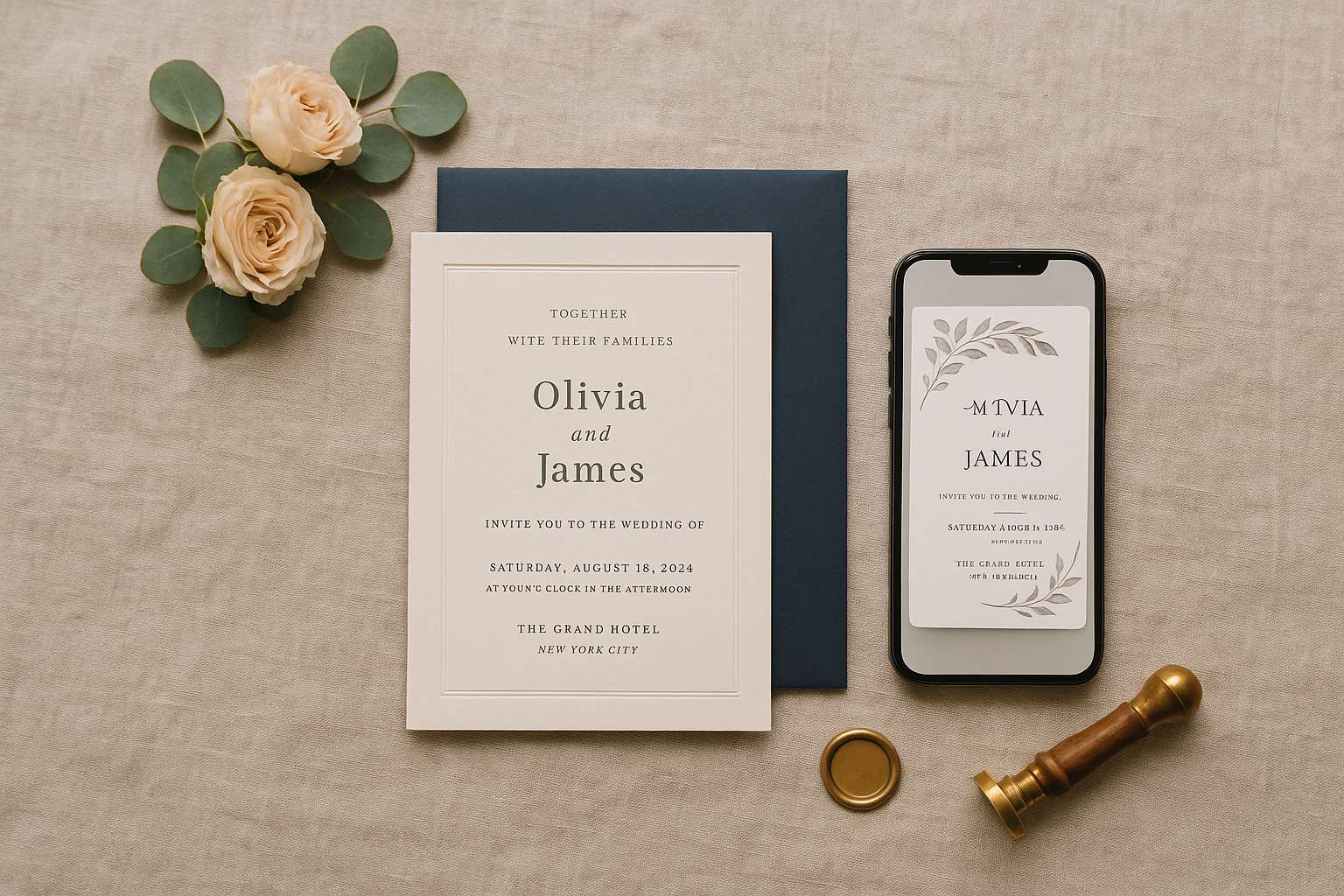
Paper invitation suites for 150 guests cost $500–$1,200; premium digital platforms like Paperless Post run $46–$95 for the same count, with Zola and Joy offering RSVP tools free. Most thoughtful brides in 2026 land on a hybrid: printed paper where it matters, digital RSVP for everyone.
Your wedding invitation is the first promise you extend to everyone you love — and it sets the tone for the day before a single flower is arranged. For generations that promise arrived by post, sealed and tissue-lined. Today it might arrive as an animated envelope unfolding on a phone screen, or as a letterpress card embedded with a QR code that routes to a digital RSVP dashboard. Neither is universally superior. The right choice is specific to your wedding's formality, your guest list's age range, your aesthetic, and what you want the experience of receiving your invitation to feel like.
Here is the complete comparison for 2026 — honest about cost, honest about limitations, and honest about why many brides end up choosing both.
How much do paper versus digital wedding invitations actually cost in 2026?
The cost gap is real and significant. A traditional paper invitation suite for 150 guests — designed invitation, inner envelope, outer envelope, response card, and postage — quickly adds up:
| Component | Budget Tier | Mid-Range | Luxury / Letterpress |
|---|---|---|---|
| Invitation printing (per piece) | $1.00–$2.00 | $2.50–$5.00 | $6.00–$12.00+ |
| Response cards + envelopes | $50–$100 | $100–$200 | $200–$400 |
| Postage (outbound) | $102–$135 | $135–$170 | $170–$225 |
| Postage (return response) | $102–$135 | $135–$170 | $170–$225 |
| Design fee | $0 (template) | $150–$400 | $400–$1,200+ |
| Total estimate (150 guests) | $400–$550 | $650–$1,000 | $1,200–$2,500+ |
Digital platforms, by contrast, eliminate printing and postage entirely. Paperless Post — which carries designer collaborations with Kate Spade, Rifle Paper Co., Carolina Herrera, and Oscar de la Renta — costs approximately $46–$57 for 100 guests on a premium design, or around $95 for 115 guests using its coin system. Greenvelope, known for eco-conscious bridal stationery, uses a flat-rate model: starting at $49 per event, with an unlimited annual plan at $225 covering all events that year, including save-the-dates and post-wedding communications. Zola and Joy both offer RSVP tools at no cost; Zola charges approximately $1.99 per digital invite for its designer cards. For a bride who goes fully digital, the savings compared to a mid-range paper suite easily reach $600–$900.
What does each format deliver for the guest experience?
Cost is only one dimension of this decision. The experience each format creates matters just as much.
A well-executed paper invitation suite is a physical artifact. It announces your wedding the moment it arrives in the mailbox, before anyone has opened it — the weight of the envelope, the quality of the paper stock, the letterpress impression or the engraved monogram communicates investment, care, and occasion. Many guests keep their invitation long after the wedding as a keepsake. For deeply formal or traditional weddings — large Catholic ceremonies, Orthodox Jewish celebrations, Southern families with strong stationery culture — a physical invitation suite is not merely a preference but an expectation. And in 2026, with the renewed cultural emphasis on slow, considered, sensory experiences, a beautiful printed invitation stands out precisely because it is rare.
A well-designed digital invitation delivers something paper cannot: immediacy, interactivity, and logistical precision. The moment a guest clicks the RSVP button, their response enters your dashboard. You can see in real time who has opened the invitation, who has responded, and who needs a follow-up. Platforms like Greenvelope send automated reminder sequences to non-responders on a schedule you set. If your venue changes or the ceremony time shifts, you push a notification to all guests in seconds — no reprinting, no re-mailing. For destination weddings where guests are booking travel months in advance, this kind of real-time information flow is genuinely valuable.
Response rates also favor digital. Online RSVP platforms achieve an estimated 85% response rate before the stated deadline, compared to approximately 70% for traditional mail-in response cards. The difference is friction: responding digitally takes under 60 seconds on a phone. A paper response card requires finding a stamp, writing by hand, and actually mailing — steps that get deferred and then forgotten, regardless of the guest's best intentions.
When does formality, faith, or family tradition tip the decision?
For some weddings, the etiquette framework is more prescriptive than a simple cost-benefit analysis would suggest.
Catholic and Orthodox Jewish ceremonies typically warrant a physical invitation suite, particularly when the ceremony carries significant liturgical or community weight. For a Nuptial Mass, a large Jewish wedding with traditional families, or any celebration where the guests' average age skews above fifty, a digital-only approach risks being read as careless rather than efficient. The physical invitation communicates that the occasion is significant enough to warrant effort.
Southern U.S. weddings carry a particularly strong stationery culture. In many communities, engraved or letterpress invitations are the expected norm, and a QR code on the response card — linking to a digital RSVP form — is the most gracious middle path: physical invitation, digital tracking.
Destination and multi-day weddings have largely moved to a hybrid model. Mail a beautiful printed invitation as a keepsake; use digital RSVP for logistical precision. Set deadlines 6–8 weeks out to allow guests to confirm travel arrangements.
Muslim, Hindu, and South Asian weddings with multiple events (Mehndi, Sangeet, Nikah, reception) benefit strongly from digital RSVP tools that support separate event headcounts. Not all platforms do this well — RSVPify and Zola handle multi-event structures more robustly than Paperless Post.
What is the hybrid approach and why do many brides choose it?
The hybrid model is exactly what it sounds like: mail a printed invitation to guests who prefer or require paper; embed a QR code or short URL that routes everyone — printed and digital invitees alike — to a digital RSVP form. This approach has become the dominant strategy among couples who self-identify as traditional-leaning but practical.
Its logic is sound. The printed invitation preserves the sensory and sentimental value of the physical object for guests who treasure it. The digital RSVP shifts the logistical burden to an organized, exportable dashboard. You produce a targeted paper run rather than printing physical response cards for every guest — reducing paper waste by 50–70% compared to a fully traditional suite. And the RSVP data is clean: sortable, meal-choice-inclusive, and directly importable into your seating-chart tool.
The most effective implementation: print a short but beautiful paper invitation suite; include a tasteful card directing guests to your RSVP link or QR code; mail only to guests who genuinely prefer physical mail. For all other guests, send a digital invitation from Paperless Post or Greenvelope — one that matches the aesthetic of the physical suite closely enough to feel like a deliberate design decision rather than a budget compromise.
Common mistakes to avoid regardless of format
Whichever format you choose, certain mistakes undermine the experience. For paper: skipping a return-address stamp on the response envelope (response rates drop significantly), sending without confirming meal options with your caterer first, and failing to account for international postage rates for overseas guests. For digital: choosing a platform that requires guests to create an account before responding (participation drops by 40–60% compared to browser-based forms), neglecting to test the RSVP form on iOS and Android before sending, and failing to configure reminder exclusions so guests who already responded don't receive follow-up nudges. For both: not exporting your RSVP data as a CSV at least weekly and backing it up locally.
Frequently asked
Is it rude to send only digital invitations for a formal wedding?
Context and formality govern this more than any blanket rule. For a modern, casual, or destination wedding, fully digital invitations are widely accepted in 2026 and carry no social stigma. For a black-tie celebration, a large Catholic or Orthodox Jewish ceremony, or a wedding where many guests are elderly or from deeply traditional communities, a digital-only approach may read as insufficiently considered. The most gracious path for formal weddings is the hybrid strategy: mail a beautifully printed invitation suite to guests who prefer or require it, while routing everyone else to a digital platform for RSVP collection. This approach honors tradition where it matters without sacrificing the logistical advantages of digital tracking.
How much do digital wedding invitations cost compared to paper in 2026?
Paper invitation suites for 150 guests typically cost $500–$1,200 once you account for design, printing ($1–$10 per suite depending on method), envelopes, response cards, and postage ($0.68–$1.50 per piece). Digital platforms are dramatically cheaper. Paperless Post, which carries designs from Kate Spade, Rifle Paper Co., and Oscar de la Renta, runs approximately $46–$57 for 100 guests using its coin system. Greenvelope's flat-rate model starts at $49 per event, with an unlimited annual plan at $225 covering every event that year. Zola and Joy offer RSVP tools entirely free, though Zola charges around $1.99 per digital invite for designer cards. The cost gap is real: couples who go fully digital save $400–$1,000 compared to a premium paper suite.
Do digital invitations have better RSVP response rates than paper response cards?
Yes, meaningfully so. Digital RSVP platforms achieve an estimated 85% response rate before the stated deadline, compared to approximately 70% for traditional mail-in response cards. The reason is friction: a digital form can be completed in under 60 seconds on a phone the moment a guest reads the invitation. A paper response card requires the guest to find a stamp, write by hand, and mail — steps that get deferred and then forgotten. That said, response rates drop significantly if your RSVP platform requires guests to create an account or download an app before responding. Platforms that use QR-code-based browser forms, like Greenvelope and RSVPify, consistently outperform those requiring login steps. Regardless of platform, automated reminder sequences — sent at one week before the deadline and on deadline day — can push response rates to 90% or above.
What is the hybrid invitation strategy and why do many brides choose it?
The hybrid approach means mailing a physical printed invitation to guests who prefer or require paper, while embedding a QR code or short URL that routes everyone to a digital RSVP form. The paper invitation preserves the sensory and sentimental value of the physical object for guests who treasure it; the digital form shifts the entire logistical burden of tracking responses to an organized, exportable dashboard. This approach is particularly well-suited to weddings with mixed-age guest lists, where some guests — elderly relatives, for example — genuinely cannot navigate digital forms, but the majority of guests are comfortable with online RSVP. The hybrid model also reduces paper waste substantially: you produce a targeted paper run rather than printing physical response cards for every guest. Industry surveys in 2025–2026 suggest this is now the dominant approach among couples who self-identify as 'traditional-leaning but practical.'
Which digital invitation platforms are best for weddings in 2026?
Platform choice depends on what matters most to you. Paperless Post leads on design quality: its partnerships with Kate Spade, Rifle Paper Co., Carolina Herrera, and Oscar de la Renta produce animated envelope-opening experiences that feel genuinely elegant. For 115 guests on a premium design, expect to spend around $95 using its coin system. Greenvelope is the better value for couples sending multiple invitation mailings — save-the-dates, invitations, and post-wedding brunch notices — thanks to its flat-rate annual plan ($225 unlimited). Its real-time RSVP dashboard and tree-planting eco-commitment appeal to environmentally minded brides. Joy is the best fully free option, with no ads and zero platform fees on cash-fund contributions. For large weddings with multi-event RSVP logic — separate headcounts for ceremony, rehearsal dinner, and welcome brunch — RSVPify's advanced conditional logic is worth its monthly fee.
How early should I send digital wedding invitations?
The timing for digital invitations follows the same etiquette as paper: send invitations 8–12 weeks before the wedding for a local or regional celebration, and 12–16 weeks before for a destination wedding. Sending earlier than 12 weeks generates lower response rates and more last-minute changes, as guests are uncertain about their own schedules that far in advance. Save-the-dates, by contrast, should go out 6–8 months before the wedding (or 9–12 months for a destination event) so guests can book travel and hold the date. Many couples now send digital save-the-dates and then follow with a printed invitation suite — this creates a graceful sequence that serves both the desire for a beautiful physical keepsake and the efficiency of digital RSVP collection.