Invitations, Registry & Gifts
Escort Cards vs Place Cards: What's the Difference?
Escort cards tell guests which table. Place cards tell guests which seat. Here is the complete 2026 breakdown of when you need each, when you need both, and when a seating chart sign is smarter than either.
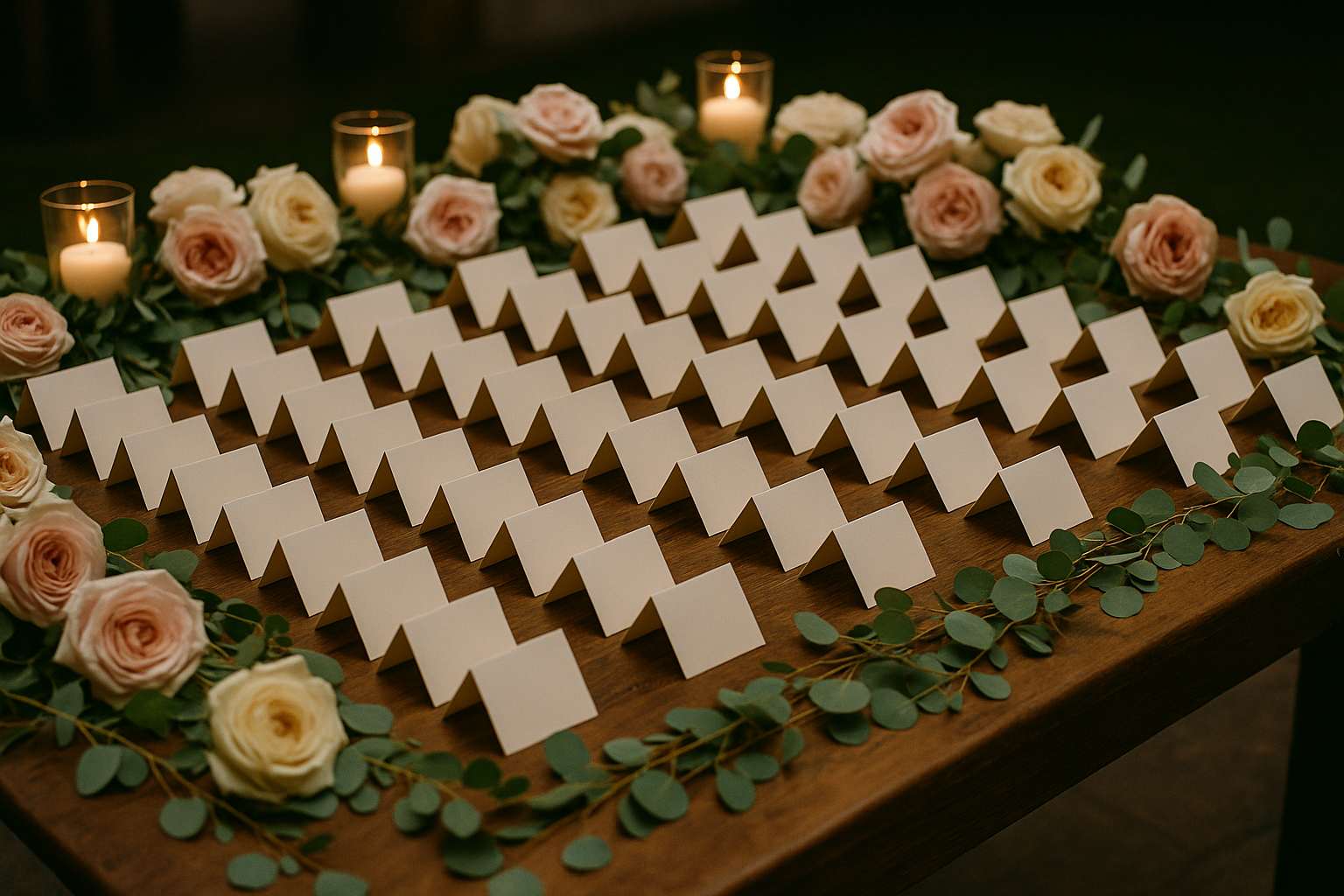
An escort card tells a guest which table they are assigned to; a place card tells them exactly which seat at that table. Most weddings need only one. You need both when you have a plated dinner with assigned entrée choices. For 150 or more guests, a large seating chart sign is often faster and more practical than individual escort cards.
Of all the day-of stationery decisions in wedding planning, escort cards and place cards are the most consistently confused — and the confusion is understandable, because the terms are used interchangeably in casual conversation even though they serve different logistical functions. Getting this right matters because it directly affects the flow of your reception from the moment the first guest arrives at the entrance display. A well-organized escort card system means no bottleneck at the door and no confused guests wandering through the reception room asking where to sit. A disorganized one means exactly the opposite.
What is the exact difference between an escort card and a place card?
The distinction is one of specificity. An escort card assigns a guest to a table. A place card assigns a guest to a seat.
Escort cards are displayed collectively near the reception entrance, typically alphabetized by last name on a flat surface, a framed display board, or a decorative installation. Each guest finds their card, picks it up, and carries it into the reception room, where it tells them which table to locate. Once at the table, they choose their own seat among the available chairs.
Place cards sit at individual place settings — typically centered above the plate or tucked into a napkin fold. They tell a specific guest exactly which chair at that table is theirs. They are most critical when there is a plated dinner with multiple entrée choices: the caterer's service staff reads place-card symbols to deliver the correct meal to each seat without asking each guest aloud what they ordered.
A seating chart sign — a large-format board displayed near the reception entrance — functions identically to escort cards but in a single shared format. Instead of finding an individual card, guests scan the board for their name and note their table number. For large weddings, this system is frequently faster because guests do not need to search through a stack of individual cards.
| Format | What It Assigns | Where It Lives | Best For | Approximate Cost (100 guests) |
|---|---|---|---|---|
| Escort card | Table assignment | Reception entrance display | Most wedding sizes; experiential design | $50–$500+ |
| Place card | Specific seat at table | Each individual place setting | Plated dinners with entrée choices | $50–$500+ |
| Seating chart sign | Table assignment | Reception entrance wall or easel | Large weddings (150+ guests) | $80–$700 |
| Combined escort/place card | Both table and seat | Reception entrance; guest carries to seat | Plated dinners; eliminates need for separate place card | $50–$500+ |
When do you need escort cards, place cards, or both?
According to WeddingWire's stationery editorial team, the decision depends on two variables: whether guests have assigned seats or only assigned tables, and whether your catering format requires each seat to be identified for service purposes.
Escort cards only (no place cards): Use this when guests have assigned tables but can choose their own seat within the table. This is appropriate for most family-style, buffet, or stations receptions, and for plated dinners where all guests are choosing from the same entrée options without pre-selection.
Place cards only (no escort cards): This approach assigns both table and seat via a card at the setting. Guests must have some way to know which table to go to — a seating chart sign at the entrance is the most common companion. This works when you want a clean entrance display rather than individual escort cards, but still need seat-level assignment at each table.
Both escort cards and place cards: Required when you have a plated dinner with multiple pre-selected entrée choices and also want an individual escort card experience at the entrance. The escort card directs guests to the table; the place card, already positioned at the setting, confirms their exact seat and communicates their meal selection to service staff.
Seating chart sign instead of escort cards: The right choice for large weddings of 150 or more guests, where searching through individual cards creates a significant bottleneck at peak arrival time. Print the chart alphabetically by last name in a minimum 12-point font on a board at least 24 by 36 inches — or 30 by 40 inches for 150 or more guests — so guests can scan quickly even in low light.
No assigned seating at all: Appropriate for micro-weddings of fewer than 30 guests, casual outdoor celebrations with one long communal table, and cocktail-style receptions where guests are expected to mingle freely rather than dine at assigned tables. If all guests can fit at one or two tables, there is no need for any seating assignment system.
How do you design escort cards that make a statement?
The escort card display has become one of the most photographed details of the modern wedding reception. In 2025 and 2026, escort cards are increasingly designed as miniature objects in their own right — small favors the guest takes home — rather than simple printed cards. The stationery trend site Roseville Designs notes that escort cards functioning as experiential objects are among the fastest-growing reception details in this cycle.
Popular formats for 2026 include: marble or acrylic tiles with calligraphed names; dried botanical sachets with attached name tags; small honey jars, seed packets, or mini wine bottles labeled with guest names; Polaroid-style photo cards; wax-sealed vellum envelopes; and luggage-tag style cards tied with satin ribbon. The common thread is that the card becomes something a guest genuinely wants to take home, transforming a logistical necessity into a keepsake gesture.
For more traditional formats, calligraphy-addressed escort cards remain the gold standard at formal weddings. A skilled calligrapher booked two to three months out, working from a confirmed and correctly spelled final guest list, produces a consistent set that signals care and formality. Budget $2.00 to $5.00 per calligraphed card in most U.S. markets; metropolitan rates run higher.
Whatever format you choose, the display itself matters as much as the individual card. Coordinate with your florist on a small floral installation framing the escort card table — a low arrangement of garden roses and greenery at the base of the display is among the most photographed first-impressions of the reception, according to wedding photographers who consistently flag it as a detail worth capturing during venue setup before guests arrive.
Frequently asked
What is the difference between an escort card and a place card at a wedding?
An escort card tells a guest which table they are assigned to at the reception. It is typically displayed near the reception entrance, alphabetized by last name, so guests can quickly find their card and carry it to the room. Once at the table, guests choose their own seat. A place card, by contrast, marks a specific seat at a specific table — it sits at the place setting and tells a guest exactly where to sit. Place cards are most important at plated dinners where caterers need to know each seat's entrée selection. An escort card handles table assignment; a place card handles seat assignment. Many weddings need only one or the other, though formal plated dinners often use both together.
Do I need escort cards, place cards, or a seating chart?
The right answer depends on your wedding's formality, guest count, and catering format. For any reception with assigned seating, you need at least one of these three tools. Escort cards — one per adult guest, displayed alphabetically near the reception entrance — work well for weddings of most sizes. A seating chart sign (an alphabetical board listing every guest's name and table) is faster for guests at large weddings of 150 or more because they scan the board in seconds rather than searching through individual cards. Place cards, at each individual setting, are most necessary when you have a plated dinner with multiple entrée choices and need to mark each seat for service staff. For a buffet or family-style reception with open seating, none of these are strictly necessary.
Should escort cards be alphabetized by first name or last name?
Always alphabetize escort cards by last name — never by first name, table number, or any other system. Guests arrive at the escort card display with a specific goal: finding their own card quickly. Searching a table of 100 names alphabetized by first name when you do not know your dining companions' first names is unnecessarily frustrating. Last-name alphabetization mirrors how guests think about their own identity at a formal event and dramatically reduces the bottleneck at the reception entrance during peak arrival time. Position the escort card display at least six feet from the reception entrance doors to prevent crowding, and ensure your venue coordinator or day-of point person knows the alphabetical organization so they can guide confused guests.
How do you mark entrée choices on place cards without printing every guest's order?
The professional standard is to use a discreet symbol, small icon, or colored dot in one corner of the place card to indicate the meal selection — not to spell out the entrée in text on the card. Common coding systems include a small leaf symbol for vegetarian, a circle for chicken, and a diamond for beef. The exact symbols are coordinated with your caterer before printing; your catering team will train service staff on the code before the reception. This system prevents guests from overhearing each other's meal announcements and keeps the card aesthetically clean. Confirm the specific coding system with your caterer at the tasting appointment, before any place cards are printed, so you do not have to reprint after a menu change.
What do escort cards cost in 2026?
Escort card costs in 2026 vary significantly by material and finishing method. Digital-print flat cards on quality paper stock run approximately $0.50 to $1.50 per card from online stationers such as Minted, Artifact Uprising, or Canva Print. Calligraphed escort cards — a popular choice at formal weddings — cost $2.00 to $5.00 per card depending on the calligrapher's market rate. Specialty materials such as acrylic tiles, dried botanical sachets with name tags, or mirrored tiles with vinyl lettering run $4.00 to $12.00 or more per card. For 100 guests, budget $50 to $120 for basic print cards, $200 to $500 for calligraphy, and $400 to $1,200 for acrylic or specialty escort card objects. Always order 10 to 15 percent overage for late RSVPs, vendor copies, and last-minute seating changes.
How do you handle last-minute seating changes after escort cards are printed?
Every wedding experiences at least a few last-minute seating changes — a guest who cancels the week before, an unexpected plus-one, a family member whose RSVP arrived late. The professional solution is simple and should be set up in advance: keep a small stack of blank escort cards and a fine-tip pen or calligraphy marker at the escort card display or with your day-of coordinator. Hand-write additions or changes onto blank cards using the same style as the printed set — or label them clearly. Have your coordinator hold a master list of all seating assignments so she can direct any guest whose card is not immediately visible. Most importantly, do not attempt to reprint and redistribute escort cards the week of the wedding; a handwritten card placed confidently is infinitely preferable to a printing emergency.