Invitations, Registry & Gifts
How to Address Wedding Invitations: The Complete Etiquette Guide
From formal outer-envelope titles to inner envelope nuances, guest names with plus-ones, and addressing for every family structure — a clear, complete reference for getting every envelope right before you reach for the calligrapher.
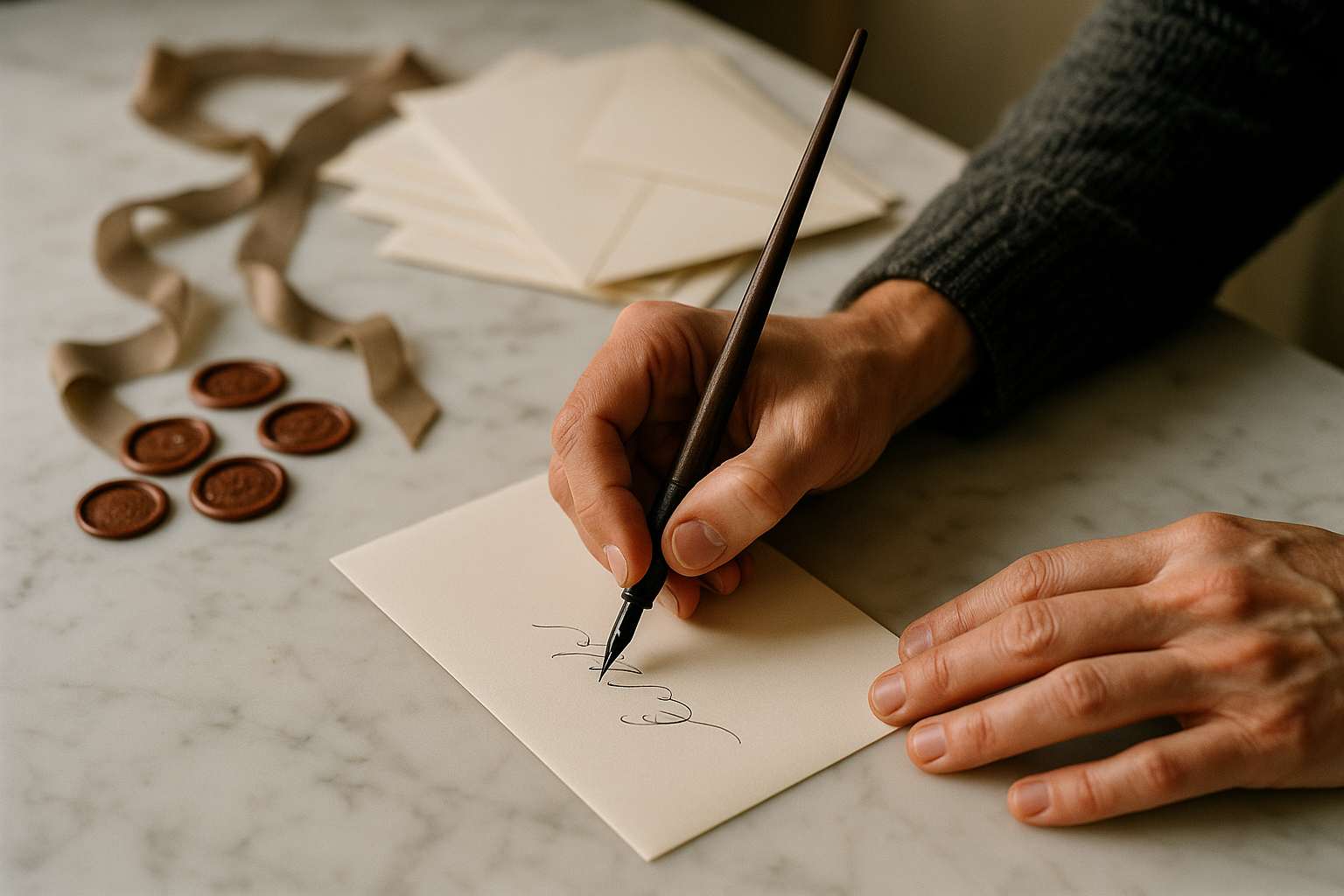
Write formal titles in full on the outer envelope — 'Doctor' is never abbreviated to 'Dr.' in formal invitation addressing. Use the inner envelope for the warm, familiar version of the same address. Every guest's name appears on their own envelope; 'and Family' is never written on the outer envelope of a formal wedding invitation.
Addressing wedding invitations is one of those tasks that appears straightforward until you sit down with your guest list and realize that roughly a third of your guests require a decision about titles, name order, or household designation that your addressing guide has not covered. The doctor whose spouse has a different last name. The married woman who kept her own surname. The nonbinary colleague whose envelope needs to feel natural and honoring. The family with three children, two of whom are invited and one of whom is not.
Done correctly, addressed invitation envelopes communicate something before the suite is even opened: that the couple has thought carefully about each guest, knows their name and title, and has taken the time to honor them properly. Done incorrectly — misspelled names, wrong titles, 'Mr. and Mrs. [Husband's Full Name]' sent to a woman who kept her own surname — the envelope can produce the first small friction before any guest has arrived. This guide covers every scenario a guest list is likely to contain, with real examples for each.
What is the difference between the outer envelope and the inner envelope?
The outer envelope is the formal, postal address — full names with titles, formal address, correct city and state with ZIP code. It is what the mail carrier, the calligrapher, and the postal service see. The inner envelope, traditionally included inside the outer envelope, is the intimate version: first names only, or the family designation ('The Harrison Family,' 'Aunt Claire and Uncle David'), written as you would address the invitation in conversation. The inner envelope is also where you list children's names if they are invited, or omit them as a signal that the invitation is for the adults of the household only.
Many modern couples choose to use only an outer envelope and forgo the inner envelope entirely — this is fully acceptable and considerably simpler. When a single-envelope suite is used, the envelope functions as the formal outer, and children's names are either written after the parents' names on the same envelope line (if invited) or omitted entirely (the conventional signal that the invitation is adults-only). The inner envelope, when used, should mirror the outer envelope's information in its familiar register — never contradict it by adding names that are not on the outer envelope.
| Household Scenario | Outer Envelope | Inner Envelope |
|---|---|---|
| Married couple, same surname | Mr. and Mrs. James Whitmore | James and Claire, or The Whitmores |
| Married couple, different surnames | Ms. Claire Hadley and Mr. James Whitmore | Claire and James |
| Married female couple, same surname | Mrs. and Mrs. Sarah and Olivia Chen | Sarah and Olivia, or The Chens |
| Male-female couple, unmarried | Ms. Claire Hadley and Mr. James Whitmore (alphabetical by surname) | Claire and James |
| Woman with medical degree | Doctor Claire Hadley and Mr. James Whitmore | Claire and James |
| Both have medical degrees | The Doctors Whitmore (same surname) or Doctors Claire Hadley and James Whitmore | Claire and James |
| Nonbinary guest | Mx. Riley Chen | Riley |
| Single guest with plus-one known | Ms. Claire Hadley and Mr. James Whitmore | Claire and James |
| Single guest, plus-one unnamed | Ms. Claire Hadley (outer envelope only; 'and Guest' on inner) | Claire and Guest |
| Family with invited children | Mr. and Mrs. James Whitmore (children listed on inner envelope only) | James, Claire, Emma, and Tom |
How should you address envelopes for guests with professional titles?
Professional titles — Doctor, Judge, Reverend, and military ranks — are written in full on the outer envelope and are never abbreviated in formal invitation addressing. 'Dr.' is not used; 'Doctor' is. 'Rev.' is not used; 'Reverend' or 'The Reverend' is. Military titles follow rank convention: a retired colonel is addressed as 'Colonel [Name], U.S. Army (Retired)' if the couple chooses to honor the rank on the invitation; if not, 'Mr.' or 'Ms.' is acceptable for civilian social contexts.
When only one person in a couple holds a professional title, their name comes first on the envelope regardless of traditional conventions about men being named first: 'Doctor Claire Whitmore and Mr. James Whitmore.' When both hold the same professional title with the same surname, 'The Doctors Whitmore' is the most elegant solution. When both hold doctorates but have different surnames, both names are written out in full: 'Doctor Claire Hadley and Doctor James Whitmore.' According to Zola's invitation addressing guide, omitting a guest's professional title is one of the most common addressing errors — and one of the few that guests reliably notice and remember.
How do you address invitations to same-sex couples, nonbinary guests, and diverse family structures?
Same-sex couples are addressed exactly as any other couple, with the same conventions for shared versus different surnames: 'Mrs. and Mrs. Sarah and Olivia Chen' for a married couple with a shared surname; 'Ms. Sarah Chen and Ms. Olivia Park' for a couple with different surnames. Name order for same-sex couples follows alphabetical order by first name when neither partner holds a title that would place them first by convention — this is a neutral and consistent system that avoids any implication that one partner is primary.
Nonbinary guests are addressed using 'Mx.' (pronounced 'mix') as the honorific: 'Mx. Riley Chen.' If the couple is unsure whether a guest uses 'Mx.' or a different honorific, asking directly is always preferable to guessing — a brief text or email that says 'We want to address your invitation correctly — do you use a specific title or honorific?' is considerate and will be appreciated by nearly every guest it is sent to. Some nonbinary guests prefer simply their full name with no honorific: 'Riley Chen.' Both are correct; the couple's role is to match the guest's own preference, not to impose one.
For unmarried couples who live together, each name appears on the envelope with the names listed alphabetically by surname, separated by 'and.' Unmarried couples are never addressed as 'Mr. and Mrs.' regardless of the length or seriousness of their relationship — the title implies marriage. Widowed guests are addressed using the honorific they have used since their spouse's death; many widows continue to use 'Mrs.' and the couple should not change this unless the guest has indicated otherwise.
How do you handle children and plus-ones on invitation envelopes?
Children who are invited are listed by first name on the inner envelope only, below their parents' names — never on the outer envelope. If all children in a household are invited, 'and Family' may appear on the inner envelope; if only specific children are invited (older siblings but not a young baby, for instance), their names are listed individually. Listing no children on the inner envelope — or on the single outer envelope — is the conventional signal that the invitation is for adults only. This convention is widely understood by guests over 40 and somewhat less so by younger guests; when the adults-only policy is important to the couple, a separate line on the details card or wedding website is clearer than relying on envelope convention alone.
Plus-ones who are known to the couple are addressed by name on the outer envelope alongside the invited guest. Plus-ones who are unknown — the couple knows their guest will bring a date but does not know the date's name — appear as 'and Guest' on the inner envelope only. Writing 'and Guest' on the outer envelope is considered informal and is discouraged by most invitation etiquette authorities including the Emily Post Institute. The practical implication is that if a couple plans to extend plus-ones to guests whose partners they do not know, the single-envelope addressing convention — outer envelope only, formal name only — is the cleaner approach, with the plus-one option communicated through the RSVP card or wedding website rather than the envelope addressing.
What are the most common wedding invitation addressing mistakes?
Five addressing errors appear consistently across the work of professional calligraphers and stationery designers. First: abbreviating 'Doctor' to 'Dr.' on the outer envelope — the title is always written in full in formal addressing. Second: using 'Mr. and Mrs. [Husband's Full Name Only]' for couples where the wife has a different surname or has kept her name — when surnames differ, both names are written in full. Third: writing 'and Family' on the outer envelope — children are listed on the inner envelope or the outer envelope by individual first name, never in a catch-all 'Family' designation on the formal address. Fourth: using the deceased spouse's name for a widow when the widow has signaled a preference for addressing without the late spouse's name — always follow the guest's own practice. Fifth: addressing the envelope to only one member of an established couple without acknowledgment of the partner, which reads as a clear signal — sometimes unintended, sometimes not — that the partner is not invited. When both people are invited, both names appear on the envelope.
Frequently Asked Questions
Does the woman's or man's name go first on a wedding invitation envelope?
The traditional convention places the man's name first for a married heterosexual couple: 'Mr. and Mrs. James Whitmore.' When the wife has a different surname, both names are written — and the man's name still traditionally appears first in a formal context: 'Mr. James Whitmore and Ms. Claire Hadley.' However, when one partner holds a professional title that the other does not, the titled partner's name always comes first regardless of gender: 'Doctor Claire Whitmore and Mr. James Whitmore.' For same-sex couples and unmarried couples, names are listed alphabetically by surname — a neutral system that both partners typically appreciate. Modern etiquette authorities including Zola and Minted note that the alphabetical convention is now widely used even for married heterosexual couples who prefer it, and that strict adherence to 'man first' is optional rather than required in contemporary invitation practice.
How do you address an invitation to a single guest who is allowed to bring a plus-one?
If the plus-one's name is known: address the outer envelope to both people ('Ms. Claire Hadley and Mr. James Whitmore') and the inner envelope to both by first name. If the plus-one is unknown: address the outer envelope to the invited guest only ('Ms. Claire Hadley') and write 'Claire and Guest' on the inner envelope. The RSVP card should include a line for the guest's companion's name so it can be entered in the seating chart before the wedding. Some stationery designers recommend including 'We have reserved ___ seats in your honor: ___' on the RSVP card, with the number of seats pre-filled in ink — typically '2' for a known plus-one situation — as a clear and elegant way to communicate the plus-one allowance without writing 'and Guest' on the formal outer envelope.
How early do you need to address and mail wedding invitations?
Standard timing is six to eight weeks before the wedding date for domestic guests and eight to twelve weeks for guests traveling internationally or who need significant travel planning. Save-the-dates, sent three to six months before the wedding, do not require the same formal addressing conventions as invitations and may be sent with first names only — but the formal invitation that follows should be fully and correctly addressed using all the conventions in this guide. The addressing process itself should begin at least three to four weeks before the mailing target date: for a guest list of 150 households, professional calligraphers typically require two to three weeks for hand-lettered envelopes, and even couples addressing their own envelopes by hand or printing at home should allow significant time for errors, reprints, and the reality that addressing fifty envelopes per hour is an ambitious pace for anyone new to the process.
Should you use 'Miss,' 'Mrs.,' or 'Ms.' for female guests?
'Ms.' is the universal default for any woman whose marital preference is unknown to the couple, and it is the modern standard recommended by virtually every current etiquette authority. 'Mrs.' is correct for married women who use it — but only when the couple knows the guest uses it and prefers it. 'Miss' is traditional for unmarried women and girls, and while it remains technically correct in formal contexts, it carries an increasingly dated quality in 2026 social addressing and is not necessary to use unless the guest herself uses it. When in doubt, 'Ms.' is correct, professional, and appropriate for every adult woman regardless of marital status. For guests under 18, 'Miss' remains appropriate in formal contexts and is the conventional choice for girls' names in formal invitation suites.
Is it acceptable to print wedding invitation envelopes rather than hand-addressing them?
Yes — printed envelopes are fully acceptable for any formality level in 2026, and digital calligraphy fonts printed on high-quality envelope stock are visually indistinguishable from hand-lettering at the distances most guests experience. The practical considerations are: envelopes must be ink-jet or laser compatible (many premium invitation papers are not, and must be specified as such when ordering from suppliers like Minted, Artifact Uprising, or Papier), the font should match or complement the invitation suite design, and the return address should appear on the back flap rather than the front face for formal suites. Professionally hand-lettered envelopes from a calligrapher remain the most elevated option and are worth the investment for smaller guest lists — typical pricing from independent calligraphers ranges from $3 to $8 per envelope for basic addressing, with more elaborate scripts and wax-seal services priced separately.
What do you do if you made a mistake on an addressed envelope?
Order 15–20% more envelopes than your guest list count specifically to account for addressing errors, and treat this as a non-negotiable budget line in your stationery order. A misspelled name, an incorrect title, or an ink smear on a formal envelope cannot be corrected — the envelope must be replaced. White correction fluid and re-labeling are not acceptable on formal wedding invitation envelopes under any circumstances. When ordering envelopes from your stationer, confirm that extra envelopes are included in your order; many stationery vendors include a standard overage, but the default quantity is sometimes only 10%, which may be insufficient for a large guest list with complex addressing needs. Keep the addressing spreadsheet current as envelopes are completed, noting any households where the addressing required research or a title check, so that reprints can be completed accurately the first time.
Frequently asked
Does the woman's or man's name go first on a wedding invitation envelope?
The traditional convention places the man's name first for a married heterosexual couple: 'Mr. and Mrs. James Whitmore.' When the wife has a different surname, both names are written — and the man's name still traditionally appears first in a formal context: 'Mr. James Whitmore and Ms. Claire Hadley.' However, when one partner holds a professional title that the other does not, the titled partner's name always comes first regardless of gender: 'Doctor Claire Whitmore and Mr. James Whitmore.' For same-sex couples and unmarried couples, names are listed alphabetically by surname — a neutral system that both partners typically appreciate. Modern etiquette authorities including Zola and Minted note that the alphabetical convention is now widely used even for married heterosexual couples who prefer it, and that strict adherence to 'man first' is optional rather than required in contemporary invitation practice.
How do you address an invitation to a single guest who is allowed to bring a plus-one?
If the plus-one's name is known: address the outer envelope to both people ('Ms. Claire Hadley and Mr. James Whitmore') and the inner envelope to both by first name. If the plus-one is unknown: address the outer envelope to the invited guest only ('Ms. Claire Hadley') and write 'Claire and Guest' on the inner envelope. The RSVP card should include a line for the guest's companion's name so it can be entered in the seating chart before the wedding. Some stationery designers recommend including 'We have reserved ___ seats in your honor: ___' on the RSVP card, with the number of seats pre-filled in ink — typically '2' for a known plus-one situation — as a clear and elegant way to communicate the plus-one allowance without writing 'and Guest' on the formal outer envelope.
How early do you need to address and mail wedding invitations?
Standard timing is six to eight weeks before the wedding date for domestic guests and eight to twelve weeks for guests traveling internationally or who need significant travel planning. Save-the-dates, sent three to six months before the wedding, do not require the same formal addressing conventions as invitations and may be sent with first names only — but the formal invitation that follows should be fully and correctly addressed using all the conventions in this guide. The addressing process itself should begin at least three to four weeks before the mailing target date: for a guest list of 150 households, professional calligraphers typically require two to three weeks for hand-lettered envelopes, and even couples addressing their own envelopes by hand or printing at home should allow significant time for errors, reprints, and the reality that addressing fifty envelopes per hour is an ambitious pace for anyone new to the process.
Should you use 'Miss,' 'Mrs.,' or 'Ms.' for female guests?
'Ms.' is the universal default for any woman whose marital preference is unknown to the couple, and it is the modern standard recommended by virtually every current etiquette authority. 'Mrs.' is correct for married women who use it — but only when the couple knows the guest uses it and prefers it. 'Miss' is traditional for unmarried women and girls, and while it remains technically correct in formal contexts, it carries an increasingly dated quality in 2026 social addressing and is not necessary to use unless the guest herself uses it. When in doubt, 'Ms.' is correct, professional, and appropriate for every adult woman regardless of marital status. For guests under 18, 'Miss' remains appropriate in formal contexts and is the conventional choice for girls' names in formal invitation suites.
Is it acceptable to print wedding invitation envelopes rather than hand-addressing them?
Yes — printed envelopes are fully acceptable for any formality level in 2026, and digital calligraphy fonts printed on high-quality envelope stock are visually indistinguishable from hand-lettering at the distances most guests experience. The practical considerations are: envelopes must be ink-jet or laser compatible (many premium invitation papers are not, and must be specified as such when ordering from suppliers like Minted, Artifact Uprising, or Papier), the font should match or complement the invitation suite design, and the return address should appear on the back flap rather than the front face for formal suites. Professionally hand-lettered envelopes from a calligrapher remain the most elevated option and are worth the investment for smaller guest lists — typical pricing from independent calligraphers ranges from $3 to $8 per envelope for basic addressing, with more elaborate scripts and wax-seal services priced separately.
What do you do if you made a mistake on an addressed envelope?
Order 15–20% more envelopes than your guest list count specifically to account for addressing errors, and treat this as a non-negotiable budget line in your stationery order. A misspelled name, an incorrect title, or an ink smear on a formal envelope cannot be corrected — the envelope must be replaced. White correction fluid and re-labeling are not acceptable on formal wedding invitation envelopes under any circumstances. When ordering envelopes from your stationer, confirm that extra envelopes are included in your order; many stationery vendors include a standard overage, but the default quantity is sometimes only 10%, which may be insufficient for a large guest list with complex addressing needs. Keep the addressing spreadsheet current as envelopes are completed, noting any households where the addressing required research or a title check, so that reprints can be completed accurately the first time.