Invitations, Registry & Gifts
How to Assemble Wedding Invitations: Step-by-Step Guide
Assembling wedding invitations correctly — the right stacking order, how to handle inner envelopes, postage, and the small details that protect your stationery investment — takes about an hour once you know exactly what you're doing.
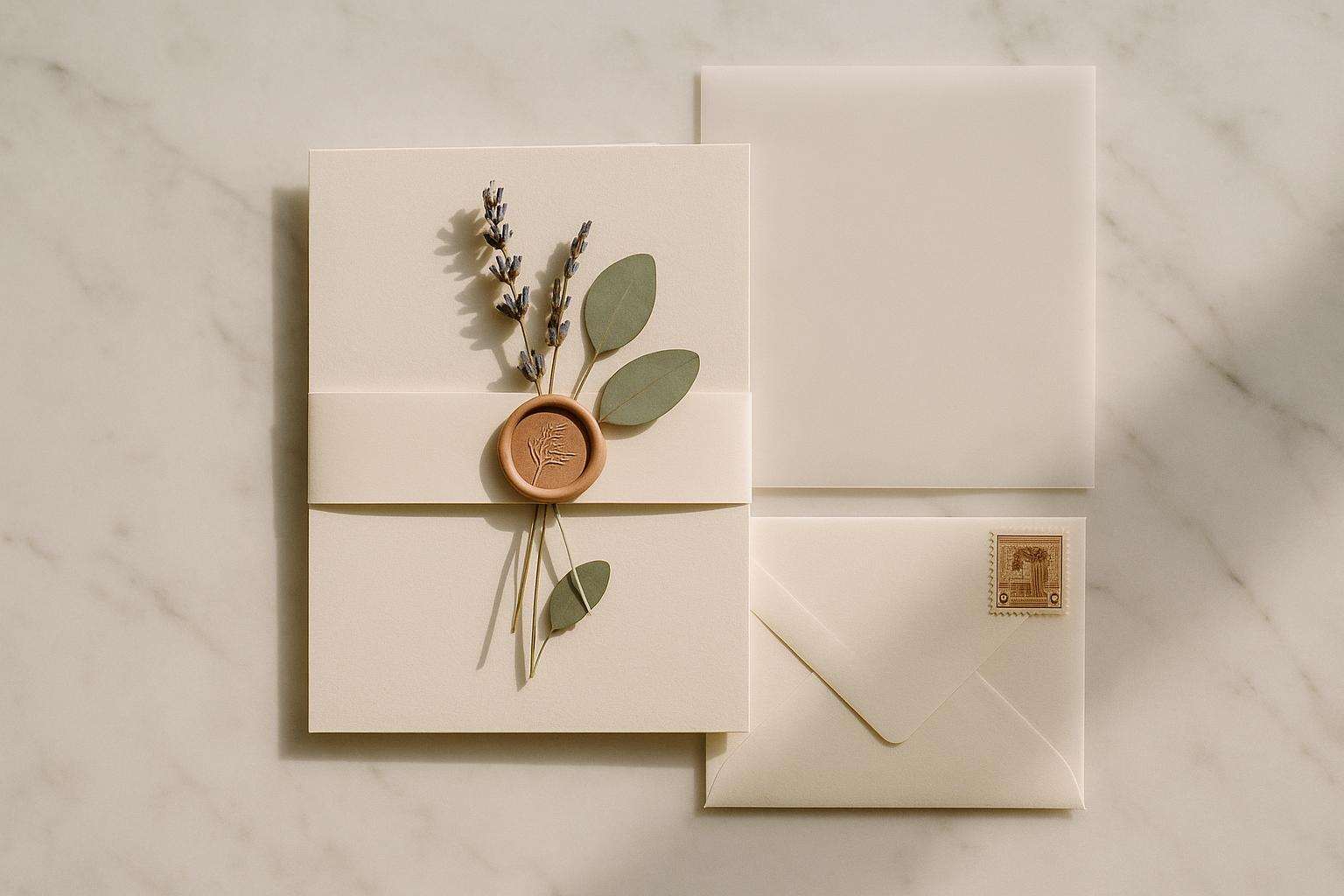
Assemble wedding invitations on a clean, dry surface with washed hands: stack inserts largest-to-smallest, printed side up, with the RSVP envelope on top and its card tucked face-up under the flap. Pre-stamp all RSVP envelopes, weigh a complete test suite at the post office before purchasing stamps, and hand-cancel at the counter on mailing day.
What do you need before you start assembling wedding invitations?
Assembly day should feel like a quiet, pleasant project — not a rescue operation. It requires advance preparation that most guides skip. Gather everything before you begin: all printed invitation components (invitation card, reception card, details/accommodations card, RSVP card and pre-addressed RSVP envelope), outer envelopes, any inner envelopes if using, embellishments (belly bands, vellum overlays, wax seals), stamps for both outer and RSVP envelopes, a damp sponge for sealing, and your addressed envelope list.
Set up on a clean, flat surface with good lighting — a large kitchen table or a cleared dining room table is ideal. Wash your hands thoroughly and dry them completely. Oils and moisture from your hands can smudge fine ink or warp luxury paper at scale. If you are assembling a large quantity, consider lightweight cotton gloves; they are inexpensive and protect high-end cotton-fiber or letterpress paper from fingerprint oils.
Allow all printed pieces at least 24 hours to dry fully before assembly. Freshly printed ink can smear even when it appears dry to the touch, particularly on digital-offset printing. Letterpress and foil-stamped suites should be allowed 48 hours. This step is almost universally skipped by couples who are eager to begin — and it costs them re-printed cards.
One more critical preparation step: stamp all RSVP envelopes before you begin the assembly process. Pre-stamping the RSVP return envelope is both an etiquette requirement and a practical necessity that directly improves response rates. Do it first, before assembly, so a stamp is never accidentally sealed inside an outer envelope.
What is the correct stacking order for wedding invitation inserts?
The stacking order is not arbitrary — it reflects both traditional etiquette and practical usability. The correct sequence, from bottom to top, is as follows:
The main invitation card sits at the bottom, face up, as the largest and most important piece in the suite. Everything else layers on top of it.
Vellum overlay or liner, if included, lies directly on top of the invitation card. Vellum was historically used to protect ink from smearing during transit; today it is primarily decorative, adding texture and a soft translucent layer over the printed card beneath.
Reception card, if ceremony and reception are at separate venues, goes face up on top of the vellum or invitation card. Not every suite includes a reception card; if your ceremony and reception are at the same location, this insert is unnecessary.
Additional enclosure cards — accommodations, details, directions, or a wedding website card — stack face up in descending size order on top of the reception card. Smaller cards on top; larger cards beneath.
RSVP envelope goes on top of the stack, addressed side down, with its pre-stamped flap to the left. The RSVP card is tucked face up under the envelope flap so the printed side is visible when the outer envelope is opened.
| Position | Piece | Orientation |
|---|---|---|
| Top | RSVP envelope with RSVP card tucked under flap | Address side down; RSVP card face up |
| 2nd | Smallest enclosure card (details, website, etc.) | Face up |
| 3rd | Larger enclosure cards (accommodations, directions) | Face up |
| 4th | Reception card (if applicable) | Face up |
| 5th | Vellum overlay (if applicable) | Over invitation card |
| Bottom | Main invitation card (largest piece) | Face up |
How do you stuff and seal wedding invitation envelopes?
Once the insert stack is assembled, it is time to place everything into the envelope. The sequence depends on whether you are using inner envelopes.
With inner and outer envelopes (traditional): Slide the assembled stack into the inner envelope with the printed sides facing the envelope's open flap — so when the guest opens it and reaches in, the invitation reads naturally. Leave the inner envelope unsealed. Place the unsealed inner envelope inside the outer envelope with the guest's name facing the flap. The logic: when your guest opens the outer envelope and reaches in, they find the inner envelope, open it, and the invitation faces them correctly.
Without inner envelopes (modern): Slide the assembled stack directly into the outer envelope, printed sides facing the envelope flap — same orientation as above, for the same readability reason.
Seal outer envelopes using a damp sponge, not your tongue. Moisture from your mouth can warp fine paper at scale and, for a large run, becomes genuinely unpleasant. Work in batches of 20–25 envelopes, sealing each before moving to the next batch. This prevents envelopes from drying unevenly.
Do not apply wax seals to the outer mailing envelope until postage is in place and you are ready to mail. According to Minted's assembly guide, wax seals on outer envelopes should be applied just before mailing and should ideally be adhesive-backed seal stickers rather than traditional hot-poured wax, which can crack or catch in postal sorting machinery.
How do you calculate and apply wedding invitation postage?
Postage is one of the most commonly mishandled steps in invitation assembly, and the consequences — returned invitations or delivery with postage-due charges — are expensive and embarrassing. The correct process requires a trip to the post office before you purchase any stamps.
Assemble one complete test suite exactly as every guest will receive it: every insert, the belly band or vellum wrap, the wax seal if applicable, fully sealed in the outer envelope. Bring this single complete suite to a post office counter — not a self-service kiosk — and ask a postal employee to weigh it and assess any surcharges. In the U.S. as of 2025, a standard first-class stamp covers one ounce at approximately $0.73. Square or unusually shaped envelopes carry a non-machineable surcharge of approximately $0.40 per piece. Suites with multiple inserts, thick cardstock, or rigid embellishments frequently weigh more than one ounce and require additional postage.
If you have some suites with extra inserts for out-of-town guests — a hotel block card, a transportation schedule — assemble one of those as well and weigh it separately. It will likely require different postage, and applying the wrong amount to that subset will result in returns or postage-due delivery.
Purchase only USPS stamps through official USPS channels. Counterfeit stamps are common on third-party online marketplaces and will result in non-delivery. For a finishing touch that reflects the care you have put into the entire suite, vintage commemorative USPS stamps in colors that complement your palette are available at most post office counters and add a warmth that standard flag stamps cannot match.
What is the best way to assemble a large quantity of invitations efficiently?
For guest lists above 80 households, an assembly-line method is significantly faster and less error-prone than building each suite individually from start to finish. Set up separate stacks of each printed component in the order they will be assembled. Work through the full batch one step at a time: add the vellum overlay to every invitation first, then add reception cards to every stack, then enclosures, then RSVP envelopes. Check one completed suite per batch of 25 before sealing, to catch any step that was missed across the batch.
One pro tip from The Knot's stationer guide: write a small, nearly invisible number in pencil on the back of each RSVP card, corresponding to the numbered entry in your master guest list spreadsheet. If a guest returns an RSVP card without a name — which happens with surprising frequency — you can identify who responded by the number. This takes two minutes to set up and saves hours of detective work four weeks before the wedding.
Plan your mailing timeline: all invitation suites should be mailed on the same day. This prevents awkward situations where some guests receive their invitations weeks before others. Mail at a post office counter, hand all suites directly to a postal employee, and request hand-canceling — this prevents automated sorting machinery from printing barcodes across your envelopes and protects wax seals from mechanical damage. It is a ten-minute task that costs nothing and ensures your stationery investment arrives exactly as it left your hands.
Frequently asked
What is the correct order to stack wedding invitation inserts?
The standard stacking order, from bottom to top, is: the main invitation card at the bottom (largest piece, printed side up), then a vellum overlay if included, then the reception card if the ceremony and reception are at separate venues, then any additional enclosure cards (accommodations, details, directions) in descending size, and finally the RSVP envelope on top with the RSVP card tucked face-up under the envelope flap. Every piece should face the same direction — printed side up — so that when the outer envelope is opened, everything reads naturally without the guest needing to flip or reorder the contents. If your invitation is a folded card rather than a flat card, place all enclosures inside the fold rather than stacking them on top.
Do wedding invitations need an inner envelope?
The inner envelope is a traditional element that is increasingly optional in 2025–2026. Its original purpose was to protect the invitation from handling during delivery — the outer envelope bore all the postal dirt and smudging, and the pristine inner envelope was what the guest actually saw and opened. Today, with high-quality envelope paper and modern postal handling, many couples skip the inner envelope entirely without any etiquette violation. However, the inner envelope serves one function no other element duplicates: it explicitly names every invited person in the household. If children are invited, their names appear on the inner envelope. If only the adults in a household are invited, only adult names appear. This removes ambiguity that no outer envelope can resolve as gracefully. If you have a complex guest list with a mix of family configurations, the inner envelope remains genuinely useful.
Should RSVP envelopes be pre-stamped by the couple?
Yes — pre-stamping the RSVP return envelope is both an etiquette requirement and a practical measure that directly improves your response rate. It is considered poor form to ask wedding guests to supply their own postage for a response you have formally requested. Beyond etiquette, the data is clear: guests who receive a pre-stamped return envelope respond at meaningfully higher rates than those who do not. In the United States, as of 2025, a first-class postage stamp for a standard one-ounce letter is approximately $0.73. Purchase RSVP postage through official USPS channels only — counterfeit stamps are common on third-party marketplaces and will result in non-delivery.
How do wax seals work with wedding invitations, and are they safe for mailing?
Wax seals add a beautiful, personal finishing touch to wedding invitation suites — but they require careful handling in the mailing process. Adhesive-backed wax seal stickers (as opposed to hot-wax poured seals) are the safest option for mailed invitations; they lie flat against the envelope and are less vulnerable to USPS sorting machinery. Traditional hot-poured seals are best used on inner envelopes or decorative elements inside the suite, not on the outer mailing envelope, where they may catch on machinery and damage both the seal and the envelope. If you want a wax seal on the outer envelope, place it on the back flap closure and request hand-canceling at the post office counter — this bypasses automated sorting and prevents damage. Always assemble one complete test suite with your wax seal in place and mail it to yourself before producing the full run.
How much postage do wedding invitations typically require?
Wedding invitation postage is not a guess — it must be calculated precisely for each suite configuration, because getting it wrong means invitations are returned or delivered postage-due. The baseline is the current U.S. first-class letter rate (approximately $0.73 for one ounce as of 2025), but most wedding suites exceed one ounce once all inserts are included. Square and unusually shaped envelopes carry a non-machineable surcharge of approximately $0.40 per piece. Envelopes with rigid elements (thick cardstock, wax seals, multiple inserts) may require additional postage. The correct process: assemble one complete suite exactly as it will mail — every insert, every embellishment, sealed and stamped — and bring it to a post office counter to be weighed before purchasing stamps for the full run. Never use a kiosk for this; you need a postal employee to assess non-machineable surcharges.
What is a belly band on a wedding invitation, and how do you apply it?
A belly band is a decorative paper or fabric strip that wraps around the assembled invitation suite to hold all the pieces together neatly inside the envelope. It serves both a functional and aesthetic purpose — it prevents inserts from shifting inside the envelope during mailing, and it adds a finished, cohesive look to the suite. To apply a belly band: assemble all inserts in the correct stacking order, center the belly band across the middle of the stack, fold the ends around the back, and secure with a small glue dot or double-sided tape — do not tape to the invitation card itself. Belly bands work best with a small suite of two to four pieces; very thick suites with many inserts are better held together by being inserted snugly into a well-fitted envelope rather than a band.