Invitations, Registry & Gifts
Jordan Almonds at Weddings: Meaning, History, and How to Honor the Tradition Today
Sugar-coated almonds have graced wedding tables since at least the 14th century — bittersweet by design, symbolic by intent. Here is everything you need to know about one of the oldest and most beloved wedding favor traditions.
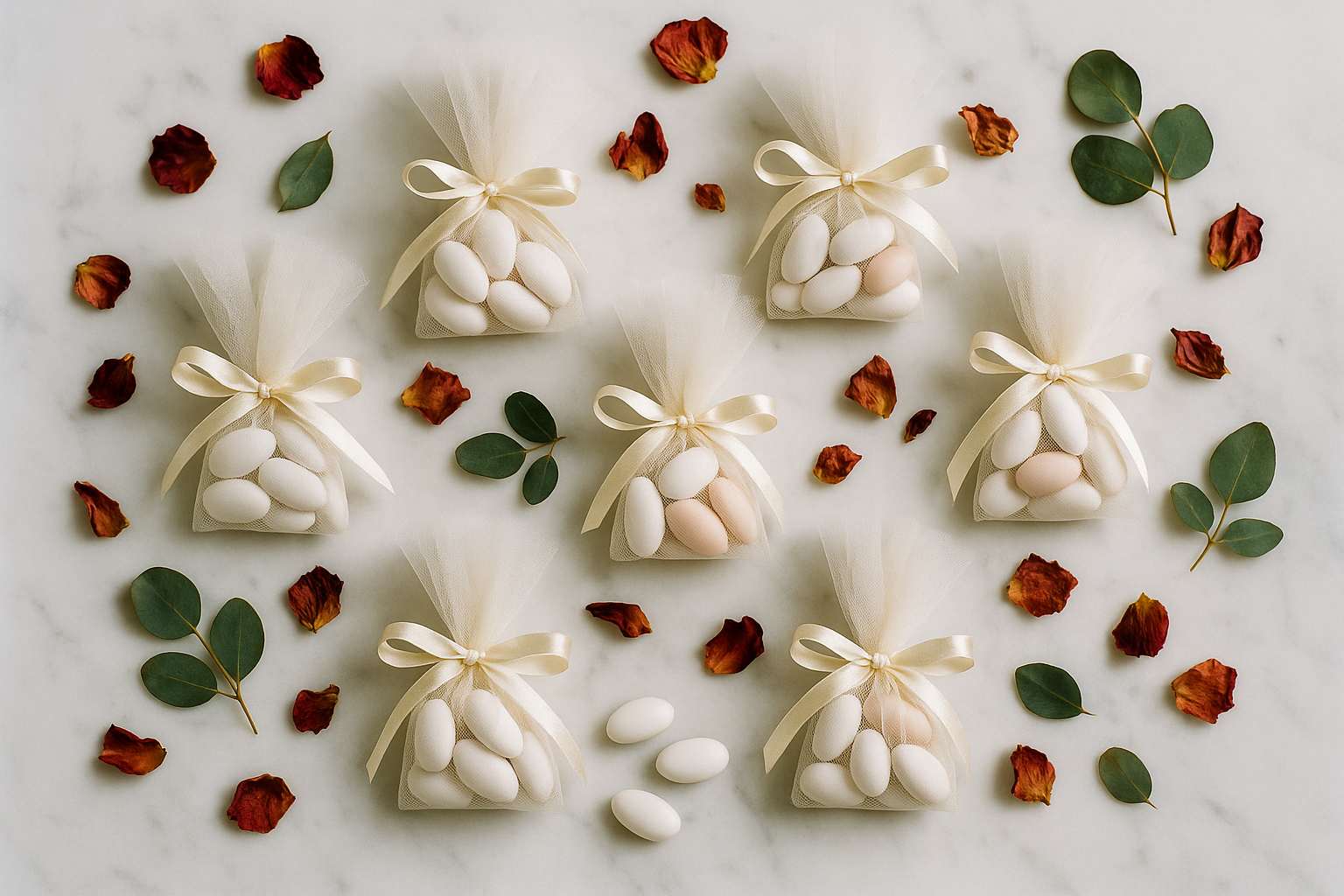
Jordan almonds — sugar-coated almonds given as wedding favors — trace their history to ancient Rome and carry deep symbolic meaning across Italian, Greek, and Middle Eastern traditions: the bittersweet almond inside its sweet coating represents the complex reality of married life. They remain a beautifully appropriate wedding favor in 2026, especially for heritage-honoring couples.
There are wedding favors, and then there are wedding traditions. A favor is a gift; a tradition is a conversation across generations. Jordan almonds — those small, egg-shaped confections of a sugar coating over a whole almond — belong firmly in the second category. They have been present at weddings for more than two thousand years, in cultures spanning the Mediterranean and the Middle East, and they carry meaning that no mass-produced favor can replicate.
If you have Italian, Greek, or Middle Eastern heritage, you likely know them already — perhaps from your parents' wedding photo, or from the tulle bundle your grandmother kept in her keepsake box. For couples discovering the tradition for the first time, the story behind these small candies is worth knowing before you decide whether to use them.
Where do Jordan almonds come from, and how old is this tradition?
The history of sweetened almonds at celebrations traces to ancient Rome, where honey-coated almonds were distributed at weddings and births as far back as 177 BC. The sugar-coated version — technically a dragée, from the French confectionery tradition — appears in written records by the 14th century. According to food historians, Giovanni Boccaccio referenced them in his Decameron, written in 1350, confirming they were already well established as celebratory sweets in medieval Italy.
The formal craft of making Italian confetti (the Italian word for sugared almonds — not the paper variety) became centered in the town of Sulmona in the Abruzzo region of Italy. The Pelino family established a confetti factory there in 1783, and Pelino Confetti still operates in Sulmona today, having provided confections for, among other notable occasions, the 2018 wedding of Prince Harry and Meghan Markle. Sconza Chocolate notes that prior to the early 15th century, almonds were coated in honey rather than sugar — the shift to sugar coating occurred as refined sugar became more widely available in European commerce.
The name "Jordan almond" itself has debated origins. Three theories persist: it may derive from the French word jardin (garden), reflecting the garden-grown almond; it may reference almonds cultivated near the Jordan River; or it may be a corruption of "Verdun," a French town where 13th-century apothecaries first coated bitter medicines in sugar to make them palatable — giving rise to the dragée tradition that eventually became the wedding confection.
What do Jordan almonds symbolize at a wedding?
The symbolism of Jordan almonds is built into their composition, not imposed onto it. The almond is naturally bitter — pleasant in small amounts but unmistakably sharp in its raw form. The sugar coating is sweet. Together, they create a candy that is simultaneously both things: sweet on the outside, complex at the center.
This is the core symbol: married life is bittersweet. Joy and difficulty, sweetness and challenge, celebration and sacrifice — these are always present together. A wedding favor that acknowledges this complexity is a more honest and ultimately more meaningful gift than one that promises only sweetness. The couples and families across centuries who chose Jordan almonds were not being pessimistic; they were being truthful in the most loving way.
Beyond the primary symbol, Jordan almonds carry several secondary meanings:
- Fertility and new beginnings — the egg shape of a Jordan almond has been associated with fertility and the promise of new life in multiple traditions
- Unity through odd numbers — they are distributed in odd quantities (3, 5, or 7) because odd numbers cannot be divided evenly, symbolizing that the married couple will share everything equally and remain an indivisible unit
- The five blessings — in Italian tradition specifically, five almonds represent five wishes for the couple: health, wealth, fertility, happiness, and longevity
| Culture / Tradition | Name | Number Given | Core Symbolism | Typical Presentation |
|---|---|---|---|---|
| Italian | Confetti / Bomboniere | 5 per bundle | Health, wealth, fertility, happiness, longevity | Tulle bundles or decorated boxes (bomboniere), personalized with names and date |
| Greek Orthodox | Koufeta | Odd number (3 or 5) | Unity and indivisibility of the couple; superstition: placed under pillow to dream of future spouse | White, pale pink, or light blue tulle bundles; distributed at reception |
| Middle Eastern (Arabic) | Mlabbas | 3 per presentation | Happiness, fertility, and longevity; associated with new beginnings | Often placed on a small chocolate or in decorative presentation; sometimes scented |
| General Western / Contemporary | Jordan almonds | 5 or decorative quantity | Bittersweet nature of married life; longevity and new beginnings | Kraft paper pouches, custom linen bags, ceramic containers; increasingly styled with heritage signage |
How do modern couples honor the Jordan almond tradition in 2026?
For heritage-tradition couples, the question is often not whether to include Jordan almonds but how to present them in a way that honors the tradition while fitting the wedding's aesthetic. The core elements — the almonds themselves, the odd number, the wrapping — are non-negotiable in their symbolic structure. Everything else is an expression of the couple's creativity.
Classic presentation: White or blush Jordan almonds in tulle bundles tied with ivory or colored ribbon. This is the most photographically timeless choice and the one that immediately communicates tradition to guests who know it. Cost per five-almond bundle, including packaging materials: approximately $0.75 to $1.50 for standard almonds, $1.50 to $3.00 for premium artisan-quality confetti from Italian producers.
Modern keepsake bomboniere: Italian-heritage couples increasingly choose a small decorative container — a porcelain box, crystal dish, or silver-plated keepsake — that holds the five almonds and is itself a lasting gift. Sohnrey Family Foods notes that personalized bomboniere with the couple's names and wedding date are a deeply beloved part of Italian wedding culture, allowing guests to keep the vessel long after the almonds are gone. Keepsake bomboniere add $3 to $10 or more per guest beyond almond costs.
Heritage storytelling cards: A growing trend among couples from Italian, Greek, and Middle Eastern backgrounds is to include a small printed card with each bundle explaining the tradition — the five blessings, the unity symbolism, or the Greek koufeta superstition. This transforms the favor from an object to a story, and allows guests unfamiliar with the tradition to receive it fully.
Color and flavor variation: Traditional Jordan almonds are white for weddings, but premium confetti producers now offer almonds in the couple's wedding colors, in chocolate-covered variations, and in flavored sugar coatings. Sulmona-made confetti in elaborately decorated floral varieties are considered among the finest available, with prices ranging from $8 to $25 per bundle for luxury artisan versions.
For couples without Italian or Greek heritage who are drawn to the tradition because of its symbolism, Jordan almonds remain a completely appropriate choice — the universal meaning (bittersweet life, unity, new beginnings) transcends its cultural origins. A brief note on the favor tag explaining the tradition makes it meaningful to any guest. The oldest wedding favors in the Western world have survived twenty-three centuries because their truth has never grown outdated. That is, in itself, a form of elegance worth honoring.
Frequently asked
What do Jordan almonds symbolize at a wedding?
Jordan almonds carry layered symbolism that has made them resilient across centuries and cultures. The most fundamental symbol is the bittersweet almond inside its sweet coating — a deliberate metaphor for married life, in which joy and difficulty, sweetness and challenge, are always present together. The act of giving guests something that contains both flavors is an honest acknowledgment that marriage is not all sweetness; it is a real, complex, deeply human endeavor. Beyond this core symbol, the egg shape of the Jordan almond represents fertility and new beginnings — the implicit promise of a family. The odd number in which they are traditionally given — three, five, or seven — reflects the mathematical principle that odd numbers cannot be divided evenly, symbolizing the unity and indivisibility of the couple. In Italian tradition, five almonds specifically represent five wishes for the couple: health, wealth, fertility, happiness, and longevity. In Greek tradition, the number is odd for the same unity reason, and tradition holds that an unmarried guest who sleeps with a koufeta under her pillow will dream of her future spouse.
Where do Jordan almonds come from and how old is the tradition?
Jordan almonds trace their recorded history to ancient Rome, where honey-coated almonds were distributed at weddings and celebrations as far back as 177 BC. The sugar-coated version — technically a dragée — appears in written records by the 14th century: Giovanni Boccaccio referenced them in his Decameron, written in 1350. The production of confetti (the Italian name for sugared almonds) became a formal craft in the town of Sulmona, in the Abruzzo region of Italy, where the Pelino family established a confetti factory in 1783 that still operates today. Pelino Confetti achieved worldwide recognition when they provided confections for the wedding of Prince Harry and Meghan Markle in 2018. The name 'Jordan almond' itself is debated: it may derive from the French word jardin (garden), from a resemblance to almonds grown near the Jordan River, or from a corruption of 'Verdun,' the French town where apothecaries first began coating medicines in sugar in the 13th century.
What is the Italian wedding tradition with Jordan almonds?
In Italian tradition, Jordan almonds are called confetti (not to be confused with the paper confetti thrown at celebrations — in Italian, 'confetti' means the sugared almond). They have been central to Italian wedding culture since at least the 14th century. The classic Italian presentation is the bomboniere: a small, decorative container — traditionally a tulle bundle tied with ribbon, but also porcelain boxes, silver-dipped shells, small crystal vases, or custom keepsake boxes — holding exactly five almonds, one for each of the five blessings wished upon the couple: health, wealth, fertility, happiness, and longevity. These bomboniere are placed at each guest's seat or distributed as the couple greets guests after the ceremony. For modern Italian-American or Italian-heritage couples, the bomboniere is often personalized with the couple's names and wedding date printed on a small card or ribbon tag. The five-almond bundle remains among the most recognized and emotionally resonant wedding favor traditions in the Western world.
What is the Greek koufeta wedding tradition?
In Greek Orthodox tradition, Jordan almonds are called koufeta and carry specific ritual significance. They are distributed in odd numbers — three or five — because odd numbers are indivisible, symbolizing the unity of the new couple. The Greek tradition holds that an unmarried woman who takes a koufeta home from the wedding and places it under her pillow that night will dream of her future husband. This superstition has persisted cheerfully for generations, giving the small sugar-coated almonds a secondary social life long after the wedding ends. Greek koufeta are typically wrapped in white, pale pink, or light blue tulle and distributed at the reception as guests arrive or placed at each table setting. The tradition is closely associated with Eastern Orthodox Christianity and the understanding that marriage unites two families as permanently and indivisibly as an odd number resists equal division. For Greek-American couples, the koufeta often functions as the primary wedding favor; it connects the celebration to heritage in a way that universally understood edible symbols uniquely accomplish.
Are Jordan almonds still relevant at modern weddings in 2026?
Yes — particularly for couples with Italian, Greek, Middle Eastern, or broadly Mediterranean heritage, for whom Jordan almonds carry centuries of genuine cultural resonance. For these couples, the bomboniere or koufeta is not a nostalgic gesture; it is an active connection to tradition, family history, and community. Among the broader wedding market, edible favors are strongly preferred over keepsake trinkets — industry data consistently shows that guests are more likely to take home and appreciate a food item than a branded object. Jordan almonds occupy a distinguished position in this edible-favor category because they come with built-in meaning, require no explanation to guests who know the tradition, and can be beautifully packaged in ways that double as table decor. Modern couples from non-Italian or non-Greek backgrounds are also increasingly discovering the tradition through research and choosing it because its symbolism — the bittersweet almond inside the sweet coating as a metaphor for married life — resonates as honest and timeless. The trend toward intentionality in wedding details over the past several years has made Jordan almonds feel freshly relevant.
How should Jordan almonds be packaged and presented at a wedding?
The presentation of Jordan almonds has evolved considerably while the underlying tradition has remained intact. Classic tulle bundles tied with ribbon remain popular and photograph beautifully — especially in ivory, white, blush, or the couple's wedding colors. Modern alternatives include small kraft paper boxes with a printed tag explaining the tradition (particularly useful when guests may not know the custom); organza drawstring bags; custom-printed linen pouches; small ceramic or porcelain keepsake vessels that the almond bundle sits inside; and sustainable options like seed-paper tags. For Italian-heritage couples honoring the bomboniere tradition, the container itself is as significant as the almonds — vintage-style porcelain boxes, silver-plated items, or crystal vessels are traditional choices that guests keep long after eating the almonds. The five almonds per bundle should be maintained if honoring the Italian tradition; Greek koufeta are typically in odd numbers of three or five. Plan to order 5 to 10 percent more almonds than your confirmed guest count to account for breakage, late RSVPs, and guests who wish to take extras for family members who could not attend.