Invitations, Registry & Gifts
Wedding Ceremony Program Wording: What Every Couple Should Know
From the cover through the in memoriam, a well-worded ceremony program guides guests, honors your wedding party, and becomes a keepsake guests genuinely keep. Here is exactly what to include, how to word each section, and the format choices that suit every ceremony style.
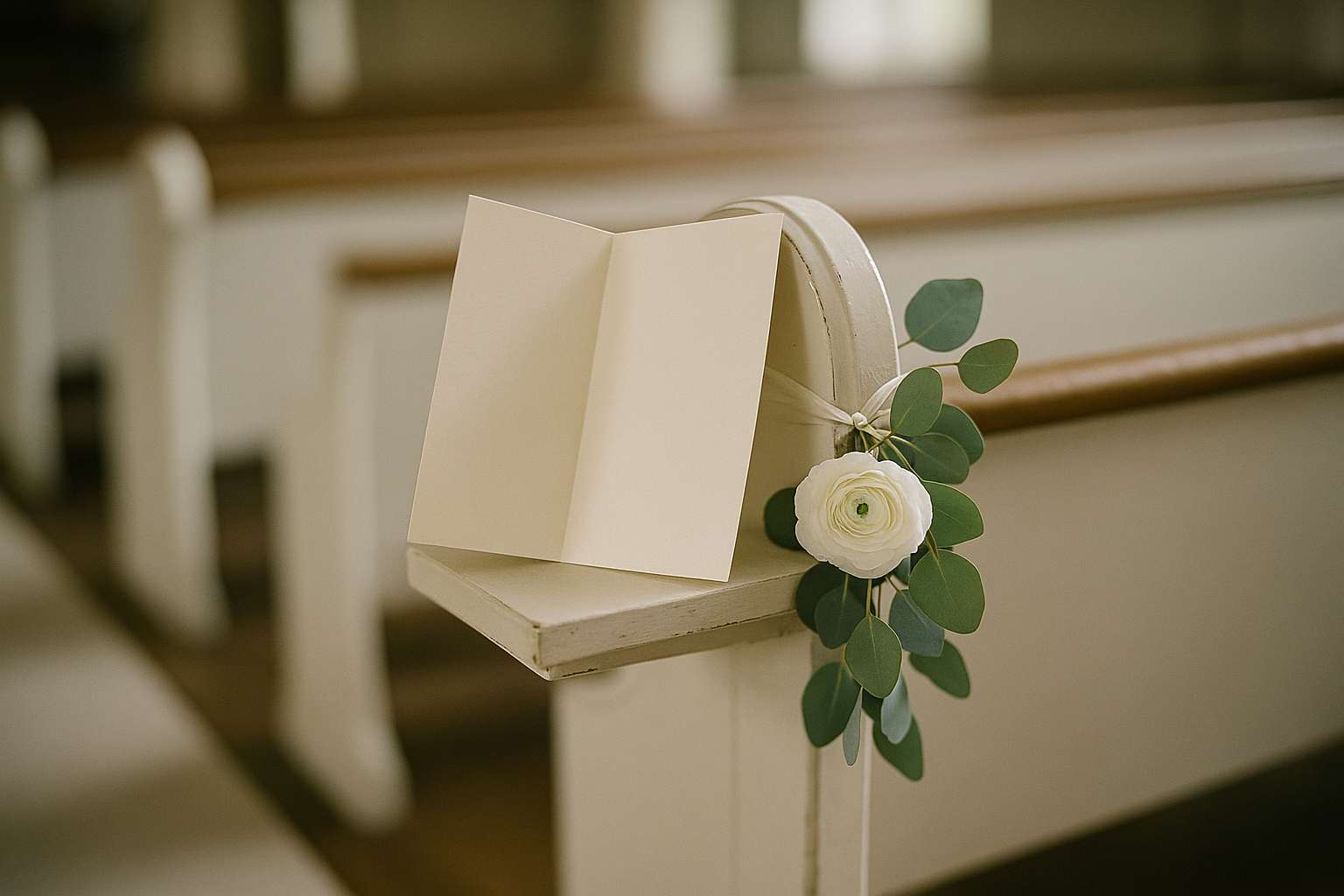
A wedding ceremony program should include the couple's names and date, the complete order of service, the full wedding party listing, music credits, and any readings or unity ceremonies — worded clearly and printed by household count, not head count. Format choices range from a single flat card for civil ceremonies to a full booklet for Catholic Masses or multi-ritual Hindu weddings.
Among all the paper goods you will design for your wedding, the ceremony program is the one your guests will actually read. It is in their hands from the moment they take their seat until the recessional ends — sometimes longer, for guests who linger or travel home with it tucked in a bag as a keepsake. A thoughtfully worded program orients first-time guests, honors every member of your wedding party by name, explains unfamiliar rituals with warmth rather than footnotes, and frames the ceremony as the intentional, curated experience you have spent months designing.
The format decision comes first, because it drives every other choice about what you can and cannot include.
What format should your wedding ceremony program be?
Program format should be determined by ceremony length and content — not by aesthetic preference alone. A beautifully designed format that cannot contain your ceremony's contents serves no one.
| Format | Best For | Typical Size | Cost Range (per piece) |
|---|---|---|---|
| Single flat card | Civil ceremonies, short garden ceremonies of 20–30 minutes | 4×9" or 5×7" | $1.50–$4.00 (custom print) |
| Bi-fold (4 pages) | Standard Protestant, non-denominational, or civil ceremony | 4×9" folded | $2.00–$5.00 (custom print) |
| Booklet (8+ pages) | Catholic Mass, Jewish ceremony, bilingual, Hindu multi-ritual | 5.5×8.5" stapled | $4.00–$12.00 (letterpress) |
| Ceremony sign (large format) | Outdoor or eco-conscious couples; no keepsake needed | 18×24" or 24×36" | $40–$150 (printed foam core or acrylic) |
| Fan program | Outdoor summer ceremonies in warm climates | Standard paddle fan | $2.00–$6.00 per fan |
The bi-fold — four panels, standard 4×9" folded — is the most versatile option for weddings up to about an hour in length. It accommodates a full order of service, wedding party listing, and reading credits without feeling padded, and it is the format most guests intuitively know how to navigate. For any ceremony involving congregational participation (hymns, responsive readings, communal prayers), a booklet that prints the full text is not a luxury — it is a practical necessity. Guests who cannot find the words become self-conscious and disengage.
What wording should go in each section of the program?
Well-worded programs share a few qualities: they are scannable (guests read in sections during a ceremony, not linearly), they are free of insider language only close friends will understand, and they are entirely free of typos, particularly in the spelling of every name. That last point deserves emphasis: a misspelled bridesmaid's name or incorrect officiant title is permanent once printed. Have at least two people proofread the final file, including someone who personally knows every name listed.
The cover needs the couple's names, the date, and the venue city at minimum. A meaningful quote or short line from the ceremony can elevate it from informational to emotional: "Today two families become one." or "The Wedding of Alexandra Bennett & James Holloway · June 14, 2026 · St. Michael's Church, Charleston".
The order of service lists each element of the ceremony in sequence. Keep it clean and scannable — guests use it to orient themselves, not to read in advance. Suggested structure for a standard non-denominational ceremony: Prelude Music · Seating of the Grandparents · Seating of the Parents · Processional · Welcome · Opening Prayer · First Reading · Second Reading · Declaration of Intent · Exchange of Vows · Exchange of Rings · Unity Ceremony · Blessing and Pronouncement · First Kiss · Recessional.
Music credits belong in the order of service, noted after the element they accompany: "Processional: 'Canon in D' — Johann Pachelbel, performed by the St. Michael's String Quartet."
Readings should be attributed with title, source, and reader: "First Reading: 1 Corinthians 13:4–8, read by Sophie Williams, sister of the bride." If the ceremony includes a literary or poetic reading rather than scripture, the same format applies: title, author, reader. If guests are invited to read along, print the full text.
The wedding party section introduces each member by full name and role. According to Paperlust's comprehensive program wording guide, listing members in processional order is standard and helps guests follow the ceremony as it begins. The officiant is always listed first. Parents in the processional are listed before the wedding party.
The in memoriam section acknowledges loved ones who have passed. It should be placed either before the order of service or on the back cover — never buried inside. Keep the format identical for each person listed: full name, relationship, and year. Suggested wording: "We remember with love those who are not with us today — Eleanor Rose Bennett, grandmother of the bride (1928–2019)."
A personal note from the couple is optional but warmly received. Two to four sentences in your own voice, thanking guests for their presence and love, makes a formal program feel human. Keep it brief — this is not a toast; it is a greeting.
What should be left out of a wedding ceremony program?
Programs are read during the ceremony, not studied afterward. Joy's wedding program guide is direct on what to omit: registry information belongs nowhere in a ceremony program. Inside jokes that are meaningful to five people and opaque to eighty-five others belong in a toast, not a program. Lengthy thank-you paragraphs that read like credits to a film are better placed on your wedding website. Honeymoon destination announcements distract from the emotional register of the ceremony itself.
What guests actually want from a program: orientation (where are we in the ceremony?), recognition (whose name is that in the wedding party?), and context for anything unfamiliar. A program that delivers all three in the clearest, most beautiful possible form has done its job. Submit your order four to six weeks before the wedding — rush production adds 25 to 50 percent to print costs — and confirm your paper weight is 80 to 100 lb. text for folded programs and 100 to 130 lb. cover stock for flat cards. The difference between a program that holds its shape gracefully in a guest's hands and one that wilts comes down almost entirely to paper weight.
Frequently asked
What are the essential sections every wedding ceremony program must include?
Every ceremony program, regardless of formality or length, should include five core elements: the couple's full names and wedding date; the venue and ceremony time; the order of service (the sequence of events from processional through recessional, clearly numbered); the wedding party listing with each person's name and role; and music credits noting song title and performer for each moment. Beyond these five, additional sections depend on your ceremony's length and content: if you have readings, name each one with its source and reader. If you have a unity ritual, name and briefly explain it. If you are including an in memoriam acknowledgment, place it thoughtfully. A single-page program can contain all five essentials comfortably; a multi-event religious ceremony may warrant a full booklet. Order your programs by household count, not head count, and add 10 to 15 percent overage.
How do you word the wedding party section of a ceremony program?
The wedding party section introduces each member by full name and role, listed in processional order. For a traditional program: 'Officiant: The Reverend Michael Chen / Maid of Honor: Sarah Katherine Bloom, sister of the bride / Bridesmaids: Emma Watts, Priya Nair, Grace Sullivan / Best Man: Daniel James Holloway, brother of the groom / Groomsmen: Thomas Park, Liam Carter, Aiden Walsh / Flower Girl: Lily Rose Bennett / Ring Bearer: Noah James Chen.' For same-sex couples, role names are adjusted to reflect the couple accurately — Person of Honor, Wedding Attendants, or any title that honors the relationship. Parents in the processional are often listed separately before the wedding party: 'Parents of the Bride: Richard and Catherine Bloom / Parents of the Groom: Margaret and Thomas Holloway.' Do not list children of divorced parents separately by parent; list each parent by their own name and relationship to the couple.
How do you word a memorial or in memoriam section in a ceremony program?
An in memoriam section is always appropriate when the couple wishes to acknowledge loved ones who have died. Keep the language simple, consistent in format, and free of hierarchy — every person listed should receive the same treatment. Standard wording: 'We remember with love those who are not with us today:' followed by each name, their relationship, and the year of their passing — for example, 'Eleanor Rose Bennett, grandmother of the bride (1928–2019).' Alternatively: 'Today we hold in our hearts those who cannot be here with us. We remember [Name], beloved [relationship].' Some programs add a single sentence from the couple: 'We feel your presence in every flower, every song, and every joyful moment of this day.' The section should appear naturally near the end of the program's introductory material, before the order of service, or on the back cover. Do not include registry information in or near this section.
What is the correct format for a Catholic, Jewish, or Hindu ceremony program?
Religious ceremonies have specific program needs that differ from civil ceremonies. A Catholic Mass program typically requires eight to twelve pages in booklet format because it includes all prayers, responses, and hymn texts in full — guests are expected to participate verbally throughout. A bilingual English and Spanish format is common; facing-page translation is the cleanest layout. A Jewish ceremony program benefits from a six to eight page booklet that explains the Ketubah signing, Seven Blessings (Sheva Brachot), and the breaking of the glass, including Hebrew transliterations of any blessings guests say aloud. A Hindu ceremony program for a multi-day or multi-event wedding may be separate for each event (Mehendi, Sangeet, wedding day). Each ritual — Baraat, Milni, Ganesh Puja, Kanyadan, Saptapadi — deserves a brief explanation in warm, accessible language. Gold foil printing honors the occasion's vibrancy. For any ceremony involving unfamiliar traditions, the program is your guests' guide: frame every cultural explanation as an invitation into your story.
How many programs should I order for my wedding?
Order programs by household or couple count, not head count. For 120 guests arriving primarily in couples or families, 70 to 75 programs is appropriate — one per adult household. Add 10 to 15 percent overage for vendors, day-of coordinators, late RSVPs, and couple keepsakes (most couples want two or three perfect copies preserved after the wedding). For a ceremony of 50 guests, 35 programs with 5 extras provides comfortable coverage. A useful rule: if in doubt, add five to ten more. Programs left over at the end of the day cost almost nothing; running out during the ceremony is embarrassing and irreversible. If your ceremony involves assigned ushering, have ushers distribute programs as guests are escorted to their seats — this creates a warm, personal first impression and eliminates the awkward stack by the door.
Can I skip printing programs and use a ceremony sign instead?
Yes — a large-format ceremony board (18 by 24 inches for smaller venues; 24 by 36 inches for larger) listing the order of service and wedding party is a beautiful, sustainable alternative to printed programs. It eliminates the printing, assembly, and distribution logistics of individual programs, reduces paper waste, and creates a dramatic visual backdrop that photographs well. The trade-off is that guests take nothing home as a keepsake — printed programs are among the most commonly saved wedding mementos. A practical middle ground: a sign for the order of service, supplemented by a single beautifully designed folded card listing the wedding party members, which guests do take home. For outdoor ceremonies, a sign is often more practical than programs, which are easily scattered by even a gentle breeze.