Invitations, Registry & Gifts
Wedding Invitation Postage Guide: Stamps, Weights, and How to Mail Right
The most expensive mistake in wedding stationery costs $0.49 per envelope and arrives as a return-to-sender stack two weeks before your wedding. Here is how to get postage exactly right.
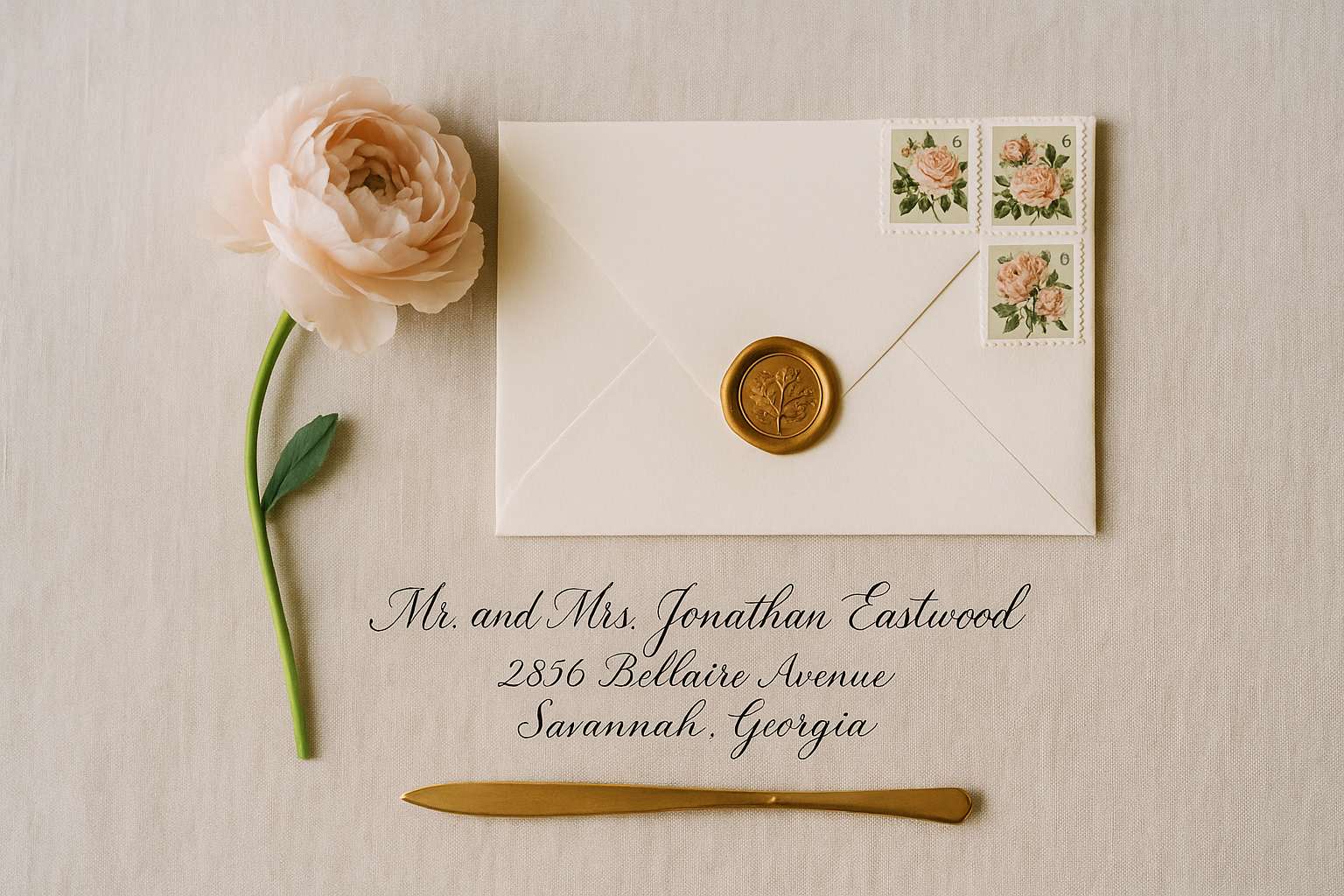
Assemble one complete invitation suite, seal it, and bring it to a post office counter before you purchase a single stamp. Most suites weigh more than one ounce ($1.07 postage), square envelopes add a $0.49 surcharge, outer-envelope wax seals trigger the same surcharge, and RSVP return envelopes need their own stamp. A 20-minute post office errand before mailing day prevents the worst stationery disaster of wedding planning.
Wedding invitations are the first physical experience your guests have of your wedding. They are designed with intention, addressed with care, and assembled over hours at your kitchen table. The last thing you want is for them to arrive bent and surcharge-labeled — or worse, return to you in a stack two weeks before the wedding because you did not use enough postage.
Postage is not complicated, but it has more variables than most couples expect. This guide covers every rate, every surcharge, and every step in the mailing process for 2025 and 2026.
What are the current USPS postage rates for wedding invitations?
USPS postage rates for standard first-class letter mail are currently as follows as of mid-2026. Note that USPS has announced a planned rate increase to $0.82 per Forever stamp effective July 12, 2026 — stamps purchased before that date retain their validity at face value indefinitely.
| Mail piece type | Weight / condition | Postage rate (mid-2026) |
|---|---|---|
| Standard rectangular invitation | Up to 1 oz | $0.78 (one Forever stamp) |
| Standard rectangular invitation | 1–2 oz | $1.07 (Forever + Additional Ounce, or Two-Ounce stamp) |
| Square envelope (any weight) | Non-machinable surcharge applies | $0.49 surcharge added to letter rate |
| Outer envelope with wax seal | Non-machinable surcharge applies | $0.49 surcharge added to letter rate |
| Large/flat envelope (over 6.125" x 11.5") | Classified as flat, not letter | $1.63+ (Flat rate, first ounce) |
| Save-the-date postcard | Standard postcard dimensions | $0.61 |
| Pre-stamped RSVP return envelope | Standard rectangular | $0.78 per envelope |
| International invitation (1 oz) | Global Forever stamp | $1.70 |
According to Paperlust's 2026 USPS postage guide, most fully assembled invitation suites — invitation card, RSVP card, pre-stamped RSVP return envelope, and at least one enclosure card — weigh between one and two ounces. One ounce is approximately the weight of a single invitation card and envelope with nothing else inside. Add an RSVP envelope, a details card, and any embellishments (belly band, vellum overlay, wax seal) and you almost certainly cross the one-ounce threshold.
What triggers a non-machinable surcharge, and how much does it cost?
A non-machinable surcharge of $0.49 is added to any piece that USPS automated sorting machinery cannot process. For wedding invitations, the three most common triggers are:
Square envelopes. Any envelope where the length and width are equal, or where the length-to-width ratio falls outside USPS letter standards, cannot pass through automated sorters. A one-ounce square invitation costs $1.27 to mail. A two-ounce square suite costs $1.56. For 100 households, that $0.49 surcharge adds $49 to your total postage — a number worth knowing before you order your suite.
Wax seals on the outer envelope. A wax seal creates a raised, rigid surface that jams automated sorting machinery. USPS charges the non-machinable surcharge for any piece with a rigid or uneven surface on the outer envelope. The practical solution: place your wax seal on the inner envelope — which guests open and hold — and use a plain, unadorned outer mailing envelope. The inner envelope wax seal reveal is fully preserved. The outer envelope processes without a surcharge.
Enclosed rigid items. Anything that creates a rigid bump through the envelope — a button, a coin, a thick charm — triggers the surcharge. If you are enclosing a special insert with any raised or rigid element, weigh and confirm postage with the full insert enclosed.
As Paper and Honey stationery studio documents, the most reliable way to avoid surcharge surprises is to bring one fully assembled, sealed sample to a post office counter and have it evaluated by a postal worker before you purchase any stamps or seal any envelopes.
How do you calculate total postage for a wedding invitation mailing?
The calculation has four components: outgoing invitation postage, RSVP return postage, out-of-town suites with additional inserts (which may weigh more than standard suites), and any international guests.
Build your total this way: count the number of households receiving invitations (not the number of individual guests — one invitation per household). Multiply by your confirmed per-piece postage rate. Add the same number multiplied by $0.78 for pre-stamped RSVP return envelopes. If some suites contain additional enclosures (accommodation card, weekend events card, transportation insert), assemble one of those heavier suites separately and weigh it to confirm whether it requires different postage than the standard suite. Add international postage at $1.70 per Global Forever stamp for any overseas guests.
For a real-world example: 100 households, standard rectangular two-ounce suites, no square envelopes, pre-stamped RSVP returns. Outgoing postage: 100 x $1.07 = $107. RSVP returns: 100 x $0.78 = $78. Total minimum postage budget: $185. This is a reliable baseline; add a 10% buffer for addressed envelopes that require reprinting or any last-minute additions to the guest list.
How do you mail wedding invitations the right way?
The mechanics of mailing matter as much as the postage math. Several details that protect your investment:
Hand-cancel at the counter. Drop every invitation at a post office counter and ask specifically for hand-canceling. Hand-canceling bypasses the automated sorting machinery that can damage wax seals, bend delicate paper, and smudge fresh ink. Do not drop invitations in a blue collection box — they will go through automated processing without any protective handling. Wedding planners at Dejanae Events list the blue-box drop as the single most common avoidable mailing mistake they see couples make.
Mail all invitations on the same day. Different postmark dates create awkward social dynamics — guests compare notes, and discovering that their invitation arrived a week after a mutual friend's generates questions. Coordinate your mailing to go out in a single visit.
Mail a test invitation to yourself first. Send one complete suite to your own address before the full mailing. This confirms actual delivery time, whether anything was bent or smudged in processing, and that the postage was sufficient. Do this two weeks before your planned mail date so you have time to make any adjustments.
Use USPS stamps from official sources only. Counterfeit postage sold through non-USPS online outlets is a documented problem in the stationery community. Purchase stamps only from store.usps.com or a post office counter. Curating coordinating vintage USPS stamps from authorized dealers is a lovely option that adds visual warmth — vintage stamps carry their original face value and are fully valid as long as the denomination meets your current postage requirement.
Frequently asked
How much postage does a wedding invitation need in 2026?
A standard rectangular wedding invitation weighing one ounce or less requires one Forever stamp, currently $0.78 in mid-2026. Most fully assembled invitation suites — invitation card, RSVP card, RSVP return envelope, and a details card — weigh more than one ounce, placing them in the two-ounce tier at $1.07. The only way to confirm your exact postage is to assemble one complete suite exactly as it will be mailed, seal it, and bring it to a post office counter (not a kiosk) to have it weighed and assessed. Do this before you purchase a single stamp. A USPS postal worker will also confirm whether your envelope shape, wax seal, or any rigid element triggers the $0.49 non-machinable surcharge — a cost many couples discover only after their invitations are returned to them.
What is the square envelope surcharge, and how do I avoid it?
USPS automated sorting machinery cannot process square envelopes, which triggers a non-machinable surcharge of $0.49 per piece on top of the standard letter rate. A one-ounce square invitation costs $1.27 to mail ($0.78 base plus $0.49 surcharge); a two-ounce square suite costs $1.56. For a mailing of 100 households, the surcharge alone adds $49 to your postage budget — a meaningful amount that many couples do not discover until they are already at the post office. The only way to avoid it is to use a standard rectangular envelope. If your stationer designed a square suite, ask whether rectangular versions of the same design are available; many are. If you have your heart set on the square format, budget the surcharge explicitly and weigh a complete sample at the post office before purchasing stamps.
Does a wax seal require extra postage?
A wax seal on the outer mailing envelope creates a rigid, bumpy surface that cannot pass through USPS automated sorting machinery, triggering the same $0.49 non-machinable surcharge that applies to square envelopes. The elegant workaround: place your wax seal on the inner envelope — which guests will open and see — and use a plain, flexible outer mailing envelope without a seal. The inner envelope reveal is preserved, the outer mailing envelope processes without a surcharge, and your postage budget stays intact. If you prefer a wax seal on the outer envelope, budget for the surcharge and hand-cancel at the post office counter to protect the seal from automated sorting equipment damage.
Do I need to stamp the RSVP return envelope, and how much does it cost?
Yes — always pre-stamp your RSVP return envelopes. Response rates drop sharply when guests are required to source their own stamp, particularly among older guests who may not keep stamps at home. A standard rectangular RSVP return envelope requires one Forever stamp at the current $0.78 rate. If you have chosen RSVP return postcards rather than envelopes, the postcard rate is lower at $0.61. Pre-stamped RSVP return postage for 100 households adds approximately $61 to $78 to your total postage budget. Consider this a non-optional hospitality investment — the cost of a single unreturned RSVP that requires a follow-up phone call exceeds the cost of pre-stamping every return envelope.
What are the current USPS wedding-themed stamp options for 2026?
USPS releases wedding-themed Forever stamp designs annually. In 2026, three designs are in active circulation: Love 2026 (a Forever stamp at $0.78, issued January 2026), Celebration Blooms (Forever, $0.78), and Wedding Blooms (a Two-Ounce stamp at $1.07, designed specifically for heavier invitation suites). All three are available at store.usps.com and most post office counters. Vintage USPS stamps in coordinating colors — sourced through authorized dealers on Etsy and from postal historians — are a beloved alternative among brides who want postage that feels curated and personal rather than standard issue. Vintage stamps are legally valid as long as they carry sufficient face value for the current postage rate, and they photograph beautifully in invitation flat-lay detail shots.
What is the most important thing to do before mailing wedding invitations?
The single most important step is to weigh one fully assembled, sealed, complete invitation suite at a post office counter before you purchase any stamps or seal any envelopes. Assemble a single suite exactly as every invitation will be mailed — every insert, any belly band or vellum wrap, the wax-sealed or unsealed outer envelope — and bring it to the postal counter. Ask the clerk to weigh it, classify the envelope shape, and identify any applicable surcharges. This twenty-minute errand saves the genuine mortification of two hundred invitation suites returned to sender, or delivered with postage-due notices attached, or simply lost in automated sorting machinery that could not process them. Mail all invitations on the same day, at the post office counter with a hand-cancel request, not in a blue collection box.