Invitations, Registry & Gifts
Wedding Invitation Suite Components: What Every Couple Should Know
A full invitation suite can include up to nine distinct pieces, each serving a specific purpose. Most couples do not need all nine — but knowing what each component does helps you build a suite that is exactly right for your wedding.
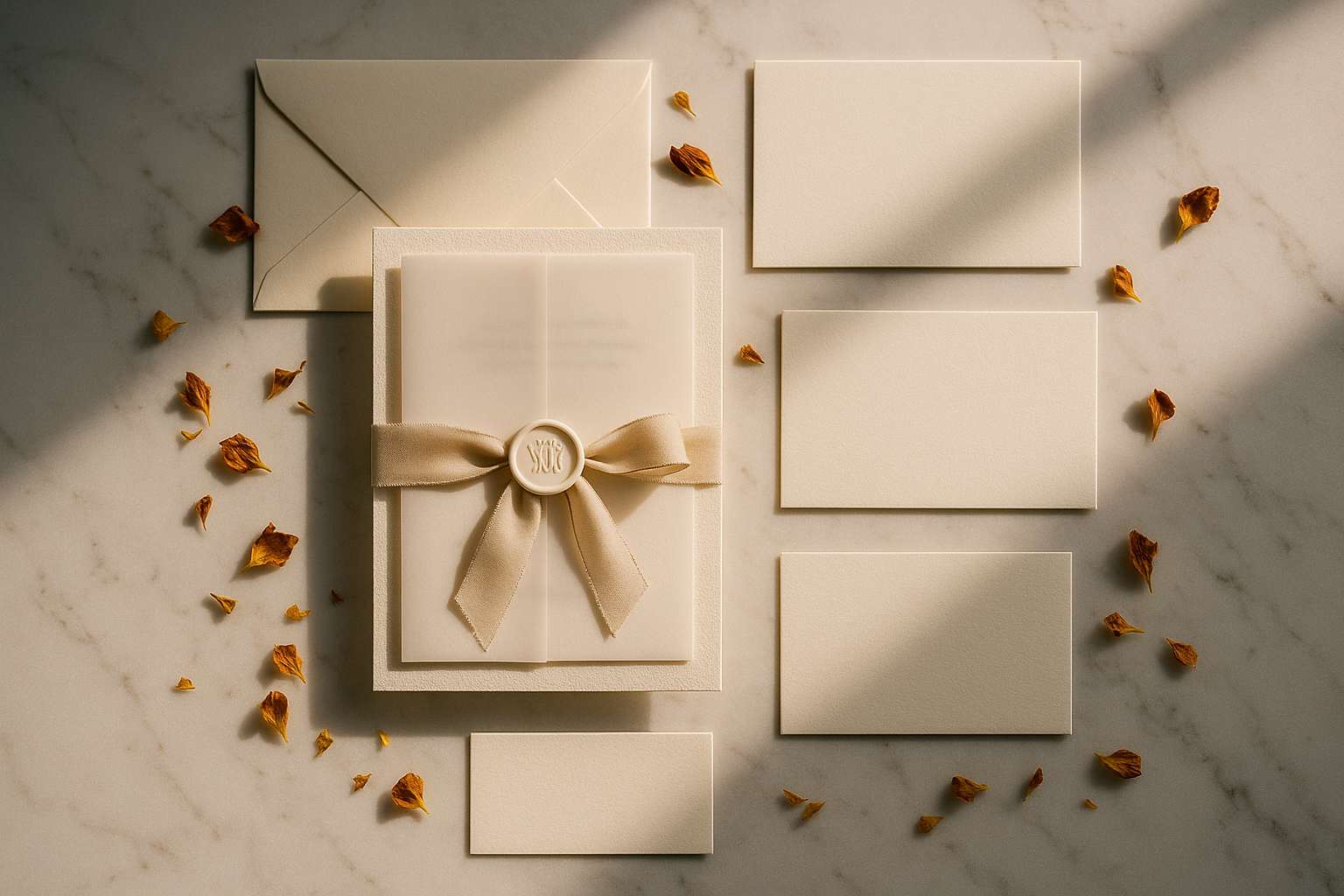
A complete wedding invitation suite includes the invitation card, outer envelope, RSVP card, and pre-stamped RSVP return envelope — those four pieces are required. An inner envelope, details card, accommodations card, website card, and decorative elements like vellum overlays or wax seals are optional additions that should be included based on your guest needs and aesthetic vision, not obligation.
Your wedding invitation is the first physical experience your guests have of your celebration. Before they see the flowers, hear the music, or find their seat, they hold a piece of paper — or open an envelope — that communicates the full story of your day in miniature: its formality, its aesthetic, how carefully you have thought about their experience. A beautifully assembled suite, opened with the right combination of ceremony and practicality, arrives in the mailbox like a small gift. This guide explains every component so you can build your suite with intention.
What is actually in a wedding invitation suite?
The term "suite" refers to everything in the envelope — the full coordinated collection of printed pieces mailed together. Here is every component, what it does, and whether you actually need it.
| Component | Purpose | Required? |
|---|---|---|
| Invitation card | Core request: date, time, ceremony location, hosting line | Yes — the anchor of every suite |
| Outer envelope | Mailing carrier; formally addressed to the household | Yes |
| RSVP card + return envelope | Collects attendance confirmation, meal choice, dietary needs | Strongly recommended — include pre-stamped return envelope |
| Inner envelope | Specifies exactly who in the household is invited; adds formality layer | Traditional; optional — most modern couples skip it |
| Details / reception card | Overflow logistics: reception venue if different, parking, transportation | Yes when reception is at a different venue |
| Accommodations card | Hotel room block, booking link, cut-off date | Yes when more than 20% of guests are traveling |
| Wedding website card | URL and password for the wedding website | Yes for the vast majority of couples in 2026 |
| Map or directions card | Illustrated venue map or driving directions | Optional — largely replaced by website card with map link |
| Decorative elements (vellum, belly band, wax seal) | Visual cohesion; premium unboxing experience | Optional — purely aesthetic; adds cost and weight |
The invitation card: what goes on it and what never should
The invitation card carries six core elements, in traditional order: the hosting line, the request line, the couple's names, the date and time, the ceremony location, and the reception notation. The dress code, when included, appears at the bottom of the card or on a separate details card.
Hosting line formats in 2026:
The hosting line has more nuance than any other element and reflects the full complexity of modern family structures. The most common formats:
- Traditional (both sets of parents hosting jointly): "Mr. and Mrs. James Collins and Mr. and Mrs. Robert Whitfield request the honour of your presence..."
- Couple hosting themselves: "Together with their families, Emma Grace Collins and Daniel Robert Whitfield invite you to share in their joy..."
- Couple alone, no family mention: "Emma Grace Collins and Daniel Robert Whitfield joyfully invite you to their wedding..."
- Complex family structures: When the hosting line would extend beyond four lines, "Together with their families" is a gracious shorthand that honors everyone without awkward length.
What absolutely does not belong on the invitation card: registry information (this applies to all enclosures — registry lives on the wedding website only), hotel room block details, parking logistics, or anything not directly related to the ceremony request. Information overload on the main card dilutes its formality and clutters the guest's first impression.
"Honour" versus "honor": "Honour" (British spelling) is by tradition reserved for ceremonies held inside a church or house of worship. "Honor" (American spelling) or "the pleasure of your company" is used for all other venues. Many couples today choose based on aesthetic preference alone — both are widely understood. A hotel ballroom, garden estate, or winery uses secular phrasing.
RSVP cards: the mechanics that actually improve response rates
The pre-stamped RSVP return envelope is the single most effective response-rate tool available. Response rates drop sharply when guests must supply their own postage; asking a guest to pay to reply to a formal wedding invitation is also a genuine etiquette lapse. Stamp every RSVP return envelope before assembly.
Your RSVP card should include a specific reply date — "Kindly reply by the fourteenth of June" — not a vague direction. Set the deadline three to four weeks before the wedding, giving you buffer time before your caterer's final headcount deadline. If your caterer needs numbers by June 20, your RSVP deadline should be June 6 to 8.
One professional tip that prevents a surprisingly common problem: number each RSVP card lightly in pencil on the back, corresponding to your guest list spreadsheet. When an unsigned card arrives — and some always do — you identify the guest by process of elimination rather than handwriting analysis. Do this before assembly, not after.
Enclosure cards and the details that matter to your guests
Enclosure cards are the suite's practical workhorses. Each one should exist because it delivers information guests genuinely need, not because the printing allows it.
Details card: Use when the reception is at a different venue from the ceremony, or when you want to share parking, transportation, or dress code details without crowding the invitation card. The details card is the appropriate place for a brief dress code note, shuttle schedule, or parking instruction.
Accommodations card: Include when any meaningful portion of guests will be traveling — typically when more than 20% of invited guests live more than an hour from the venue. Include the hotel room block name, the booking link, the rate, and the cut-off date. One to three hotel options across price tiers is ideal.
Wedding website card: The smallest and most universally included enclosure in 2025 and 2026. A simple card with the URL (and password, if the site is protected) directs guests to the full information hub. Include a QR code alongside the URL for guests who prefer not to type.
2026 invitation suite trends to know
The aesthetic direction in 2026 represents a deliberate shift away from the stark minimalism of the early 2020s toward texture, layering, and elevated craft. According to Paperlust's 2026 invitation suite guide, enclosure wraps and reveal designs are defining this cycle — pieces that unfold like French doors or slide apart like theater curtains create a distinct unboxing moment that reflects the couple's investment in the guest experience.
Wax seals continue their sustained popularity, now often featuring custom monograms, florals, or family crests. Vellum overlays — a translucent sheet over the main invitation — add an ethereal, layered quality that photographs beautifully for detail shots. Arch-shaped die-cut cards are displacing the standard rectangle as a design differentiator at every price tier.
On paper and typography: thick cotton-fiber and linen-textured stocks in warm neutrals (ivory, sage, dusty rose, warm terracotta) are dominant. Bold illustrated botanicals paired with restrained clean serif typefaces balance maximalism and elegance. Monochromatic tone-on-tone palettes — cream printed on ivory, sage foil on green — feel simultaneously current and timeless.
Cost context: A mid-range professionally printed suite for 100 to 150 households — invitation card, RSVP card and return envelope, one enclosure card, outer envelopes — runs approximately $600 to $1,200 through stationers such as Minted, Zola, or Artifact Uprising. Letterpress or foil-stamped suites at the same quantity run $1,500 to $2,700 and require four to eight weeks' lead time. Budget $150 to $300 additional for postage on both outgoing and RSVP return envelopes. Order 15 to 20 percent more suites than your household count — reprinting even a short run later is expensive and may not match original ink lot colors.
Frequently asked
What is a wedding invitation suite?
A wedding invitation suite is the complete collection of printed pieces sent to guests as a single coordinated mailing. At minimum, a suite includes the invitation card and an outer envelope. A full suite may include up to nine distinct pieces — each designed to coordinate visually and function as a unified system. The suite refers specifically to what goes in the envelope; other paper items like menus, ceremony programs, seating cards, and thank-you notes are considered part of the broader wedding stationery suite but are not mailed with the invitation. The invitation suite establishes the formality and aesthetic of the entire celebration before guests ever set foot in the venue — it is the first tangible experience they have of your wedding day.
Do I need an inner envelope?
No — the inner envelope is traditional but entirely optional in 2026. It originated in an era when envelopes were handled by multiple people and arrived at homes soiled; the inner envelope protected the suite and arrived clean. Today it serves two purposes: it specifies exactly which household members are invited (a child listed on the inner envelope is invited; a child omitted is not), and it adds a layer of formality for the most traditional events. If you choose to skip it — as the majority of modern couples now do — address the outer envelope with all invited household members by name. 'Mr. and Mrs. James Harrington, Olivia and Thomas' communicates the invitation clearly without the extra piece. Inner envelopes are still considered standard for Southern traditional weddings and formal events where the double-envelope tradition carries cultural significance.
What should go on the wedding invitation card itself?
The invitation card contains the six core elements of the event, in traditional order: the hosting line (who is hosting the wedding), the request line ('request the honour of your presence'), the names of the couple, the date and time spelled out formally, the ceremony venue and city, and a reception line ('Reception immediately following'). A seventh element — the dress code — is placed at the bottom of the invitation card or on a separate details card. Information that does not belong on the invitation card: registry information (never), hotel room block details, parking instructions, or other logistics. Those belong on enclosure cards. The invitation card should read with clarity and dignity; crowding it with logistics undermines both the formality and the guest's first impression.
What goes on the RSVP card and when should the deadline be?
The RSVP card should include: the response deadline (a specific date — 'Kindly reply by June 14, 2026' — not 'at your earliest convenience'); a name line for the guest to write or print their name; an attendance confirmation (attending vs. regrets); and meal choice options if using a plated dinner (limit to three or four maximum). If you are extending plus-ones to some guests, include a line for the number of guests attending, but only for those guests — otherwise guests will add uninvited companions. A best-practice tip from professional stationers: lightly pencil a sequential number on the back of each RSVP card, corresponding to your guest list. When unsigned cards arrive — and they will — you can match the card to the guest by the envelope handwriting or by process of elimination. Your RSVP deadline should be set three to four weeks before the wedding, giving you one to two weeks of follow-up time before your final catering count is due.
How do I assemble wedding invitations correctly?
Wash your hands before beginning and work on a clean, dry surface — moisture and oils damage fine paper and can blur fresh printing. Stack the components on the invitation card in this order, all printed side up, smallest piece on top: invitation card, then details or reception card, then accommodations card, then RSVP envelope with the RSVP card tucked inside or placed face-up on top. The RSVP return envelope should already be pre-stamped. Slide the assembled stack into the inner envelope (if using) with text facing the flap, leaving the inner envelope unsealed. Place the inner envelope inside the outer envelope with the guest's name facing the flap. If omitting the inner envelope, slide the assembled stack directly into the outer envelope. Seal with a damp sponge — saliva can warp fine papers at scale. Affix postage. Mail all invitations on the same day and hand them to a postal worker requesting hand-canceling, not a drop box.
How do I calculate the correct postage for a wedding invitation?
Assemble one complete suite — every insert, wax seal, belly band, sealed outer envelope — exactly as it will mail, and bring it to a post office counter to be weighed before you purchase stamps for the full run. Wedding invitations frequently weigh more than one ounce, bumping postage from the standard first-class rate to additional-ounce pricing. Square envelopes incur a non-machineable surcharge of approximately $0.40 per piece regardless of weight. Wax seals and rigid envelopes may also be classified differently. In 2025, standard first-class U.S. postage ran $0.73 for one ounce, with approximately $0.24 for each additional ounce. Pre-stamp your RSVP return envelopes — response rates drop sharply when guests must supply their own postage, and asking guests to pay to reply to your wedding invitation is a genuine breach of etiquette.
What are the biggest stationery trends for wedding invitation suites in 2026?
The dominant trends in 2026 reflect a reaction against the stark minimalism of the early 2020s and a move toward elevated, experiential details. Invitation wraps and enclosure reveals — vellum wraps that peel open, pieces that unfold like French doors — are 'having a moment,' according to Shana Wanco of Iris + Marie Letterpress. Wax seals with custom monograms or floral motifs continue their sustained renaissance. Vellum overlays printed with the couple's names or a repeat botanical pattern add depth without cluttering the main design. Arch-shaped die-cut cards are replacing standard rectangles as a design differentiator. Sustainable papers — cotton rag, seed paper, recycled card stock — are increasingly requested, particularly in Pacific Northwest and Pacific Coast markets. On the design side: maximalist botanical florals paired with restrained clean serif typefaces, and monochromatic tone-on-tone palettes (cream on ivory, sage on sage green).