Invitations, Registry & Gifts
The Wedding Stationery Timeline: Exactly When to Order and Send Everything
A save-the-date mailed too late costs you guests. An invitation ordered without accounting for production time arrives at the worst possible moment. Here is the complete stationery timeline — with every milestone, every lead time, and the hidden details that most guides skip.
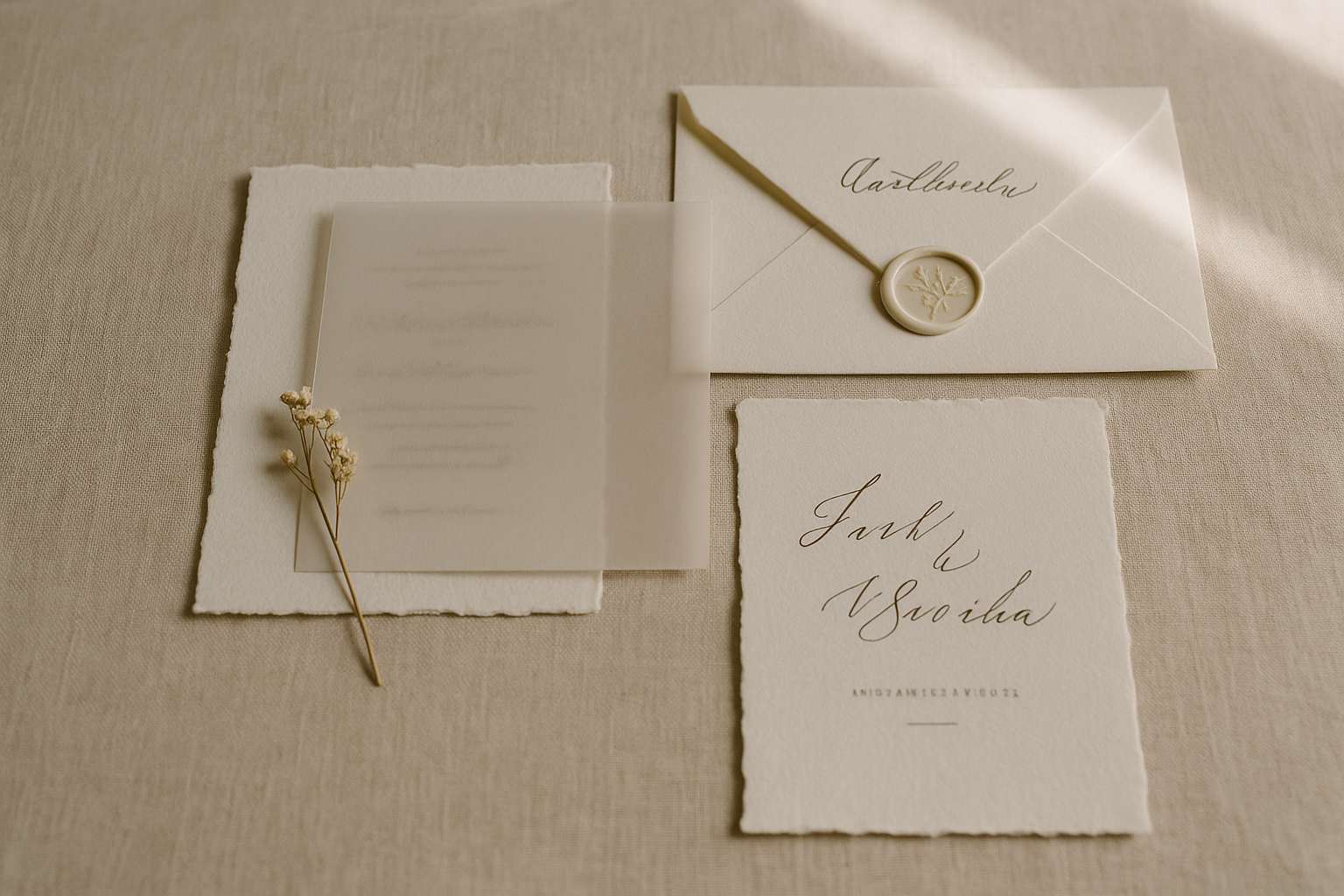
The most important stationery date is your vendor booking date — not your mailing date. For a 2026 wedding, book your stationer and calligrapher at 10 to 12 months out, finalize design at 8 to 10 months, and mail invitations 6 to 8 weeks before the ceremony (3 to 4 months for destination). Ordering 25 to 30 extra units is always right.
What Is the Full Wedding Stationery Timeline, from Engagement to Thank-You Notes?
Wedding stationery spans twelve or more months for couples on a standard engagement timeline. The most reliable way to approach it is to work backward from your wedding date using firm milestones, not vague intentions. Here is the complete master timeline:
| Milestone | Timing Before Wedding | Notes |
|---|---|---|
| Budget and vendor research | 12–14 months out | Order samples from 2–3 finalists before committing |
| Book stationer / designer | 10–12 months out | Premium designers in major markets book 12+ months out |
| Book calligrapher | 10–12 months out | At the same time as your stationer |
| Send save-the-dates (local / regional) | 8–10 months out | Include wedding website URL if live |
| Send save-the-dates (destination) | 10–12 months out | Guests need maximum lead time for travel |
| Finalize suite design and wording | 7–8 months out | Have two outside proofreaders check all details |
| Approve digital proof and place order | 6–7 months out | Get a physical press proof for letterpress / foil orders |
| Receive and audit invitation order | 5–5.5 months out | Check every piece against the proofing checklist |
| Deliver addressed envelopes to calligrapher | 5 months out | Provide clean spreadsheet; allow 2–4 weeks for completion |
| Assemble, stamp, and mail invitations (local) | 6–8 weeks out | Request hand-canceling at the post office |
| Mail invitations (destination) | 3–4 months out | |
| RSVP deadline on card | 3–4 weeks before wedding | Earlier than you think — allows time to chase non-responders |
| Order day-of paper goods (programs, menus, place cards) | 6–8 weeks out; receive 3–4 weeks out | Wait for RSVP deadline before finalizing quantities |
| Mail rehearsal dinner invitations | 4–6 weeks out | |
| Send thank-you notes | Within 2–3 months after wedding | Handwritten; no later than 3 months after |
The Knot's invitation timing guidance confirms that couples who order invitations at least twelve to fourteen weeks before their target mailing date — and mail at the six-to-eight-week mark — have the smoothest stationery experience with the fewest last-minute corrections and reprints. Every week of buffer time you build into this timeline is insurance against the production delays, shipping miscommunications, and proof revision cycles that routinely affect even the most organized couples.
How Much Lead Time Does Each Printing Method Actually Require?
The single most common stationery mistake is underestimating how long production takes. Digital and offset printing is the fastest method; letterpress, foil, and engraving require weeks of additional time. Always add two weeks to any vendor-quoted production timeline to account for shipping, customs if ordering internationally, and the proof approval cycle.
| Print Method | Production Time | Cost vs. Digital | Visual Character |
|---|---|---|---|
| Digital / offset printing | 1–3 weeks | Baseline | Crisp, full-color, versatile |
| Thermography (raised ink) | 2–4 weeks | 1.5–2× digital | Raised texture, traditional feel |
| Letterpress | 3–6 weeks | 2–4× digital | Tactile impression, deeply classic |
| Foil stamping | 4–8 weeks | 2–5× digital | Metallic shimmer, modern luxury |
| Engraving | 6–10 weeks | 4–8× digital | Formal, heirloom quality |
| Letterpress + foil combination | 6–10 weeks | 3–6× digital | Maximum luxury; longest lead time |
Minted's stationery planning guidance notes that couples who fall in love with a letterpress suite but do not plan accordingly often face a painful choice: pay a significant rush surcharge or compromise on the design. Booking your stationer ten to twelve months out eliminates this pressure entirely.
How Do You Calculate the Right Quantity to Order?
Order based on households, not guests. A couple counts as one invitation. A family of four counts as one invitation. Here is the formula:
- Start with your total invited guest count
- Divide by approximately 1.8 (the average household size for wedding guest lists)
- Add 25 to 30 buffer and keepsake units
- Never order the exact minimum — reprinting a small quantity costs nearly as much as the original order
Example: 150 invited guests ÷ 1.8 = approximately 83 households + 27 buffer = 110 invitations to order.
The buffer units serve multiple purposes: keepsakes for both families and yourselves, flat-lay copies for your photographer's styling session, a copy for your wedding planner, and replacements for any addressing errors. If you are working with a calligrapher, always order 10 to 15 percent extra envelopes beyond the invitation count specifically for addressing mistakes — calligraphers expect this and it is not a reflection on their skill.
The Proofing Process: Where Expensive Errors Are Caught
The proofing cycle is the highest-stakes step in the stationery process. A misprint of the venue address, a misspelled name, or a wrong date discovered after 110 suites have been printed is a costly, stressful, and sometimes irreversible disaster. Treat every proof review with the same seriousness as contract review.
The non-negotiable proofing checklist: both names spelled correctly and in the correct order; all parents' names and courtesy titles; full ceremony and reception venue names and addresses; wedding date with day of week, month, day, and year all matching each other; ceremony time with correct AM/PM; RSVP card return address and deadline date; wedding website URL tested and live; dress code language; all hotel block and accommodation details.
Most stationers include two to three rounds of digital proof revisions at no charge; additional rounds typically cost $25 to $75 each. For letterpress, foil, or engraving orders, always request a physical press proof ($75 to $250) — digital proofs cannot accurately represent the tactile depth of a letterpress impression or the shimmer of metallic foil. It is an investment that protects a much larger one. Have at least two people who are not involved in the wedding planning review the final proof round — familiarity blindness is real, and you will stop seeing errors in text you have read dozens of times.
What Are the 2026 Wedding Stationery Trends?
The dominant aesthetic shift in 2025 to 2026 stationery is from the minimalist sans-serif aesthetic that defined the early 2020s toward maximalist, heavily illustrated, layered suites with botanical and floral motifs. Vellum overlays — a printed or plain vellum wrap over the invitation card — are now among the most-requested add-ons at mid-to-luxury tiers: high visual impact at a low per-unit cost. Custom wax seals with monograms or floral motifs are expected at mid-to-luxury tiers and increasingly DIY at budget tiers. QR code integration linking directly to the wedding website on save-the-dates is near-universal. Color-drenched envelopes in jewel tones, black, and navy with gold or white calligraphy have emerged as one of the most photographed stationery trends of the season, creating a dramatic unboxing moment that generates strong social shareability.
Frequently asked
When should I send save-the-dates?
For a local or regional wedding, send save-the-dates eight to ten months before your wedding date. For a destination wedding — or any event that requires guests to book flights, significant travel, or extended time away from work — send them ten to twelve months out. For a short engagement of nine months or fewer, send save-the-dates as soon as your venue is booked and your date is locked, even if some planning details are still in flux. Save-the-dates need only include both names, the wedding date, the city and state, and a note that the formal invitation will follow. Withhold the venue name, dress code, and any detail still subject to change — keeping the content minimal ensures it remains accurate through planning pivots. A wedding website URL is a useful addition if your site is live.
How far in advance should I mail formal wedding invitations?
For most local and regional weddings, six to eight weeks before the ceremony is the industry standard — long enough for guests to plan and RSVP, short enough that the event stays present in their minds. For holiday weekend weddings, extend to ten weeks. For destination weddings where guests must arrange flights, accommodations, or significant time off, mail invitations three to four months in advance. These send dates are separate from your order date — for offset or digital-printed invitations, order twelve to fourteen weeks before you intend to mail, to allow production, shipping, assembly, and addressing time. For letterpress, foil-stamped, or engraved suites, add an additional four to eight weeks to account for the extended production timeline of specialty printing.
How many wedding invitations should I order?
The correct quantity calculation is based on households, not individual guests. A couple counts as one invitation; a family of four counts as one invitation. Begin with your total invited guest count, divide by approximately 1.8 (the average household size for wedding guest lists, which skew toward couples and families), then add 25 to 30 buffer units for keepsakes for yourselves and parents, your wedding planner, photographers for flat-lay styling, and replacements for addressing errors. For 150 guests: 150 divided by 1.8 equals approximately 83 households, plus 27 buffer units, equals 110 invitations to order. For 100 guests, order 75 to 90. For 200 guests, order 135 to 145. Never order the exact minimum — reprinting a small quantity costs nearly as much as the original order, without the per-unit cost reduction that comes with a larger print run.
What is the single most expensive stationery mistake couples make?
Ordering too late — and the chain reaction it creates. Underestimating production lead time is by far the most common and most costly stationery mistake. A couple who realizes in March that they need letterpress invitations mailed by April 1st for a June wedding will face two bad choices: pay a rush surcharge of 15 to 30 percent above the standard order price, or switch to a faster production method that compromises the design they fell in love with. The second most expensive mistake is forgetting to add buffer units, which forces a reprint at near-full cost for a fraction of the original quantity. The prevention for both: book your stationer or identify your printing vendor at ten to twelve months out, confirm your order timeline and rush policy before committing, and always add 25 to 30 units beyond your calculated minimum.
Do I need to hire a calligrapher, and how early should I book one?
A calligrapher is not required, but hand-lettered envelope addressing elevates even a simple suite into something memorable. The decision depends on your budget and aesthetic — calligraphy is entirely accessible across a wide price range, from emerging student calligraphers at $2 to $4 per envelope to sought-after luxury artists at $8 to $20 or more per outer envelope. Book your calligrapher at least three to four months before your wedding date, at the same time as your stationer. Premium calligraphers in major metropolitan markets — New York, Los Angeles, Chicago, Dallas — book out six or more months. What calligraphers need from you: a finalized, verified guest address list in a clean spreadsheet with consistent columns, your invitation envelope dimensions, and ink color preferences. Always order 10 to 15 percent extra envelopes to account for calligrapher mistakes; this is standard and expected.
How much does postage actually cost for a wedding invitation suite?
More than most couples expect. The standard first-class stamp in 2025 to 2026 is $0.68, but a fully assembled invitation suite — multiple enclosures, RSVP card, details card, and outer and inner envelopes — often weighs more than one ounce, requiring additional postage of $0.87 to $1.44 per envelope. Square envelopes require a non-machinable surcharge. RSVP return envelopes must be pre-stamped; failing to include return postage is a notable etiquette violation and a practical barrier to RSVP response rates. Before purchasing any postage, take a fully assembled invitation to the post office and have it weighed. Request hand-canceling for the full mailing — machine processing can damage delicate letterpress, foil, or embossed printing. The postage budget for a 110-invitation mailing can run $150 to $250 once the full weight and RSVP return stamps are accounted for.