Invitations, Registry & Gifts
Wedding Thank You Note Wording: What Every Couple Should Know
Mastering wedding thank you note wording is one of the most enduring gifts you can give yourself — and your guests. Here is the complete guide: the five-part formula that works for every gift type, real wording examples for registry gifts, cash funds, honeymoon contributions, group gifts, and off-registry surprises, plus the timeline and stationery guidance that turns a daunting task into something genuinely personal.
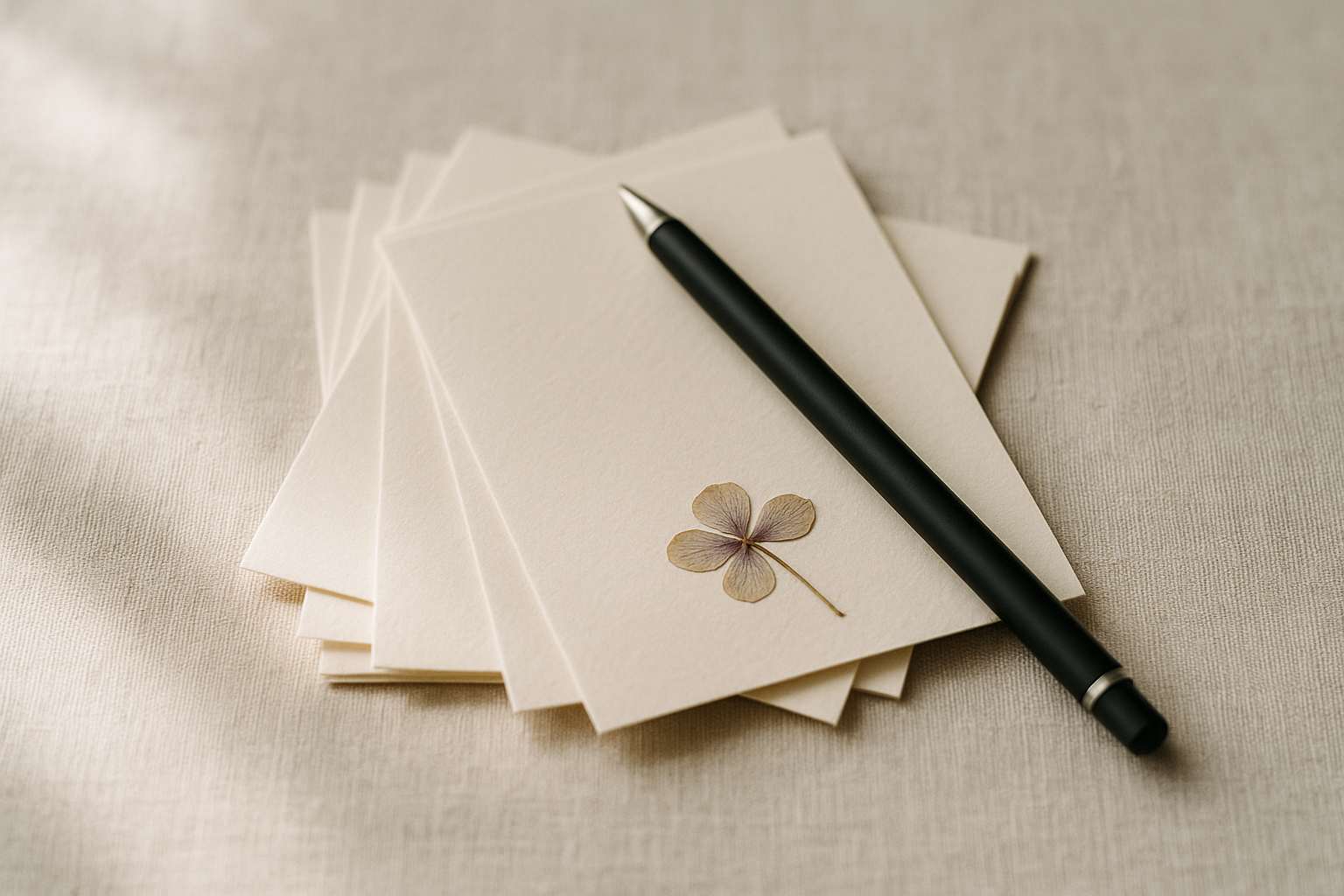
Write a specific, handwritten note for every gift — naming the exact item and how you will use it — within three months of your wedding (six to eight weeks is the real goal). Use the five-part formula: salutation, specific gift, how you will use it, relationship line, warm close. Never reference a cash amount; always name the experience or dream the money funds.
A wedding thank you note is not a formality to dispatch. It is, in many ways, the last act of your wedding — the moment a guest opens a small cream envelope weeks after the dancing has ended and feels, again, that they were seen. Handwritten, specific, and warm: those three qualities are all that stand between a note that gets kept in a drawer for years and one that goes straight to recycling.
The mechanics are simpler than most couples fear. Once you have a formula and a set of real examples for every gift scenario, the actual writing moves quickly. The bigger challenge is the logistics: tracking who gave what, maintaining momentum through weeks of daily sessions, and actually mailing the stack when it is done. This guide handles both — the words and the system behind them.
What is the right formula for every wedding thank you note?
The five-part structure below works for every gift type — registry item, cash, honeymoon fund, group gift, off-registry surprise. Learn it once and you will never stare at a blank card again. According to the Emily Post Institute, a personalized handwritten note is non-negotiable; fill-in-the-blank cards and generic messages do not meet the standard.
- Salutation: Use the name the person actually goes by — Dear Aunt Margaret if that is how you know her; Dear Margo if that is how she signs her texts.
- Name the specific gift: Not “thank you for your generous gift” but “thank you for the Le Creuset Dutch oven.” Naming the item confirms receipt and shows attention.
- Personal connection: One sentence on how you will use it or what it means to you. “We have already made pasta twice and it is becoming a Sunday ritual.”
- Relationship line: Reference their attendance, their travel, or something specific to your history. “Watching you and Dad on the dance floor is something we will carry for years.”
- Warm close: A forward-looking sentence. “We cannot wait to have you over for dinner.” Both partners sign every note.
Length should run four to eight sentences — long enough to feel genuine, short enough to actually write a hundred of them. Notes shorter than three sentences read as rushed; notes longer than ten risk becoming performative rather than personal. The register should sound like you on a good day, not like a formal letter.
What are the exact wording examples for every gift type?
The scenarios below cover every situation a couple typically encounters. Use them as starting points and adapt the personal details — a note that sounds like it could have gone to anyone still feels like it was written for no one.
Registry gift (physical item)
“Dear Sarah and James — Thank you so much for the KitchenAid stand mixer. It arrived beautifully packaged and has already earned a permanent spot on the counter. We made our first batch of scones together the weekend we got home, and we thought of you. It meant so much to have you with us — your toast at the reception was one of our favorite moments from the whole day. With love, Claire and Tom.”
Cash gift
Never reference the dollar amount. Name the dream or purchase the money will fund. According to guidance from Zola's wedding etiquette team, specificity about how the money will be used is the quality that makes cash-gift notes feel warm rather than transactional.
“Dear Grandma Ruth — Your generous gift will go directly toward our first home down payment, and it brings us so much closer to that front door. We are moved by your generosity more than we can say. Having you at the ceremony, watching you hold Mom's hand during the vows — that image is one we will keep forever. With all our love, Anna and David.”
Honeymoon fund contribution
“Dear Michael and Lynn — Thank you for contributing to our honeymoon fund. Your gift made our sunset sailing excursion in Santorini possible — we toasted you both as the sun hit the water. It was the most beautiful evening of the trip, and we are so grateful. We cannot wait to show you the photos. With love, Emma and Jack.”
If you have not yet taken the trip when writing the note, write toward the experience: “We are saving your contribution for the cooking class in Tuscany we have been dreaming about, and we will think of you the whole time.”
Group gift
For an organized group gift with known contributors, write an individual note to every person who gave. Address each note to that specific contributor and name the shared gift: “Thank you so much for contributing to the Le Creuset set — it is already on the stovetop and it is already beloved.” For a large workplace group (fifteen or more contributors you do not know personally), a warm single note through the organizer is acceptable.
Off-registry or unexpected gift
Focus on the giver, not the object. You are not required to invent enthusiasm you do not feel — but you are required to thank genuinely. Keep the warmth in the relationship line:
“Dear Aunt Patricia — Thank you so much for your beautiful and thoughtful gift. Your love and support as we begin this chapter mean more to us than we can express. Having you at the reception — watching you laugh with Mom and your sisters — was one of the true highlights of our night. We love you. Claire and Tom.”
Guest who attended but gave no gift
Write this note. Guests are never obligated to give, and thanking someone for attending — with warmth and without any hint of expectation — is a mark of genuine hospitality. “Thank you so much for celebrating with us. Your presence truly made the day complete.”
Late thank you note
A late note is always better than no note. Acknowledge the delay briefly and without excessive apology, then move immediately to genuine warmth: “We know this note is long overdue, and we are so sorry for the wait — please know how often we have thought of your kindness. Thank you for the beautiful [gift] and for being part of our day.”
| Gift Type | Key Wording Move | What to Avoid |
|---|---|---|
| Registry gift | Name the item; describe one use of it | “Thank you for your generous gift” (too vague) |
| Cash / check | Name the dream or purchase it funds | Referencing the dollar amount |
| Honeymoon fund | Name the specific experience it made possible | Generic “contribution to our fund” only |
| Group gift | Individual notes to each known contributor | Thanking only the organizer |
| Off-registry gift | Focus on the relationship; warm the giver, not the object | Mentioning you returned or exchanged it |
| Attendance only | Thank genuinely for presence; reference a shared moment | Any implication a gift was expected |
When should wedding thank you notes be sent — and what is realistic?
The one-year grace period is a persistent myth that etiquette authorities uniformly reject. The Emily Post Institute is clear: all notes should be sent within three months of receiving the gift, and that is the outer acceptable maximum, not the goal. For gifts received before the wedding — at showers, mailed early — write the note within two weeks of receipt. For wedding day and post-wedding gifts, aim for six to eight weeks after returning from the honeymoon.
The math on a mid-size wedding is not as daunting as it looks: a 150-guest wedding where most couples give one gift per household generates approximately 80 to 120 notes. At a comfortable pace of ten notes per hour, that is 8 to 12 hours of writing. Spread over six weeks — fewer than two hours per week — it is entirely manageable. The advice to set a daily quota of five to ten cards is nearly universally recommended, for one reason: marathon sessions produce formulaic notes, and formulaic notes defeat the purpose.
Begin before the honeymoon wherever possible. For every shower gift and early-arriving wedding gift written before the wedding, that is one fewer note waiting on the other side of it.
What stationery should we use for wedding thank you notes?
The paper itself communicates something before the first word is read. A note on quality cotton or fine paper stock feels like an event; a note on thin, mass-produced card stock does not. You do not need to spend extravagantly — but the stationery choice should honor the gesture of the gift.
Crane & Co. is the traditional benchmark for formal correspondence. Their cotton-paper notecards, available in engraved, letterpress, or thermography printing, carry a substance and warmth that is immediately apparent. Personalized folded notes from Crane are a premier choice for couples prioritizing formality and longevity. Artifact Uprising offers photo thank-you cards printed on 100% recycled paper from Mohawk Paper, starting at approximately $1.45 per card — the ideal option for couples who want to include a wedding image on the card itself. Minted produces consistently excellent photo cards with true-color reproduction. For a more accessible in-store option, Paper Source carries elegant cotton and fine paper blank notecards that look and feel premium without custom ordering timelines.
Custom monogrammed notecards — a couples’ monogram in navy or charcoal on quality card stock — run approximately $50 to $200 for 100 to 150 cards depending on the printer. Plain quality stationery from a paper shop costs $15 to $40 for a similar quantity. Either is entirely correct. The warmth of what you write matters far more than the price of the paper it is written on.
One practical note on timing: personalized stationery requires two to four weeks for production. Order before the wedding so the cards are ready when you return from the honeymoon, not in the mail while your writing window ticks down.
What is the gift-tracking system that makes all of this work?
The quality of your thank you notes depends almost entirely on the quality of your gift log. A note written from memory — six weeks after opening eighty gifts — will be generic by necessity. A note written from a well-kept record will be specific and warm, because the details are right there.
Build a simple spreadsheet from the moment gifts start arriving: Giver Name, Mailing Address, Gift Description (specific), Registry vs. Off-Registry, Date Received, Personal Detail to Mention, Note Sent Date. Google Sheets and Excel both work well; dedicated apps such as GiftVault include thank-you note drafting prompts alongside the tracking fields. Most major registry platforms (Zola, The Knot, Amazon) automatically log purchased registry items — use those as your base and supplement with a spreadsheet for cash gifts, off-registry items, and checks received at the reception.
Assign someone at the reception to manage the gift table: collect all envelopes and packages, label them with the giver’s name if not already labeled, and keep a real-time log of anything given directly in person. The card box, in particular, requires a point person — loose envelopes can lose their identifying cards in transport, and a cash gift received from the wrong person will produce the wrong thank-you note.
Photograph every gift as you open it. Memory is unreliable when you are opening sixty items across two post-wedding weekends; a photo log provides a backup that the spreadsheet alone cannot.
Frequently asked
How long do we have to send wedding thank you notes?
The oft-cited one-year rule is a myth that etiquette authorities uniformly reject. According to the Emily Post Institute, all thank you notes should be sent within three months of receiving a gift — and that is the outer, gracious maximum, not the goal. For gifts received before the wedding (at showers or mailed early), aim to write the note within two weeks of receipt. For gifts received at or just after the wedding, six to eight weeks post-honeymoon is the aspirational window. The longer you wait, the more awkward the note becomes to write and to receive — a note arriving four months after the fact carries an implicit apology that overshadows the gratitude. Set a daily quota of five to ten notes rather than attempting marathon sessions, and begin before the honeymoon if at all possible on pre-wedding gifts.
What is the five-part formula for a perfect thank you note?
Every strong wedding thank you note — whether it runs three sentences or eight — follows five beats. First, a warm salutation using the name the person prefers, not a generic opener. Second, specific gratitude naming the exact gift ('thank you for the Le Creuset Dutch oven' not 'thank you for your generous gift'). Third, a personal connection sentence describing how you plan to use it or what it means to you. Fourth, a relationship line acknowledging the guest's attendance, their travel to be there, or something specific to your history together. Fifth, a warm close that looks forward — 'we hope to have you over for a Sunday dinner soon.' Both partners should sign every note, and each note should sound like a genuine person wrote it, not a template with blanks filled in. Specificity is what separates a note that is kept from one that is recycled.
How do you word a thank you note for a cash gift or honeymoon fund contribution?
Never reference the dollar amount — this is a firm etiquette rule that etiquette advisors including Emily Post agree on. Instead, name how you plan to use the gift. For a cash gift: 'Your generous gift will go toward our first home down payment — we are so much closer to that front door thanks to you.' For a honeymoon fund contribution: 'Your gift made our sunset sailing excursion in Santorini possible — we thought of you the whole evening.' For a generic cash envelope: 'Your generosity will go toward our home fund, and we are moved by your kindness.' The principle is the same whether the gift was $50 or $500 — the giver wants to know their money touched your life in a real way, not that it was deposited anonymously. Name the experience, name the dream, or name the specific thing your money will become.
Do we need to write separate thank you notes for shower gifts and wedding gifts?
Yes, absolutely — each gift event warrants its own separate note. A guest who gave a shower gift and then a wedding gift gave generously twice; combining both acknowledgments into a single note ('thank you for the vase at the shower and for your wedding gift') is sometimes done out of convenience, but it reads as economical rather than grateful. Write a separate, specific note for each gifting occasion. For shower gifts, the timeline is even tighter — notes ideally go out within two weeks of the shower, well before the wedding itself. This also protects you from the post-wedding mountain of notes: starting shower thank-yous promptly means that by your wedding day, you may have already written thirty or forty of the notes you would otherwise face all at once.
What do you write when you don't love the gift?
Focus entirely on the giver, not the gift. You are not required to describe loving something you do not love; you are required to thank sincerely. A warm, honest note can honor the relationship without fabricating enthusiasm: 'Dear Aunt Carol — thank you so much for thinking of us with such a beautiful gift. Your love and support mean the world as we begin this chapter, and having you at the wedding made the day complete.' When the relationship is close, add a specific memory from the day — 'watching you and Mom at the reception is something we will always treasure.' If the gift is something you genuinely will use differently from its intended purpose, you may reference that warmly. What you should never do is mention that you returned it, that it is not your style, or ask for a gift receipt in the note itself.
How do we handle group gift thank you notes?
For an organized group gift with known contributors, write an individual note to every person who contributed — referencing the shared gift in each one. 'Thank you for contributing to the KitchenAid stand mixer — it is already on the counter and we have been baking every weekend since we got home.' For a large, loosely organized workplace group gift with fifteen or more contributors, sending a single thoughtful note through the organizer — and asking them to pass along your gratitude to contributors — is socially acceptable. For close friends who pooled together, individual notes remain the expectation and the gracious choice. The guiding principle: no contributor should ever wonder whether you know they participated. If you have any doubt whether someone was part of a group gift, write the note.
What stationery should we use for wedding thank you notes?
Handwritten notes on quality paper are the gold standard — the texture and weight of good stationery communicates care before a single word is read. Crane & Co. produces cotton-paper notecards using engraving and letterpress that have long been the formal choice; their personalized folded notes carry a gravitas digital printing cannot replicate. Artifact Uprising offers photo thank-you cards printed on recycled Mohawk Paper, starting at approximately $1.45 per card — ideal for couples wanting a wedding image included. Minted's cards are praised for accurate, crisp photo reproduction. Paper Source carries elegant blank notecards in cotton and fine paper stocks for a more accessible option. Custom monogrammed sets run approximately $50 to $200 for 100 to 150 cards; plain quality stationery costs $15 to $40 for the same quantity.