Invitations, Registry & Gifts
25 Wedding Welcome Bag Ideas That Guests Will Actually Use in 2026
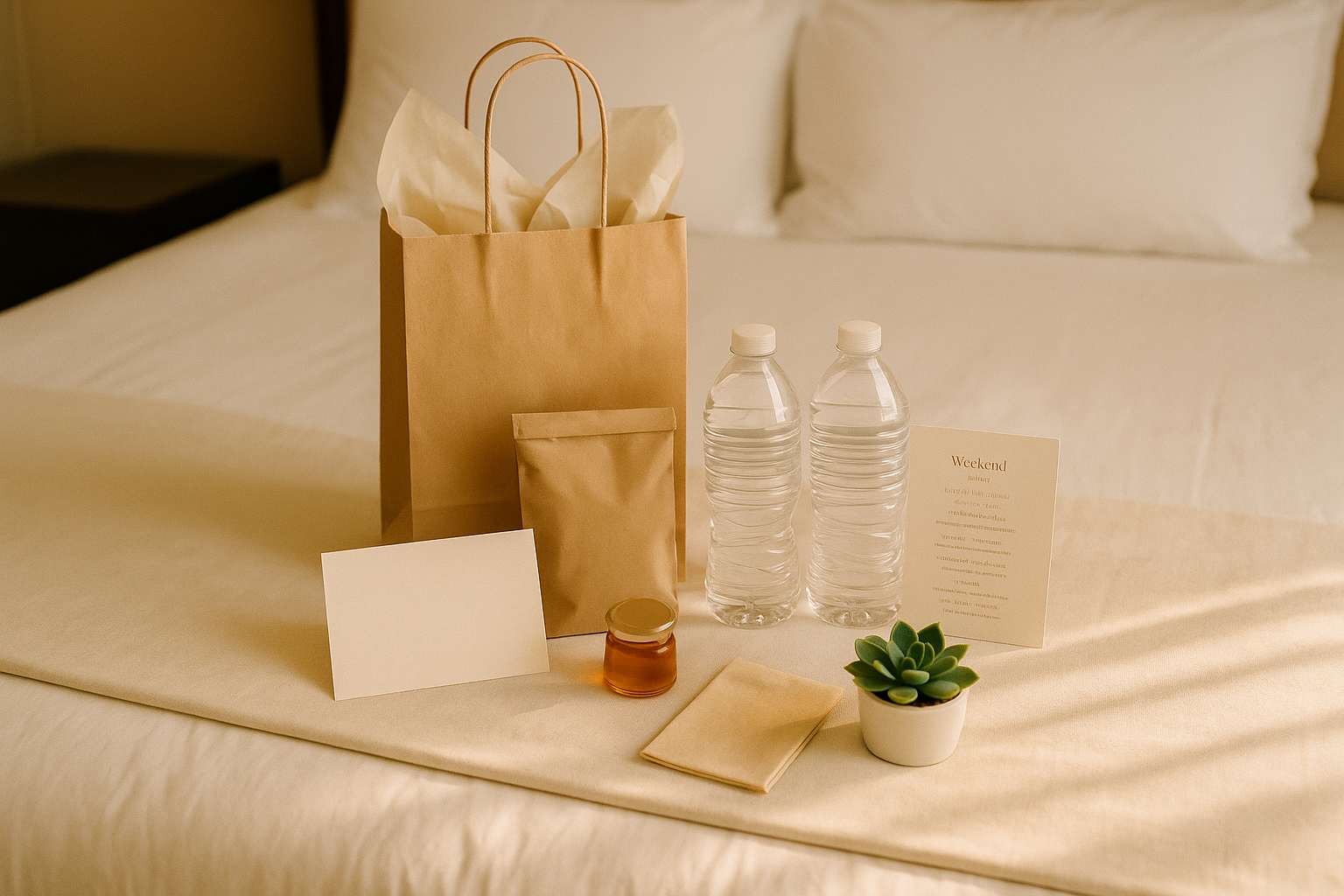
A welcome bag is the first hospitality gesture your out-of-town guests receive. The best ones are warm, practical, local, and assembled with the understanding that guests will be living out of a hotel room for the weekend.
Welcome Bag EssentialsLocal Wedding GiftsOut-of-Town Guest CareDestination HospitalityBudget Welcome BagsRecovery Kit Ideas
The quick verdict
From the essentials every bag needs to the local touches guests will remember — organized by budget tier with full logistics guidance.
- Best overall
- Handwritten Welcome Note + Recovery Kit — The note is the most memorable item and the recovery kit is the most used. Together they cost under $10 and they are what guests talk about afterward.
- Best value
- A Local Food or Artisan Product — For $3–$8, the one item that makes the bag specific to your wedding location and irreplaceable — guests cannot buy it at home.
- Best for Destination and warm-climate weddings
- Sunscreen, Electrolytes, and a Local Guide — Functional in the climate, useful across the whole weekend, and personal enough to be remembered long after the trip home.
How we evaluated
We evaluated welcome bag ideas the way an experienced host would: against the lived reality of a guest who has flown in, checked into a hotel room, and is about to spend a long weekend living out of a suitcase. Our analysis draws on guest-satisfaction reporting from The Knot, Zola, and Brides, conversations with wedding planners, and real 2026 retail and bulk-order pricing from named vendors (Minted, Etsy makers, Amazon, Liquid I.V., LMNT, The Sill, Anthropologie). We weighted each item on practical utility, alignment with current hospitality and gifting trends, coverage across budget tiers, and logistical feasibility — hotel delivery, allergy considerations, weight, and destination adjustments. Every price range reflects what couples actually pay in 2026, and every item is something guests genuinely use rather than discard.
- Practical utility. How genuinely useful the item is to a guest living from a hotel room over a multi-day wedding weekend.
- 2026 trend alignment. Fit with current hospitality and gifting trends, especially the move toward hyper-local, sustainable, and consumable gifts.
- Budget coverage. Whether the item works across simple, standard, and premium bag tiers and delivers value at its price point.
- Logistical feasibility. Ease of hotel delivery, weight and fragility, allergy labeling needs, and suitability for destination travel.
Rating scale: Ratings are on a 1-5 scale, where 5 marks a non-negotiable essential and 3.5 a premium-tier extra.
Last verified .
At a glance
| # | Name | Rating | Best for | Pricing |
|---|---|---|---|---|
| 1 | The Handwritten Welcome Note | 5.0 | Every welcome bag, at every budget level, for every guest | Notecard stock $15–$40 per 50 at Minted |
| 2 | Weekend Itinerary Card | 5.0 | All welcome bags; especially valuable for destination weddings and multi-event weekends | $0.50–$3 each (Canva print or stationer-matched) |
| 3 | Recovery Kit Essentials | 5.0 | All welcome bags; especially valued at receptions with open bars and late-night events | $3–$7 per bag (ibuprofen, antacid, electrolytes, eye drops) |
| 4 | Two Bottles of Water | 5.0 | Every welcome bag without exception | Case of 24 $8–$12; Etsy labels $15–$25 per 50 |
| 5 | A Local Food or Artisan Product | 5.0 | All welcome bags; especially effective for destination weddings and cities with distinctive regional food culture | $3–$8 per item; custom labels +$0.25–$0.50 for 50+ |
| 6 | Canvas Tote Bag as the Container | 4.5 | Mid-range and premium bags; couples whose aesthetic aligns with a natural, understated design | $5–$12 each for 50+; custom printing +$2–$4 per unit |
| 7 | Local Restaurant and Coffee Recommendations | 4.5 | City weddings and destination events in interesting places; couples who want to share something personal | $0.25–$0.75 per card (Canva design, local print) |
| 8 | Small-Batch Coffee or Tea | 4.5 | Morning-after comfort; destination weddings; couples with a coffee connection | Local roaster $3–$7; custom-labeled Etsy $5–$9 |
| 9 | Artisanal Honey in a Small Jar | 4.5 | All welcome bags; especially beautiful in rustic, garden, or farmhouse aesthetics | Local 2 oz jar $3–$6; custom-labeled Etsy $4–$7 for 50+ |
| 10 | Gourmet Snack Selection | 4.5 | All welcome bags; particularly valuable for guests with long travel times or early arrival | Granola + chocolate $3–$6; cracker + cheese combo $8–$12 |
| 11 | Mini Candle | 4.0 | Mid-range and premium bags; couples whose aesthetic leans toward home luxury and quiet elegance | $6–$12 per 2–4 oz candle (Anthropologie or Etsy makers) |
| 12 | Children's Insert for Families | 4.5 | Any welcome bag for guests traveling with children; destination weddings | $5–$15 per insert (activity pages, snacks, a small toy) |
| 13 | Seed Packets | 4.0 | Garden weddings; eco-conscious couples; domestic destination weddings where guests drive | $0.50–$1.50 per packet with custom label for 50+ |
| 14 | Mini Bottle of Local Wine, Spirits, or Craft Beer | 4.0 | Premium bags; weddings in wine or spirits regions; couples with a local beverage connection | 187 ml wine $5–$10; craft spirit $8–$15; craft beer $4–$8 |
| 15 | Lip Balm and Hand Lotion | 4.0 | Standard and premium bags; especially valuable for winter weddings and dry climates | Lotion + lip balm $3–$8 per bag; artisan options $6–$12 |
| 16 | Destination Additions: Sunscreen and After-Sun | 4.5 | Beach and coastal destination weddings; outdoor warm-climate events with likely sun exposure | Reef-safe SPF 50 $3–$5; travel after-sun $2–$4 |
| 17 | Electrolyte Packets | 5.0 | All welcome bags; elevated value at multi-day celebrations with several events | Liquid I.V. or LMNT $1.50–$2.50 each; two per bag $3–$5 |
| 18 | A Book of Local Maps and Neighborhood Guides | 4.0 | Destination weddings in cities with real hospitality culture; couples who love their wedding city | $1–$3 per booklet for 50+ (Canva design, local print) |
| 19 | Stain Remover Pen | 4.5 | All welcome bags; virtually no reason to exclude this item | Tide to Go $2–$3 retail; $1–$2 per unit in bulk |
| 20 | Mini Sewing Kit and Safety Pins | 4.0 | Standard and premium bags; especially valuable for weekend-long celebrations with outfit changes | $0.50–$1 per kit for orders of 50+ |
| 21 | Small Succulent or Potted Plant | 4.0 | Welcome bags for domestic guests; garden, outdoor, and botanical aesthetics | $2–$5 per succulent; custom tags $0.25–$0.50 each |
| 22 | Luggage Tag | 3.5 | Premium welcome bags; smaller intimate weddings where guest-specific personalization is feasible | $8–$15 per personalized leather tag (Minted or Etsy) |
| 23 | Locally Made Hot Sauce or Infused Salt | 4.0 | Weddings in cities with distinctive food culture; couples who want a functional, long-lasting local product | Hot sauce $4–$8; artisan sea salt tin $4–$7 |
| 24 | Foldable Fan (Warm-Climate Events) | 4.5 | Outdoor warm-climate weddings; summer garden and beach ceremonies where temperatures exceed 80°F | $2–$4 per bamboo fan; program fans $3–$6 per unit |
| 25 | QR Code Card Linking to the Photo Gallery | 4.0 | Tech-comfortable couples; any wedding with a shared gallery; effective as a follow-up after the initial bag | $0.50–$1 per card (Canva design); gallery via Pixieset |
The Handwritten Welcome Note
The most important item in any bag — and the one most commonly forgotten.
Editor's pick
No item in a welcome bag matters more than a personal note from the couple. Not a printed card with a generic message, but a brief, warm, specific message that acknowledges the guest's journey, expresses genuine gratitude for their presence, and tells them how much it means that they are there. It does not need to be long — four to six sentences is ideal. What it must be is personal. A note that could have gone into any bag reads like a form letter. A note that mentions something true and specific — 'We know how far you traveled to be here and we are so grateful' — reads as a gift before the bag is even opened. Print this on quality notecard stock from a stationer like Minted, sign both names, and place it on top of everything else so it is the first thing guests see. This costs almost nothing and is consistently cited by guests as the most memorable element of any welcome experience.
Strengths
- Creates an immediate emotional connection that no physical item can match
- Costs almost nothing beyond stationery
- Sets the tone for the entire weekend and the couple's hospitality
Weaknesses
- Requires time to personalize at scale — for large guest lists, a semi-personalized note addressing groups (traveling family, college friends) is an acceptable compromise
- Best for
- Every welcome bag, at every budget level, for every guest
- Pricing
- Notecard stock $15–$40 per 50 at Minted
Source: Minted — Wedding Stationery · Visit The Handwritten Welcome Note
Weekend Itinerary Card
The practical document that answers every question guests would otherwise text you to ask.
A printed weekend itinerary card is the second essential item in every welcome bag — it eliminates the flood of 'what time does it start?' and 'where do I park?' messages that otherwise fill the couple's phones on the morning of the wedding. A complete itinerary card should include the welcome event details (time, venue, dress code, whether dinner is included), the wedding day schedule (ceremony start time and location with address, reception start time and venue, dress code, transportation), and the farewell brunch details if applicable. Include the address of each venue and any parking notes. If there is a shuttle, include the pickup times and location. For destination weddings, add local restaurant recommendations, a brief note about the area, and any pre-arranged group activities. Design this to match your wedding invitation aesthetic — a beautifully designed card feels intentional. Canva and most invitation stationers offer matching itinerary card templates you can adapt in an afternoon.
Strengths
- Eliminates day-of logistics questions before they start
- Signals organized, thoughtful hospitality
- Guests keep this for the weekend and reference it repeatedly
Weaknesses
- Must be finalized and printed at least two weeks before the wedding — late venue or time changes are difficult to accommodate
- Best for
- All welcome bags; especially valuable for destination weddings and multi-event weekends
- Pricing
- $0.50–$3 each (Canva print or stationer-matched)
Source: Canva — Wedding Itinerary Templates · Visit Weekend Itinerary Card
Recovery Kit Essentials
Ibuprofen and electrolytes — the items guests consistently rate most useful.
Year after year, in guest surveys and in conversations with wedding planners, the recovery kit items — pain relief, antacids, electrolyte packets, and eye drops — are cited as the most appreciated items in a wedding welcome bag. Guests understand the implicit message: the couple wants them to celebrate fully on Friday night and still feel good on Saturday afternoon. The core kit is single-serve ibuprofen (Advil packets are the most common choice), an antacid (Tums singles), one or two electrolyte packets (Liquid I.V. or LMNT sachets), and a small bottle of eye drops. These items are inexpensive, lightweight, and genuinely useful. A secondary practical tier worth considering: a travel sewing kit (one loose button during getting-ready has derailed more than a few mornings), a Tide to Go stain pen, and an individual hand lotion or lip balm. Together these cost $3–$7 per bag and produce a return in guest gratitude that far exceeds their cost.
Strengths
- Highest practical utility of any item in the bag
- Inexpensive — the entire kit costs $3–$7
- Signals genuine thoughtfulness about the guest's experience
Weaknesses
- Check local laws on mailing OTC medications when shipping bags in advance rather than delivering in person
- Best for
- All welcome bags; especially valued at receptions with open bars and late-night events
- Pricing
- $3–$7 per bag (ibuprofen, antacid, electrolytes, eye drops)
Source: Zola — Wedding Welcome Bag Ideas · Visit Recovery Kit Essentials
Two Bottles of Water
The simplest, most quietly appreciated item in every bag.
Two bottles of water — nothing more complicated than that — are a universally appropriate, non-allergen, space-efficient, and genuinely useful addition to any welcome bag. Guests arriving after a flight or a long drive are dehydrated, the room is often warmer than expected, and having cold water immediately available without paying hotel minibar prices reads as genuine hospitality care. A small upgrade many couples choose is a personalized water bottle label (available from Etsy sellers for roughly $0.30–$0.75 per label, applied to standard 16.9 oz bottles) printed with the couple's names and wedding date. This is one of the rare personalizations that works: it is understated, functional, and a small keepsake guests finish before throwing away. The standard is one bottle per bag, but two is slightly more generous and communicates the right message — that you genuinely thought about how the weekend would actually feel from the guest's side, all the way down to the first thirsty hour after a long flight.
Strengths
- No allergy risk; universally appropriate for every guest
- Practical and immediately useful on arrival
- Personalized labels are a subtle, appreciated touch for almost no cost
Weaknesses
- Heavy in large quantities — factor in weight when transporting bags to the hotel
- Best for
- Every welcome bag without exception
- Pricing
- Case of 24 $8–$12; Etsy labels $15–$25 per 50
Source: Etsy — Wedding Water Bottle Labels · Visit Two Bottles of Water
A Local Food or Artisan Product
The item that makes the bag specific to your wedding city.
Best value
A single locally sourced food or artisan product is the element that transforms a functional welcome bag into a genuinely memorable one — and it is the item guests are most likely to tell other people about. The defining quality of a great local product is that it introduces guests to something they could not have found at home. A small jar of honey from a local apiary, a bag of locally roasted coffee, a regionally distinctive snack (pralines in New Orleans, taffy at a coastal wedding, apple butter in the Hudson Valley, a jar of hot sauce in Austin), or a small tin of locally produced sea salt with a card noting its origin all accomplish the dual purpose of hospitality and place. Budget $3–$8 per bag. When sourcing locally made products, contact the producer directly — many small food producers are happy to provide custom labels for orders of 50 or more units and will sometimes offer a slight bulk discount. The label naming the farm, roaster, or producer adds both authenticity and a local narrative that mass-produced products cannot provide.
Strengths
- Makes the bag specific to your wedding — guests cannot get this anywhere else
- Introduces guests to local culture and place
- Supports a local business, aligning with the 2026 hyper-local gifting trend
Weaknesses
- Requires allergy labeling — always include an ingredient card for any edible item
- Best for
- All welcome bags; especially effective for destination weddings and cities with distinctive regional food culture
- Pricing
- $3–$8 per item; custom labels +$0.25–$0.50 for 50+
Source: Brides — Welcome Bag Ideas · Visit A Local Food or Artisan Product
Canvas Tote Bag as the Container
The bag that carries the bag — and leaves the room with the guest.
Choosing a quality tote bag as the welcome bag container rather than a kraft box or paper bag serves two functions at once: it is the vessel for everything else, and it is itself a useful gift that guests take home and use after the weekend. The key word is quality — a thin polyester tote with a logo reads as promotional swag, not hospitality. A natural canvas tote in a neutral color, with a simple monogram or a tasteful design, reads as a genuine gift. Budget roughly $5–$12 per tote for a quality canvas option from a supplier like Etsy or a bulk printer. Minimalist design — a city or state name, a wedding date, or a simple monogram — is far more likely to be kept and used than a heavily branded design with the couple's names and faces. The test is simple: would a guest use this bag at a farmers market three months from now? If yes, it is a good choice; if it screams 'wedding favor,' it will end up in a closet.
Strengths
- Dual function — container and take-home gift in one
- Quality canvas totes are genuinely kept and used, unlike paper packaging
- Natural canvas with minimal branding ages gracefully
Weaknesses
- More expensive than paper bags or kraft boxes; adds $5–$12 per bag to the total budget
- Best for
- Mid-range and premium bags; couples whose aesthetic aligns with a natural, understated design
- Pricing
- $5–$12 each for 50+; custom printing +$2–$4 per unit
Source: Etsy — Canvas Wedding Totes · Visit Canvas Tote Bag as the Container
Local Restaurant and Coffee Recommendations
The insider knowledge guests cannot get from a search engine.
A small printed card — sized to fit in a wallet or sit on the hotel nightstand — with the couple's personal recommendations for the best coffee shop, the best Sunday brunch spot (other than the farewell brunch), the best easy walk or view, and any stores or attractions worth visiting is an underrated welcome bag addition. Guests who arrive Thursday night or stay through Sunday afternoon often do not know the area and genuinely appreciate personal recommendations over generic review-site results. The card gains authenticity when the recommendations feel personal: 'We discovered this coffee shop while planning the wedding and it has become our Saturday ritual' is far more compelling than 'Best Coffee: XYZ Cafe.' A list of five to eight recommendations is ideal — enough to be useful, few enough to feel curated. Design it in Canva to match the rest of the suite. This card costs almost nothing to print and consistently earns positive feedback from guests who actually use it.
Strengths
- Highly practical for guests with extra time before or after the wedding
- Personalizes the bag without adding cost or weight
- Gives guests a glimpse of the couple's life in the city
Weaknesses
- Best for weddings in cities with genuine hospitality culture — less useful at remote resort venues where guests stay on the property
- Best for
- City weddings and destination events in interesting places; couples who want to share something personal
- Pricing
- $0.25–$0.75 per card (Canva design, local print)
Source: Canva — Card Templates · Visit Local Restaurant and Coffee Recommendations
Small-Batch Coffee or Tea
For the guests who need something before they can engage with anything else.
A small bag of locally roasted coffee (2–4 oz, enough for two or three cups) or a selection of artisan tea sachets is a universally appreciated welcome bag item — particularly for guests in hotel rooms where the in-room coffee is uniformly disappointing. Coffee and tea have the advantage of being consumable (no packing required), non-allergen for most guests (with a gluten and nut caveat), and strongly associated with place and memory. Sourcing from a local roaster gives the gift a narrative: a small card noting the roaster's name and neighborhood, when the couple discovered it, and why they love it transforms a bag of coffee into a personal recommendation. For couples who met over coffee, or who have a shared coffee ritual, this item carries additional resonance. Budget $3–$7 per bag for a quality small-batch option. Etsy sellers also offer custom-labeled coffee bags designed to match wedding stationery for orders of 25 or more, which is a small premium for a notably more polished presentation.
Strengths
- Consumable — guests use it during the weekend without packing anything extra
- Locally sourced options carry strong narrative value
- Universally appropriate across age groups
Weaknesses
- Include an allergy note for coffee processed in facilities with nuts; confirm with the producer
- Best for
- Morning-after comfort; destination weddings; couples with a coffee connection
- Pricing
- Local roaster $3–$7; custom-labeled Etsy $5–$9
Source: Etsy — Wedding Coffee Favors · Visit Small-Batch Coffee or Tea
Artisanal Honey in a Small Jar
The welcome bag item that has become a modern classic.
Small glass jars of locally sourced honey have become one of the most recognizable and beloved welcome bag items in the current wedding landscape — and for good reason. A 2 oz jar with a custom label is beautiful, genuinely useful, and carries strong local meaning when sourced from a regional apiary. Unlike many food items, honey is non-perishable at room temperature, visually striking in a bag, and broadly appealing across dietary preferences. A punned label is a common and charming choice: 'Meant to Bee,' 'Honey, We're Getting Married,' or simply the couple's names with a bee illustration. The customization works well here because it is brief, visual, and charming rather than over-personalized. Budget $3–$6 per jar for locally sourced options, or order custom-labeled honey directly from an apiary or through Etsy sellers for quantities of 25 or more. Because the jars are glass, position them carefully in the bag and confirm with the hotel about handling so nothing arrives broken.
Strengths
- Visually beautiful — a small honey jar looks intentional in any bag aesthetic
- Non-perishable and travel-safe
- Locally sourced options carry place-specific meaning
Weaknesses
- Glass packaging adds weight and is not appropriate for guests with bee allergies — a small but worth-knowing group
- Best for
- All welcome bags; especially beautiful in rustic, garden, or farmhouse aesthetics
- Pricing
- Local 2 oz jar $3–$6; custom-labeled Etsy $4–$7 for 50+
Source: Etsy — Wedding Honey Favors · Visit Artisanal Honey in a Small Jar
Gourmet Snack Selection
Something to eat between the airport and the welcome dinner.
Guests traveling to a wedding often arrive at the hotel hours before any hosted event, hungry and uncertain whether to eat before the welcome dinner. A small but satisfying snack selection solves this gracefully — it is a genuine act of hospitality that acknowledges the practical reality of travel. The best selections balance indulgence with portability: two or three items rather than a large assortment that overwhelms the bag. Popular combinations include a bag of locally made granola or trail mix plus a small bar of artisan chocolate; a packet of gourmet crackers plus a small round of soft cheese (if the hotel can refrigerate and deliver same-day); or a tin of flavored nuts plus a locally made shortbread. For the cheese option, confirm with your hotel coordinator whether refrigerated delivery is possible — most hotels can manage it with advance notice. For non-refrigerated snacks, include ingredient labeling for all items; nut allergies are common enough to require clear, prominent labeling on anything that contains or may contain them.
Strengths
- Addresses a genuine guest need — arrival-day hunger between travel and the welcome event
- Artisan and locally sourced options are memorable
- Wide range of budget levels available
Weaknesses
- Requires allergy labeling for all items; nut-containing snacks need clear identification
- Best for
- All welcome bags; particularly valuable for guests with long travel times or early arrival
- Pricing
- Granola + chocolate $3–$6; cracker + cheese combo $8–$12
Source: Etsy — Wedding Snack Favors · Visit Gourmet Snack Selection
Mini Candle
A small luxury that turns a hotel room into a temporary home.
A small candle — 2–4 oz, in a clean glass vessel with a wooden wick — is a welcome bag item that bridges the gap between useful and beautiful. It is one of the few non-edible items guests consistently keep rather than leaving behind, primarily because a quality small candle in an attractive vessel does not immediately read as 'something from a wedding bag.' The aesthetic rules apply: a minimally branded or unbranded candle in a neutral or seasonal scent (fresh linen, fig, jasmine, sandalwood — not overly perfumed or synthetic) will be kept; a candle with the couple's names and date embossed on the glass will be appreciated in the moment and quietly discarded later. Anthropologie and small-batch Etsy makers both offer attractive options. Budget $6–$12 per candle for a quality small-batch choice. One important logistics note: some hotels prohibit candle use in guest rooms, so include a small card noting this gracefully ('Light at home after the weekend') if the property has such a policy.
Strengths
- High perceived value relative to cost
- One of the few non-edible items guests consistently keep
- Doubles as part of the bag's visual presentation before it is taken out
Weaknesses
- Some hotels restrict candle use; check policy before including, and choose neutral scents over heavily perfumed ones
- Best for
- Mid-range and premium bags; couples whose aesthetic leans toward home luxury and quiet elegance
- Pricing
- $6–$12 per 2–4 oz candle (Anthropologie or Etsy makers)
Source: Anthropologie — Candles · Visit Mini Candle
Children's Insert for Families
For the parents who traveled with small children — acknowledged with care.
If you have guests traveling with children, a small children's insert tucked into the parent's welcome bag is one of the most deeply appreciated gestures of the entire weekend. It requires almost no additional cost and communicates that the couple noticed and cares about the families who made the extra effort to travel with young children. The insert can be as simple as a sheet of printed activity or coloring pages, a small puzzle or activity, a few age-appropriate snacks, and a short note to the parent: 'We are so happy your little ones are here with you this weekend.' For destination or outdoor weddings, consider adding a pair of tiny sunglasses or a small bottle of reef-safe sunscreen sized for children. The total cost of a children's insert runs $5–$15, and the goodwill it generates with traveling parents — who are often the most logistically stretched guests at any wedding — is significant and lasting.
Strengths
- Extraordinarily appreciated by traveling parents
- Low cost for high relational return
- Signals genuine thoughtfulness about every guest's experience
Weaknesses
- Requires knowing which guests are traveling with children — flag this on your RSVP or confirm with the hotel room list
- Best for
- Any welcome bag for guests traveling with children; destination weddings
- Pricing
- $5–$15 per insert (activity pages, snacks, a small toy)
Source: The Knot — Welcome Bag Guide · Visit Children's Insert for Families
Seed Packets
A living favor that guests can plant when they get home.
Seed packets in kraft envelopes with a custom label are one of the most affordable, eco-conscious, and genuinely charming welcome bag additions available in 2026. They are a direct extension of the sustainable gifting trend that has grown consistently over the past several years. A well-chosen packet — wildflowers, an herb mix, sunflowers, or a species native to the wedding location — can be ordered in bulk for as little as $0.50–$1.50 per packet with a custom label. The label carries a simple message: 'Plant these and think of us' or 'Grow something beautiful.' Seed packets are lightweight with no shipping-weight issues, have no meaningful expiration concern at these quantities, and carry essentially zero environmental burden. They are a particularly strong choice for garden weddings, outdoor ceremonies, and couples whose values include sustainability or a connection to nature. The one real limitation is travel: seeds can be restricted at international customs and some border crossings, so they are best for domestic guests who are driving or for local distribution.
Strengths
- One of the lowest-cost items on this list with genuine guest appreciation
- Zero waste — seed packets are biodegradable
- Perfect for garden, outdoor, and eco-conscious wedding aesthetics
Weaknesses
- Not ideal for destination weddings where guests fly — seeds may be restricted at international customs and some border crossings
- Best for
- Garden weddings; eco-conscious couples; domestic destination weddings where guests drive
- Pricing
- $0.50–$1.50 per packet with custom label for 50+
Mini Bottle of Local Wine, Spirits, or Craft Beer
A welcome drink that introduces guests to your wedding city's best.
A mini bottle (187 ml) of locally produced wine, a miniature of a regionally distilled spirit, or a single-serve canned craft beer from a local brewery is a premium welcome bag addition that communicates genuine local knowledge and a celebratory spirit. The strongest version is one the couple has a personal connection to — a wine from a vineyard they visited during their engagement, a spirit from a distillery near the venue, a craft beer from a brewery they frequented when they first started dating. That personal connection elevates a mini bottle from a generic gesture to a specific, meaningful one, and a small tag noting the story makes the connection legible to the guest. Budget $5–$12 per bottle depending on the product. One critical logistics note: confirm with the hotel's events coordinator that they permit alcohol in welcome bags and that it can be included in delivery to guest rooms — hotel policies on this vary significantly by property and by local law, and some require the bags be picked up at the front desk by an adult rather than placed in rooms.
Strengths
- High perceived value and a real sense of luxury
- Strong narrative opportunity when locally sourced with a personal connection
- Appreciated by adult guests across most backgrounds
Weaknesses
- Requires hotel policy confirmation, and is not appropriate for guests who do not drink — know your guest list before defaulting to it
- Best for
- Premium bags; weddings in wine or spirits regions; couples with a local beverage connection
- Pricing
- 187 ml wine $5–$10; craft spirit $8–$15; craft beer $4–$8
Source: Vivino — Wine Discovery · Visit Mini Bottle of Local Wine, Spirits, or Craft Beer
Lip Balm and Hand Lotion
Travel dries everything out — these two items are always used.
A travel-size hand lotion and a lip balm are the two personal care items most likely to be genuinely used from a welcome bag. Air travel is dehydrating, hotel rooms are often dry, and both hands and lips show it within hours of arrival. A quality travel-size hand lotion — 1 oz, from a recognizable brand like L'Occitane, Kiehl's, or a local artisan skincare maker — and a quality lip balm such as Burt's Bees or EOS together cost $3–$8 per bag. Scent matters: choose unscented or fresh botanical profiles rather than heavily perfumed lotions that may clash with guests' own fragrance choices. Branded versions from a local artisan skincare maker add a local narrative, while unbranded options from known national brands are equally appreciated and easier to source in bulk. These items are so universally useful that they are a default inclusion at the standard and premium bag tiers, and they are especially valued at winter weddings and in dry climates where the air does the most damage.
Strengths
- Universally practical for traveling guests
- Low cost, small weight, and high real-world use rate
- Quality artisan options carry additional local significance
Weaknesses
- Fragrance sensitivity — choose mild, fresh, or unscented profiles to avoid reactions
- Best for
- Standard and premium bags; especially valuable for winter weddings and dry climates
- Pricing
- Lotion + lip balm $3–$8 per bag; artisan options $6–$12
Source: Burt's Bees — Lip Care · Visit Lip Balm and Hand Lotion
Destination Additions: Sunscreen and After-Sun
For warm-climate events, sun care is functional hospitality.
For destination and warm-climate weddings — beach ceremonies, outdoor venues in Florida, Hawaii, the Caribbean, Mexico, or Southern California — a travel-size sunscreen and an after-sun lotion are not luxury additions but genuinely useful functional items. Choose reef-safe SPF 30 or 50 options for any beach or coastal event, both as the right environmental choice and because many venues near reef ecosystems now require it. An after-sun gel (aloe vera or an SPF repair gel) is deeply appreciated by guests dealing with sun exposure by day two of the weekend. If the event includes a pool, add a brief note about sunscreen timing before the ceremony — a sunburned face or neck in the wedding photos is a small but entirely avoidable regret. Budget $3–$6 per bag for travel-size sun care. This is a category where matching the item to the setting is everything: indispensable for a beach weekend, irrelevant for an indoor winter wedding, so include it only when the climate and venue genuinely call for it.
Strengths
- Practically essential for warm-climate and beach events
- Reef-safe choice signals environmental awareness appropriate to coastal venues
- High-use items that guests genuinely need and appreciate
Weaknesses
- Not applicable for indoor or cold-climate weddings — include only when the setting calls for it
- Best for
- Beach and coastal destination weddings; outdoor warm-climate events with likely sun exposure
- Pricing
- Reef-safe SPF 50 $3–$5; travel after-sun $2–$4
Source: Brides — Destination Welcome Bags · Visit Destination Additions: Sunscreen and After-Sun
Electrolyte Packets
The single item guests are most grateful for on Sunday morning.
Electrolyte single-serve packets — Liquid I.V., LMNT, and Nuun are the leading 2026 brands — have become one of the most reliably appreciated welcome bag items on the market. They are lightweight, travel-safe, non-perishable, and address a need that is entirely real for guests who have been celebrating across multiple days. Two packets per bag is the standard quantity: one for Friday evening recovery, one for Saturday after the reception. Flavor matters slightly — citrus and tropical profiles are broadly appealing, while overly sweet or unusual flavors have lower uptake. A brief note beside the packets that acknowledges their purpose with warmth ('For dancing all night and still feeling like yourself in the morning') reads as knowing and caring rather than presumptuous. Budget $2–$4 per bag for two quality packets. One small caution: some hydration mixes contain caffeine, so label clearly for guests who are caffeine-sensitive or who reach for these right before bed.
Strengths
- One of the highest utility-to-cost ratios in the entire bag
- Travel-safe, lightweight, and non-perishable
- Consistently cited by guests as a standout item
Weaknesses
- Some packets contain caffeine — label clearly for guests who are caffeine-sensitive
- Best for
- All welcome bags; elevated value at multi-day celebrations with several events
- Pricing
- Liquid I.V. or LMNT $1.50–$2.50 each; two per bag $3–$5
Source: Liquid I.V. — Hydration Multiplier · Visit Electrolyte Packets
A Book of Local Maps and Neighborhood Guides
For guests who want to explore beyond the wedding schedule.
For destination weddings in cities with genuine tourism appeal — Charleston, Savannah, New Orleans, Napa, Nashville, Asheville, New York, Chicago — a small printed neighborhood or walking guide created by the couple is a keepsake-quality addition to the welcome bag. The guide should be distinctly personal: not a reprint of a tourist brochure, but the couple's curated list of the neighborhoods they love, the restaurants they went to on early dates, the views that meant something during their engagement. Three to five neighborhoods, five to eight recommendations per category (coffee, food, walks, shopping), presented in a simple, cleanly designed booklet or fold-out map format, hits the right balance of useful and curated. Guests who stay an extra day or arrive early will genuinely use this guide, and the personal voice in which it is written creates a connection to the couple's story that no generic guidebook can provide. Design it in Canva and print locally for $1–$3 per booklet at quantities of 50 or more.
Strengths
- High perceived value; feels like a keepsake rather than a logistics document
- Deeply personal when written in the couple's voice
- Useful for guests who have extra time before or after the wedding
Weaknesses
- Requires design time and a venue city with enough to recommend; not suited to remote single-property venues
- Best for
- Destination weddings in cities with real hospitality culture; couples who love their wedding city
- Pricing
- $1–$3 per booklet for 50+ (Canva design, local print)
Source: Canva — Booklet Templates · Visit A Book of Local Maps and Neighborhood Guides
Stain Remover Pen
A single item that has saved more rehearsal dinner outfits than any other.
A Tide to Go Instant Stain Remover pen is a roughly $3 item that earns a disproportionate amount of gratitude from any guest who needed it. Red wine, cocktail sauce, and hors d'oeuvre grease are the mortal enemies of rehearsal dinner attire, and a stain pen in the welcome bag communicates practical forethought that guests appreciate deeply — particularly when they open it on Friday evening, encounter a mishap at the welcome dinner, and find exactly what they need already in their room. This item is often included as part of a larger 'quick fixes' pouch alongside a mini sewing kit, a few safety pins, and a blister bandage. The combined weight and cost of these items is minimal; the combined utility is substantial. Buy Tide to Go pens in bulk online for $1–$2 per unit. Any welcome bag with room to include it should — there is virtually no scenario where a guest is unhappy to find one.
Strengths
- Addresses a real and common pre-wedding wardrobe emergency
- Extremely low cost and no meaningful weight
- Generates lasting memory — guests remember when the stain pen saved their night
Weaknesses
- Genuinely no downside at this price and weight, though it works best grouped in a labeled quick-fixes pouch so it is not lost in the bag
- Best for
- All welcome bags; virtually no reason to exclude this item
- Pricing
- Tide to Go $2–$3 retail; $1–$2 per unit in bulk
Source: Tide — Tide to Go · Visit Stain Remover Pen
Mini Sewing Kit and Safety Pins
The underrated emergency item that has held more dresses together than any seamstress.
A compact travel sewing kit — a small card or pouch containing a needle, a few colors of thread, three or four safety pins, and two or three spare buttons — is a $1–$2 item that guests can use in genuine emergencies. Loose buttons, popped seams, and wardrobe malfunctions happen regularly across a wedding weekend, and a sewing kit in the welcome bag is the kind of quiet preparedness guests notice only when they need it, then remember fondly afterward. Bulk travel sewing kits are available in quantities of 50–100 for under $50 total from Amazon or wholesale party-supply vendors, making this one of the lowest-cost-per-bag items on the list. Include it alongside the stain remover pen and a few blister bandages as a 'quick fixes' pouch within the larger bag — a small kraft envelope labeled 'Weekend Essentials' pulls these tiny items together so they do not disappear at the bottom of the bag, and it reads as deliberate rather than as loose clutter.
Strengths
- Extremely low cost per unit
- Addresses a real and common emergency during getting-ready
- Pairs naturally with the stain remover pen as a combined quick-fixes addition
Weaknesses
- Genuinely tiny — easy to lose inside a larger bag, so grouping it in a labeled pouch helps
- Best for
- Standard and premium bags; especially valuable for weekend-long celebrations with outfit changes
- Pricing
- $0.50–$1 per kit for orders of 50+
Source: Zola — Welcome Bag Essentials · Visit Mini Sewing Kit and Safety Pins
Small Succulent or Potted Plant
A living take-home that doubles as bag décor.
A small succulent in a 2-inch pot — with a punned tag such as 'Together We Grow' or 'You're Our Succulent' — is one of the most charming welcome bag or reception favor options in 2026. Succulents are an exception to the general rule that non-edible items get left behind: they are small enough to pack, hardy enough to survive a car or short flight, and attractive enough to display at home. They require minimal care and serve as a lasting visual reminder of the event. Suppliers like The Sill and local nurseries offer them in quantity for roughly $2–$5 per plant. The custom punned tag adds personalization at the packaging level rather than on the plant itself, which means the succulent survives on its own terms once the tag is removed and never reads as disposable wedding swag. A small watering note included in the bag — how to care for the plant, ideal light conditions — is a thoughtful addition that takes twenty seconds to prepare and meaningfully raises the odds the plant actually lives.
Strengths
- Living, lasting keepsake that guests can display at home
- Hardy and portable for most domestic travel
- One of the few non-edible items guests consistently keep
Weaknesses
- Not appropriate for guests traveling by air internationally, and fragile in large bags — position at the top and wrap the pot
- Best for
- Welcome bags for domestic guests; garden, outdoor, and botanical aesthetics
- Pricing
- $2–$5 per succulent; custom tags $0.25–$0.50 each
Source: The Sill — Succulents · Visit Small Succulent or Potted Plant
Luggage Tag
A functional keepsake that leaves with the guest on the flight home.
A quality leather or vegan-leather luggage tag — with the couple's initials or a simple botanical design — is a premium welcome bag item that performs well against the 'will they keep it' test. Luggage tags are genuinely functional, visually identifiable on a crowded carousel, and have no expiration or consumability concern. A personalized tag carrying the guest's name or initials rather than the couple's names has a much higher retention rate than a tag that only identifies the event, so spend the extra effort on guest-specific personalization where the list is small enough to make it feasible. Budget $8–$15 per tag for a quality leather option, ordered through a stationer, Minted, or an Etsy leather maker with a lead time of three to four weeks. A simple enclosed card noting its purpose ('For every adventure after this one') adds warmth without over-explaining. This item works best at the premium bag tier, where the overall assembly cost runs $35–$60 and a single standout keepsake fits the budget and the tone.
Strengths
- Highly functional — genuinely used for years after the wedding
- Guest-name personalization dramatically increases retention
- Premium perceived value that anchors a high-end bag
Weaknesses
- Cost-prohibitive for large guest lists, and requires three to four weeks lead time plus accurate guest-name data
- Best for
- Premium welcome bags; smaller intimate weddings where guest-specific personalization is feasible
- Pricing
- $8–$15 per personalized leather tag (Minted or Etsy)
Source: Minted — Personalized Gifts · Visit Luggage Tag
Locally Made Hot Sauce or Infused Salt
For guests who will genuinely use it in their kitchen for months.
A small bottle of locally made hot sauce or a small tin of artisan-infused sea salt (citrus, smoked, or herb-infused) is the food welcome bag item that travels best, lasts longest, and has the highest chance of being used at home weeks after the wedding. Unlike perishable snacks, hot sauce and finishing salt have long shelf lives, take up minimal bag space, and are genuinely distinctive products when sourced from a local maker. The association with place is strong — a hot sauce from a family operation in Austin or New Orleans, or a smoked salt produced on the coast of North Carolina, carries a story that a mass-produced condiment never can. Budget $4–$8 for a small bottle or tin. Coordinate with the producer for ingredient labeling and allergy information, particularly for hot sauces that include common allergens like garlic, tree nuts (in some specialty blends), or fish sauce, and consider offering a milder alternative for heat-sensitive guests so the item works for the whole list rather than only the adventurous eaters.
Strengths
- Long shelf life — guests use this at home for months
- Strong local narrative when sourced from a regional maker
- Distinctive and memorable compared to generic snack items
Weaknesses
- Requires allergy labeling for complex ingredient profiles, and heat-sensitive guests need a milder alternative
- Best for
- Weddings in cities with distinctive food culture; couples who want a functional, long-lasting local product
- Pricing
- Hot sauce $4–$8; artisan sea salt tin $4–$7
Source: Etsy — Local Hot Sauce & Salt · Visit Locally Made Hot Sauce or Infused Salt
Foldable Fan (Warm-Climate Events)
Functional, beautiful, and appreciated from the moment the ceremony starts.
For warm-climate outdoor ceremonies — summer garden weddings, beach ceremonies, outdoor events in the American South or Southwest — a quality foldable fan included in the welcome bag (or distributed at the ceremony entrance) is one of the highest-utility items available. Paper fans with a bamboo spine, or woven natural-fiber fans, cost $2–$5 each and are genuinely used the moment temperatures climb. A fan that doubles as a ceremony program is a particularly elegant solution: the program text is printed on the fan's face, reducing the printed collateral count and giving every guest something useful from the moment they take their seat. For welcome bag inclusion, a fan with a simple design that does not reference the wedding date explicitly has a higher chance of being kept and reused after the event, which keeps it from becoming single-use waste. Budget roughly $2–$4 per fan for a quality bamboo-and-paper option, or $3–$6 for program fans with custom printing — a small premium for an item that does double duty.
Strengths
- Immediately useful — guests often open this item before anything else in warm conditions
- A program fan doubles as a ceremony collateral piece, reducing printed waste
- Low cost and minimal weight
Weaknesses
- Climate-specific — irrelevant for cold-weather or indoor-only events
- Best for
- Outdoor warm-climate weddings; summer garden and beach ceremonies where temperatures exceed 80°F
- Pricing
- $2–$4 per bamboo fan; program fans $3–$6 per unit
Source: Etsy — Wedding Fans · Visit Foldable Fan (Warm-Climate Events)
QR Code Card Linking to the Photo Gallery
A post-wedding addition that connects the bag to what came after.
A small card added to the bag — or slipped under the hotel room door after the wedding rather than in the initial bag — with a QR code linking to the shared photo gallery is a contemporary touch guests genuinely appreciate. The card might read: 'The photos are in. We hope you love them as much as we do.' Most professional photographers deliver wedding galleries within four to eight weeks, so this works best as a follow-up touchpoint. For couples who want to make the card a physical keepsake, a small print on quality stock with a simple botanical design and the QR code is worth the $0.50–$1 per-card production cost. The item works best when the gallery platform — Pixieset, ShootProof, or similar — lets guests download their favorites directly, giving them something tangible that reinforces the memory of the weekend months later. Include a brief note on the back asking guests not to share the gallery publicly until the couple has selected their announcement images, and add the URL as plain text for guests who prefer not to scan a code.
Strengths
- Connects the welcome bag experience to the post-wedding memory
- Very low cost to produce
- Guests appreciate an easy, direct link to photos without searching
Weaknesses
- Timing depends on photographer delivery — confirm turnaround before committing, and include the URL as text for guests who avoid QR codes
- Best for
- Tech-comfortable couples; any wedding with a shared gallery; effective as a follow-up after the initial bag
- Pricing
- $0.50–$1 per card (Canva design); gallery via Pixieset
Source: Pixieset — Client Galleries · Visit QR Code Card Linking to the Photo Gallery
Which should you choose?
Couple on a tight per-guest budget · Large guest list, hometown wedding
Goal:Deliver real hospitality for under $15 per bag
Handwritten Welcome Note + Recovery Kit — The most memorable and most-used items cost almost nothing, so the message lands even when the budget is thin.
Couple marrying in a food city · City wedding with strong regional culture
Goal:Make the bag specific to the wedding location
A Local Food or Artisan Product — A jar of local honey or a local hot sauce gives guests something they cannot buy at home and ties the bag to your place.
Couple hosting a beach or destination weekend · Warm-climate destination wedding
Goal:Keep guests comfortable across a multi-day outdoor event
Destination Additions: Sunscreen and After-Sun — Reef-safe sun care plus electrolytes are functional necessities in the climate and read as genuine care for the guest experience.
Couple with many traveling families · Multi-generational guest list
Goal:Acknowledge guests who traveled with young children
Children's Insert for Families — A $5–$15 insert of activities and snacks generates outsized goodwill with the most logistically stretched guests at the wedding.
Frequently asked
Who should receive a wedding welcome bag?
Welcome bags are traditionally given to out-of-town guests staying in the hotel block arranged by the couple. The standard etiquette is one bag per hotel room, not one per guest, for every room in the block. If you single out only certain guests within the same block, you risk creating a visible hierarchy that generates hurt feelings, so if you offer bags at all, offer them to everyone staying in your block. Local guests who are not staying in the hotel do not typically receive welcome bags. If you have many local guests and want to extend the same hospitality, a small table at the venue with a selection of the items for guests to take at will is a gracious alternative that avoids the cost and logistics of a full bag for everyone.
How much should a wedding welcome bag cost per guest?
The 2026 budget sweet spot is $15–$35 per bag for a well-curated standard welcome bag, with $25 the most common target. Premium bags run $35–$60 and add higher-quality local products, a quality tote as the container, and possibly a mini bottle of wine or a local spirit. Simple bags with only the essentials — welcome note, itinerary card, water, recovery-kit basics, and one local snack — can be assembled for $8–$15 per bag without sacrificing the hospitality message. When calculating total budget, include hotel handling fees of $3–$10 per bag, which most hotels charge for delivering bags to guest rooms. For sixty out-of-town guests at $25 per bag plus a $5 hotel delivery fee, the total budget works out to roughly $1,800, so the per-guest figure scales quickly and is worth deciding first.
When should you deliver wedding welcome bags to the hotel?
Deliver bags the morning of, or the day before, guests begin checking in — typically the day before the wedding. Contact the hotel's events coordinator four to six weeks in advance to confirm their policy, because most hotels have a specific process for welcome bag delivery, including labeling requirements (guest name and room number) and whether the hotel places bags in rooms or distributes them at the front desk. Both methods are standard. Provide the coordinator with a complete list of guests in the block at delivery time, including names and anticipated check-in dates, so distribution is correct. Follow up after check-in begins to confirm all bags were delivered, which matters most for guests checking in on different days across a long wedding weekend.
What should you never include in a wedding welcome bag?
Four categories consistently underperform and are worth avoiding. First, chocolate and temperature-sensitive foods for warm-climate or outdoor destination events — chocolate melts in a bag sitting in a warm hotel storage room. Second, fragile or glass-heavy items that may break in handling or damage other contents; if you include glass like a honey jar or a candle, position it carefully and confirm handling with the hotel. Third, anything requiring refrigeration unless you have coordinated same-day delivery and the hotel can guarantee it — soft cheeses, fresh fruit, and refrigerated items are logistical risks. Fourth, strongly fragranced items that may clash with guests' own scent choices or cause reactions in sensitive guests; choose mild, fresh, or unscented profiles for all personal care items in the bag.
Is it necessary to include something local in every welcome bag?
Not strictly necessary, but a local item is the single highest-return addition you can make to a bag that is otherwise functional and well-assembled. The reason is simple: a locally sourced product makes the bag specific to your wedding — it tells guests you thought about where you are getting married, what is special about that place, and what you want to share from it. For guests traveling from another city or state, a jar of local honey, a bag of locally roasted coffee, or a distinctive regional snack is something they genuinely cannot get at home, and it creates a memory tied directly to your wedding city. None of the other items in the bag can do that. If your budget only allows one elevated item, make it a local product over any premium gadget or keepsake.
What are the most appreciated items to put in a welcome bag?
Across guest surveys and planner experience, the most appreciated items are consistently the cheapest and most practical ones. A handwritten note from the couple ranks first for emotional impact, while the recovery kit — single-serve ibuprofen, antacids, and electrolyte packets from brands like Liquid I.V. or LMNT — ranks first for sheer usefulness, especially on the morning after the reception. Bottled water, a printed itinerary card, and one memorable local food product round out the core that earns the most genuine gratitude. Premium novelty items like embossed candles or custom barware photograph well but are far more likely to be left behind in the room. The reliable rule is to spend on what guests open and use, not on what looks impressive in the flat-lay photo before the weekend begins.