Venues & Destinations
Church Wedding Music Restrictions: What Every Couple Should Know
Catholic, Episcopal, and mainline Protestant churches each carry specific rules about what music is permitted — and what is quietly banned — at a wedding ceremony. Understanding these before you book musicians or a DJ saves significant stress.
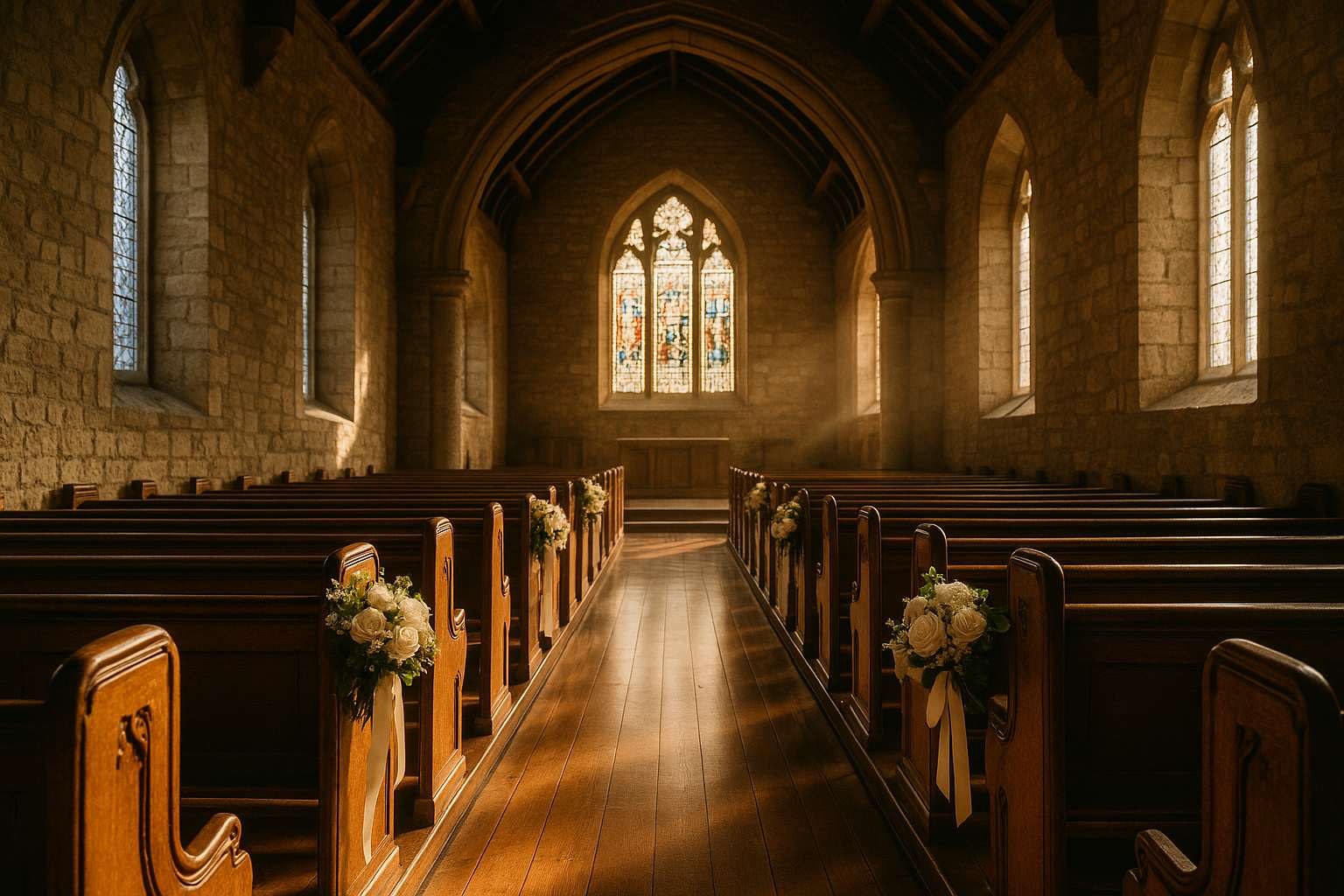
Most Catholic and Episcopal churches prohibit secular music, Wagner's Bridal Chorus, and recorded audio during the ceremony — music must be live and liturgically appropriate. Restrictions on decor are equally specific. Learning the rules within the first 30 days of booking your venue prevents expensive surprises later.
Choosing to marry in a house of worship is one of the most meaningful decisions a couple can make. For many women, the church where they were baptized, confirmed, and raised in faith is the only imaginable backdrop for their vows. But religious venues operate under an entirely different set of conventions than secular ballrooms or garden estates — and couples who underestimate those conventions face avoidable stress, surprise costs, and occasionally the awkward mid-ceremony correction from a clergy member.
The key reframe is this: religious venues are active spiritual communities. Their requirements reflect theology, liturgical integrity, and congregational care — not event logistics. Understanding and embracing this distinction is not a constraint on your wedding; it is the doorway into a ceremony that carries the full weight and beauty of your tradition.
What music is actually permitted in a Catholic church ceremony?
A Catholic wedding Mass is an act of worship. The United States Conference of Catholic Bishops' guidelines on music for marriage — grounded in the General Instruction of the Roman Missal and the USCCB document Sing to the Lord — make clear that all music must serve the liturgy, not the couple's personal musical preferences.
This means several things practically. Pre-recorded music is not permitted during the ceremony; all music must be performed live. The pipe organ holds "pride of place" in Catholic liturgy, though piano, violin, cello, harp, and trumpet are commonly accepted. Popular secular love songs — "A Thousand Years," "All of Me," "At Last," and their contemporaries — belong at the reception, not the Mass, regardless of how personally meaningful they may be.
Wagner's Bridal Chorus from the opera Lohengrin is specifically prohibited at most Catholic parishes. The piece has no sacred origin and is widely listed in diocesan guidelines as inappropriate. This surprises many couples for whom it has always been simply "the wedding song" — but the prohibition has been standard for decades in most U.S. dioceses.
| Music Element | Catholic | Episcopal | Lutheran / Methodist / Presbyterian |
|---|---|---|---|
| Wagner's Bridal Chorus | Banned at most parishes | Explicitly banned at most cathedrals and parishes | Varies by congregation; often discouraged |
| Secular pop love songs | Not permitted during Mass | Not appropriate; reception only | Often discouraged; clergy discretion |
| Recorded/amplified digital music | Generally prohibited | Not permitted; live music only | Varies widely |
| Pipe organ | Preferred; "pride of place" | Standard instrument | Standard instrument |
| Strings, harp, brass | Permitted to supplement organ | Permitted (trumpet, violin, oboe, strings) | Generally permitted |
| Ave Maria (Schubert / Bach-Gounod) | Permitted — widely used | Generally acceptable | Acceptable at most congregations |
| Approved sacred hymns from liturgical hymnals | Required (OCP, GIA publications) | Required (Hymnal 1982, The Episcopal Church) | Standard |
| Congregation singing a hymn | Encouraged | Explicitly encouraged; one or two hymns | Common and encouraged |
What is permitted makes for a genuinely beautiful ceremony. Approved processional repertoire includes Bach's Jesu, Joy of Man's Desiring, Clarke's Trumpet Voluntary, Handel's Water Music suite, Pachelbel's Canon in D as a purely instrumental piece, and contemporary liturgical hymns from OCP or GIA hymnals. For the recessional, Handel's Hornpipe or a choral setting of Ode to Joy creates an appropriate and genuinely joyful close. The Ave Maria by Schubert or the Bach-Gounod setting — performed during the offertory or as a Marian devotion after communion — remains one of the most moving moments in any Catholic wedding Mass.
What are the music rules for Episcopal and mainline Protestant churches?
Episcopal churches share the Catholic principle that the ceremony is a sacred rite, not a social occasion. Wedding guidelines from prominent Episcopal venues including The Cathedral of St. Philip in Atlanta are explicit: music texts must come from the hymnal, the Bible, or the Book of Common Prayer; only sacred music is appropriate; and both Wagner's Bridal Chorus and Mendelssohn's Wedding March are specifically listed as inappropriate for church processionals at many Episcopal parishes.
Episcopal churches typically welcome the congregation to sing one or two hymns during the service — a participatory element that both honors the tradition and adds genuine warmth to the ceremony. Appropriate instruments beyond the organ include trumpets, violin, oboe, and string ensembles. All music decisions at Episcopal churches fall under the jurisdiction of the Minister for Music, and couples should schedule a meeting with them at least two to three months before the wedding.
Lutheran, Methodist, and Presbyterian churches have more variation. Most discourage secular music but apply fewer absolute prohibitions; the individual pastor or music director typically has significant discretion. Confirm policies at your specific congregation rather than assuming denominational averages apply.
What decor restrictions should couples expect at religious venues?
Religious venues are not blank canvases, and florists who have not worked extensively in houses of worship can inadvertently violate restrictions that carry real consequence — from a priest redirecting a photographer during the ceremony to a charge for venue damage.
Several decor restrictions are nearly universal. Many Catholic and Episcopal churches prohibit fabric aisle runners: the nave floor may be treated as sacred space, and runners present a tripping hazard on uneven stone or historic hardwood floors. Pew flowers must be attached with non-damaging clips or cones — nothing tied, nailed, or adhered to the woodwork. Open-flame candles may be restricted by fire code, with LED substitutes sometimes accepted. Confetti, rice, bubbles, and sparklers are almost universally prohibited inside the building and frequently outside as well.
Floral arches require explicit written approval from the venue coordinator before you finalize designs with your florist — some parishes consider them visually competitive with the liturgical environment. The most important seasonal restriction: during Lent, Catholic and some Episcopal churches prohibit flowers in the sanctuary entirely. If your date falls between Ash Wednesday and Easter, confirm decor expectations before any contracts with your florist are signed.
The Jewish huppah is a liturgical requirement in traditional Jewish weddings and carries its own set of considerations: it may be provided by the synagogue, rented, or custom-designed, but modifications require coordination with both the rabbi and the venue coordinator in advance.
How do you brief your photographer and musicians before a church ceremony?
The most common friction point between religious venues and wedding vendors is a photographer or musician who was not briefed on the venue's restrictions. A photographer who positions in a prohibited zone at the altar during Mass will be audibly redirected by a clergy member during the ceremony — a moment that disrupts the liturgy and is recorded on video. Preventing this entirely is straightforward: get all restrictions in writing from your venue coordinator, then share the written document with your photographer before they sign a contract with you.
Schedule a walk-through of the venue with your photographer after they have reviewed the written restrictions — not before. This allows them to understand the specific sightlines and positioning available to them within the rules, and to flag any concerns before the day itself. Ask specifically about drone restrictions near the property; most houses of worship prohibit them.
For musicians, the house musician policy requires early attention. Many Catholic and Episcopal churches have a contracted organist, cantor, or music director who must be retained for at least part of the service. You may bring in outside musicians to supplement — a string quartet for the processional, a soprano for the Ave Maria — but they are typically not permitted to replace the house musician entirely. Budget for the house musician's fee ($200 to $800) from the beginning, even if you plan to bring your own ensemble.
A practical note on gratuities: a personal thank-you envelope for the sexton, sound technician, and organist — typically $50 to $150 each — is widely appreciated, builds goodwill for couples from that parish, and is worth building into your day-of vendor envelope budget.
Frequently asked
Is 'Here Comes the Bride' allowed in a Catholic or Episcopal church?
No — Wagner's Bridal Chorus from the opera Lohengrin is specifically prohibited at most Catholic parishes and is explicitly listed as inappropriate in Episcopal wedding guidelines at many dioceses and cathedrals, including The Cathedral of St. Philip in Atlanta. Both traditions consider the piece non-sacred music from a secular opera, incompatible with the liturgical character of the ceremony. Mendelssohn's Wedding March from A Midsummer Night's Dream faces the same prohibition in Episcopal settings. These bans catch many couples off guard; it is one of the first questions to ask your officiant. Appropriate alternatives for the processional include Bach's Jesu Joy of Man's Desiring, Clarke's Trumpet Voluntary, Pachelbel's Canon in D as an instrumental piece, and Handel's Water Music suite — all sacred or classical works widely accepted across traditions.
Can we play recorded music at a church wedding ceremony?
In most Catholic and Episcopal churches, no. The United States Conference of Catholic Bishops and most individual dioceses specify that music during the liturgy must be performed live. Pre-recorded music — whether CDs, a laptop playlist, or Bluetooth speakers — is generally not permitted during the ceremony itself. This is not merely aesthetic preference; it reflects the theological understanding that music in the liturgy is an act of communal prayer, not background audio. Many churches also have a contracted organist, cantor, or music director who must be retained — or whose release fee (typically $200 to $800) must be paid even if you bring your own musicians. Budget for this line item from the beginning. Protestant denominations vary more widely; Baptist and evangelical independent churches often have fewer restrictions on recorded music, but confirm in writing.
Are secular love songs ever permitted during a church ceremony?
In Catholic liturgy, secular love songs are explicitly prohibited during the ceremony, regardless of how personally meaningful they may be. Songs such as 'A Thousand Years,' 'All of Me,' 'At Last,' and virtually all contemporary pop love songs are appropriate for the reception, not the Mass. The theological principle is consistent: the ceremony is an act of worship, not a concert or a personal performance. Most Episcopal and mainline Protestant churches share this principle, though individual clergy have varying degrees of flexibility. The one helpful reframe is this: sacred music — choral anthems, psalm settings, classical processionals — is often more moving within the ceremony than any contemporary song could be, because it carries the weight of the tradition you are entering. Many couples who initially resist the restrictions come to feel the music was among the most profound parts of the day.
What decor restrictions do church weddings typically have?
Religious venues are not blank canvases, and decor expectations are shaped by liturgical, aesthetic, and practical considerations specific to each tradition. Many Catholic and Episcopal churches prohibit fabric aisle runners — the nave floor may be considered sacred and runners present a tripping hazard on uneven stone or hardwood. Floral arrangements are typically limited to designated spots near the altar; pew flowers must use non-damaging clips or cones rather than anything tied or nailed to the woodwork. Open-flame candles may be restricted by fire code, with LED substitutes sometimes accepted. Confetti, rice, bubbles, and sparklers are almost universally prohibited inside the building and frequently outside as well. Floral arches require explicit approval, as some parishes consider them visually competitive with the liturgical environment. During Lent, Catholic and some Episcopal churches prohibit flowers in the sanctuary entirely — if your date falls between Ash Wednesday and Easter, confirm decor expectations before finalizing anything with your florist.
How far in advance should we meet with the parish music director?
Most churches with active music ministries ask you to schedule a meeting with their music director or organist at least two to three months before the wedding, with six months being ideal. This meeting should happen before you finalize your musician contracts, because the parish musician's availability and policies directly affect what you can offer to outside musicians. Many Catholic and Episcopal churches require you to use the parish organist for at least part of the service; they may allow outside musicians to supplement but not replace the house musician. Share your inspiration and your must-haves early in this conversation — music directors who have been treated as collaborators rather than obstacles are far more flexible than those approached at the last minute. Always follow up your meetings with a written summary confirming what was discussed and agreed upon; clergy and coordinators change, and verbal agreements alone are fragile.
What music is actually appropriate for a Catholic wedding Mass?
A Catholic wedding within Mass has six designated musical moments: the gathering/entrance song, the responsorial psalm (which must be sung, not read), the gospel acclamation (Alleluia), the preparation of gifts, the communion meditation, and the recessional. The responsorial psalm and Alleluia are liturgical requirements; the others are optional but strongly encouraged. Appropriate repertoire is drawn from approved hymnals published by OCP Publications (Oregon Catholic Press) and GIA Publications, which are the two dominant Catholic music publishers in the United States. Well-loved options for the processional include Ave Maria by Schubert or Bach-Gounod, Pachelbel's Canon as an instrumental, and contemporary liturgical hymns such as 'How Great Thou Art' and 'On Eagle's Wings.' During communion, instrumental pieces or meditative sacred songs work beautifully. For the recessional, Handel's Hornpipe or Ode to Joy in a choral setting creates an appropriately joyful close.