Venues & Destinations
Outdoor Wedding in Summer Heat: What Every Couple Should Know
The most common summer wedding planning mistake is treating heat as a secondary concern behind rain. At 90°F with 70% humidity, the heat index reaches 105°F — and unprepared guests become genuinely uncomfortable. Here is how to host beautifully in the warmth.
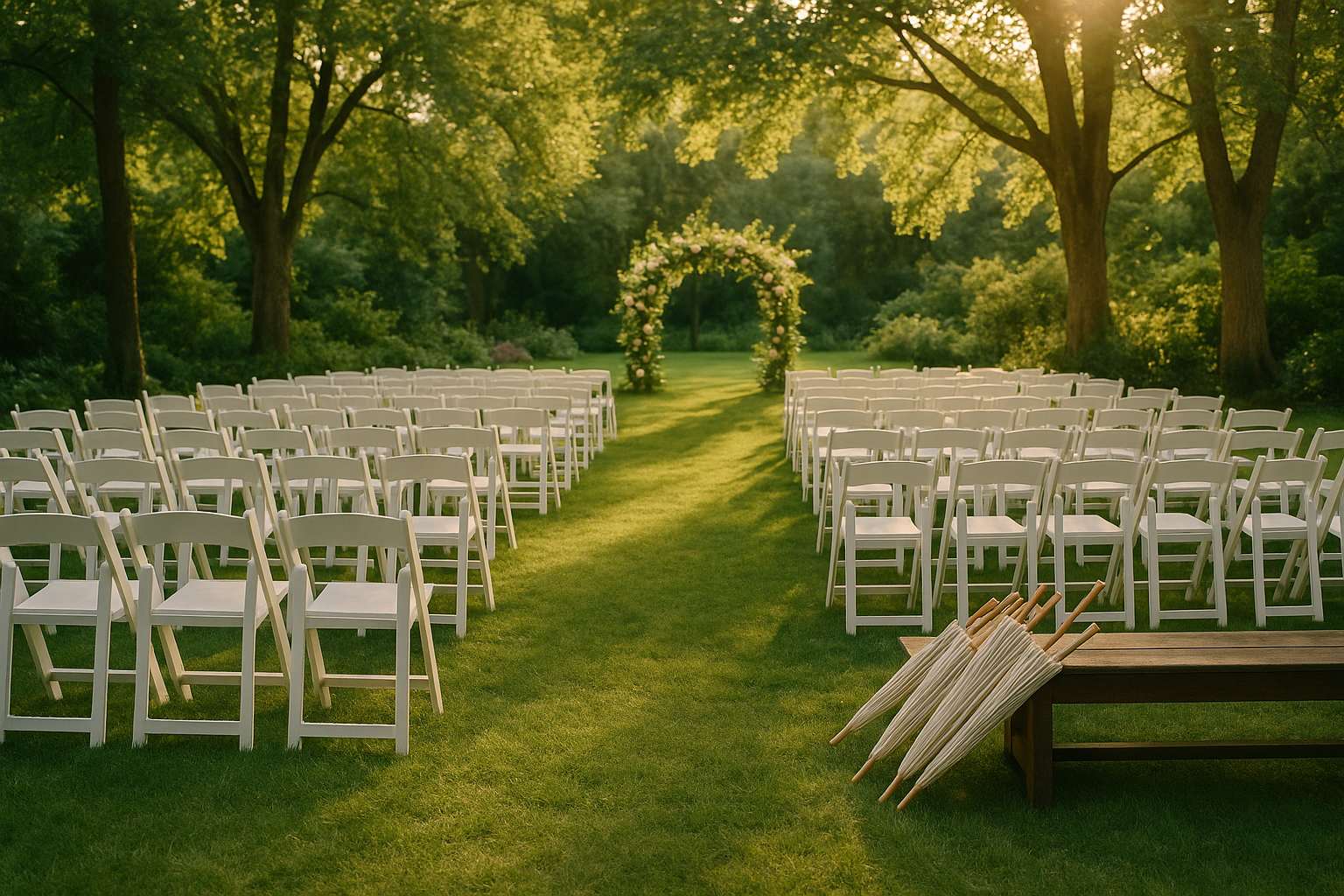
Heat is the most underestimated weather threat at outdoor summer weddings. Schedule ceremonies before 11 a.m. or after 4 p.m., provide a tent with fans or air conditioning, set up cold hydration stations, distribute parasols or hand fans, and prepare a written weather protocol shared with all vendors. Budget 8–12% of your total spend for weather infrastructure — it is the investment that makes outdoor beauty professionally possible.
An outdoor summer wedding is one of the most breathtakingly beautiful settings imaginable. Open sky, natural light, the scent of fresh flowers — the sensory richness of a garden or hillside ceremony is unlike anything a ballroom can offer. It is also a genuine planning responsibility. At 90°F with 70% humidity, the heat index reaches 105°F, and guests in formal attire — seated in direct sun, possibly without water nearby — are not simply uncomfortable. They are at risk.
The couples who pull off extraordinary outdoor summer weddings are not the ones who got lucky with the weather. They are the ones who planned for it with the same thoroughness they brought to the florals, the menu, and the music. This guide gives you the specific framework to do exactly that.
Why timing your ceremony is your single most powerful tool
The hottest part of any summer day falls between 11 a.m. and 3 p.m. — precisely the window many couples default to for afternoon ceremonies. By scheduling your ceremony before 11 a.m. or after 4 p.m., you protect your guests from peak sun intensity without any additional equipment or expense.
A late-afternoon start of 5:30 or 6 p.m. is the most popular choice in 2025 and 2026 for good reason: temperatures have typically dropped several degrees from their afternoon peak, golden-hour photography light is at its most luminous, and the transition into an evening reception feels entirely natural. The ceremony ends just as dinner and dancing begin, and guests carry the warmth of the day into the cool of the evening.
Morning ceremonies — starting at 10 or 10:30 a.m. — pair beautifully with brunch receptions and allow the entire celebration to conclude before the afternoon heat peak. They work particularly well in Southern and Gulf Coast markets, where summer afternoon conditions are consistently the most challenging in the country.
To map the sun angle at your specific venue for your specific ceremony start time, use a sun position tool such as SunCalc or the Sun Surveyor app. A 5 p.m. site visit in April tells you almost nothing about where the sun falls during a 5 p.m. ceremony in August. Measure it at the actual date and time. Shade from a nearby tree that looked generous in April may have moved entirely by midsummer, or the tree may not yet have leafed out in your spring visit.
What cooling infrastructure do you actually need?
Effective heat management for an outdoor summer wedding layers multiple systems, each addressing a different dimension of the problem.
| Solution | Rental Cost (Est.) | Best For | Limitations |
|---|---|---|---|
| Pedestal fans | $50–$150/unit | Tent interiors; universal | Moves heat; does not cool it |
| Misting fans | $300–$1,500 rental | Cocktail hours; dry-heat climates | Less effective in high humidity |
| Evaporative coolers | $150–$400/unit | Low-humidity regions (Southwest, Mountain West) | Ineffective above 60% humidity |
| Portable AC units | $500–$2,500/unit | Enclosed tent with full sidewalls | Requires power planning |
| Market umbrellas | $50–$200/each | Cocktail hour seating areas | Insufficient for dinner; needs weighting in wind |
| Parasols for guests | $3–$8/parasol | Outdoor ceremony; cocktail hour | Decorative; not structural cooling |
Moving air is also the single most effective mosquito deterrent. Pedestal fans under a tent serve dual purpose: they provide cooling airflow and keep flying insects at a distance. At a summer wedding near water or in a wooded setting, this dual function makes fans a non-negotiable rather than a comfort upgrade.
A cold welcome beverage station at the ceremony entrance — chilled water, lemonade, and iced tea — is one of the most hospitable and thermally effective things you can provide. Guests who are hydrated before sitting down for the ceremony are meaningfully more comfortable than those who arrive in the heat and sit down without a drink. Position the station before guests walk to their seats, not adjacent to the reception bar.
Your written weather protocol: the document every vendor needs
A weather protocol is not a contingency plan — it is an operational document. Every vendor who will be at your wedding, from your florist to your photographer, should receive it at least two weeks before the event. The protocol should include:
- A named decision timeline: 72-hour forecast review, 24-hour go/no-go on tent sidewalls and cooling deployment, 4-to-6-hour go/no-go on ceremony location
- A designated weather captain — ideally your planner or a highly organized family member — whose sole role is monitoring forecasts and executing the communication chain. Remove this responsibility from the bride entirely on the wedding day.
- A three-level contingency: Level 1 (light conditions — tent holds, fans on full), Level 2 (moderate conditions — ceremony moves under tent or to indoor backup), Level 3 (severe conditions — full indoor relocation)
- Contact information for all vendors and the explicit communication channel (group text is fastest) for weather-related updates
- Pre-printed signage for venue redirection, ready to deploy
For the forecast itself, use a point-forecast tool rather than a general weather app. The National Weather Service's point forecast at weather.gov delivers a forecast for your specific GPS coordinates rather than a regional estimate — which for a venue 20 miles outside a city can differ by four to six degrees in afternoon temperatures.
The biggest mistake couples make is delaying the weather decision to "see how it goes." By the time conditions become obviously problematic, vendors are mid-setup, guests are arriving, and options have narrowed dramatically. A documented decision time — communicated to everyone in advance — means the choice is made confidently and calmly, rather than in crisis mode.
Guest comfort details that make a lasting impression
The grace notes of a beautifully managed summer wedding are the small, thoughtful provisions that tell guests they were considered from the start.
For the ceremony: A program hand fan — which serves double duty as the ceremony program and a personal cooling tool — is one of the most appreciated summer wedding details. A small basket of personalized parasols at the ceremony entrance is both beautiful and practical. Heel caps (small rubber tips that slip over stiletto heels) prevent guests' shoes from sinking into lawn surfaces; a basket of them near the venue entrance communicates both consideration and attention to detail.
For the reception: A frozen treat station — gelato, sorbet, or artisan popsicles — deployed during cocktail hour or as a late-evening surprise hits the exact balance between refreshment and delight. Individual insect-repellent wipes in small decorative baskets near restroom areas and venue entry points, labeled warmly, take an uncomfortable reality and address it graciously. Sunscreen in small tubes at the cocktail hour is both practical and now widely expected at summer garden events.
In your communications: Include a sentence on your wedding website FAQ — "Our ceremony takes place in a garden setting; light, breathable fabrics and comfortable footwear are warmly encouraged" — before guests make attire decisions. For guests you know are particularly vulnerable to heat, a personal note or call acknowledging what you have arranged for their comfort is a beautiful expression of the same hospitality that defines a great host at any gathering, indoors or out.
Frequently asked
What time of day should an outdoor summer wedding ceremony start?
Schedule outdoor ceremonies before 11 a.m. or after 4 p.m. to avoid peak sun intensity, which typically falls between 11 a.m. and 3 p.m. A late-afternoon ceremony starting at 5:30 or 6 p.m. captures beautiful golden-hour photography light, benefits from cooling temperatures, and delivers a natural transition into an evening reception. Morning ceremonies starting at 10 or 10:30 a.m. allow the entire celebration to occur before the hottest part of the day and pair beautifully with a brunch or luncheon format. Avoid 2 to 4 p.m. start times in summer months in any warm-climate region — this window consistently creates the most guest discomfort regardless of how much shade is provided.
What is the heat index and why does it matter for outdoor wedding planning?
The heat index, also called the 'feels like' temperature, combines actual air temperature with relative humidity to reflect how hot conditions feel to the human body. At 90°F with 70% relative humidity, the heat index reaches approximately 105°F — well above the threshold where heat becomes a physiological concern, particularly for elderly guests, pregnant guests, young children, and anyone in formal attire. Outdoor wedding planning should use the heat index as the planning metric, not just the air temperature. A seemingly moderate 88°F day in the Gulf Coast humidity of July has a heat index that demands the same precautions as a desert wedding at 100°F. Check the NOAA weather service forecast for your specific venue location in the weeks before the wedding and build your cooling plan around the expected heat index, not the temperature headline.
Do I need a tent for an outdoor summer wedding?
For any outdoor wedding with more than 50 guests, a tent is strongly recommended — not primarily as a rain backup, but as a comfort infrastructure that makes hosting outdoors professionally and responsibly possible. A tent with sidewalls protects against unexpected rain and wind. A tent with a ceiling allows you to install fans, misting systems, and air conditioning. A tent anchors your decor, lighting, and catering setup in one unified structure. The alternative — hoping the weather cooperates and that guests can tolerate open sun — is an approach that consistently results in discomfort and early departures. Tent rental costs range from approximately $1,500 for a basic frame tent to $30,000 or more for a clear-span structure; for peak season, book nine to twelve months in advance, as premium tent rental companies in popular wedding markets sell out entirely.
What cooling equipment is most effective for outdoor summer weddings?
The most effective cooling strategy layers multiple systems rather than relying on a single solution. Pedestal fans are the most cost-effective starting point — plan one per 400 square feet of tent space. In low-humidity regions, evaporative coolers (swamp coolers) are highly effective at $150 to $400 per unit. Misting fans are ideal for cocktail hours and outdoor ceremony areas at $300 to $1,500 rental. For enclosed tent structures with full sidewalls, portable air conditioning units provide the most reliable relief at $500 to $2,500 per unit, but require power infrastructure planning. Moving air is also the single most effective mosquito deterrent at a summer wedding, so fans serve dual purpose. Cold beverage stations at entry points — chilled water, lemonade, and iced tea — are both hospitable and genuinely effective at helping guests manage heat on arrival.
How should I communicate heat expectations to guests before the wedding?
Include a note on your wedding website FAQ page and on the details card in your invitation suite. A warm, direct sentence — 'Our ceremony is outdoors in a garden setting; light, breathable attire and comfortable footwear are recommended' — sets accurate expectations and earns genuine gratitude. Communicate the shade and cooling infrastructure you are providing so guests arrive prepared to enjoy the day rather than bracing for discomfort. For guests with known health vulnerabilities — elderly relatives, pregnant guests — a personal note or phone call acknowledging the conditions and the accommodations you have arranged is a beautiful gesture of care that will not be forgotten. Never keep guests in weather discomfort to preserve an aesthetic; the couple's job is to be a gracious host first and foremost.
What is a reasonable weather contingency budget for an outdoor summer wedding?
Budget eight to twelve percent of your total wedding budget for weather-related line items combined: tent, flooring, fans or air conditioning, propane heaters for evening temperature drops, weather insurance, and any required permits. For a $30,000 wedding, this is $2,400 to $3,600. Couples who skip this budget line consistently spend more in emergency day-of solutions than they would have invested in advance planning. Weather insurance — policies from carriers including WedSafe, Markel, and Event Helper — typically runs $200 to $600 for $10,000 to $25,000 in coverage and should be purchased at the time of initial venue deposit, not weeks before the event. The pre-existing-condition clause in most policies excludes events triggered by named storms or active watches that existed when the policy was purchased.
How do I handle vulnerable guests at a summer outdoor wedding?
Identify vulnerable guests in advance: elderly grandparents, pregnant guests, guests with chronic health conditions, and young children require explicit planning attention rather than good intentions. Specific accommodations include: an air-conditioned indoor space available for anyone who needs relief at any point, clearly signed and communicated to all guests; seating in the shade with priority for elderly and pregnant guests; a cooling towel or personal fan at each seat; and a designated event staff member whose role includes wellness check-ins for this group. For ceremonies longer than 20 minutes outdoors in temperatures above 85°F, consider whether the entire ceremony should be moved to a shaded or air-conditioned alternative. A brief outdoor ceremony (under 15 minutes) followed by an indoor or tented reception is a hybrid approach that captures the outdoor beauty without subjecting vulnerable guests to extended heat exposure.