Invitations, Registry & Gifts
Wedding Signs Size Guide: Every Sign, the Right Dimensions, and When to Order
A welcome sign that is too small disappears into the venue. A seating chart that is too small creates a traffic jam. Here are the exact dimensions for every wedding sign — with the timing guidance to make sure they arrive perfectly.
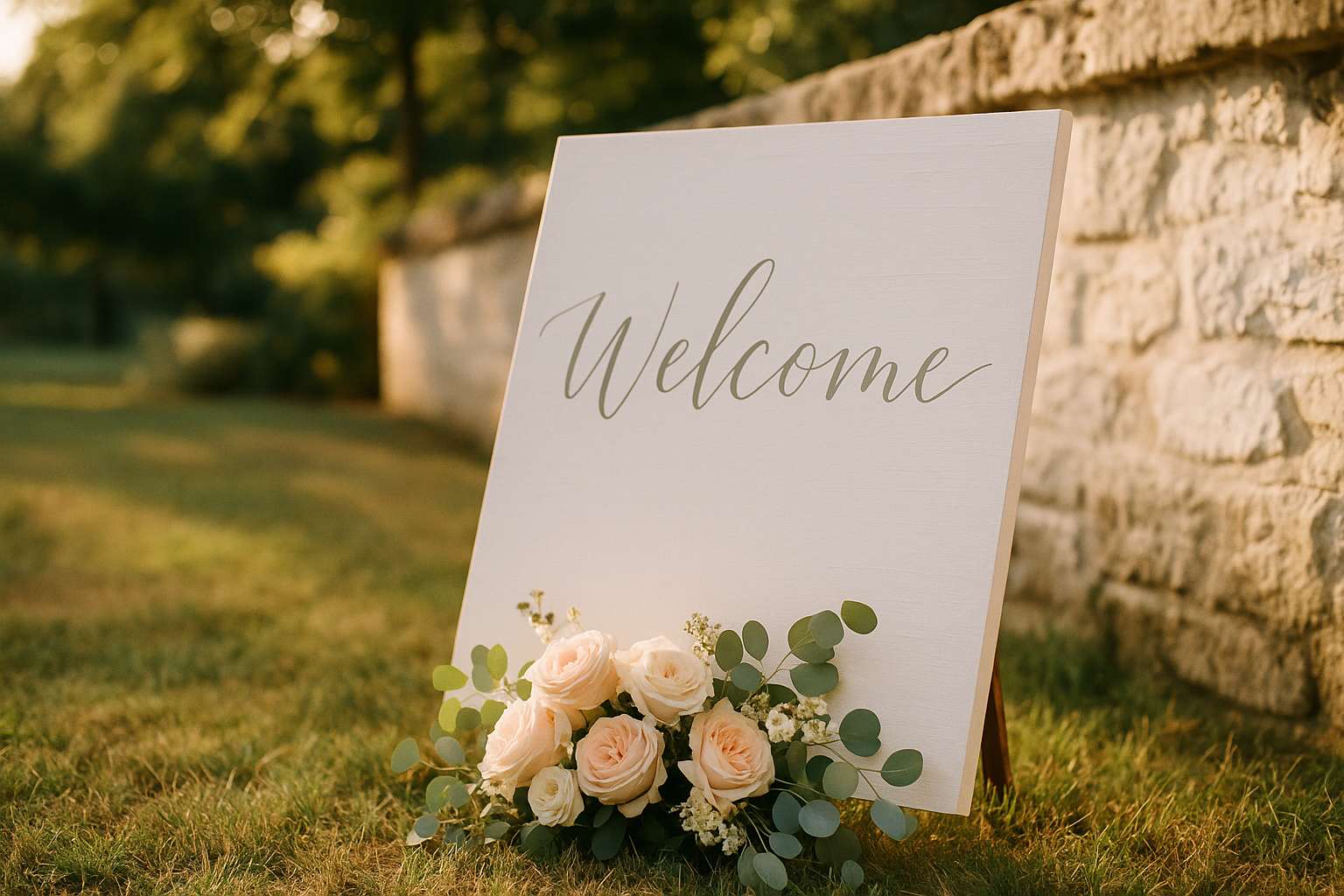
A welcome sign should be 18x24 inches indoors or 24x36 inches outdoors. Your seating chart size depends on guest count — 24x36 for 100–150 guests is the standard. Table numbers should be legible from 5 feet. Order all signage 6–8 weeks before the wedding to avoid rush fees.
Wedding signage is the quiet infrastructure of a beautifully run celebration. A welcome sign that is too small disappears into the venue foyer and leaves arriving guests uncertain. A seating chart sized for half your guest count creates a bottleneck at the reception entrance that guests will remember. A table number obscured by a tall centerpiece sends newlyweds' carefully arranged guests wandering. These are not aesthetic problems — they are functional problems that good planning entirely prevents.
This guide gives you the exact dimensions, material options, and ordering timelines for every piece of wedding signage from welcome sign to table number. The numbers below reflect current guidance from professional stationery designers and have been validated against real venue feedback from couples and coordinators in the 2025–2026 planning season.
What are the standard sizes for every type of wedding sign?
Wedding signage falls into three functional categories: arrival and orientation signage (welcome sign, directional signs, seating chart); table-level signage (table numbers, menu cards, escort and place cards); and atmospheric signage (bar menu, dessert table labels, photo booth instructions, in memoriam display). Each category has its own sizing logic based on viewing distance and function.
| Sign Type | Standard Size (US) | When to Order | Notes |
|---|---|---|---|
| Welcome sign (indoor) | 18" × 24" | 6–8 weeks out | Guests at close range; easel mounted |
| Welcome sign (outdoor / grand entrance) | 24" × 36" | 6–8 weeks out | Visible from 10+ feet; larger = rarely wrong |
| Seating chart (50–75 guests) | 18" × 24" | 3–4 weeks out | After final guest count confirmed |
| Seating chart (100–150 guests) | 24" × 36" | 3–4 weeks out | Standard industry size for this range |
| Seating chart (150–200 guests) | 30" × 40" | 3–4 weeks out | Names must be 12pt+ for legibility |
| Seating chart (200+ guests) | 36" × 48" or multi-panel | 3–4 weeks out | Position 6+ feet from entrance |
| Directional signs | 12" × 18" | 6–8 weeks out | Parking, ceremony, cocktail hour, reception |
| Ceremony order of events board | 24" × 36" | 5–6 weeks out | After ceremony program finalized |
| Bar menu sign | 11" × 14" to 12" × 18" | 4–5 weeks out | After bar menu finalized with caterer |
| Table numbers | 4" × 6" or 5" × 7" | 4–5 weeks out | Legible from 5 feet; elevate above centerpiece |
| Food/dessert station labels | 4" × 6" each | 3–4 weeks out | One label per item; note allergens |
| Photo booth instruction sign | 24" × 36" | 4–5 weeks out | Clear sight line from photo area entry |
A note from Wild Bloom Design Studio, whose stationery team advises hundreds of couples per year: "It is very hard to go too big with wedding signage — but it is very easy to go too small and have it get lost." If you are choosing between two sizes and cannot view the sign in situ before ordering, choose the larger option.
What are the most common wedding signage mistakes — and how do you avoid them?
Most wedding signage problems are avoidable with planning. The four most common errors professional coordinators encounter:
Seating chart organized by table number, not alphabetically. Every stationer and wedding planner will tell you this: always alphabetize the seating chart by guest last name. Table-grouped seating charts require guests to read every table to find their name, which creates confusion and bottlenecks. Alphabetized seating charts let a guest scan directly to their surname in seconds. This is not a preference — it is a functional requirement for guest flow.
Seating chart positioned too close to the reception entrance. A seating chart placed immediately inside the door creates a surge of stationary people directly in the path of arriving guests. Position the seating chart display at least 6 feet — ideally 10 feet — from the entrance, with clear approach paths from multiple directions. Your venue coordinator should weigh in on the optimal position during your final walkthrough.
Table numbers obscured by centerpieces. A 4x6 inch table number card centered inside a tall floral arrangement is effectively invisible from the room. If your centerpieces are tall, place the table number at the outer edge of the table on a dedicated taller stand, or choose a taller format (an acrylic block elevated on a stem, or a tall framed card) that clears the floral height. Inketch's wedding sign guide recommends that table numbers always be legible from at least 5 feet.
Rushing signage orders. Large-format custom printing, especially for calligraphy signs, acrylic pieces, or anything requiring hand-finishing, cannot be produced overnight. Ordering 6–8 weeks before the wedding is not overcautious — it is the standard timeline that professional stationers build their production queues around. Rush production carries a 25–50% premium and eliminates the ability to correct errors. Order your large signage with the same lead time you would give a floral or catering vendor.
How do you create a cohesive signage suite without hiring a professional designer?
A cohesive signage suite does not require a custom design relationship with a professional stationer — though that is ideal if budget allows. The three-element system that produces cohesion at any budget level:
Lock one font pair and one color palette before ordering anything. One script font for names and headlines, one clean serif or sans-serif for body text. Two or three colors drawn from your overall wedding palette. Apply both consistently across every piece. Inconsistent fonts and colors across a signage suite are immediately visible to guests and photographers.
Use the same paper stock and finish family across all printed pieces. If your escort cards are on matte white heavyweight card stock, your table numbers and menus should be on the same stock. Mixing glossy and matte finishes, or lightweight and heavyweight stocks, within a single suite creates a jarring, unfinished quality.
Order through one vendor or supply one design file to multiple vendors. If you are ordering your escort cards from Minted and your welcome sign from a local print shop, supply the exact font files, color codes, and design elements to both vendors so the resulting pieces look like they belong together.
For a complete overview of how signage fits into the full day-of paper goods system — including programs, menus, and escort cards — see our guide to escort cards vs. place cards, and our wedding ceremony program wording guide for the companion piece to your ceremony board.
Frequently asked
What size should a wedding welcome sign be?
For most indoor venues, an 18x24 inch welcome sign is the standard — large enough to read comfortably at close range, proportionate to most doorway and entrance settings, and easy to mount or display on a standard easel. For outdoor venues, grand entrances, or spaces where guests will view the sign from more than 10 feet away, upgrade to 24x36 inches to ensure legibility at a distance. As a practical rule from stationery designers at Wild Bloom Design Studio: if guests will walk right past the sign within 3–5 feet, 18x24 works beautifully; if guests approach from across a lawn, a parking lot, or a wide venue entrance, 24x36 is the safer choice. When in doubt, size up — it is very easy for a welcome sign to feel too small in a real venue, and very difficult for a well-designed sign to feel too large. Standard easels accommodate both formats comfortably.
What size should a wedding seating chart be?
The seating chart size should be determined by your confirmed guest count, and it is the most consequential sizing decision in the entire signage suite because an undersized seating chart creates an immediate traffic jam at the reception entrance. The standard guidance from professional stationers: for 50–75 guests, an 18x24 inch chart is workable with font sizes that remain legible. For 100–150 guests, 24x36 inches is the established standard. For 150–200 guests, 30x40 inches provides comfortable readability. For 200 guests and above, a 36x48 inch chart — or a multi-panel display — is strongly recommended. The guiding principle is that every name must be legible at a reading distance of 2–3 feet, and the chart must be positioned at least 6 feet from the reception entrance to prevent a crowd bottleneck. Always alphabetize by guest last name rather than organizing by table number.
What are the standard sizes for wedding bar and menu signs?
Bar menu signs are typically displayed on countertops or behind the bar where guests read them at close range, which means they do not need to be as large as ceremony or seating signage. The most common bar menu sign sizes are 8x10, 11x14, or 12x18 inches depending on the number of menu items and the style of the display. A specialty cocktail menu listing 4–6 drinks with brief descriptions works well at 11x14 on an easel or leaned against a tiered bar display. A full bar menu with wines, spirits, and non-alcoholic options may warrant 12x18 or larger to maintain legible font sizes. For food stations and dessert tables, small individual labels (4x6 or 5x7 inches) for each dish are more functional and more elegant than a single large sign — they let guests identify items at point of service rather than referencing a distant board.
What size should wedding table numbers be?
Table numbers are the smallest piece in the signage suite and are primarily determined by the centerpiece height rather than distance readability. The standard table number card is 4x6 or 5x7 inches, displayed in a holder or standing on its own. The critical requirement is that the number must be legible from 5 feet away — visible to a guest scanning the room looking for their assigned table. If your centerpieces are tall (more than 18–24 inches), place the table number at the outer edge of the table or on a taller dedicated stand rather than centered among the florals where it will be obscured. Acrylic table number holders are particularly effective because they elevate the card above the table surface and create a clean, contemporary presentation that works with most design aesthetics in 2026.
How far in advance should I order wedding signs?
The general rule is to submit all signage orders 6–8 weeks before the wedding, with the welcome sign and large-format pieces ordered at the outer end of that range. Large-format printing, especially for custom calligraphy signs, acrylic pieces, or mirror-finish signs, requires production time that varies by vendor and by season. During peak wedding season (April through September), production queues at popular stationery vendors can extend to 3–4 weeks for standard pieces and longer for rush or bespoke items. Rush production typically carries a 25–50% price premium. The most efficient timing is to finalize your ceremony order of service 8–10 weeks before the wedding (so programs and ceremony boards can be ordered in time), submit large signage orders at 6–8 weeks, and submit escort cards, place cards, and table numbers at 3–4 weeks after confirming your final guest count and meal choices. Always order 10–15% overage on any piece that guests will handle or take home.
What are the best materials for wedding signs and what do they cost?
Wedding sign materials range from affordable paper on foam core to luxury acrylic and mirror, and the choice should reflect both your aesthetic and your venue's practical requirements. Foam core or foam board with printed paper is the most affordable option ($15–$60 for most sizes) and is appropriate for indoor-only use; it deteriorates in humidity or outdoor conditions. Painted or printed wood ($40–$150) suits rustic, garden, and bohemian aesthetics beautifully and has good structural stability for leaned or easel-mounted displays. Acrylic or lucite ($80–$300 depending on size and printing) is the contemporary luxury standard for modern and minimalist weddings — it photographs with exceptional clarity and is more durable than any paper-based alternative. Mirror ($100–$250) provides a glamorous art-deco effect but is heavy and fragile; professional installation is recommended. For outdoor ceremonies, any paper-based sign should be given a protective laminate coating or mounted in a frame with protective glass; even gentle breezes can scatter lightweight unprotected signage.